
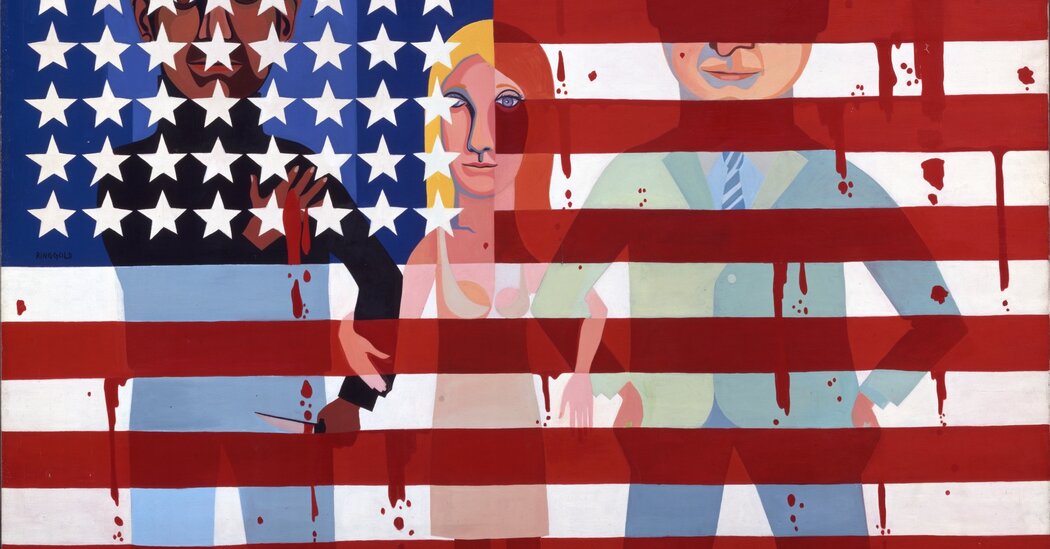
If you want to catch the heat of the lava flow that was United States racial politics in the 1960s, the second floor of the New Museum in Manhattan is a good place to go. There you’ll find the earliest work in “Faith Ringgold: American People,” the first local retrospective of the Harlem-born artist in almost 40 years.
Now 91, Ringgold was already a committed painter when the Black Power movement erupted. And she had a personal investment in the questions it raised: not just how to survive as a Black person in a racist white world, but how, as a woman, to thrive in any world at all.
As an artist of ambition, she seems to have made strategic decisions for forward movement. One was to be constantly producing, no matter what. Another was to seek out support within a Black matriarchy of family and friends. A third decision — the tough one — was to forge a career path of maximum resistance. To this end, she pursued figure painting, worked with fabric art and focused on narrative content at a time when the mainstream art market wanted little to do with any of these.
This retrospective, which fills three floors of the New Museum, combines figures, craft techniques and storytelling in inventive combinations. And it makes clear that what consigned Ringgold to an outlier track half a century ago puts her front and center now. It says a lot about strong art and changing taste that her 1967 mural-size painting “American People Series #20: Die,” an explosive scene of blood-spattered biracial carnage, was a star attraction of the Museum of Modern Art’s much-watched 2019 permanent collection rehang.
Stick-to-itiveness and art-making came early to Ringgold. As a child she was frequently housebound with asthma. To keep her occupied her mother, Willi Posey, a seamstress and clothing designer, supplied her with art materials. The creativity stuck. In 1950, she enrolled in art courses at City College of New York. She also married and had, in quick succession, two daughters, one of whom, Michele Wallace, is now a noted art historian, and a collaborator with Ringgold on activist projects.
The marriage came and went. What persisted was Ringgold’s interest in art. After earning a graduate degree, she took a job teaching in a public school. There one of her students was the young sister of James Baldwin, whose writings were instrumental in turning Ringgold’s painting — mostly Impressionistic landscape through the 1950s — in a political direction.
The retrospective — organized by Massimiliano Gioni, the artistic director of the New Museum, Gary Carrion-Murayari, a curator, and Madeline Weisburg, a curatorial assistant — begins at this turning point moment with a group of brooding, broadly stroked figure paintings called “American People Series.” In one, dated 1963, a row of light-skinned male figures face outward, a wall of blank-eyed malice. In another, called “The Civil Rights Triangle,” four of five men depicted have dark skin, but a light-skinned fifth man towers over them. All the pictures are about hierarchies of power; women are barely even present. Ringgold referred to this early, wary work as “super realist.”
At this point she approached members of New York’s Black male art establishment — Romare Bearden, Hale Woodruff — for career help but was turned away with what sounds like the equivalent of a pat on the head. She must have realized that she was, professionally, on her own, and maybe that further loosened up her art.
In the late 1960s and early ’70s — years marked by police killings of Black activists across the country — her paintings suddenly go big, loud, bull-blast crazy. MoMA’s “Die” comes from this time, as does a related picture, “The Flag Is Bleeding,” both done on a mural scale to connect them with Picasso’s “Guernica” and Mexican mural paintings of the past.
“I just wanted to give some understanding of what America is about,” Ringgold said of that work, in the catalog interview with Gioni. “You notice there is no Black woman in the picture. The white woman was trying to bring the Black and white man together because she really had no power, and the only way to acquire it was by bringing together the men. Black women were literally out of the picture, period. It took decades before people realized that we existed.”
Other paintings of the time go almost mute. For a group called “Black Light Series,” Ringgold eliminated white paint entirely from her palette and darkened her colors with black. Faces and bodies seem to float out of reach, submerged, all but invisible.
Her political commitments in general expanded. As co-organizer of an anti-Vietnam War exhibition she was accused of desecrating the United States flag and arrested. (The charge was dropped.) She designed posters protesting the jailing of Angela Davis and the killing of prisoners at Attica. She joined Michele Wallace in picketing the Whitney Museum of American Art for its exclusion of Black women artists.
Her relationship to the predominantly white feminist movement was guarded, though not to feminism itself. A bold statement of her allegiance came in the form of a mural-style painting she made for the Correctional Institute for Women on Rikers Island in 1971.
Long in storage on Rikers and now, at Ringgold’s request, on long-term loan by the city to the Brooklyn Museum, the work is in the show. Using bright colors and a compartmented design based on African textiles, it depicts women of different ages and ethnicities engaged in a range of professions — doctor, athlete, bus driver, United States president — that prisoners, given the chance and resources, might pursue once out in the world. Before getting down to work on the piece, Ringgold invited all the women at Rikers to propose ideas for it. And she discreetly included herself in the picture. (You see her in profile in the picture’s lower right side.)
Collaboration with women has always figured in her art, beginning with contributions made by her fashion-designer mother, Willi Posey.
They first worked together in the early 1970s on the “Feminist Series,” a group of paintings with fabric frames modeled on those of Tibetan thangkas and sewn by her mother. Posey also worked on a group of life-size, African-inspired fabric figures worn by Ringgold in performances or displayed as soft-sculpture tableaus, like the imposing, multipart 1976 “The Wake and Resurrection of the Bicentennial Negro,” installed on the museum’s third floor.
Finally, in 1980, Posey sewed Ringgold’s first painted quilt, “Echoes of Harlem,” helping to create the prototype for what would become the artist’s most familiar art medium. After her mother died the following year, Ringgold paid tribute with “Mother’s Quilt,” a quilt appliquéd with doll-like Black figures, like angels, made from fabric scraps the women were saving for future use.
An elaboration on the painted quilt form, called “story quilts,” brought Ringgold attention both inside and outside the art world. Vehicles for personal narratives, often annotated with sewn-in text panels, some of these hangings are diaristic, as in the case of “Change: Faith Ringgold’s Over 100 Pound Weight Loss Performance Story Quilt,” from 1991. Most combine fiction and autobiography.
Best known of them is the single quilt “Tar Beach,” which illustrates Ringgold’s childhood memory of summer-night picnics on a Harlem rooftop with the George Washington Bridge glowing in the distance. From the quilt, Ringgold derived a suite of drawings, which, in 1991, appeared as a widely praised children’s book, the first of many Ringgold has done. (You can page through all of them in an exhibition reading room on the museum’s 7th floor.)
The story-quilt form is also the vehicle for Ringgold’s most formally complex and buoyant painting project, “The French Connection,” which unfurls in 12 regally scaled hangings, like chapters, on the midnight-blue walls of the museum’s 4th floor. It related the experience of a single main character, a young African American painter named Willia Marie Simone, who comes to Europe for the first time in the 1920s with her two young children, to immerse herself in European art — a journey, which, as it happens, Ringgold herself made in 1961 for the same reason, and with her mother and daughters in tow.
Once settled in, Simone is everywhere, meeting everyone. She poses for Matisse. She spends time in Gertrude Stein’s salon. She joins time-traveling compatriots — Sojourner Truth, Harriet Tubman, Rosa Parks — to stitch a sunflower quilt in Van Gogh’s Arles. Finally, back in Paris, she paints an all-female déjeuner sur l’herbe, in which all the picnickers are Ringgold’s family and friends. Actually, there is one male in this scene, Pablo Picasso, posing skinny and nude on a towel on the grass. No one seems to notice him.
Overall, “The French Collection” feels, in tone, like a far cry from the grim, damning “American People” pictures of the 1960s (and from the scary, apocalyptic “We Came to America” picture — it’s in the show — that Ringgold painted right after the 12-part series was done). But there’s politics at work in the French paintings, too, embodied in the guiding Black female presence of the cosmopolitan Willia Marie Simone, who is, of course, a version of Ringgold herself.
Half a century ago, a presence like hers had to fight to exist in the mainstream art world. Look around now, and you see it, not everywhere yet, but more and more. Faith Ringgold, artist-agitator-seer, can be thanked for that.
Faith Ringgold: American People
Through June 5 at the New Museum, 235 Bowery, Manhattan. 212-219-1222; newmuseum.org.


Discussion about this post