
• Home
  • Insight
  • Blog
  • Business
  • Entertainment
  • Health
  • Politics
  • Shop
    • Gift Shop
    • Value Shop
    • Store
    • Bargain Shop
    • Discount
  • Sports
  • Tech
  • Travel
  • USA
  • Video
  • World
    • Asia
    • Africa
    • South America
    • North America
    • Europe
    • Oceania
Thursday, July 30, 2026
No Result
View All Result
Subscribe Now
  • Home
  • Insight
  • Blog
  • Business
  • Entertainment
  • Health
  • Politics
  • Shop
    • Gift Shop
    • Value Shop
    • Store
    • Bargain Shop
    • Discount
  • Sports
  • Tech
  • Travel
  • USA
    TX Rep. Brandon Gill Mocks James Talarico Over Fauci Action Figure Post

    TX Rep. Brandon Gill Mocks James Talarico Over Fauci Action Figure Post

    NBA players are ‘being taught’ to flop

    NBA players are ‘being taught’ to flop

    Industry was warned for years about chemical ‘runaway’ dangers. Then came near-catastrophe in O.C.

    Industry was warned for years about chemical ‘runaway’ dangers. Then came near-catastrophe in O.C.

    Trump administration seeks government-wide NDAs to stop leaks : NPR

    Trump administration seeks government-wide NDAs to stop leaks : NPR

    Dog discharges shotgun inside truck, striking woman at Nebraska traffic light

    Dog discharges shotgun inside truck, striking woman at Nebraska traffic light

    Toshifumi Suzuki, Japan’s ‘God’ of Convenience Stores, Dies at 93

    Toshifumi Suzuki, Japan’s ‘God’ of Convenience Stores, Dies at 93

     Judge Sanctioned CoreCivic for Destroying Video in ICE Death Suit

     Judge Sanctioned CoreCivic for Destroying Video in ICE Death Suit

    Suspect dead after opening fire near White House security checkpoint, Secret Service says

    Suspect dead after opening fire near White House security checkpoint, Secret Service says

    Trump trashes Colbert’s high-rated finale as “no ratings”

    Trump trashes Colbert’s high-rated finale as “no ratings”

  • Video
  • World
    • Asia
    • Africa
    • South America
    • North America
    • Europe
    • Oceania
The Insight Post
  • Home
  • Insight
  • Blog
  • Business
  • Entertainment
  • Health
  • Politics
  • Shop
    • Gift Shop
    • Value Shop
    • Store
    • Bargain Shop
    • Discount
  • Sports
  • Tech
  • Travel
  • USA
    TX Rep. Brandon Gill Mocks James Talarico Over Fauci Action Figure Post

    TX Rep. Brandon Gill Mocks James Talarico Over Fauci Action Figure Post

    NBA players are ‘being taught’ to flop

    NBA players are ‘being taught’ to flop

    Industry was warned for years about chemical ‘runaway’ dangers. Then came near-catastrophe in O.C.

    Industry was warned for years about chemical ‘runaway’ dangers. Then came near-catastrophe in O.C.

    Trump administration seeks government-wide NDAs to stop leaks : NPR

    Trump administration seeks government-wide NDAs to stop leaks : NPR

    Dog discharges shotgun inside truck, striking woman at Nebraska traffic light

    Dog discharges shotgun inside truck, striking woman at Nebraska traffic light

    Toshifumi Suzuki, Japan’s ‘God’ of Convenience Stores, Dies at 93

    Toshifumi Suzuki, Japan’s ‘God’ of Convenience Stores, Dies at 93

     Judge Sanctioned CoreCivic for Destroying Video in ICE Death Suit

     Judge Sanctioned CoreCivic for Destroying Video in ICE Death Suit

    Suspect dead after opening fire near White House security checkpoint, Secret Service says

    Suspect dead after opening fire near White House security checkpoint, Secret Service says

    Trump trashes Colbert’s high-rated finale as “no ratings”

    Trump trashes Colbert’s high-rated finale as “no ratings”

  • Video
  • World
    • Asia
    • Africa
    • South America
    • North America
    • Europe
    • Oceania
No Result
View All Result
No Result
View All Result
Home Energy

Guest post: How climate change could reverse progress in global inequality

by Theinsightpost
April 13, 2024
in Energy
0 0
0
Guest post: How climate change could reverse progress in global inequality

According to most metrics, economic inequalities across the world have been declining since the late 1980s.

This has been driven by decreasing inequalities between countries – due to rapid economic growth in Asia – and has occurred despite increasing inequalities within a number of countries.

However, this trend could be reversed by the impacts of climate change.

While the repercussions of a warming climate are being felt in all corners of the world, the scale of these impacts on different countries, regions, communities and individuals varies hugely. The degree of economic inequality in the future will largely depend on how well different groups can adapt.

In a new review study, published in Environmental Research Letters, we analysed the existing literature and gathered evidence on whether, where and how climate change exacerbates economic inequality.

We find robust evidence that climate change impacts do indeed increase economic inequality and disproportionately affect the poor – both globally and within countries on all continents.

Climate change increases inequalities locally and globally

Our review covers 127 peer-reviewed studies into climate change and inequality.

These research papers cover a wide range of geographies, climate impacts, types of economic inequality measured (such as income disparities, differences in consumption or welfare disparities), methods used (such as econometric models or surveys) and findings.

The vast majority of studies confirm that climate change is exacerbating economic inequalities or hitting the poorest the hardest. This finding holds true across regions, types of physical impacts, sectors, types of inequalities and assessment methods. It is particularly prominent in studies that compare the impact of climate change across countries.

There are only two studies that find that climate change reduces inequality, but they focus on specific local circumstances – that is, flooding in Pakistan or price disparities among fishers and traders in Mexico.

Similarly, four papers find that the wealthy – whether households or countries – are more affected by climate change than the poor. However, these instances are exceptions and mostly limited to specific circumstances. For example, one study shows that the tropical cyclone Bulbul in Bangladesh caused higher losses for richer shrimp farmers, because they had larger farms.

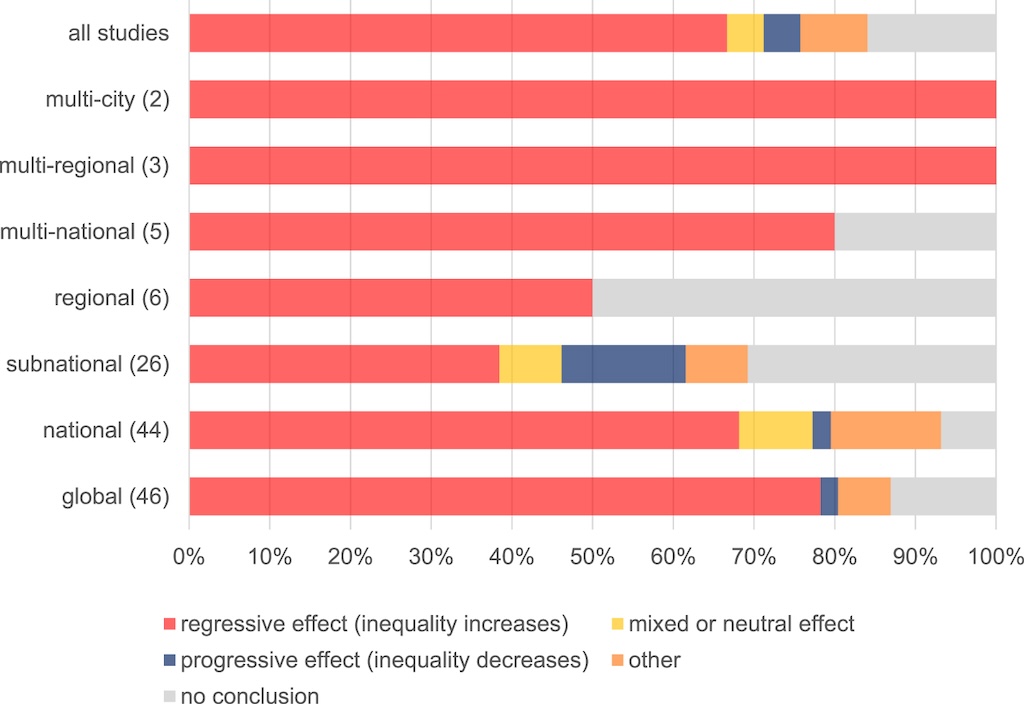
The chart below summarises these overarching results across the 127 studies, categorised by the percentage of studies showing a negative (red), positive (blue) or mixed (yellow) impact on inequality. Orange indicates a finding that does not fit one of the categories, while grey shows studies that could not reach a conclusion.

The different bars represent the geographical focus of the different studies. Most of the studies we reviewed either look at the global picture (46) or focus on individual countries (44).

Effect of climate change on economic inequality according to geographical scope of the studies in our review. These are categorised as regressive (red), progressive (blue), mixed (yellow), other (orange) or no conclusion (grey). Note that the x-axis gives the share of occurrences within studies at that geographical scope, while the number between brackets indicates the total number of studies in that category. Source: Méjean et al. (2024).

When it comes to global studies, the consensus is that climate change is widening inequalities or affecting the poor the most, with around 78% of the papers reaching this conclusion.

Some studies also highlight other groups being disproportionately impacted by climate change, such as rural communities, urban populations, women or specific regions and sectors.

However, there’s a minority of papers that remain inconclusive about both the impact of climate change on inequalities and which groups are most affected.

When it comes to national studies, the trend remains consistent: around 68% of these papers find that climate change is driving up economic inequality or hitting the poorest the hardest (30 out of 44 papers).

As the map below shows, this holds true in all parts of the world. The purple shading indicates the number of studies finding a negative climate impact on inequality for each country.
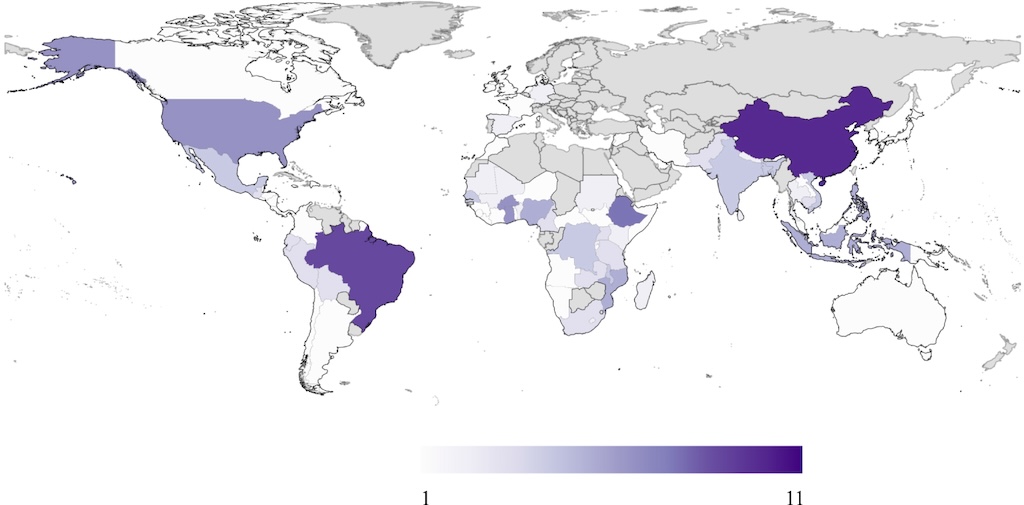
Map of countries where studies show a regressive effect
Map of countries where studies show a regressive effect (that climate change increases economic inequality or that the poor are more impacted). This map includes studies with a national or subnational scope and multi-country studies where that result is valid for single countries. This map excludes global studies. Source: Méjean et al. (2024).

The countries with the highest number of studies (more than five) showing that climate change increases economic inequality or disproportionately affects the poor are China, Brazil, Ethiopia and the US.

Different climate impacts contribute to inequality

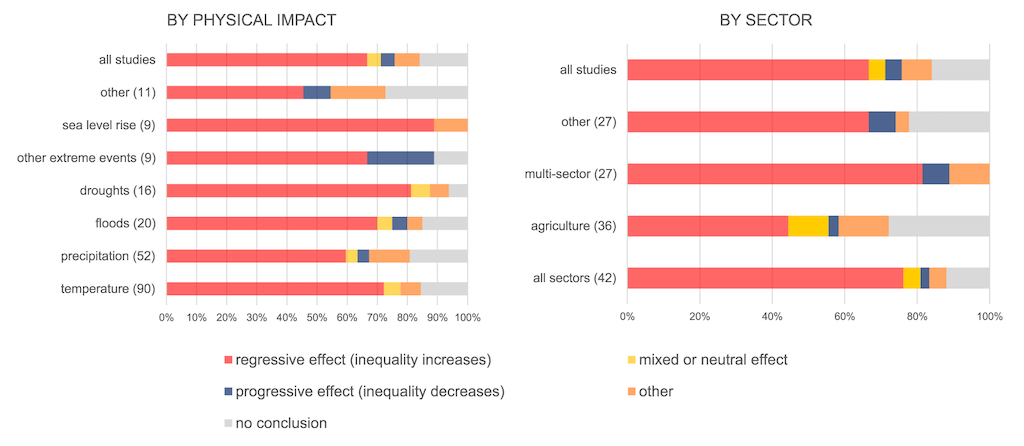
Looking at the breakdown of studies, we found that the percentage of papers pinpointing a particular climate impact as exacerbating inequality or affecting the poor more significantly ranges from 60% for changes in rainfall to 89% for sea level rise.

You can see this in the left-hand chart below, which shows the findings of the literature review separated by climate impact. The right-hand chart shows the findings separated by sector. The categories are the same as in the earlier chart.
Impact of climate change on economic inequality by physical impact and channel
Impact of climate change on economic inequality by physical impact (left) and channel (right). These are categorised as regressive (red), progressive (blue), mixed (yellow), other (orange) or no conclusion (grey). Note that the x-axis gives the share of occurrences within studies for a given category, while the number in brackets indicates the total number of studies in that category. The sum of those numbers may differ from the total number of papers (127), as some papers may fall into several subcategories, for instance in the case where several types of physical impacts are discussed in a single paper. Source: Méjean et al. (2024).

A majority of studies focus on the impact of rising temperature, with 72% of these concluding that temperature changes worsen economic inequality or affect the poor the most.

Most of the studies that find a reduction in inequality concern extreme weather events. This is often because these studies assess the impact on physical assets, which are predominantly owned by the wealthiest.

There are several channels through which biophysical climate change impacts translate into economic effects. These channels include broad economic effects that influence all sectors, changes in agricultural revenues due to factors such as crop yield declines, impacts on labour productivity, changes to infrastructure and physical assets, shifts in energy demand or water availability.

We found that studies identifying labour productivity or energy as the main channel through which climate change affects economic inequalities overwhelmingly conclude that inequalities increase or that the poor are more impacted.

A decline in labour productivity may indeed increase inequality if it disproportionately affects low-skilled workers, especially those who work outdoors or in non-air-conditioned environments.

Notably, a large proportion of the studies where physical assets are identified as the main channel suggest that inequality actually decreases due to climate change or that the wealthy suffer more. This is because rich individuals tend to face greater losses due to the higher value of their property.

Tackling climate impacts on inequality

Our investigation into the impacts of climate change on economic inequality was motivated by the need to better understand the climate change impacts are distributed across the world. This provides the other side of the coin to the effects of mitigation policies on inequality, which are often more widely discussed.

The evidence strongly indicates that the impacts of a warming climate are regressive across countries. Tackling the impacts of climate change on economic inequality will demand substantial policy changes and financial resources.

At the national level, policymakers will need to ensure that adaptation finance and loss and damage compensation effectively reach low-income households to reduce their vulnerability and increase their resilience to climate change impacts.

The results of our review underscore the importance of policymakers integrating climate risk management strategies into the design of “climate-proof” social programmes in poor regions, which are crucial for achieving climate justice objectives.

Of course, other forms of inequality beyond economic inequality, such as gender inequality, are important and interact with climate change, but this is a topic for another review.

.shadeBg{
background: rgba(0,0,0,0.18);
}
Guest post: Mapping where tree-planting has the greatest climate benefit
Guest posts

|

26.03.24

Guest post: Climate adaptation becomes less effective as the world warms

Guest posts

|

15.03.24

Guest post: The challenge of consensus decision-making in UN climate negotiations
Guest posts

|

05.03.24

Guest post: Heavy use of CO2 removal would trigger high sustainability risks

Energy

|

02.02.24

jQuery(document).ready(function() {
jQuery(‘.block-related-articles-slider-block_f37b787b8c0a036ecc419fcbe36be61b .mh’).matchHeight({
byRow: false
});
});

The post Guest post: How climate change could reverse progress in global inequality appeared first on Carbon Brief.

ShareTweetSend
Previous Post

A nutritionist shares her simple diet for optimal health

Next Post

Researchers Uncover Hundreds of New Marine Species in the Underwater Mountain Ecosystems of the Pacific Ocean

Related News

World falling short on 22 of 23 nature targets for 2030, says draft UN report
Energy

World falling short on 22 of 23 nature targets for 2030, says draft UN report

July 30, 2026
Q&A: Can China turn hydrogen into its next clean-energy industry?
Energy

Q&A: Can China turn hydrogen into its next clean-energy industry?

May 27, 2026
Analysis: China’s new carbon metric leaves Germany-sized gap in its emissions
Energy

Analysis: China’s new carbon metric leaves Germany-sized gap in its emissions

May 26, 2026
Revealed: Floods have forced at least 67 closures at NHS hospitals since 2021
Energy

Revealed: Floods have forced at least 67 closures at NHS hospitals since 2021

May 25, 2026
Next Post
Researchers Uncover Hundreds of New Marine Species in the Underwater Mountain Ecosystems of the Pacific Ocean

Researchers Uncover Hundreds of New Marine Species in the Underwater Mountain Ecosystems of the Pacific Ocean

Discussion about this post

Subscribe To Our Newsletters

    Customer Support


    1251 Wilcrest Drive
    Houston, Texas
    77042 USA
    Call-832.795.1420
    e-mail – news@theinsightpost.com

    Subscribe To Our Newsletters

      Categories

      • Africa
      • Africa-East
      • African Sports
      • American Sports
      • Arts
      • Asia
      • Australia
      • Business
      • Business Asia
      • Business- Africa
      • Canada
      • Defense
      • Education
      • Egypt
      • Energy
      • Entertainment
      • Europe
      • European Soccer
      • Finance
      • Germany
      • Ghana
      • Health
      • Insight
      • International
      • Investing
      • Japan
      • Latest Headlines
      • Life & Living
      • Markets
      • Mobile
      • Movies
      • New Zealand
      • Nigeria
      • Politics
      • Scholarships
      • Science
      • South Africa
      • South America
      • Sports
      • Tech
      • Travel
      • UK
      • USA
      • Weather
      • World
      No Result
      View All Result

      Recent News

      Free Cloud Computing Course | AWS Re/Start Program 

      Free Cloud Computing Course | AWS Re/Start Program 

      July 30, 2026
      Thirty Years Later

      Thirty Years Later

      July 30, 2026
      Announcing Codemagic Patch: an open-source CodePush rebuild for React Native

      Announcing Codemagic Patch: an open-source CodePush rebuild for React Native

      July 30, 2026
      Following Expansion in China, Regional Private Equity Faces New Scrutiny in Southeast Asia – The Diplomat

      Following Expansion in China, Regional Private Equity Faces New Scrutiny in Southeast Asia – The Diplomat

      July 30, 2026
      • Home
      • Advertise With Us
      • About Us
      • Corporate
      • Consumer Rewards
      • Forum
      • Privacy Policy
      • Social Trends

      Theinsightpost ©2026 | All Rights Reserved. Theinsightpost is an Elnegy LLC company, registered in Texas, USA

      Welcome Back!

      Login to your account below

      Forgotten Password?

      Retrieve your password

      Please enter your username or email address to reset your password.

      Log In

      Add New Playlist

      We are using cookies to give you the best experience on our website.

      You can find out more about which cookies we are using or switch them off in .

      No Result
      View All Result
      • Home
      • Insight
      • Blog
      • Business
      • Entertainment
      • Health
      • Politics
      • Shop
        • Gift Shop
        • Value Shop
        • Store
        • Bargain Shop
        • Discount
      • Sports
      • Tech
      • Travel
      • USA
      • Video
      • World
        • Asia
        • Africa
        • South America
        • North America
        • Europe
        • Oceania

      Theinsightpost ©2026 | All Rights Reserved. Theinsightpost is an Elnegy LLC company, registered in Texas, USA

      The Insight Post
      Powered by  GDPR Cookie Compliance
      Privacy Overview

      This website uses cookies so that we can provide you with the best user experience possible. Cookie information is stored in your browser and performs functions such as recognising you when you return to our website and helping our team to understand which sections of the website you find most interesting and useful.

      Strictly Necessary Cookies

      Strictly Necessary Cookie should be enabled at all times so that we can save your preferences for cookie settings.

      Cookie Policy

      More information about our Cookie Policy