









A long-term Hubble Space Telescope study of the Draco dwarf galaxy’s stars suggests dark matter is concentrated at the galaxy’s center, supporting the density cusp theory. This finding challenges earlier observations and improves our understanding of dark matter’s role in galaxy formation. (Artist’s concept.) Credit: SciTechDaily.com
The Hubble Space Telescope’s longevity is an asset in gaining clarity about the universe’s invisible glue.
When theory and observations favor different results, how can astronomers determine which one is more feasible?
Increasing confidence in one theory over another oftentimes requires building a richer dataset to improve current models and lower uncertainties. A team of scientists have done just that to help alleviate the murkiness of a long-standing debate: the cusp-core problem. By analyzing 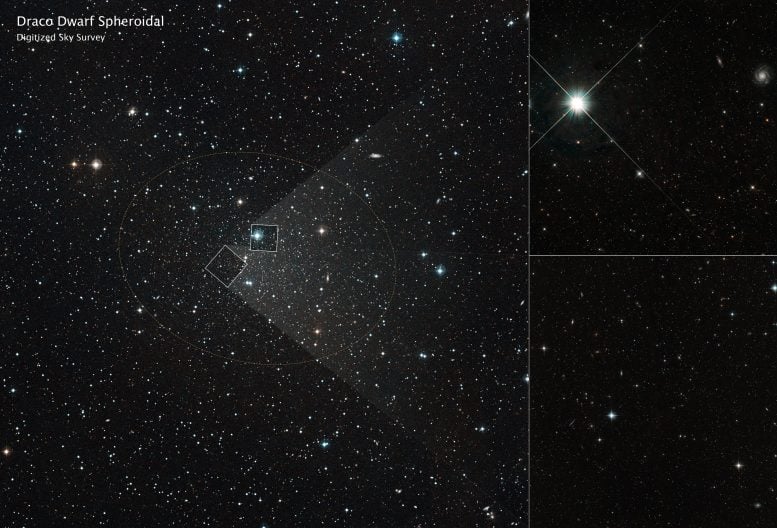
A team of astronomers analyzed observations by NASA’s Hubble Space Telescope taken over a span of 18 years to measure the dynamic motions of stars within the Draco dwarf galaxy. The telescope’s extensive baseline and data archive enabled the team to build the most accurate three-dimensional map of the stars’ movements within the system. These improved measurements are helping to shed “light” on the mysterious qualities and behavior of dark matter, the universe’s invisible “glue.” Credit: NASA, ESA, Eduardo Vitral (STScI), Roeland van der Marel (STScI), Sangmo Tony Sohn (STScI), DSS, Joseph DePasquale (STScI)
Hubble Space Telescope Traces Dark Matter in Dwarf Galaxy Using Stellar Motions
The qualities and behavior of dark matter, the invisible “glue” of the universe, continue to be shrouded in mystery. Though galaxies are mostly made of dark matter, understanding how it is distributed within a galaxy offers clues to what this substance is, and how it’s relevant to a galaxy’s evolution.
While computer simulations suggest dark matter should pile up in a galaxy’s center, called a density cusp, many previous telescopic observations have indicated that it is instead more evenly dispersed throughout a galaxy. The reason for this tension between model and observation continues to puzzle astronomers, reinforcing the mystery of dark matter.
Leveraging the Hubble Telescope
A team of astronomers has turned toward NASA’s Hubble Space Telescope to try and clarify this debate by measuring the dynamic motions of stars within the Draco dwarf galaxy, a system located roughly 250,000 light-years from Earth. Using observations that spanned 18 years, they succeeded in building the most accurate three-dimensional understanding of stars’ movements within the diminutive galaxy. This required scouring nearly two decades of Hubble archival observations of the Draco galaxy.
“Our models tend to agree more with a cusp-like structure, which aligns with cosmological models,” said Eduardo Vitral of the dark matter’s properties among different galaxies thanks to its ability to survey large swaths of the sky.
“This kind of study is a long-term investment and requires a lot of patience,” reflected Vitral. “We’re able to do this science because of all the planning that was done throughout the years to actually gather these data. The insights we’ve collected are the result of a larger group of researchers that has been working on these things for many years.”
These results were published on July 11 in The DOI: 10.3847/1538-4357/ad571c
The Hubble Space Telescope (HST) is a groundbreaking orbiting observatory launched in 1990 by NASA in partnership with the









Discussion about this post