

From the switch to digital photos for ID cards to the continued use of fax machines and the holidays you can look forward to in May, here’s what we’ve been talking about at The Local this week.
Inside Germany is our weekly look at some of the news, talking points and gossip in Germany that you might’ve missed. It’s published each Saturday and members can receive it directly to their inbox by going to their newsletter preferences or adding their email to the sign-up box in this article.
Our most-read story this week by a long shot was an update on Germany’s digitalisation efforts and the announcement that photos for ID cards and residence permits must be submitted digitally from May.
What this means concretely for foreign residents is that you can probably skip a trip to the photo booth next time you need to renew your Aufenthaltstitel, because immigration and citizens’ offices in Germany are being equipped with new terminals that can take your photo on-site.
If you really want to support your local photo studio, you can still do a shoot there and then bring your digital ID photos to the Ausländerbehörde or Bürgeramt in the form of a scannable code.
READ ALSO: What foreigners should know about Germany’s digital ID cards and residence permits
Another change on the residence permit and ID card front is that you’ll soon be able to opt-in for delivery of your ID card by mail.
Germany’s Interior Ministry has said the service will be available for a fee of €15. This is to cover the cost of secure delivery. Alternatively, you can still pick-up your documents back at the office where you applied for them when they are ready for free.
This shake-up of ID cards is far from the only big change happening in May. From next month, newly wed couples will be allowed to adopt combined surnames and people who leave plastic in their biowaste will be hit by higher fines.
READ ALSO: Everything that changes in Germany in May 2025
Post of the week
If Germany’s purported digitalisation efforts leave you feeling a bit sceptical, you’re not the only one.
A recent survey of our readers revealed that German bureaucracy, and especially the paperwork involved, is still a major stressor for those living here. Whether renewing a residence permit, applying for citizenship or communicating with the tax office, many of our readers complained about long wait times and mountains of paperwork.
Advertisement
To help navigate the bureaucratic monster that is German life, one reader went as far as recommending that you can simply get a tax machine, adding, “Your local flea market sells them cheap.”
And while that response was clearly meant in jest, new evidence that Germany just can’t quite bring itself to end its love affair with fax machines continues to surface. For instance, 77 percent of German entrepreneurs still use fax machines, according to research by Germany’s digital association, BitKom.
In response, digital services platform FINOM took some drastic action to stamp out faxes this week. In a tongue-in-cheek marketing stunt, the company faxed messages to small businesses across Germany which were written from the perspective of a weary fax machine begging to be retired.
The company also set up a number of fax machines on streets in Berlin which were programmed to spit out messages like “Ich mass jetzt schluss mit faxen” (I’m done with faxing now), or “Ich bin fax und fertig” (a play on the phrase ‘fix und fertig’, which basically means “I’m wiped out”). Will Germany take pity on them and give them a well-earned rest?
Advertisement
Where is this?
Photo: picture alliance/dpa | Oliver Berg
Following the passing of Pope Francis on Easter Monday at the beginning of the week, Germany’s Catholic community has been in mourning, with memorial books placed at many of the big catholic churches across the country.
Catholicism has a long history in Germany dating back as far as 300 AD, with Christianity firmly taking hold of the entire region by the time of Charlemagne’s reign in the eighth and ninth century.
This photo shows one of Germany’s better known holy sites within the Catholic faith. It is, of course, the Aachener Dom – the western city of Aachen’s historic cathedral.
Advertisement
Public holidays coming in May
The first day of May is a public holiday in Germany known as Maitag (May Day) or Tag der Arbeit (Labour Day).
Especially in Berlin, May 1st festivities include demonstrations in the name of workers’ rights and protections, some of which have evolved over time to be staunchly anti-capitalist and are known to get infamously rowdy, with outbreaks of violence between protestors and police.
In other parts of Germany, “May Day” celebrations stem from old pagan rites that later became Christian traditions. These include dancing through the last night of April and into the early hours of May 1st and festivals centred around a maypole.
Then, May 29th marks Ascension Day, or Christi Himmelfahrt as it’s known in Germany. Besides the day’s significance in the Christian religion, in Germany it is largely known as Father’s Day, on which men head out with a wagon full of beers that they pull around with their friends while getting merry.
Both Maitag and Christi Himmelfahrt are federal public holidays in Germany, so most regularly employed workers will see two paid days off in May. What’s more is both holidays fall on a Thursday, which makes for a ripe opportunity to take advantage of a long holiday weekend with a Brückentage (bridge day).
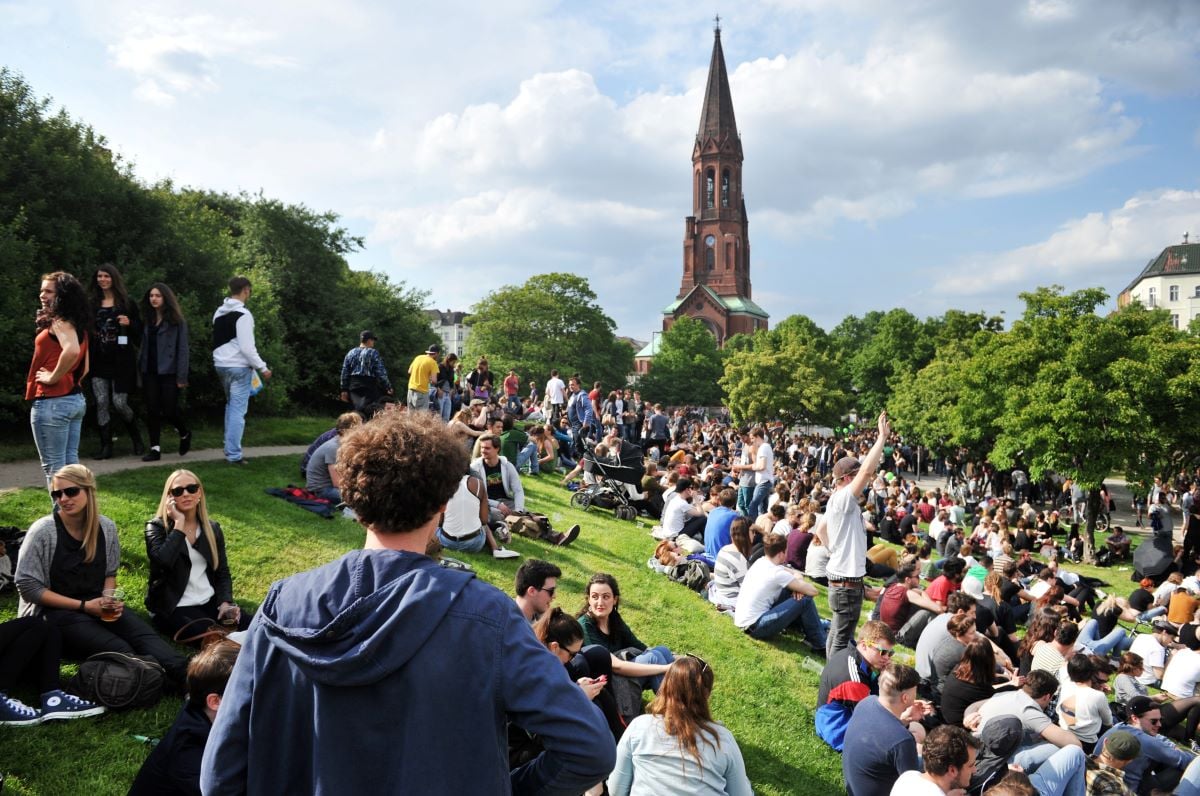
Berlin’s Görlitzer Park in Kreuzberg often becomes an over-crowded hub for casual May Day celebrations on the 1st. Photo: picture alliance / dpa | Ole Spata
Many Germans will request time off on the Friday after a Thursday holiday to gain four days off in a row over a long weekend. If you can get both bridge day Fridays off this May, you’ll gain two four-day weekends for the price of just two vacation days used.
READ ALSO: How employees in Germany can make the most of public holidays in 2025
Readers in Berlin will also see an additional holiday this May as the city-state will celebrate the 80th anniversary of Liberation Day (or Tag der Befreiung) on the 8th. This comes after International Women’s Day, which is a public holiday in Berlin, fell on a weekend earlier this year.
Since May 8th is also a Thursday, regularly employed Berliners will have an additional chance to take advantage of a Liberation Day bridge day – giving them the possibility of having three four-day weekends in a month.
I think we can all agree that this is part of the beauty of life in Germany.


Discussion about this post