
• Home
  • Insight
  • Blog
  • Business
  • Entertainment
  • Health
  • Politics
  • Shop
    • Gift Shop
    • Value Shop
    • Store
    • Bargain Shop
    • Discount
  • Sports
  • Tech
  • Travel
  • USA
  • Video
  • World
    • Asia
    • Africa
    • South America
    • North America
    • Europe
    • Oceania
Sunday, March 15, 2026
No Result
View All Result
Subscribe Now
  • Home
  • Insight
  • Blog
  • Business
  • Entertainment
  • Health
  • Politics
  • Shop
    • Gift Shop
    • Value Shop
    • Store
    • Bargain Shop
    • Discount
  • Sports
  • Tech
  • Travel
  • USA
    Headless victim in 1976 New York cold case identified through DNA: police

    Headless victim in 1976 New York cold case identified through DNA: police

    What’s Good? – The New York Times

    What’s Good? – The New York Times

    Israel’s Deadly Blockade Traps 7 U.S. Doctors in Gaza

    Israel’s Deadly Blockade Traps 7 U.S. Doctors in Gaza

    Carney announces billions for defense and infrastructure in Canada’s North

    Carney announces billions for defense and infrastructure in Canada’s North

    Right-wing media’s Mamdani outrage fuels GOP anti-Muslim rhetoric

    Right-wing media’s Mamdani outrage fuels GOP anti-Muslim rhetoric

    12-year-old girl dies days after collapsing following fight near school bus stop

    12-year-old girl dies days after collapsing following fight near school bus stop

    Speaker Mike Johnson Sketches ‘Course Correction’ in DHS Deportation Policy

    Speaker Mike Johnson Sketches ‘Course Correction’ in DHS Deportation Policy

    Where Was ‘War Machine’ Filmed? Discover the ‘War Machine’ 2026 Filming Locations for Alan Ritchson’s Netflix Movie

    Where Was ‘War Machine’ Filmed? Discover the ‘War Machine’ 2026 Filming Locations for Alan Ritchson’s Netflix Movie

    L.A. City Council candidate stays in race after report that he stabbed a boy at age 12

    L.A. City Council candidate stays in race after report that he stabbed a boy at age 12

  • Video
  • World
    • Asia
    • Africa
    • South America
    • North America
    • Europe
    • Oceania
The Insight Post
  • Home
  • Insight
  • Blog
  • Business
  • Entertainment
  • Health
  • Politics
  • Shop
    • Gift Shop
    • Value Shop
    • Store
    • Bargain Shop
    • Discount
  • Sports
  • Tech
  • Travel
  • USA
    Headless victim in 1976 New York cold case identified through DNA: police

    Headless victim in 1976 New York cold case identified through DNA: police

    What’s Good? – The New York Times

    What’s Good? – The New York Times

    Israel’s Deadly Blockade Traps 7 U.S. Doctors in Gaza

    Israel’s Deadly Blockade Traps 7 U.S. Doctors in Gaza

    Carney announces billions for defense and infrastructure in Canada’s North

    Carney announces billions for defense and infrastructure in Canada’s North

    Right-wing media’s Mamdani outrage fuels GOP anti-Muslim rhetoric

    Right-wing media’s Mamdani outrage fuels GOP anti-Muslim rhetoric

    12-year-old girl dies days after collapsing following fight near school bus stop

    12-year-old girl dies days after collapsing following fight near school bus stop

    Speaker Mike Johnson Sketches ‘Course Correction’ in DHS Deportation Policy

    Speaker Mike Johnson Sketches ‘Course Correction’ in DHS Deportation Policy

    Where Was ‘War Machine’ Filmed? Discover the ‘War Machine’ 2026 Filming Locations for Alan Ritchson’s Netflix Movie

    Where Was ‘War Machine’ Filmed? Discover the ‘War Machine’ 2026 Filming Locations for Alan Ritchson’s Netflix Movie

    L.A. City Council candidate stays in race after report that he stabbed a boy at age 12

    L.A. City Council candidate stays in race after report that he stabbed a boy at age 12

  • Video
  • World
    • Asia
    • Africa
    • South America
    • North America
    • Europe
    • Oceania
No Result
View All Result
No Result
View All Result
Home Energy

Climate change and La Niña made ‘devastating’ southern African floods more intense

by Theinsightpost
January 29, 2026
in Energy
0 0
0
Climate change and La Niña made ‘devastating’ southern African floods more intense

“Exceptionally heavy” rainfall that led to deadly flooding across southern Africa in recent weeks was made more intense by a combination of climate change and La Niña.

This is according to a rapid attribution study by the World Weather Attribution service.

From late December 2025 to early January, south-eastern Africa was hit hard by intense downpours that resulted in more than a year’s worth of rain falling in some areas in just a few days, according to the study.

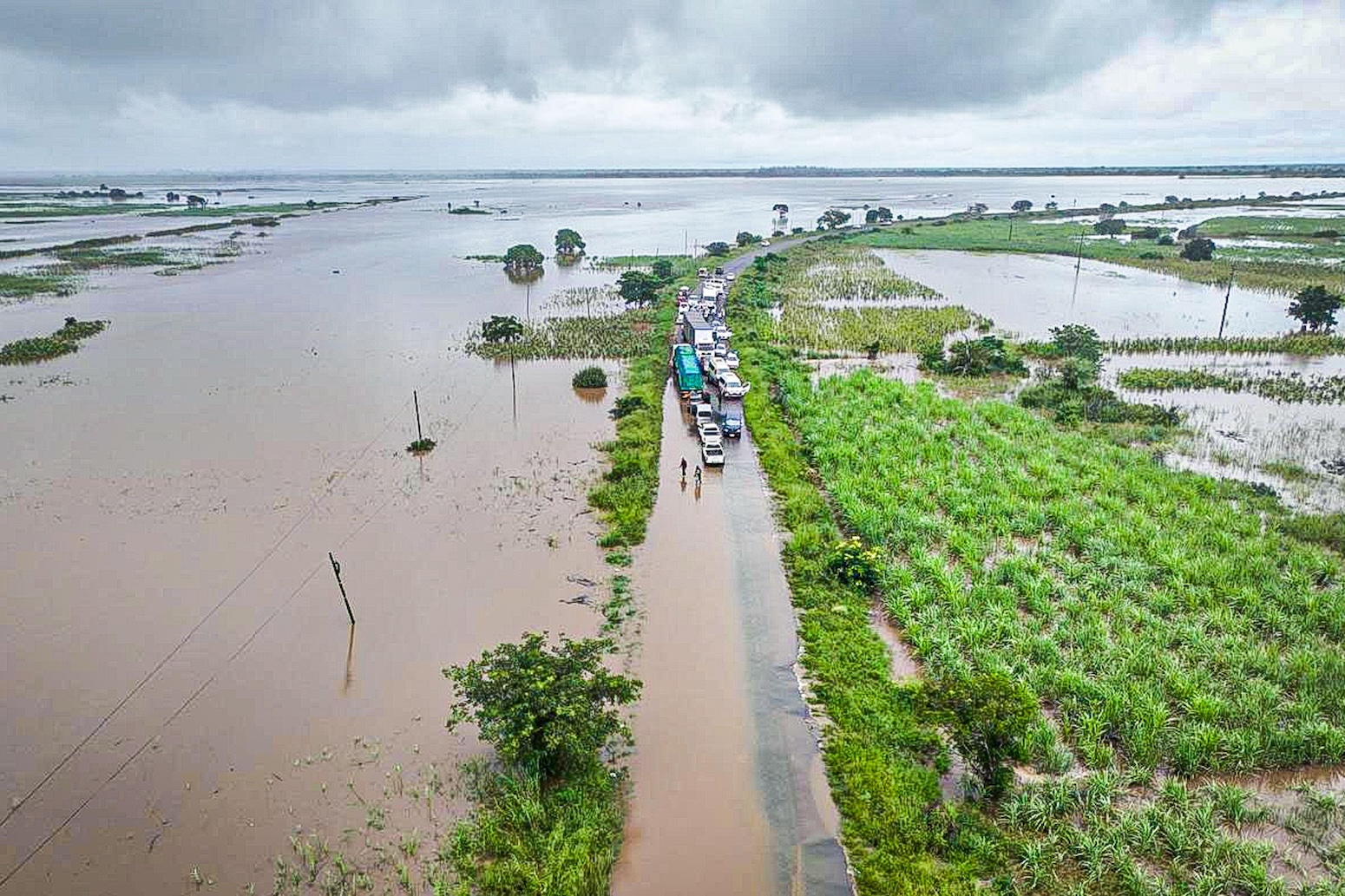
This led to severe flooding that left at least 200 people dead, thousands sheltering in temporary accommodation and tens of thousands of hectares of farmland waterlogged.

The analysis finds that periods of intense rainfall over southern Africa have become 40% more severe since pre-industrial times, according to observations.

The authors say they were unable to calculate how much of this increase was driven specifically by climate change, due to limitations in how climate models simulate African rainfall.

However, the study notes that the researchers “have confidence that climate change has increased both the likelihood and the intensity” of the rainfall.

The authors also note that the El Niño-Southern Oscillation phenomenon played a role in the “devastating” flooding, estimating that a La Niña event made the rainfall around five times more likely.

Major disruption

The heavy rainfall started on 26 December last year and intensified from early January. The most-extreme rainfall took place between 10 and 19 January.

The countries most affected by the floods, and analysed by the study, are Eswatini, Mozambique, South Africa and Zimbabwe, with some areas receiving up to 200mm of rain, according to the study authors.

Study author Bernardino Nhantumbo – a researcher at Mozambique’s National Institute of Meteorology – told a press briefing that in just two or three days, some areas recorded the amount of rainfall that is “expected for the whole rainy season”.

The map below shows the areas most affected by intense rainfall over 10-19 January. Darker blue indicates a greater accumulation of rainfall, while light green indicates less rainfall. The pink box shows the study area.

Most affected areas by large floods in southern Africa. Darker blue indicates a greater accumulation of rainfall, while light green indicates less rainfall. The pink box shows the study area. Source: WWA (2026).

In Mozambique, the floods damaged nearly 5,000km of roads, which has hindered the transport of goods and affected pharmaceutical supply chains, the study says. In Zimbabwe, bridges, roads and infrastructure were “significantly damaged or destroyed”.

More than 75,000 people have been affected by the floods in Mozambique, according to the study. BBC News reported the floods were the worst seen “in a generation” in the country.

Dr Izidine Pinto, a climate scientist from Mozambique currently working at the Royal Netherlands Meteorological Institute, told a press briefing that the country was particularly affected because it “lies downstream of major river basins”. 

The flooding prompted Mozambique’s education minister to consider rescheduling the start of the academic year, according to Channel Africa.

In South Africa, the country’s weather service said that areas receiving more than 50mm of rain over 11-13 January were “widespread”, with some places seeing up to 200mm.

South Africa’s Kruger National Park – the largest national park in South Africa – was severely damaged by floods and temporarily closed after several rivers burst their banks, reported TimesLIVE. 

The South African news outlet quoted environment minister Willie Aucamp as saying: “The indication is that it will take as long as five years to repair all the bridges and roads and other infrastructure.” 

Extreme rainfall

The peak of the rainy season in southern Africa falls between December and February.

To put the extreme rainfall into its historical context and determine how unlikely it was, the authors analysed a timeseries of 10-day maximum rainfall data for the December-February season.

They find that in today’s climate, extreme rainfall events of the scale seen this year in southern Africa would be expected only once every 50 years. 

They add that such events have become “significantly more intense”, with observational data showing a 40% increase in rainfall severity since pre-industrial times.

The map below shows accumulated rainfall over Eswatini, Mozambique, South Africa and Zimbabwe over 10-19 January, as a percentage of the average December-February rainfall for the region over 1991-2020.

Green shading indicates that the rainfall in 2026 was higher than in 1991-2020, while brown indicates that it was lower. The red box indicates the study region. 
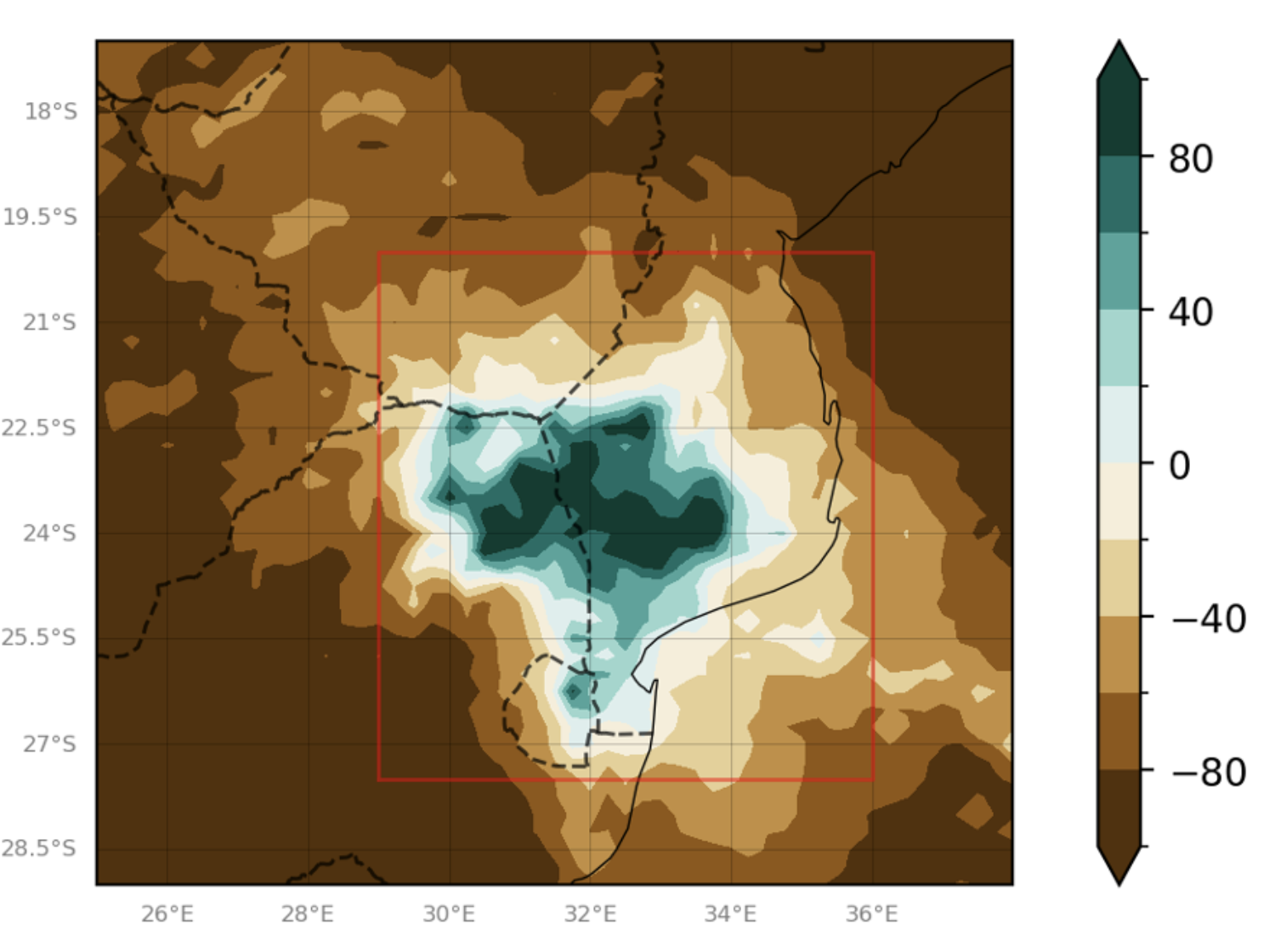
Accumulated rainfall over Eswatini, Mozambique, South Africa and Zimbabwe over 10-19 January 2026, shown as a percentage of the average December-February rainfall for the region over 1991-2020. The study region is outlined in dark red. Source: WWA (2026).

The study explains that in January and February, rainfall patterns in southern Africa are “strongly influenced” by the El Niño-Southern Oscillation (ENSO), a naturally occurring climate phenomenon that affects global temperatures and regional weather patterns. 

La Niña is the “cool” phase of ENSO, which typically brings wetter weather to southern Africa.

Pinto told the press briefing that “most past extreme rainfall events [in the region] have occurred during La Niña years”. 

The authors estimate that the current weak La Niña event made the extreme rainfall five times more likely and increased the intensity of the event by around 22%.

For attribution studies, which identify the “fingerprint” of human-caused climate change on extreme weather events, scientists typically use climate models to simulate and compare worlds with and without global warming.

However, many models have limitations in their simulations of African rainfall. In this study, the authors found that the models available to them cannot “adequately capture” the influence of ENSO on rainfall in the region.  

Study author Prof Fredi Otto, a professor in climate science at the Imperial College London, told a press briefing that these limitations are “well known”. They stem, in part, because the models were “developed outside of Africa” by modellers with different priorities, she explained. 

This means that the authors were unable to calculate how much more intense or likely the rainfall event was specifically as a result of human-caused warming.

However, Otto explained that the authors are “very, very confident that climate change did increase the likelihood and intensity of the rainfall” to some extent. This is because the observations all show an increase in rainfall over time and other existing literature supports this assumption, she added. 

She told the press briefing that the results of this study were “definitely not 100% satisfactory”, adding that this study will “definitely not be the last of its kind in this region”. 

(These findings are yet to be published in a peer-reviewed journal. However, the methods used in the analysis have been published in previous attribution studies.)

Vulnerability

The study warns that the flooding “exposed deep and persistent social vulnerability in the region”.

The authors say that a large proportion of the population – especially in urban areas – live in poor housing with “inadequate planning and insufficient provision of basic services”.

Paola Emerson, head of office at the UN Office for the Coordination of Humanitarian Affairs (OCHA) in Mozambique, told a UN press briefing about the flooding that nearly 90% of people in the country live in traditional adobe houses that “basically melt after a few days’ rains”.

In a WWA press release, study author Nhantumbo explained:

“When 90% of homes are made of sun-dried earth, they simply cannot withstand this much rain. The structural collapse of entire villages is a stark reminder that our communities and infrastructure are now being tested by weather they are just not designed to endure.”

Study author Renate Meyer – an adviser with the conflict and climate team at the Red Cross Red Crescent Centre – said in a WWA press briefing that the “recurring frequency of hazards such as drought and extreme rainfall have had a significant impact on communities experiencing, amongst others, displacement, health challenges, socioeconomic loss and psychological distress”.

For example, the World Health Organization (WHO) said in a press release that the event had disrupted access to health services and increased the risks of water- and mosquito-borne diseases, as well as respiratory infections across southern Africa.

Meyer explained that the countries included in this study have “substantial populations living below or near the poverty line with limited savings, low insurance cover and a high dependence on climate sensitive livelihoods”. 

ShareTweetSend
Previous Post

Sophie Ellis-Bextor, Summer Actually and Opera in the Park: The Spinoff event guide

Next Post

‘The Karate Kid’ and ‘Clueless’ Join National Film Registry

Related News

Q&A: Why does gas set the price of electricity – and is there an alternative?
Energy

Q&A: Why does gas set the price of electricity – and is there an alternative?

March 14, 2026
Jewellok Launches Advanced Liquid Chemical Delivery Modules and Systems to Accelerate Photovoltaic Manufacturing Efficiency
Energy

Jewellok Launches Advanced Liquid Chemical Delivery Modules and Systems to Accelerate Photovoltaic Manufacturing Efficiency

March 14, 2026
DeBriefed 13 March 2026: War and oil | Why gas drives electricity prices | Japan’s ‘vulnerability’ to Iran crisis
Energy

DeBriefed 13 March 2026: War and oil | Why gas drives electricity prices | Japan’s ‘vulnerability’ to Iran crisis

March 13, 2026
Wind Turbine Market to Reach USD 107.1 Billion by 2032 | 6.4% CAGR | Trends, Technology & Forecast
Energy

Wind Turbine Market to Reach USD 107.1 Billion by 2032 | 6.4% CAGR | Trends, Technology & Forecast

March 13, 2026
Next Post
‘The Karate Kid’ and ‘Clueless’ Join National Film Registry

‘The Karate Kid’ and ‘Clueless’ Join National Film Registry

Discussion about this post

Subscribe To Our Newsletters

    Customer Support


    1251 Wilcrest Drive
    Houston, Texas
    77042 USA
    Call-832.795.1420
    e-mail – news@theinsightpost.com

    Subscribe To Our Newsletters

      Categories

      • Africa
      • Africa-East
      • African Sports
      • American Sports
      • Arts
      • Asia
      • Australia
      • Business
      • Business Asia
      • Business- Africa
      • Canada
      • Defense
      • Education
      • Egypt
      • Energy
      • Entertainment
      • Europe
      • European Soccer
      • Finance
      • Germany
      • Ghana
      • Health
      • Insight
      • International
      • Investing
      • Japan
      • Latest Headlines
      • Life & Living
      • Markets
      • Mobile
      • Movies
      • New Zealand
      • Nigeria
      • Politics
      • Scholarships
      • Science
      • South Africa
      • South America
      • Sports
      • Tech
      • Travel
      • Travel-Africa
      • UK
      • USA
      • Weather
      • World
      No Result
      View All Result

      Recent News

      NanoClaw and Docker partner to make sandboxes the safest way for enterprises to deploy AI agents

      NanoClaw and Docker partner to make sandboxes the safest way for enterprises to deploy AI agents

      March 15, 2026
      Why fuel prices have remained unchanged despite attacks on Iran

      Why fuel prices have remained unchanged despite attacks on Iran

      March 15, 2026
      10 Best Apps Like QooApp: QooApp Alternatives in 2024

      10 Best Apps Like QooApp: QooApp Alternatives in 2024

      March 15, 2026
      Ancient Dogs Started Diversifying 11,000 Years Ago, Long Before the Modern Breeds We Know Today

      Ancient Dogs Started Diversifying 11,000 Years Ago, Long Before the Modern Breeds We Know Today

      March 15, 2026
      • Home
      • Advertise With Us
      • About Us
      • Corporate
      • Consumer Rewards
      • Forum
      • Privacy Policy
      • Social Trends

      Theinsightpost ©2026 | All Rights Reserved. Theinsightpost is an Elnegy LLC company, registered in Texas, USA

      Welcome Back!

      Login to your account below

      Forgotten Password?

      Retrieve your password

      Please enter your username or email address to reset your password.

      Log In

      Add New Playlist

      We are using cookies to give you the best experience on our website.

      You can find out more about which cookies we are using or switch them off in .

      No Result
      View All Result
      • Home
      • Insight
      • Blog
      • Business
      • Entertainment
      • Health
      • Politics
      • Shop
        • Gift Shop
        • Value Shop
        • Store
        • Bargain Shop
        • Discount
      • Sports
      • Tech
      • Travel
      • USA
      • Video
      • World
        • Asia
        • Africa
        • South America
        • North America
        • Europe
        • Oceania

      Theinsightpost ©2026 | All Rights Reserved. Theinsightpost is an Elnegy LLC company, registered in Texas, USA

      The Insight Post
      Powered by  GDPR Cookie Compliance
      Privacy Overview

      This website uses cookies so that we can provide you with the best user experience possible. Cookie information is stored in your browser and performs functions such as recognising you when you return to our website and helping our team to understand which sections of the website you find most interesting and useful.

      Strictly Necessary Cookies

      Strictly Necessary Cookie should be enabled at all times so that we can save your preferences for cookie settings.

      Cookie Policy

      More information about our Cookie Policy