
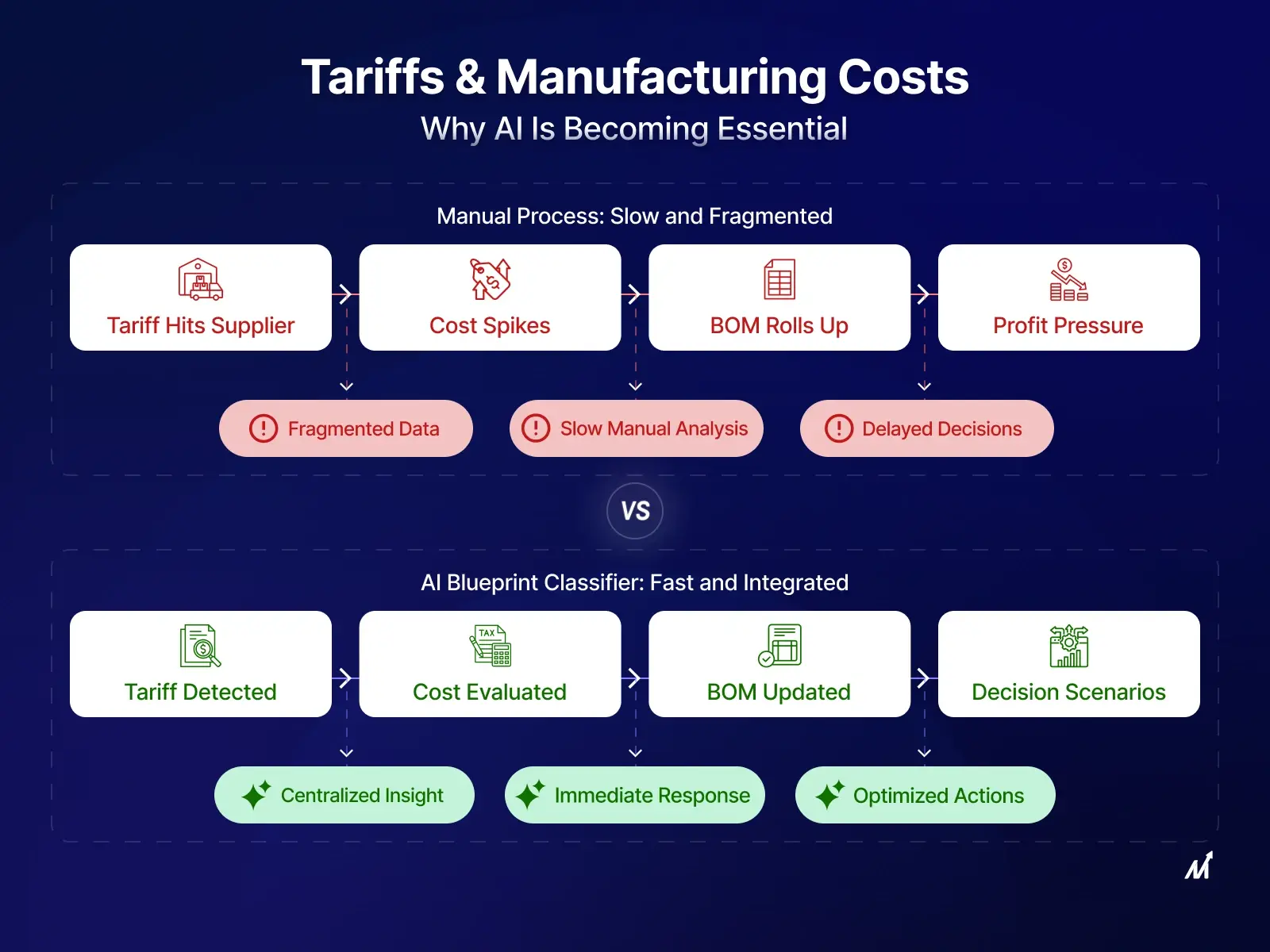
For manufacturing leaders, tariffs are no longer an abstract policy debate; they are a real and measurable factor shaping cost structures, supply chains, and operating performance. In 2025 and into 2026, expanded U.S. duties on imported materials and components have driven up prices for critical inputs such as steel, aluminum, and electronics, amplifying the tariff impact on manufacturing operations globally. Analysts estimate that tariff‑related cost increases can boost factory operating expenses by roughly 2–4.5%, even before accounting for secondary supply chain effects.
Unlike service‑oriented sectors, manufacturing is built on complex, globally distributed supply chains, engineering‑intensive processes, and thin operating margins. When tariffs increase the cost of steel, semiconductors, battery materials, or precision parts, those additional costs ripple through procurement, production planning, and product pricing. Many manufacturers continue to absorb a significant share of these costs due to long‑term contracts, competitive pressures, or lengthy supplier qualification timelines.
What makes the current environment particularly challenging is speed and scale. Tariff changes often arrive faster than traditional analysis tools can respond. Teams responsible for evaluating cost exposure must now reconcile scattered engineering documentation, supplier data, and product specifications under tight timelines, while keeping production running and quality consistent.
This is not a question of trade policy advocacy. It is a question of operational readiness and strategic competitiveness. Companies that can quickly assess where tariff exposure exists, evaluate alternatives, and adjust their planning processes are better positioned to protect margins, maintain continuity, and adapt to future shifts in global trade dynamics.
Table of Contents
- The Tariff Impact on Manufacturing Operations
- Differential Industry Impact of U.S. Tariffs
- Strategic Responses Manufacturers Are Using Today
- AI and Data: Enabling Faster Tariff Response in Manufacturing
- Conclusion: Preparing Manufacturing Operations for the Next Disruption
- Frequently Asked Questions About Tariffs and Manufacturing Operations
How Tariffs Affect Manufacturing Operations
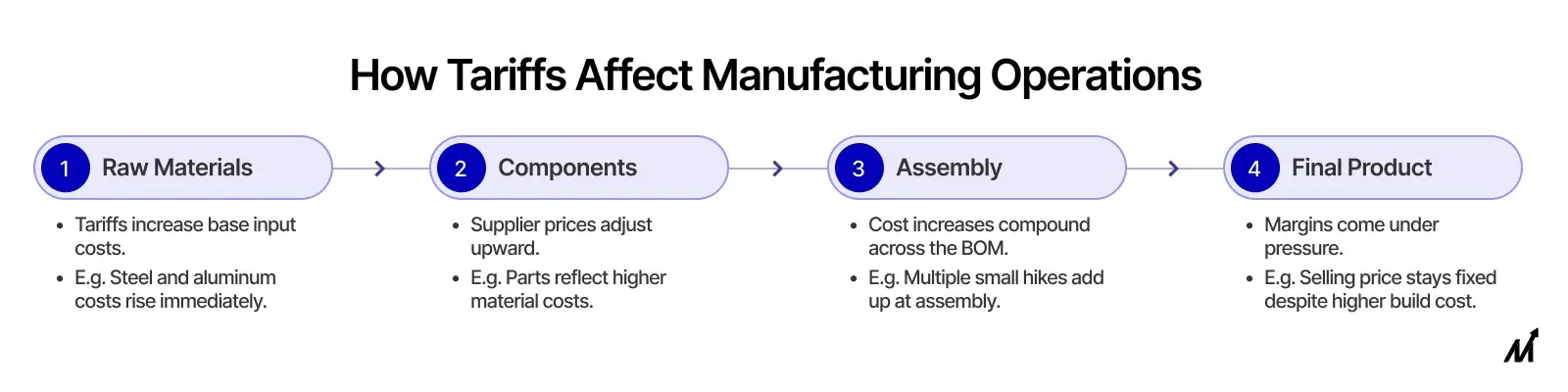
In 2026, tariffs function as persistent costs and planning constraints that directly influence sourcing strategies, engineering decisions, and margin performance. Unlike short-term price fluctuations, tariff impacts tend to be structural; embedded across raw materials, components, and multi-tier supply chains.
For manufacturing and other heavy industries, the challenge is not simply higher duties but the downstream effects they trigger across operations. Increased material costs affect product economics, supplier shifts introduce qualification and quality risks, and delayed responses often lock in avoidable margin erosion. These pressures are amplified by long production cycles and contractual pricing structures that limit flexibility.
As a result, tariff exposure today must be understood at an operational level, part by part, material by material, rather than as a single line-item cost. The sections below examine how tariffs translate into real operational strain across input costs, supply chain stability, and pricing power.
1. Increased Input Costs
One of the most immediate consequences of rising tariffs is higher input costs, particularly for materials that form the backbone of manufactured products.
- Steel and aluminum tariffs, which have been raised to roughly 50% on many imported products, are contributing to sharper price inflation for metals-intensive industries. According to industry analysis, these broader tariffs could add more than $22 billion to U.S. import costs for steel and aluminum, and another ~$29 billion when derivative products are included, all before downstream supply chain impacts are accounted for.
- When tariffs are applied to high-volume materials and components, their effects compound quickly across cost structures. For manufacturers operating on thin margins, incremental duty increases across multiple inputs can materially affect unit economics, pricing assumptions, and working capital requirements, even when no major design changes occur.
- For specific sectors such as electronics, where imported components account for a large share of production inputs, tariffs can significantly increase costs. For example, some mid-sized electronics firms reported year-on-year component cost increases of ~12%, driven by broader tariff exposure and supply chain adjustments.
These cost increases are not limited to primary metals. Precision subcomponents, rare earth materials, and semiconductor parts, often sourced from global suppliers, are also subject to tariff escalation, adding layers of complexity to procurement and production cost forecasting.
2. Supply Chain Disruptions
Tariff changes also introduce supply chain volatility that can delay production schedules and increase working capital requirements.
- Higher duties on imported goods have encouraged manufacturers to place advance orders (often 6–12 months ahead) for tariff-exposed components, straining working capital and storage capacity.
- Many suppliers, particularly in metals and subcomponents, are seeing lead times extend by 40–60% for critical materials as companies compete for limited pre-tariff pricing and inventory.
- The need to qualify alternative sources in lower-tariff regions often introduces quality inconsistencies or additional compliance steps, further slowing time-to-production.
Disruptions like these are especially visible in automotive and aerospace supply chains, where production sequencing and just-in-time inventory strategies are prevalent. Even small delays at lower tiers can result in significant schedule slippage for final assembly lines.
3. Margin Pressures & Pricing Challenges
Higher input costs and supply volatility naturally compress margins, particularly when manufacturers cannot fully pass through these increases to customers.
- Many manufacturers operate under long-term contracts with fixed pricing terms, limiting their ability to raise prices in response to tariff-induced cost inflation.
- Competitive pressure in mature markets often means that only a portion of cost increases can be passed on to buyers, forcing companies to absorb the remainder, thereby squeezing profitability.
- There are also hidden operational costs that don’t show up in headline tariff figures, such as expedited freight premiums, additional quality inspections, and increased engineering hours to evaluate and qualify alternatives.
Taken together, these pressures affect not only short-term financial metrics but also investment decisions and strategic planning. Teams in procurement, finance, and engineering are being asked to produce rapid assessments and scenario analyses, often with tools that were never designed for real-time strategic sensitivity. The result is slow response times, growing backlogs, and missed opportunities to proactively mitigate tariff exposure.
Differential Industry Impact: Tariff Impact on Manufacturing Operations
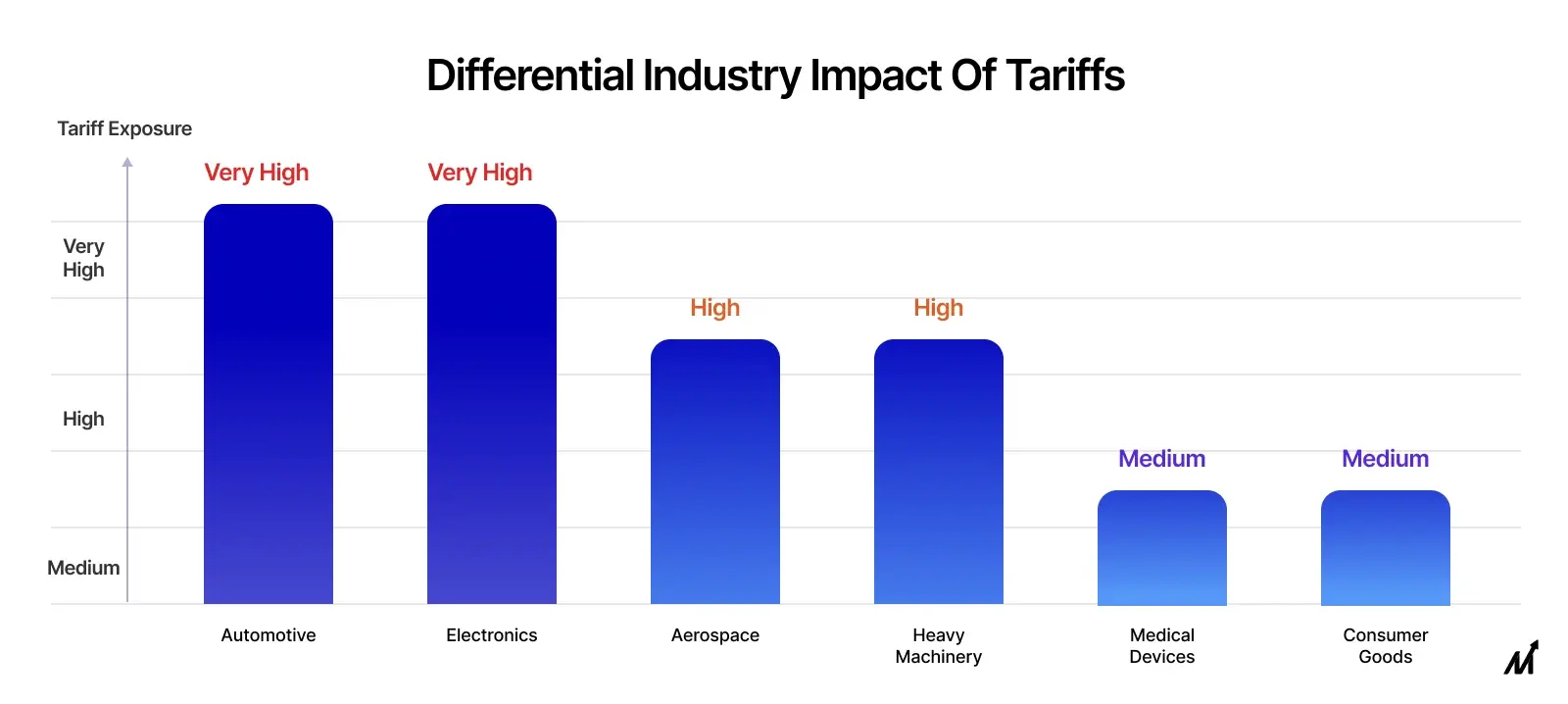
While tariffs affect nearly every industrial sector, their impact on manufacturing industries varies significantly by material intensity, supply chain complexity, and regulatory constraints. Industries that rely heavily on imported raw materials, globally distributed suppliers, and long qualification cycles face disproportionately higher tariff exposure. Understanding these differences is critical for prioritizing tariff response strategies and allocating engineering and procurement resources effectively.
Differential Industry Impact Summary
| Industry | Indicative U.S. Tariff Exposure Range* | Brief Explanation |
| Automotive | Steel & Aluminium up to ~25%, electronics/components often 7.5-25% | Highly global, multi-tier supply chains with thousands of parts per vehicle. Long design and supplier qualification cycles limit rapid response to tariff changes. |
| Aerospace | Especially metals and avionics often 5-25% | Reliance on certified materials and limited suppliers. Regulatory and airworthiness requirements make redesign or supplier substitution slow and costly. |
| Heavy Machinery & Industrial Equipment | Steel, motors, hydraulics commonly 10–25% | Large, material-intensive products with long lifecycles. Tariffs raise material and logistics costs, while redesign efforts are resource-heavy for legacy platforms. |
| Electronics & Electrical Equipment | Semiconductors, PCBs, and displays often 7.5–25% | Highly concentrated global manufacturing and short product lifecycles increase sensitivity to tariff-driven cost escalation. |
| Medical Devices | Precision components and specialty materials often 5–25% | Regulatory validation requirements constrain sourcing flexibility, leading manufacturers to absorb costs rather than switch suppliers quickly. |
| Consumer Goods | Packaging, plastics, textiles typically 5–15% | More flexible supply chains, but high-volume production means small tariff increases can materially impact margins. |
*Tariff percentages shown are indicative ranges based on commonly applied U.S. trade measures (e.g., Section 232 and Section 301). Actual duties vary by HS code, material specification, country of origin, and exemption status.
1. Automotive: Very High Exposure
Automotive manufacturing remains one of the most tariff-exposed manufacturing sectors due to its dependence on steel, aluminum, electronics, and increasingly complex battery systems. A single vehicle can contain 30,000 or more individual parts, many sourced across multiple countries, making tariff exposure both widespread and difficult to isolate.
Steel and aluminum tariffs directly affect body structures and chassis components, while tariffs on electronic modules, sensors, and battery materials increase costs across vehicle powertrain systems (the components that generate and deliver power, such as engines, motors, transmissions, and drivetrains) and advanced driver-assistance systems. Because vehicle programs are designed years in advance and supplier changes require lengthy requalification, automakers and Tier-1 suppliers often have limited flexibility to respond quickly. The result is sustained margin pressure, particularly in high-volume programs under fixed-pricing agreements.
2. Aerospace: High Exposure
Aerospace manufacturing faces significant tariff exposure due to specialty metals, advanced composites, and avionics components. Materials such as titanium alloys and nickel-based superalloys are sourced from a limited number of qualified global suppliers, increasing vulnerability to trade restrictions and import duties.
Certification and airworthiness requirements further complicate response efforts. Any change to materials, suppliers, or manufacturing processes can trigger extensive testing and regulatory review, extending timelines and increasing costs. As a result, even modest tariff increases can have an outsized financial impact on long-running aircraft programs where cost structures are tightly controlled, and design flexibility is limited.
3. Heavy Machinery: High Exposure
Heavy equipment and industrial machinery manufacturers are heavily affected by tariffs on steel, electric motors, hydraulic systems, and powertrain components. These products are typically large, material-intensive, and produced in lower volumes, limiting opportunities to offset cost increases through scale efficiencies.
Tariffs increase not only material costs but also logistics, warehousing, and inventory carrying expenses, as manufacturers stockpile components to reduce the risk of supply disruptions. While component redesign or domestic substitution is possible in some cases, engineered-to-order products and long equipment lifecycles make these changes slow and resource-intensive, particularly for legacy product lines.
4. Electronics: Very High Exposure
The electronics sector faces some of the highest tariff exposure due to its dependence on semiconductors, printed circuit boards (PCBs), displays, and precision components. Supply chains are highly globalized, with critical manufacturing steps concentrated in a small number of regions.
Tariffs in this sector often lead to rapid cost escalation, as alternative suppliers may not be immediately available or qualified. Short product lifecycles further intensify the challenge, leaving limited time to absorb cost increases before market pricing becomes uncompetitive.
5. Medical Devices: Medium–High Exposure
Medical device manufacturers experience medium to high exposure, particularly for precision components, specialty plastics, and rare-earth materials used in imaging, diagnostic, and implantable devices. While margins are often higher than in other manufacturing sectors, regulatory constraints significantly limit sourcing flexibility.
Any supplier or material change typically requires validation and regulatory approval, slowing response timelines. As a result, tariff-related cost increases are often absorbed internally rather than passed on, especially in price-sensitive healthcare markets.
6. Consumer Goods: Medium Exposure
Consumer goods manufacturers face moderate tariff exposure, primarily through packaging materials, plastics, textiles, and imported subassemblies. While supply chains are generally more flexible than in regulated or heavy industries, competitive pricing pressure is intense.
Beyond core manufacturing sectors, industries such as energy equipment, industrial components, rail, and defense manufacturing also face growing tariff exposure due to their reliance on engineered metal parts and globally sourced assemblies. These sectors often operate on long product lifecycles and legacy documentation, making AI-driven blueprint classification particularly valuable for accelerating tariff analysis and substitution planning.
Manufacturers in this sector are often better positioned to switch suppliers or adjust designs, but high-volume production means even small cost increases can materially affect profitability.
Strategic Responses by Manufacturers to Tackle Tariff Impact on Manufacturing Operations
Faced with rising tariffs and ongoing policy uncertainty, manufacturers have not stood still. Across industries, leadership teams are deploying a familiar set of strategic responses to reduce exposure, stabilize operations, and protect margins. While these approaches remain valid, their effectiveness increasingly depends on how quickly and accurately organizations can assess trade-offs across cost, risk, and feasibility.
1. Traditional Responses
Supplier Diversification
One of the most common responses to tariff pressure is diversifying suppliers across regions. Manufacturers have accelerated sourcing efforts in countries such as Vietnam, India, and Mexico to reduce reliance on heavily tariffed trade corridors. In theory, geographic diversification spreads risk and increases negotiating leverage. In practice, onboarding new suppliers introduces qualification timelines, documentation challenges, and quality variability, especially for complex or safety-critical components.
Reshoring and Nearshoring
Some manufacturers are bringing production closer to end markets through reshoring or nearshoring initiatives. Moving operations to North America or neighboring regions can reduce tariff exposure and improve supply chain resilience. However, these efforts often require significant capital investment, workforce development, and multi-year planning. Labor availability, infrastructure readiness, and higher operating costs can limit the pace at which reshoring delivers measurable financial benefits.
Inventory Buffering
To manage uncertainty, many organizations increase safety stock for tariff-exposed components. Buffering inventory can protect against sudden supply disruptions or price spikes, but it comes at a cost. Higher inventory levels tie up working capital, increase storage and handling expenses, and raise the risk of obsolescence, particularly in fast-moving or engineered product lines.
Contract Renegotiation
Manufacturers also attempt to renegotiate contracts with customers and suppliers to share tariff-related costs. Some suppliers pass through tariff surcharges, while manufacturers seek pricing adjustments or temporary relief clauses with customers. These negotiations are often constrained by long-term agreements, competitive dynamics, and customer resistance, limiting the cost that can be realistically recovered.
Product Redesign
Engineering-led redesign initiatives aim to reduce tariff exposure by substituting materials, simplifying components, or standardizing parts. In theory, redesign offers one of the most durable responses to tariffs. In practice, it is time-intensive and resource-heavy, requiring careful analysis of specifications, tolerances, and regulatory implications. Redesign efforts must also compete with ongoing product development priorities.
2. Limitations of Manual Approaches
While these strategies are well established, many manufacturers struggle to execute them effectively with traditional manual methods.
Tariff analysis is often performed using spreadsheets and static cost models that are ill-suited to rapid policy changes. When tariffs shift, teams must manually gather data from procurement systems, engineering drawings, supplier documents, and compliance records, an effort that can take weeks or months.
Engineering teams, in particular, are overwhelmed by “what-if” scenarios. Evaluating whether a component can be redesigned, substituted, or sourced elsewhere requires a detailed understanding of materials, dimensions, and performance requirements. Without centralized visibility into this information, engineers are forced to review documentation one part at a time.
Procurement teams face similar constraints. While they may know which suppliers are tariff-exposed, they often lack insight into whether alternative components will meet technical requirements without extensive engineering back-and-forth.
The net result is speed. By the time a full impact analysis is completed, tariff changes may already be affecting costs, or the next policy update may already be on the horizon. Traditional approaches still matter, but their effectiveness increasingly depends on how quickly manufacturers can move from identification to action.
AI and Data: Enabling Faster Tariff Response in Manufacturing
As tariff volatility grows and decision timelines shrink, manufacturers face a constraint that goes beyond trade policy: visibility into the technical data that drives costs, sourcing, and compliance. Leaders may know they need to assess exposure, explore alternatives, and act quickly, but the data required is often fragmented, unstructured, and difficult to access at scale.
Technology, particularly AI applied to manufacturing documentation, becomes an enabler, not a replacement for expertise, but an amplifier of engineering, procurement, and compliance capabilities.
1. The Data Challenge in Manufacturing
Most manufacturing organizations hold decades of technical knowledge locked in formats that are slow to analyze: engineering drawings, legacy CAD exports, scanned PDFs, and supplier documentation. These serve as the single source of truth for materials, dimensions, tolerances, and functional intent.
Industry research indicates that around 80% of engineering knowledge exists in unstructured formats, creating bottlenecks when precise tariff classification or cost-impact analysis is needed.
Tariff exposure cannot be reliably assessed using part descriptions alone. Classification depends on material type, thickness, coatings, tolerances, and functional intent—details often buried in drawings rather than structured databases. Manual extraction is slow, error-prone, and can take weeks, leaving teams reactive when policies shift rapidly.
2. How AI Helps
AI-driven document intelligence transforms unstructured engineering data into actionable, searchable, structured information, enabling teams to focus on decision-making rather than data wrangling.
This shift is particularly important in manufacturing, where the most critical tariff inputs, materials, dimensions, tolerances, coatings, and functional intent, are embedded in engineering drawings and technical documents, not neatly stored in ERP systems.
Markovate’s proprietary solution, ‘AI Blueprint Classifier,’ powered by Cadiam™, shows how this capability is being applied in real manufacturing environments. The platform is designed specifically to analyze engineering drawings and technical documentation at scale, extracting the specifications required for tariff classification, sourcing decisions, and redesign analysis, without replacing engineering judgment.
Capabilities at a glance:
- Drawing analysis: Hours per drawing → automated extraction in seconds
- BOM and component classification: Expert-dependent → consistent and repeatable
- Cost-impact analysis: Static spreadsheets → dynamic scenario evaluation across thousands of parts
- Supplier identification: Institutional knowledge → data-driven matching based on technical requirements
- Compliance verification: Audit-based → continuous monitoring with audit-ready documentation
In practice, this means tariff exposure across entire product lines can be assessed in days, not months, and analyses can be revisited whenever policies evolve.
From Exposure to Savings: CADIAM™ in Action
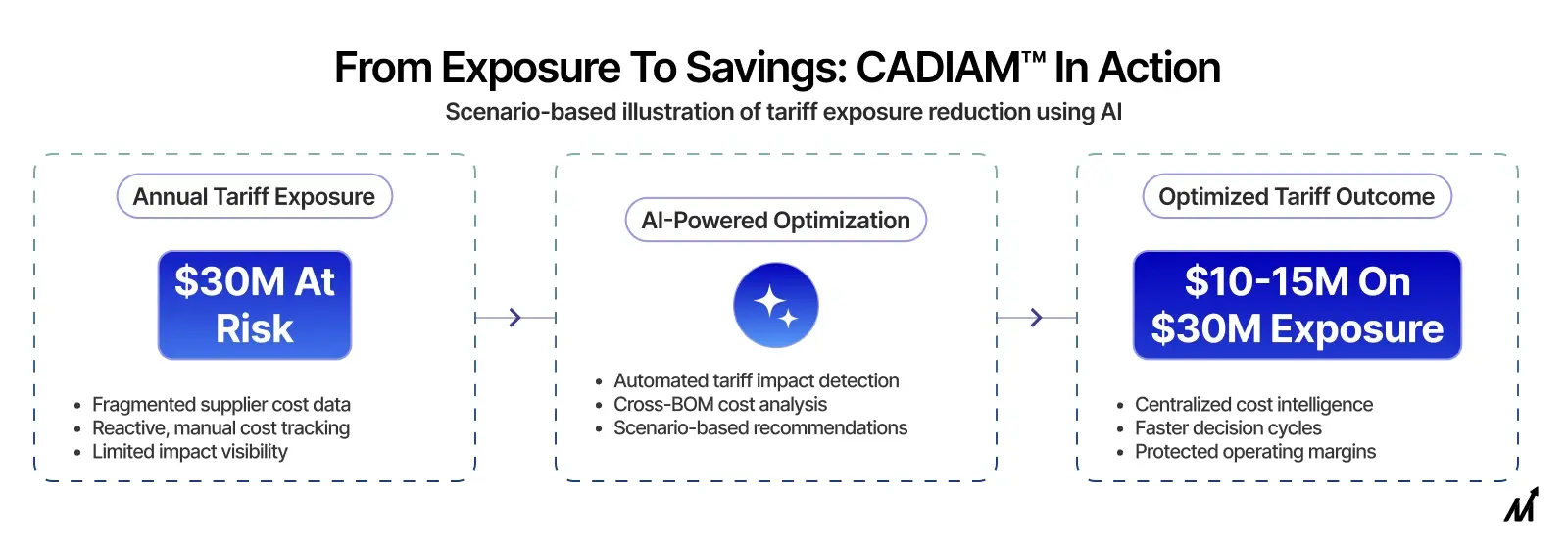
Scenario: Mid-size manufacturer importing $50M in components annually
| Metric | Traditional Approach | CADIAM™ Enabled | Savings/Impact |
| Tariff Exposure | $30M potential cost | Identify 40% of components for redesign/substitution | $8 – 12M potential savings |
| Analysis Time | 6 – 12 months | 2 – 4 weeks | 85% faster |
| Engineering Hours | 500+ | 50 | 90% reduction |
| Component Substitution | 5 – 10% Identified | 25–40% identified | 3 – 4x more opportunities |
| Supplier Qualification | 6 months | 6 weeks | 75% faster |
| Misclassification Recovery | Reactive audits | Proactive identification | 3–5% duty recovery ($900K–$1.5M) |
Key functions driving these results
Rapid Tariff Exposure Assessment
- Extracts materials from 10,000+ drawings in hours
- Identifies country-of-origin indicators
- Flags high-tariff parts for immediate attention
ROI Example:
“A customer with 15,000 parts identified $4.2M in exposure within 72 hours—analysis that would have taken 4+ months manually.”
Design-for-Tariff Optimization
- Identifies components with domestic alternatives
- Flags over-specified parts where simpler, non-tariffed materials work
- Prioritizes redesign by potential cost impact
Example for ROI:
“An aerospace supplier substituted 23% of tariffed components, saving $2.8M annually.”
Supplier Qualification Acceleration
- Generates complete, standardized technical specs for RFQs
- Identifies gaps slowing supplier approval
- Enables apples-to-apples comparisons
ROI Example:
“Qualification timelines reduced from 6 months to 6 weeks.”
Compliance & Classification Accuracy
- Ensures consistent tariff classification
- Creates an audit-ready documentation trail
- Identifies misclassified parts for duty recovery
ROI Example:
“3–5% of annual tariff spend recovered on $30M exposure = $900K–$1.5M.”
Real-world outcomes (anonymized):
- Automotive Tier-1 Supplier: 12,000 drawings analyzed in 5 days; $6.2M exposure flagged; 340 components substituted; projected savings $2.1M/year.
- Aerospace Components Manufacturer: 8,500 legacy drawings classified; 70% reduction in supplier qualification time; 15% misclassified components recovered; $890K duty recovery.
- Heavy Equipment OEM: 25,000 drawings analyzed; tariff impact dashboard by product line; 180 components prioritized for redesign; 2,400 engineering hours saved.
Strategic Takeaway
The competitive advantage does not come from predicting tariff policies, but from being structurally prepared. AI-enabled document intelligence allows manufacturers to:
- Quantify exposure across product lines
- Simulate alternatives and supplier options
- Prioritize redesign and substitution for maximum ROI
- Act decisively and proactively, rather than reactively
By transforming unstructured data into actionable insights, our AI blueprint classifier turns tariff management from a reactive challenge into a proactive strategic capability, protecting margins and enabling faster, smarter decision-making.
Assess Your Blueprint Readiness
See whether your engineering drawings and CAD data are ready to support faster tariff analysis, sourcing decisions, and redesign planning – using your own data, securely and confidentially.
Evaluate Blueprint Readiness Here!
Conclusion: Tariff Impact on Manufacturing Operations
Tariffs are no longer an occasional disruption for manufacturers; they are a recurring operating condition. Whether driven by trade policy shifts, geopolitical dynamics, or supply chain realignment, cost volatility is now part of the manufacturing landscape. The question is no longer if tariffs will affect operations, but how prepared organizations are to respond.
Traditional approaches, manual analysis, spreadsheet-based modeling, and reactive decision-making were not designed for this level of speed or complexity. As tariff changes ripple through raw materials, components, and global supply chains, these methods struggle to keep pace. The result is delayed insight, constrained options, and margin pressure that arrives before decisions can be made.
In this environment, data and AI are not about automation for its own sake. They are becoming operational necessities that enable faster understanding, clearer prioritization, and more confident action. Manufacturers can shift from reacting after costs are incurred to anticipating impact before it occurs by improving visibility into engineering data, supplier exposure, and cost drivers.
The manufacturers best positioned for the years ahead will not be those trying to predict the next policy change. They will be the ones investing now in adaptable systems, resilient supply chains, and decision-making capabilities that scale with uncertainty.
American manufacturing, and global manufacturing more broadly, has always evolved in response to disruption. Organizations will define the next phase of competitiveness by how quickly they turn insight into action before the next disruption arrives.
FAQs: Tariff Impact on Manufacturing Operations
Q1: How do tariffs specifically impact manufacturing compared to other industries?
Manufacturing faces higher exposure because it depends on imported materials, runs complex multi-country supply chains, and operates on thin margins that cost increases quickly erode. Long product development cycles also make rapid adjustments challenging.
Q2: Which manufacturing sectors are most exposed to tariffs?
Industries with high material intensity and global supply chains, such as automotive, aerospace, electronics, and heavy machinery, are most affected. For example, a single vehicle can include thousands of parts sourced from multiple countries, making tariff exposure both broad and complex.
Q3: Can manufacturers pass tariff costs directly to customers?
In most cases, passing the tariff costs in full is difficult. Long-term contracts, competitive pressures, and customer expectations limit the ability to transfer these costs, so manufacturers often absorb a significant portion of tariff increases.
Q4: How long does it typically take to switch suppliers due to tariffs?
Switching to qualified alternative suppliers can take several months, depending on component complexity. The process includes testing, documentation updates, and production ramp-up, which is often longer than the timeline of new tariff implementations.
Q5: How can AI help address tariff-related challenges?
AI allows manufacturers to automatically extract specifications from technical drawings, quickly analyze potential cost impacts, identify alternative suppliers, and monitor tariff classifications continuously. This reduces the time and effort required for decision-making compared to traditional manual processes.
Q6: What benefits can manufacturers expect from AI-driven tariff analysis?
AI enables manufacturers to identify redesign or substitution opportunities, prioritize sourcing decisions, and maintain compliance more efficiently. These improvements can significantly accelerate decision-making and reduce the operational burden of tariff management.
Q7: Where should manufacturers start when preparing for tariff volatility?
The first step is improving data visibility. Digitizing and structuring technical documentation, drawings, BOMs, and specifications lays the foundation for informed analysis. Once data is accessible, AI-powered tools can help quantify exposure and evaluate alternatives effectively.