







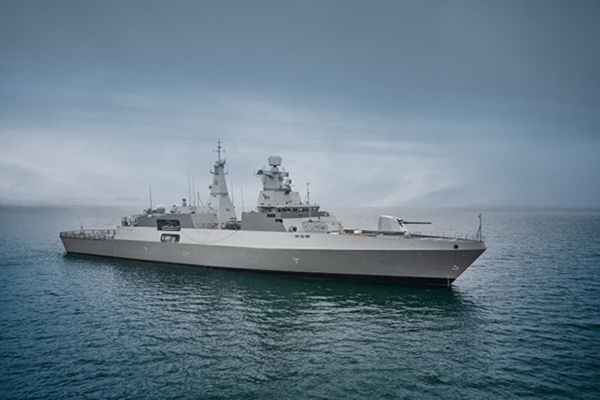
Following several weeks of speculation, the German government and shipbuilder ThyssenKrupp Marine Systems (TKMS) announced the conclusion of a preliminary agreement on Tuesday, Feb. 3, to build three MEKO A-200 frigates for the German Navy.
The decision came somewhat abruptly, as delays and technical issues have continued to plague Germany’s longstanding F-126 frigate acquisition, one of Berlin’s largest modern naval purchases. With the lead ship delayed by years, and the others not yet under construction, Germany faces the emerging risk of a capability gap in surface warfare ships at a time when it has committed to a broad-scale military modernization. The interim procurement from TKMS offers an opportunity for Germany’s largest shipbuilder and reveals the uncertain future of the German fleet.
The F-126
The F-126, or Niedersachsen, frigate, was conceived as a replacement for Germany’s aging F-123 Brandenburg class. A tender was issued in 2015, and in June 2020, a $6.12 billion (EUR5.5 billion) contract was awarded to the Netherlands’ Damen Shipyards for four ships. An option for two further vessels was exercised in June 2024, bringing the total ordered to six. Damen, partnered with German shipbuilder Blohm + Voss (a subsidiary of Naval Vessels Lürssen), beat out bids from BAE Systems and TKMS. The choice of a non-German prime contractor led to early criticism, with both industry and government officials concerned about the outsourcing of work.
TKMS’ non-selection for the F-126 project was widely perceived as a response to the company’s lackluster delivery on the earlier F-125 Baden-Württemberg frigate project, which also experienced delays and structural issues. The lead ship of the F-125 class was delivered overweight and with several technical problems in December 2017, resulting in the first-ever instance of the German Navy refusing to commission a delivered ship. The rejected ship was re-worked and re-delivered nearly two years later. While the full class of four was eventually commissioned, issues during the process marred TKMS’ reputation, likely impacting the subsequent F-126 selection.
By 2024, the Damen-led F-126 hit difficult waters. IT interfaces used in the design and manufacturing system reportedly had significant technical problems, slowing the process down considerably. To make matters worse, Damen ran into problems transferring vital construction plans and information to German partners, a problem that was only declared resolved in January 2026. The resulting backlogs have delayed the project at least three years, with some German lawmakers complaining that the Navy could not offer a firm operational date for the first ship.
Tensions between client and manufacturer escalated to the point of the German Ministry of Defense refusing Damen’s interim payments, which were planned to be tied to construction milestones that were not achieved. Blame for the issues had been laid, fairly or unfairly, at the feet of Damen Shipyards.
Resolving the Capability Gap
With the F-126 program in jeopardy, the German Navy risks a capability gap, a period between the retirement of the previous class, in this case, the aging F-123 Brandenburg class, and the introduction of the new platform. Such windows are considered glaring weaknesses, and typically either force a navy to engage in a hasty and often inefficient lifetime extension for aging, less capable vessels, or accept a period of diminished military capacity. In Germany’s case, the F-126 is optimized for anti-submarine warfare (ASW), a vital capacity currently undertaken primarily by the outdated F-123 class. Modernization will allow the F-123 class to remain operational into the mid-2030s, but its ability to support the German Navy’s advanced ASW requirements will gradually decline, making early replacement increasingly necessary.
The ASW function is particularly critical to Germany as it plans an ambitious modernization of its surface fleet. Within NATO, the German Navy is a key contributor to maritime security in the Baltic and North Atlantic, important areas of operation for the Russian Navy’s extensive submarine fleet. As Europe modernizes its military capabilities with an eye to an increasingly belligerent Moscow, capability gaps within the German surface fleet could prove a major weakness to continental security.
Given the F-126 delays, Berlin had several options to address the impending problem. Scrapping the project altogether, while still possible, would be a major sunk cost. Though clearly, relying entirely on a class of ships with a slipping delivery date was untenable. The idea of designating a new prime contractor from the German side was also considered, and Berlin has been in negotiations to transfer the leadership of the project to Naval Vessels Lürssen (NVL), currently a participant in the project, with Damen remaining a key partner. NVL is a local producer with the capacity for projects of this size and complexity that has experience with the F-126 project. Berlin is betting that this re-priming will improve project execution and facilitate an accelerated delivery timeline.
TKMS Capitalizes
The idea of interim procurement was floated for several months before TKMS announced the order for MEKO A-200 frigates. Berlin opted for a dual procurement of the F-126 under new leadership and the new interim class. The situation has proven advantageous to TKMS, allowing them to recapture some lost market share after the disappointing F-126 contract award.
The opportunity to deliver three new-build frigates brings in revenue for Germany’s largest shipbuilder, helps rebuild the company’s reputation with the German navy, and provides work for its MEKO production lines. If the F-126 program, reorganized under NVL, cannot right its course soon, an expanded MEKO frigate order may also be in the works. The failure of a foreign prime contractor to deliver as intended will also influence future contract awards from the German Navy to the benefit of domestic shipbuilders like TKMS.
Though the MEKO order is an undeniable opportunity for TKMS, it also risks several pitfalls for the company. The new ships, and any possible future units, will need to be delivered on time and without the structural issues that plagued the F-125 project. TKMS will be under pressure to differentiate the project from the disappointments associated with other recent and concurrent procurements.
While TKMS has an extensive industrial footprint, accepting a new major contract while also fulfilling prior commitments could overstretch its capacity and delay production. The company is responsible for numerous export orders as well as Germany’s planned F-127 air defense frigate program, meant to complement the troubled F-126. While the company has claimed the F-127 is on track, a new, quickly issued order for a larger class of MEKO A-200s may overburden its ability to deliver, threatening both the new interim procurement and the bigger-ticket F-127 project.
*****
Germany’s decision to procure MEKO A-200 frigates reflects the growing urgency created by delays in the F-126 program and the operational risks tied to maintaining anti-submarine warfare capacity during a fleet transition. While Berlin continues efforts to stabilize the F-126, the interim purchase underscores a pragmatic shift toward preserving near-term readiness and safeguarding NATO maritime commitments.
For TKMS, the order offers a critical opportunity to reassert itself as a leading supplier to the German Navy, but it also places the company under pressure to deliver on schedule while managing an expanding program portfolio. The success or failure of both the MEKO procurement and the recovery of the F-126 program will ultimately determine whether Germany can avoid a surface fleet capability shortfall in the coming decade.

Tom Freebairn is a weapons analyst with Military Periscope covering naval affairs and maritime systems. He pursued an undergraduate degree in International Relations and Modern History, followed by a master’s in Middle East, Caucasus, and Central Asia Security Studies from the University of St. Andrews. His master’s thesis focused on the relationship between oil and separatist politics in Northern Iraq. Tom’s interests include the politics of energy, ethnic separatism, the evolution of naval warfare, and classical history.







Discussion about this post