





From Marie Curie to the age of artificial intelligence, the story of women in science is a story of brilliance the world was not ready for. It is time we got ready.
In 1903, Marie Curie became the first woman to win a Nobel Prize. She had no proper laboratory. She worked in a converted shed. The radiation she studied would eventually kill her. None of that stopped her. Eight years later, she won a second Nobel, this time in Chemistry, becoming the only woman in history to win the prize in two different sciences. She did not wait for the world to be ready for her. She simply did the work.
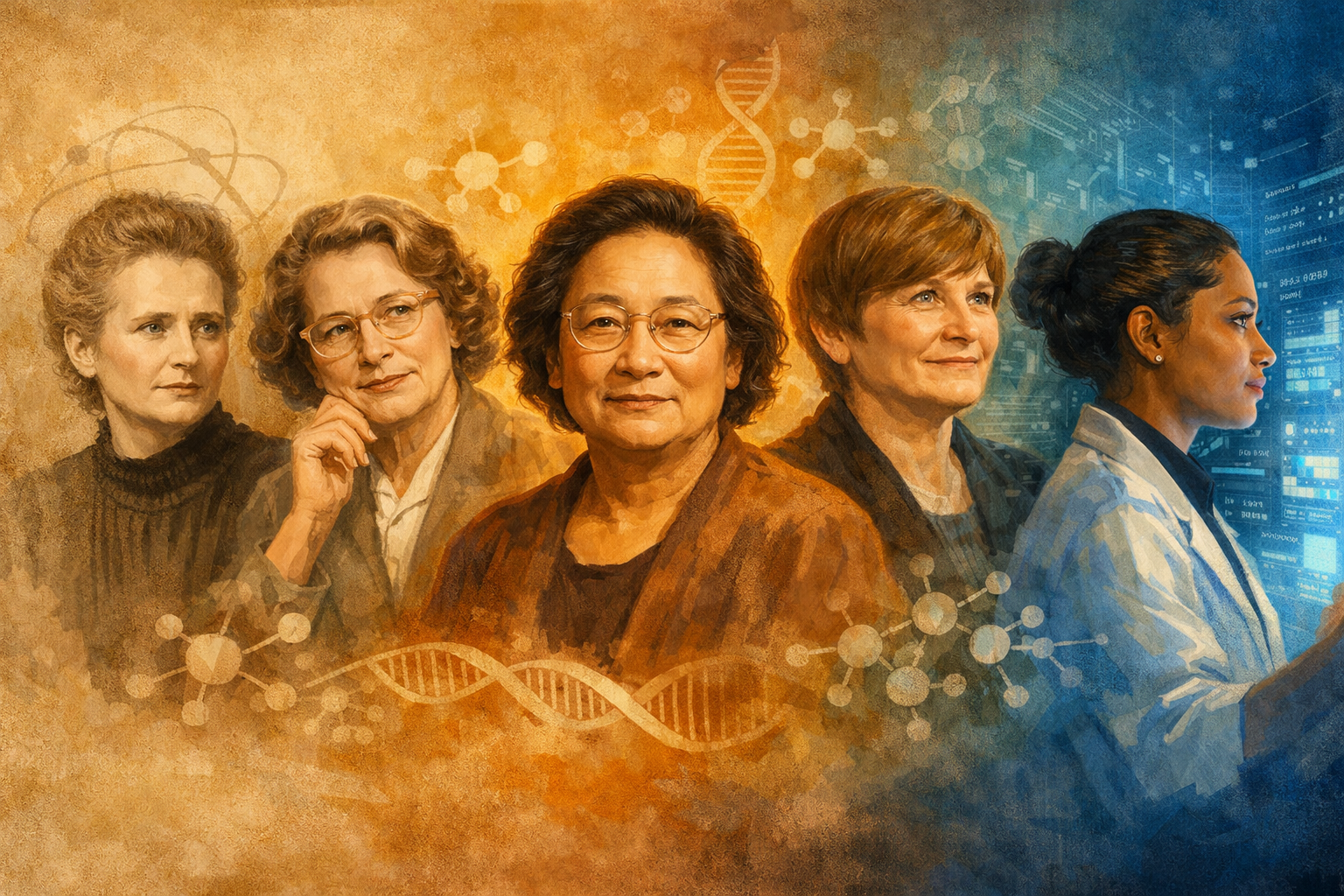
In the 125 years since the Nobel Prizes began, only 67 women have been laureates, compared to 894 men. In physics, the number is five. Five women in more than a century. And yet, look at what those five accomplished. Marie Curie decoded radioactivity. Maria Goeppert Mayer explained why some atoms are more stable than others, working for decades without a single paid position because universities would not hire a woman alongside her husband. Donna Strickland developed a technique for creating ultra-intense laser pulses that now powers everything from eye surgery to manufacturing. Andrea Ghez proved the existence of a supermassive black hole at the centre of our galaxy. Anne L’Huillier captured electrons in motion using attosecond light pulses, letting us see things that had been invisible since the beginning of time.
The pattern repeats across every category. Tu Youyou saved millions of lives by extracting artemisinin from ancient Chinese medical texts to fight malaria. She had no doctorate, no medical degree, no training abroad. She tested the compound on herself first. Jennifer Doudna and Emmanuelle Charpentier developed CRISPR gene editing, a tool that may reshape medicine for centuries. Katalin Karikó spent decades being demoted and defunded before her mRNA research became the foundation for the COVID-19 vaccines that saved the world.
These women did not succeed because the system supported them. They succeeded in spite of it. And that is the uncomfortable truth we must sit with on this International Women’s Day. The theme for 2026, chosen by the United Nations, is “Rights. Justice. Action. For ALL Women and Girls.” It asks us to look honestly at the gap between rights on paper and justice in practice. Nowhere is that gap more visible today than in the field that is reshaping every industry on earth: artificial intelligence.
Women make up just 22 percent of AI professionals globally. Only 12 percent of AI researchers are women, and in leadership the figure drops below 15 percent. The consequences are not abstract. A 2024 study found that 44 percent of AI systems exhibited gender bias. AI is now deciding who gets hired, how diseases are diagnosed, and whose loan application gets approved. When the people building that technology do not reflect the people living with its consequences, it encodes that absence into every decision it makes.
This matters in ways that are already measurable. Harvard Business Review found that female engineers who used AI for code generation were rated nearly 9 percent less competent than male counterparts, even when evaluators were looking at identical work. The technology is not neutral. It learns what it is taught, and right now it is being taught mostly by men.
But there is reason for hope, and it is arriving fast. Women’s adoption of generative AI in the United States has tripled over the past year, outpacing men’s growth rate. LinkedIn data shows that women listing AI engineering skills rose from 23.5 percent in 2018 to 29.4 percent in 2025. In Africa, 47 percent of STEM graduates from universities are women, a higher share than Europe, Asia, or North America. The pipeline is not empty. It is being blocked.
I see this in South Africa every day. We produce brilliant women in science and technology, and then watch them disappear. Women make up 39.5 percent of our ICT workforce, but in the rooms where AI strategy is decided, where policy is written, where funding is allocated, the chairs are overwhelmingly filled by men. Only 5 percent of ICT companies in this country are led by women. We are not short of talent. We are short of willingness to let that talent lead.
Marie Curie worked in a shed. Maria Goeppert Mayer worked without pay. Katalin Karikó was demoted and told her research was a dead end. Every one of them proved the world wrong. But we should not need women to be extraordinary just to be included. The goal is not to produce more exceptions. It is to dismantle the systems that make exceptions necessary.
On this International Women’s Day, the call is not just for celebration. It is for action. Fund women-led research in AI. Train girls in digital skills before the gap becomes a canyon. Put women in governance roles where AI policy is being written. And remember that every algorithm carries the fingerprint of whoever built it. If we want AI that is fair, we need the teams behind it to look like the world it serves.
Curie once said, “Nothing in life is to be feared, it is only to be understood.” The women who come after her, the researchers, the engineers, the builders, are still working to be understood. Let us make sure they no longer have to work to be seen.
Dr Zakia Salod is a medical AI research scientist, software developer, artist and philanthropist. Mail & Guardian Power of Women awardee 2024, STEMI category, youth leader and multi-awarded STEMI advocate in South Africa.









Discussion about this post