
A new New Zealand Medical Journal article on the Victorian phenomenon says a lot about medical anxiety and misinformation.
If you think modern technology is something only the current generation of human beings has ever needed to worry about, think again. Back in ye olde Victorian times, a new piece of technology took the world by storm and left some enlightened corners of the medical fraternity absolutely frothing with concern. That new technology was the bicycle – yes, the bicycle – and there was one particular issue that everyone – but in particular, women – needed to take very seriously: “bicycle face”.
Bicycle face was such a phenomenon that The New Zealand Medical Journal (NZMJ) recently published a paper about it. ‘Bicycle face: a timely reminder on discarded diagnoses in the age of anxiety’, by Robert E Bartholomew, Kate MacKrill and Emerson Bartholomew, looks at how in the 1890s, the popularity of this new technology provoked several years of medicalised warnings, aimed predominantly at women. “Bicycle face” was seen as a terrifying new nervous condition created by the constant stress of balancing a bicycle, and newspapers and magazines promoted it as a serious threat to women’s delicate beauty and wellbeing.


The NZMJ paper argues that rather than being based on any medical evidence, bicycle face grew out of technological anxiety, and aimed to create fear and division. The bicycle offered women a new level of freedom and independence, which meant they could hoon quickly away from restrictive gender norms. Those left behind became obsessed with how some people (ie, women) had the gumption not only to embrace new technology, but to move their faces while they did.
Was bicycle face actually a thing? You bet your Spokey-Dokeys it was. In 1903, The Nelson Mail credited a Dr Shadwell with inventing the famous phrase, and raised a question that cycle lane opponents have been asking ever since: has anyone on a bike ever been happy? “Has anybody… ever seen persons on bicycles talking, laughing, and looking ‘jolly’ in the same way as other amusements?” they asked. The strain and undignified tension of riding a bike risked permanent disfigurement – unless you jumped on a Red Bird bike, which promised to help its riders avoid the dreaded bicycle face.
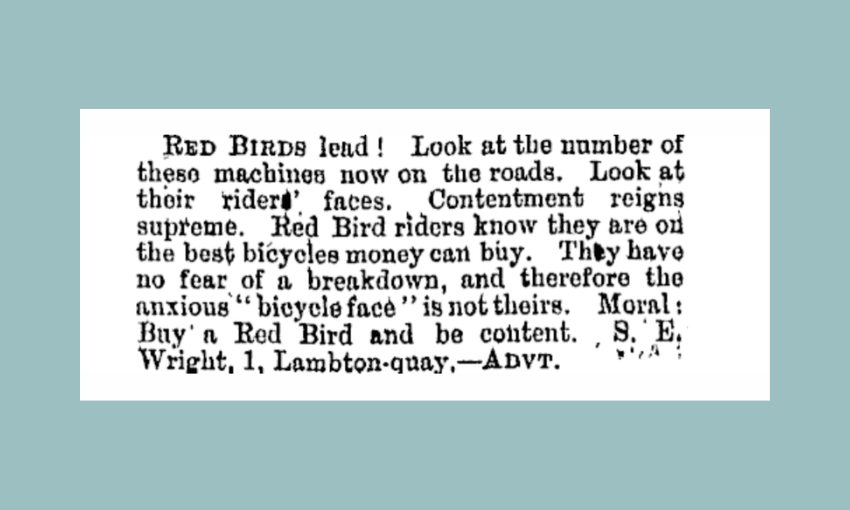
Bicycle face, it turned out, was just the beginning. “Bicycle hump” and “bicycle stoop” were the next wheel-related ailments that society needed to avoid, with concerns that the two-wheeled wonder was not only deforming women’s faces, but creating hunched posture and spinal deformities as well. An 1897 New Zealand Times ad even gave it an official name: Kyphosis Bicyclostorium.
As time went on and technology continued to advance, bicycle face rode off into the distance, its cavernous void filled by an endless list of more alarming afflictions. “Telephone ear” was mentioned in 1897. “Golfing voice” was a threat to Southland women in 1903, who after spending days galavanting loudly on the links, forgot to lower their tone indoors. “Automobile face” was reported in America in 1902 and by 1903, Dunedin’s Evening Star newspaper was warning over the perils of this condition, caused by driving at speed into evil wind and dust.
“Human eyes were never built for such strain,” the article grumbled. “Gradually they bulge out, half demonlike, streaked with blood and yellowed where they should be white.”
Worst of all was the nightmarish “card face”, a distressing condition caused by the stress of playing – save yourselves – bridge. The Auckland Star lamented in 1908 that pretty women who looked “no more than 25” when they sat at the table for a gangster game of cards quickly transformed into ruined hags, boasting a “pale, pinched, drawn, old look in their faces”. According to The New Zealand Times in 1905, symptoms of “bridgitis” included violent pains in the head, “particularly behind the ears”.
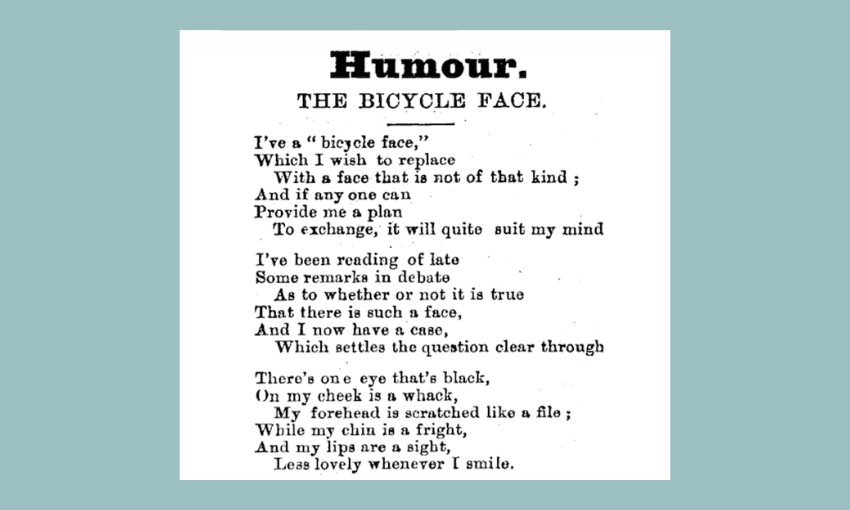
Of course, in the blessed year of 2026 when nobody gives a shit about how women live their lives, it’s easy to bulge your own demon eyes out at the misconceptions and hysteria of the late 1890s and early 1900s. But as the NZMJ paper notes, this technological anxiety still exists today – but rather than being shared through magazines and newspapers, our medical anxiety speeds through social media faster than a Victorian wife on a bike. The NZMJ paper mentions conditions like “wi-fi sickness” and “5G sensitivity”, where non-specific anxiety and physical symptoms have been misattributed to being caused by new and poorly understood technology.
But even the technology we understand today still manages to have a detrimental effect on our health and wellbeing by tapping into our ever-increasing insecurities. I don’t see any Botox ads, collagen-loss videos or cortisol stomach reckonings popping up on my husband’s social media algorithm, whereas mine is overflowing with them. Thanks to unqualified and misguided information on the internet, children now believe they need a multi-step skin care regime, women are encouraged to become smaller and smoother every day, and staring at our phones for the rest of our lives is about to make the human race evolve into a bunch of claw-fisted beasts with hunched backs and double eyelids.
What’s a middle-aged wrinkled crone with a cortisol stomach to do? Let’s just stay in our lane, ladies – as long as it’s not the bicycle lane.