
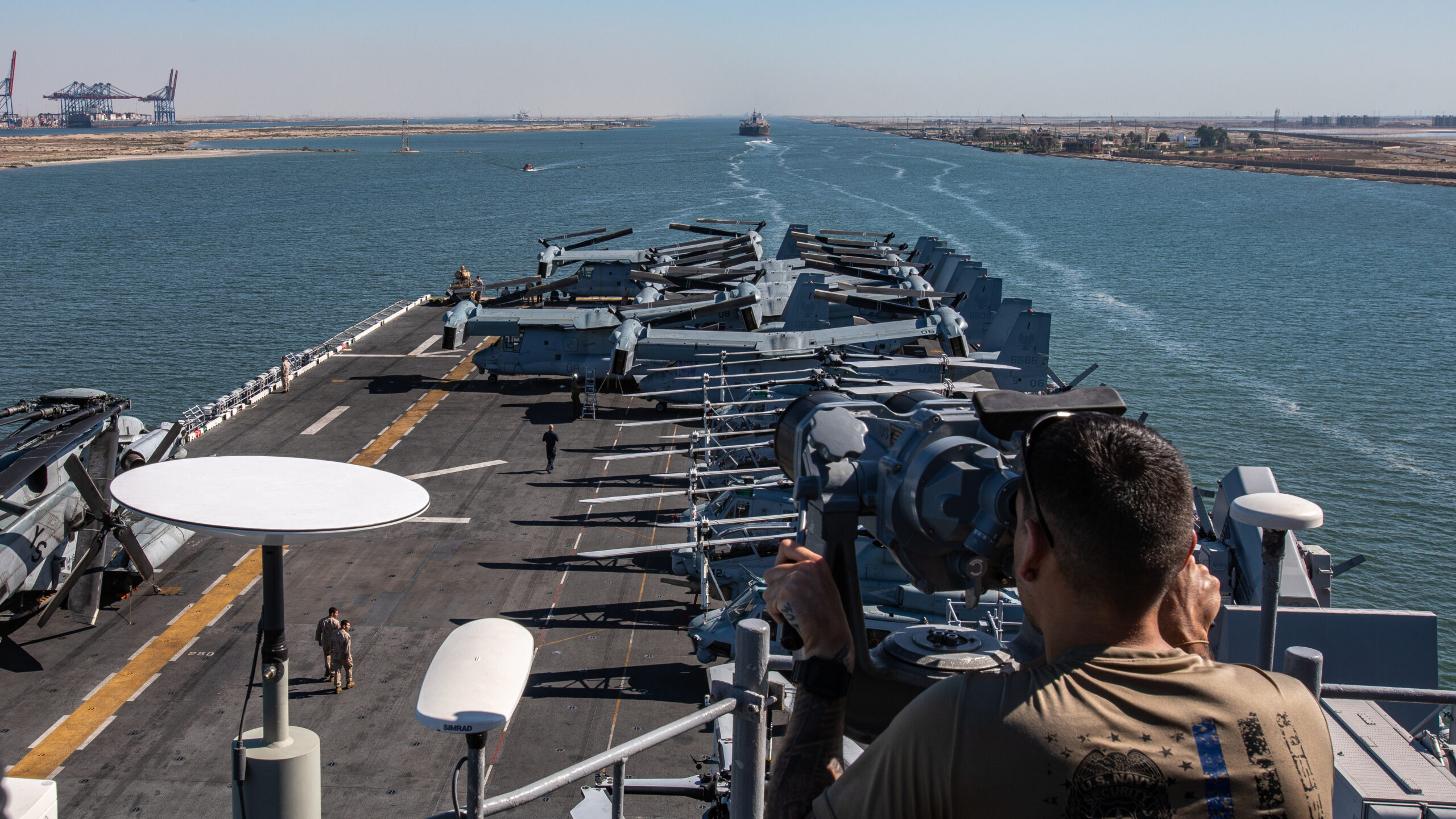
WASHINGTON — The Navy and the Marine Corps are zeroing in on amphibious warship readiness as a new board that aims to expedite progress and eliminate obstacles gets underway, according to the director of the Marine Corps’ operation division.
“We’re going to be identifying barriers to readiness, figuring out what levers we can pull to improve that readiness and make sure that we are managing and keeping an eye on the right metrics to make sure that we are increasing amphibious readiness,” Maj. Gen. Jason Morris said in an interview with Breaking Defense.
While amphibious warships and their readiness have proven a thorny topic for service leaders and lawmakers in recent years, with combat surge readiness lagging, the Navy and the Marine Corps say they are working in tandem to address a readiness shortfall that is gradually improving.
One way they’re working to do that is through the Amphibious Force Readiness Board (AFRB), which gathered for the first time Thursday and will continue to meet monthly to brief Secretary of the Navy John Phelan and the other service chiefs on challenges related to generating more ships, as well as maintaining and modernizing the amphibious fleet.
“If you don’t work on something day-to-day on a regular basis, sometimes it falls off the priority list, but this AFRB is going to put this [amphibious readiness] squarely in on the front burner of the service chiefs to make sure that they are keeping a laser focus on the issues, and that we are making forward progress,” Morris said.
An Amphibious Ready Group (ARG) typically includes an assault ship, a transport dock, and a support vessel that carry an embarked Marine Expeditionary Unit (MEU) of at least 2,200 Marines, ultimately composing what the Marine Corps refers to as an “ARG-MEU.” These forces are capable of completing missions ranging from humanitarian assistance, to amphibious raids and assaults. Meanwhile, the Navy is in charge of maintaining these vessels.
The Marine Corps seeks to maintain a 3.0 ARG-MEU presence that includes three three-ship ARG-MEUs, with one forward deployed from the East Coast, one from the West Coast, and another that is periodically dispatched from Okinawa, Japan. Marine Corps Commandant Gen. Eric Smith said in May 2025 that combatant commanders were requesting a 5.5 ARG-MEU (more than five three-ship formations) presence, but that the service could only provide 1.0.
As a result, Morris said that leaders like Secretary of Defense Pete Hegseth and Phelan have ordered the services to “do everything we can to get to a 3.0 MEU presence as quickly as possible.”
“So that will probably happen in the next few years, but we’re definitely under the guidance to accelerate that as quickly as possible, and find efficiencies and find best practices, and basically provide the oversight required to reduce particular readiness drivers,” Morris said.
Readiness drivers are obstacles like parts for ships that the services know need to be replaced on a routine basis. “We can address that readiness driver by buying more of those parts up front so they’re readily available on the shelves, so the maintainers can reinstall those parts when they go down,” Morris said.
Despite challenges meeting the 3.0 ARG-MEU presence, readiness is gradually improving and more ships are becoming available, according to service leaders.
Vice Chief of Naval Operations Adm. Jim Kilby told lawmakers on the Senate Armed Services Committee Wednesday that amphibious warships face a 53 percent combat surge readiness rate now — up from 42 percent last year when he testified. Still, that falls short of readiness goals, he said.
“I don’t feel good about that because our goal is 80 percent,” Kilby said.
Marine Corps Gen. Bradford Gering, the service’s assistant commandant, told lawmakers at the same hearing that he and Kilby — who both co-chair the Amphibious Force Readiness Board — are “completely aligned” on efforts to address amphibious readiness, and said that the board would assess how many amphibious ships the fleet needs. Current law dictates the Navy must maintain a fleet of at least 31 amphibious ships, but Gering predicted that more are likely necessary to meet demand.
“I would think it’s probably somewhere near 40, but we have to put more rigor into that analysis,” Gering said.
The condition of the Navy’s amphibious ships has faced increased scrutiny in recent years, and the Government Accountability Office found that half of the vessels were in “poor condition” in a report released in December 2024. The report pointed to challenges the Navy has faced maintaining these ships, citing issues with spare parts and canceled maintenance as contributing factors.
Lt. Gen. Jay Bargeron, the Marine Corps’ deputy commandant for plans, policies, and operations, said in a statement to Breaking Defense that the ARG-MEU is the “premier force” at the Marine Corps’ disposal to support combatant commanders.
“The current shortfall in amphibious warship availability is a risk to our nation’s ability to project power, respond to crises, and maintain deterrence in key maritime regions,” Bargeron said. “These ships are the cornerstone of naval expeditionary warfare, providing the global persistence and versatility required to defend the Homeland. This gap strains our readiness, reduces our operational tempo, and ultimately cedes initiative to our adversaries, who may perceive a lack of capability.”


Discussion about this post