






Kate
Green , Health Correspondent
Health NZ
knew cutting data and digital staff would increase risks to
patient care and hospital resilience, and require one-off
investment to mitigate, according to a newly released
internal document.
The report, titled End user impact
of digital change – consequences – was written in April 2025
and details the likely impact of a restructure which would
cut hundreds of IT positions. It was released to the PSA
union under the Official Information Act.
It said many
of the risks could be mitigated by investment and keeping
key staff in service desk, support and training roles – but
long-term risk remained.
“The long-term forecast for
these risks (i.e, with fewer people and less knowledge; and
with an ageing IT ecosystem) is that the risk rating will
almost certainly elevate as technical debt becomes
unsustainable and the modernisation/transformation required
to meet the future needs of the sector is delayed,” the
report said.
Those risks would need to be mitigated
further down the track, through further
investment.
Health NZ said because of the report, it
had built targeted mitigations into its plans for
change.
The changes came as part of a push
from the government to increase efficiency and cut
wasteful spending across the public sector, with departments
ordered to make savings of between 6.5 and 7.5
percent.
Advertisement – scroll to continue reading
In April last year, Health NZ confirmed
sweeping cuts
to a third of IT roles.
That would take data and
digital roles from 2000 to 1460.
There are currently
200 vacant positions.
Health NZ said before the change
process began in May last year the total number people
employed was 1412.
But, that did not take into account
the roughly 600 roles that were already vacant and not being
filled.
In the past two months, there were a number of
major IT outages – a six-hour
outage in the lower North Island in mid January, a 12-hour
outage at Auckland and Northland hospitals in late
January, and another
for those same hospitals in late
February.
According to the report, the proposed
changes would leave the system vulnerable.
It already
had low baseline resilience due to a lack of business
continuity plans, and “minimal” “hot failover” mechanisms –
that is, systems which automatically took over when a system
failed, without the input of a person, the report
said.
“It is important to note issues and risks
attributed to Digital Services are already present in our
environment due to legacy technologies, fragmentation and
increasing pressure from external threats, such as cyber,”
it said.
Despite the intent of the change being to
save money, the report said one-off investment would be
required to mitigate the risks cutting staff would create.
The report did not say how much that might
cost.
Regional and isolated sites, such as Rotorua,
Gisborne, New Plymouth, Whanganui, Masterton, Nelson,
Greymouth and Timaru, would be left more vulnerable than
others, due to losing staff who performed multiple
jobs.
Service desk calls had already progressively
increased over the past six months before the report’s
writing “due to staff attrition and the pause on
hiring”.
“This trend is expected to tick upwards post
restructure with an estimated average wait time of approx. 2
minutes per caller. Call abandonment times (i.e., staff
hanging up), are also anticipated to increase from a current
rate of 15 percent to 19 percent post-restructure, under the
current proposal.”
Due to the reduction in staff
resolving incidents and service requests, total call numbers
were expected to increase under the proposal, exacerbated by
an increase in callers checking on the status of their
requests.
The report said a number of Hauora Māori
organisations, community services and NGO sites would be
left unsupported, as they currently received outreach and
support from Health NZ Digital Services, but did not have
formal agreements in place – for example, Te Puia Springs in
Tāi Rāwhiti.
“Post-change Digital Services will not
have ability to flex services to meet the needs of these
types of stakeholders,” it said.
PSA says more
outages and data breaches will follow
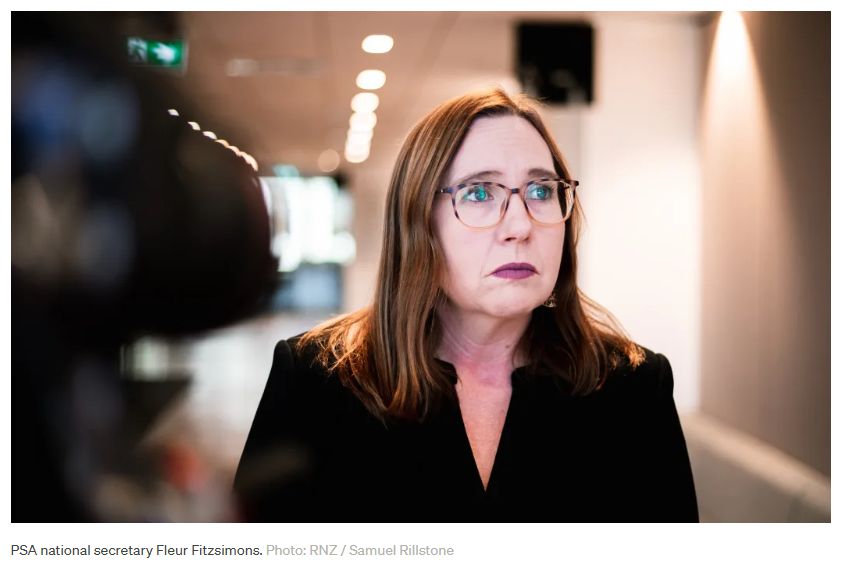
PSA
national secretary Fleur Fitzsimons said the document was a
crystal-clear warning that reducing people would lead to
increased clinical risk – and that was ignored in the
restructure.
Health NZ and the minister ignored
internal warnings about how the impacts of the downsizing,
she said.
“In recent months we have seen the
consequences of this rushed, ill considered drive to meet
the government’s arbitrary funding cuts at a time when
public health was already facing a funding crisis,” she
said.
“Make no mistake, the risks to cuts in data and
digital were well understood by Health New Zealand and
should never have occurred.”
Health NZ says it is
managing the risks
In response to questions from RNZ,
Health NZ’s acting chief information technology officer
Darren Douglass confirmed the report had identified that any
reduction of that scale would carry risks if not actively
managed.
“That is why targeted mitigations were built
into the final proposal, including prioritising critical
clinical systems, retaining additional operational support
roles, strengthening regional digital leadership, and adding
funded transition roles to support frontline services,” he
said.
Health NZ was still transitioning to the new
ways of working and was still making changes to risk
management, he said.
The organisation had many
different systems working in different parts of the country
so did sometimes experience “technical
issues”.
“Fortunately, the majority of incidents are
resolved quickly. We also have well-established
contingencies in place to manage issues when they arise, to
ensure patients continue to get the care they
need.”
© Scoop Media

New Zealand’s public broadcaster, providing comprehensive NZ news and current affairs, specialist audio features and documentaries.
Radio New Zealand is a Crown entity established under the Radio New Zealand Act 1995. Radio New Zealand News are vital elements in our programming, providing impartial news and information to New Zealanders every day. Radio New Zealand (RNZ) provides listeners with exciting and independent radio programmes in accordance with the Radio New Zealand Charter.









Discussion about this post