
China’s early economic reforms, led by Deng Xiaoping in the late 1970s, are frequently cited as the main basis for comparison when it comes to North Korea’s economic improvement measures implemented by Kim Jong Il and later continued by Kim Jong Un. However, despite certain institutional similarities, head-to-head comparisons are deceptive. To understand North Korea’s current economic structure, it is first necessary to examine the original socialism of the Soviet Union upon which the North Korean system was built, as well as the ideological transformations that emerged following the collapse of the Soviet Union and the Eastern Bloc.
After World War II, North Korea emerged under Soviet patronage as a communist state modeled closely on the Stalinist system. Kim Il Sung established a regime grounded in centralized authority, state ownership, and party-led control over economic and social life. North Korea’s early political and economic structure closely mirrored what Hungarian economist János Kornai later identified as the defining characteristics of socialist economies.
In Kornai’s classical framework, socialist systems rest upon five interconnected pillars that together sustain the structure and functioning of the socialist state.
First, the communist party. A pure socialist economy is a centralized one-party dictatorship grounded in a political ideology centered on class struggle and the establishment of a proletariat dictatorship. The ruling party monopolizes political authority and directs all major aspects of state and social life.
Second, nationalization of the means of production. Socialist systems depend upon the elimination of private ownership over the means of production. Influenced by the theories of Karl Marx and Friedrich Engels, socialist states seek to abolish capitalist ownership by transferring factories, land, resources, and major industries into state control in order to eliminate exploitation and unequal distribution of wealth.
Third, central planning. Once ownership is concentrated in the hands of the state, economic activity is organized through central planning. State authorities, rather than market forces determine production targets, resource allocation, pricing, and distribution. This allows the government to monopolize economic decision-making processes.
Fourth, a rationing system. The distribution system functions not only as an economic mechanism, but also as an instrument of bureaucratic and political control. Access to goods, resources, and employment is administered by the state, reinforcing dependence upon central authorities.
Fifth and finally, totalitarianism. Socialist systems tend to evolve into highly totalitarian structures characterized by extensive state control over political, social, and ideological life. Through surveillance, censorship, indoctrination, and coercive institutions, the state seeks to regulate not only the actions of its citizens, but also their education, movement, and thought.
Kornai argued that a change in at least two of these pillars would constitute a reform of the socialist system. However, sustained economic development requires fundamental change in two of these pillars: first, a transition in the ownership structure from state ownership to private ownership, which must be preceded by the second pillar – the renouncement of class struggle ideology.
All socialist economic systems eventually confronted this structural constraint. None remained unchanged. Kazakhstan and other post-Soviet states dismantled the socialist economy and moved toward full-fledged market systems.
China retained its one-party system with the exclusive rule of the Communist Party, but revised other core features of classical socialism, particularly exclusive state ownership, central planning, the rationing system, and class struggle ideology, thereby creating socialist market economy based on mixed ownership, market incentives, and continued party control.
North Korea, however, followed a third path. It preserved juche ideology and the formal attributes of socialism while tolerating informal markets. Within this hybrid system, individual economic activities and business entities came to be largely permitted through “benign neglect” as a mechanism of survival. This represented neither a full market transition nor Chinese-style market socialism.
In theory, the Workers’ Party of Korea remains formally at the center of power, yet it now operates under the absolute authority of a supreme leader. The means of production are still officially state-owned, but this ownership exists largely in name. The state increasingly functions as a rentier, informally leasing parts of its industrial apparatus to private actors operating within a technically illegal, yet widely tolerated, informal economy.
Meanwhile, two of Kornai’s defining pillars, centralized economic planning and bureaucratic rationing, effectively collapsed during the crisis of the 1990s and were never fully restored. The remaining pillars, including the monopoly of the ruling party, state ownership in formal legal terms, ideological orthodoxy, and totalitarian governance, remain firmly intact. The result is a system that preserves the totalitarian shell of socialism while operating through a distorted hybrid logic.
China and North Korea: Different Systems, Different Results
Unlike China under Deng Xiaoping, even referring to the term “reform” (개혁), which implies that there are defects in the system, is strictly prohibited in North Korea. Instead, terms such as “improvement” or “enhancement” (개선) are used by the regime, which implies adjustment without questioning the legitimacy of the existing system.
The Chinese and North Korean experiences further diverge in that China’s reforms ultimately involved adapting its ideology and allowing forms of private ownership to emerge. The process was politically difficult, but the socio-political upheaval emanating from the Cultural Revolution created conditions in which the leadership, under Deng Xiaoping, could demonstrate that rigid ideological obsession had precipitated severe poverty, economic stagnation, and widespread suffering. Thus, China’s leadership shifted legitimacy from revolutionary purity toward economic performance.
There are two major differences between the North Korean and Chinese reforms. For instance, in the late 1970s, China phased out the collective farm system. Although land formally remained collectively owned, production responsibilities shifted to individual households. As Kevin Gray and Jong-Woon Lee noted, “full official acceptance of the new household responsibility system (HRS) was finally given in late 1981, by which time 45 percent of production teams had already been dismantled. By the end of 1983, 98 percent of all production teams had adopted the HRS.”
Farmers gained direct incentives to increase productivity because output became tied to household benefit rather than collective quotas alone. This fundamentally changed the incentive structure of rural production and gradually transformed broader ownership relations within the economy.
Deng understood that the socialist “cat” cannot “catch mice.” China’s leadership did not abandon authoritarian control, but it shifted the source of political legitimacy away from revolutionary purity and toward economic benefits. North Korea, on the other hand, operates under different political conditions. The legitimacy of the state is tied not only to the ruling party, but also to the personal power and sovereignty that originated from the Supreme Leader, Kim Il Sung. In this context, introducing systemic market-oriented reform faces an insurmountable barrier that requires repudiating parts of the ideological foundation, namely the juche ideology, founded by Kim Il Sung. This makes the political and ideological implications of reform in North Korea considerably more complex than those faced by China during its reform period.
In Pyongyang, the state introduced what it called the “Field Responsibility System,” where collective ownership structures still remained intact. Gray and Lee explicitly noted that the May 30 measures “did not dismantle the collective farm units themselves, in contrast to China, where the People’s Communes were abolished in 1982.” Unlike in the case of China, only Kim Jong Un himself can authorize reform in North Korea because viable market reform directly entangles with the ideological legitimacy of the regime. Reform is therefore not simply an economic question, but also an ideological and political one.
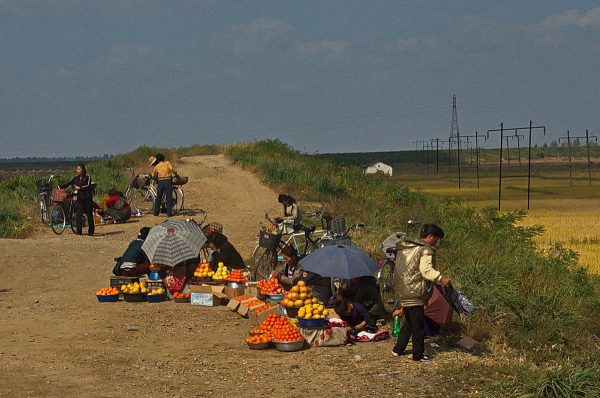
North Korea’s economic system since the collapse of the Soviet Union has continued to evolve. The disintegration of the rationing system and the collapse of centralized planning forced the state to acquiesce the spread of market activities that would previously have been unacceptable. Subsequently, informal markets expanded, as state property was leased in practice, and individuals increasingly engaged in semi-private economic activity. Yet these developments were largely reactionary rather than systemic reforms. While China’s reform was led by top down policy, North Korea was a case of marketization from below.
The differences in economic trajectory between North Korea and China are therefore significant. The disintegration of planning and rationing in North Korea should not be mistaken for genuine reform. In China, reform was politically authorized and gradually institutionalized; in North Korea, marketization emerged first as a survival response to state failure. North Korea’s economy has therefore moved far beyond classical socialism in practice, but without formally legitimizing private ownership, market autonomy, or ideological revision. Much of its economic activity today functions outside the framework of classical socialism, while the state continues to preserve the formal language and symbols of socialist orthodoxy. Markets operate, but official ownership structures remain unchanged.
For North Korea to achieve sustained and robust economic development, it would ultimately have to trade its nuclear weapons program for a comprehensive package deal negotiated through the framework of the Six-Party Talks. Such an agreement would need to include the lifting of both U.S. and U.N. sanctions, alongside the termination of American military threats against North Korea. It would also require binding security guarantees, including a formal peace treaty between North and South Korea, the normalization of diplomatic relations with the United States and Japan, and the reaffirmation of existing security arrangements with Russia and China. Equally important, the package would have to provide sufficient economic development funds to support the modernization of the North Korean economy over the next decade, with the objective of achieving annual growth rates of 10 percent or more. These measures would constitute the necessary conditions for economic transformation and regime survival.
Yet external guarantees and economic assistance alone would not be sufficient. For North Korea to translate such an agreement into meaningful development, it would also need to abandon the juche ideology as an organizing principle and implement market-oriented economic reforms. The current system survives largely through military provocations and internal repression, while the spread of jangmadang markets has steadily eroded the regime’s socialist legitimacy. Without structural reform, the socialist economy will continue its gradual decline.
At the same time, reform carries major political risks, as it could undermine the ideological legacy of the Supreme Leader. To offset these risks, the benefits of reform would have to clearly exceed its political costs by securing regime legitimacy, ensuring the long-term survival of North Korea, and lifting millions out of poverty. This would require robust sustained, dynamic, economic growth, surpassing the peak growth rates once achieved by Taiwan, Singapore, or China, in order to generate broad public support and visibly improve living standards.


Discussion about this post