
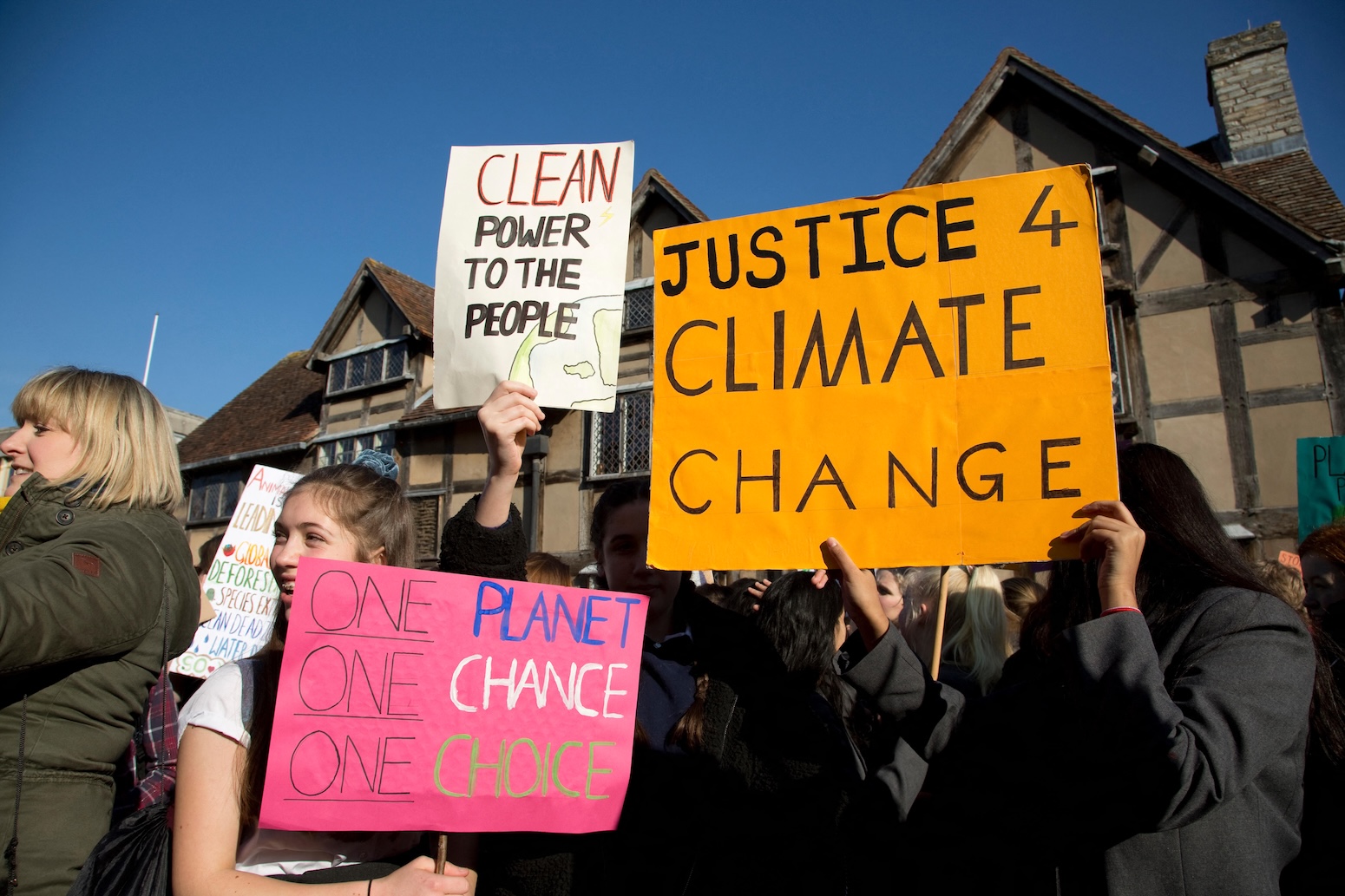
The general public often underestimate support for climate action, while overestimating the real-world actions taken by other people to address the problem, according to new research.
The study, published in Nature Climate Change, explores the differences between people’s support for climate change, their behaviour and their assumptions about other people’s behaviour.
It is based on multiple surveys of more than 5,000 people across Germany and the US.
The study expands on previous research on how the general public systematically underestimate the climate commitment of their peers.
The difference between actual and perceived support for climate action among the public is sometimes known as a “perception gap”.
The surveys tested how people’s perceptions of climate attitudes and behaviours relate to their own willingness to contribute and undertake “climate-friendly” actions.
One of the authors tells Carbon Brief that this perception gap is not due to “ignorance or bias”, but because “people are just not good at making good estimations”.
The research also reveals that people’s opinions and behaviours are more “nuanced than previously assumed” and suggests that simply “correcting misperceptions” does not automatically lead to greater climate action.
Measuring climate actions
The study notes that correcting the perception gap is often seen as a “cost-effective” way to promote public engagement and drive action to reduce the intensification and impacts of climate change.
Most studies that explore the perception gap have primarily focused on surveys that have asked people to report their willingness to support climate change.
In other words, researchers have relied upon people saying they would support efforts to tackle climate change, rather than measuring people’s real-world actions, such as financial donations, attending protests or changing their behaviour.
To fill this gap, the researchers behind the new study surveyed a total of more than 5,000 people in Germany and the US over 2024-25. Surveys were split across five different experiments, each focused on public perceptions of climate attitudes and how they relate to individuals’ actual behaviour:
| Experiment | What they did |
| Survey one | Participants were asked if they were willing to donate 1% of their household income to WWF – and then were given the chance to do so. Follow-up questions asked participants to predict how many of their peers said “yes” and how many actually donated to the charity. |
| Survey two | Participants read a constitutional complaint against the German government, led by Greenpeace, which demands for stricter climate policies. They were asked if they were willing to participate as a claimant and/or donate to the cause – and then were given the chance to do so. Follow-up questions asked participants to predict how many of their peers said “yes” and how many went on to support the complaint. |
| Survey three | Participants were requested to complete an online “work for environmental protection task” where the more “pages” they completed resulted in more donations to WWF. They then predicted how many pages their peers completed. Participants also rated their individual behaviours and support for eight climate policies and then estimated the same for other people. |
| Surveys four and five | Participants were split into three groups that were either informed that 4% of participants had donated 1% of their household income to WWF, that “68% were willing to contribute” or given no information. They then had to state whether they were willing to support WWF and then were given the opportunity to do so. |
The authors note that Germany and the US are two of the “top 10 CO2 emitters” and are places where climate action is “especially necessary”. However, they add that the two countries are not reflective of “diverse cultural contexts” and further research is needed across the world.
The perception gap
The researchers find that most of their participants supported climate action, but much fewer actually performed verifiable behaviours.
For example, survey one finds that 37% of participants said they were willing to donate to WWF, yet just 4% did when given the opportunity.
Participants generally overestimated the climate actions of their peers, predicting that 23% of other people donated. Willingness, on the other hand, was slightly underestimated with respondents averaging around 34%.
The results from survey three suggest that this perception gap is likely due to general cognitive processes within the human brain that make accurate estimations about large groups difficult, say the authors.
The chart below shows the actual percentage of people who supported different environmental policies and performed climate-friendly behaviours (blue dots) compared to average predictions from the surveys (red dots).
They reveal a “consistent pattern” where “small proportions were overestimated and large ones were underestimated”, the authors say, driving predictions towards the middle. This phenomenon is known as “regression to the mean”.
In other words, where public support for a policy was high, participants in the survey estimated it was lower than it was. When the support was lower, estimates would be higher.
The study finds that individual and environmental factors played a role in shaping people’s perceptions of their peers’ climate actions, which were distinct from general misestimations.
For example, people who were already involved in climate action, had more frequent climate discussions and consumed more climate-focused news and media predicted a higher proportion of climate support “across the board”.
The results from the fourth and fifth surveys show that knowing the context of other people’s beliefs and behaviour in surveys can impact the attitudes of participants.
Participants that were told that 68% of people were willing to donate 1% of their household income to the WWF were more willing to donate.
In contrast, participants that were told that 4% of people actually donated did not report more willingness to “discuss climate change, sign petitions or donate” than the control group.
However, there was no obvious impact on actual donations for any of the three groups, the study notes.
Lead study author Dr Kevin Tiede, scientific managing director of the Institute for Planetary Health Behaviour at the University of Erfurt, tells Carbon Brief that the findings suggest that “just telling people how many people support climate action is likely not enough to really change something”.
However, Tiede adds that “direct comparability” between people saying they would donate and actually donating is “limited” and that giving people more time to answer and autonomy over where to donate might result in more people taking action.
‘Pluralistic ignorance’
Tiede explains that the study findings demonstrate the existence of “pluralistic ignorance”, where a person believes their own views differ from the majority.
For climate change, this means that the “vast majority of people around the world support climate action, but people considerably underestimate the extent of this support”, the study says.
However, the surveys reveal that pluralistic ignorance “in the climate domain” is more nuanced than previously thought, say the authors.
Prof Madalina Vascleanu, an assistant professor at Stanford University’s Doerr School of Sustainability, who was not involved in the study, tells Carbon Brief that encouraging climate action is complex.
It may take multiple and repeated “attempts” at effective communication, or for people to directly “experience” the “norm” that climate change is widely supported, she says, rather than simply being told.
“Observable” behaviours, such as “identity signalling” – which could involve anything from protesting to vegetarianism – might have more of an impact on encouraging climate action among peers than “private behaviours like donations”, she adds.
The study is a “great addition to the literature”, Vascleanu says, because “correcting” the perception gap did not have an effect on climate-friendly behaviour, as “scholars had previously assumed”. She adds that it has “sparked several new hypotheses” that her “lab is now working on”.
Prof Mauro Bertolotti, associate professor of social psychology at the Università Cattolica del Sacro Cuore, explains that the “attitude-behaviour gap” revealed by the research is a “rather common finding”.
However, he is “sceptical” of the “simplified and abstract” measures, warning that experiment environments often come with “assumptions and expectations” that are different from real life.
As a result, they might not “replicate” the process people go through when choosing to “make a donation to an environmental cause”, he says.
‘Targeted’ communication strategies
The researchers argue that it is more effective to focus on “targeted” communication strategies – encouraging climate-friendly behaviours that aim to reach the majority who already support climate action, rather than trying to convert climate sceptics.
They call for attention to be paid to the attitude-behaviour gap between people saying they support efforts to tackle climate change and following up with real-world climate actions.
The study suggests strategies for decision-makers to reduce the attitude-behaviour gap, such as “facilitating climate-friendly behaviour” with “convenience and subsidies”. They also recommend ensuring environmental policy prioritises fairness to gain visible and widespread public support.
They add that the public would benefit from understanding the “effectiveness and co-benefits” of climate action.
Tiede, K.E. et al. (2026) People systematically under- and overestimate public engagement in climate action, Nature Climate Change, https://doi.org/10.1038/s41558-026-02668-z
Scientists are ‘most trusted’ source of climate information in global-south survey

Survey: ‘Very few’ Africans place responsibility for climate action on ‘rich nations’
Guest post: How public attitudes towards ‘CO2 removal’ differ in the UK and US



Discussion about this post