
In 2015’s “Jurassic World” — the first of the “Jurassic Park” franchise’s largely interminable bastard step-children — there’s a moment of action that briefly suggests the film might exist for reasons other than to extend its source material and make oodles of cash. In the scene, which occurs just as things fall apart (as they always seem to do in these films), dinosaurs break loose and attack all of the theme park’s patrons.
In the ensuing chaos, a woman is snatched up by a flying Pteranodon and swooped into the air, where others of its species take turns throwing her between their beaks. She’s then dropped into the water, where the winged creatures swarm her once more. Just as the dinosaurs pluck her out of the depths, a Mosasaurus leaps from the water and swallows both the woman and the dino attacking her. It’s downright cruel and undeniably entertaining. But namely, this sequence of dino-terror suggests that “Jurassic World” might actually provide audiences something they’d sorely lack for the next decade: fun.
That was, of course, not the case. In the years that followed, three more “Jurassic World” films saw the light of day, and none of them came close to reaching that first movie’s brief, brutal height. A swath of other summer blockbusters would be released alongside them; A “Spider-Man” here, a “Mission: Impossible” there. But finding a popcorn movie that could entertain beyond nostalgia alone was rare. (Though not entirely inconceivable.) Perhaps, in an ironic twist of fate, the truly original summertime creature feature went extinct before the onscreen dinosaurs could.
(Warner Bros. Pictures) “The End of Oak Street”
Audiences seldom get to experience summer fun at this caliber anymore. But as depressing as that may be, “The End of Oak Street” could very well be a blueprint for a fresh era in popcorn movies. They might not make ‘em like this anymore, but that doesn’t mean they can’t.
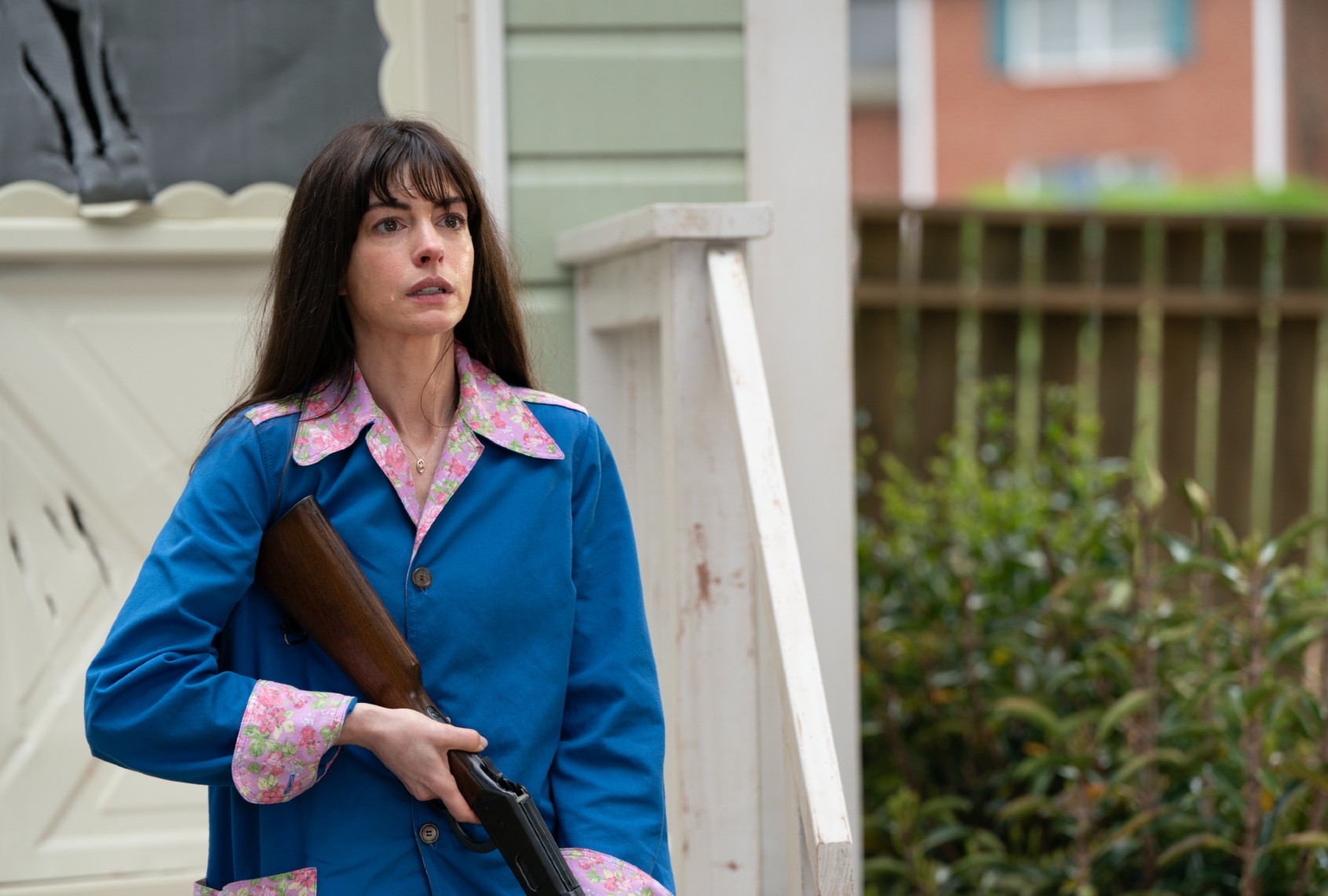
Cue Anne Hathaway, stepping into frame sensible sandals first, pointing a shotgun at her own ancient adversary in David Robert Mitchell’s delightful “The End of Oak Street.” That alone is the kind of image powerful enough to make any viewer believe that mainstream cinema is still kickin’. Everything that follows is simply further confirmation.
Mitchell’s film, which follows a family of four in 1982 as they realize their entire quaint suburban neighborhood has somehow been transported back to the Mesozoic era, has understandably swept audiences off their feet. “The End of Oak Street” has everything a viewer could want — especially a viewer fatigued by the Hollywood sequel system and all its shortcomings. There’s action, romance, suspense, creatures, creatures having sex, large piles of excrement, interdimensional portals, pizza, a comical amount of split-diopter shots, and what looks to be a pleasantly well-funded public library. What’s more, Mitchell’s film is feisty and unpredictable, always managing to stay one step ahead of the viewer.
“The End of Oak Street” has all the elements that Hollywood studio executives love to pluck from box-office hits of the past in their never-ending attempts to Frankenstein a decent modern blockbuster out of spare parts. Yet, here, there are no visible stitches, no scars or seams. Mitchell’s film succeeds where others have failed because it runs on its feelings rather than its features. It’s still pastiche, but unbeholden to the nostalgia-obsessed, highly referential style that has plagued so much contemporary media, like “Stranger Things,” “Super 8” and “Wonder Woman 1984.” The more Mitchell conjures joy and fear from thin air with the snap of his fingers, the more frustrating it becomes that audiences seldom get to experience summer fun at this caliber anymore. But as depressing as that may be, “The End of Oak Street” could very well be a blueprint for a fresh era in popcorn movies. They might not make ‘em like this anymore, but that doesn’t mean they can’t.
But that will require some convincing. For a few years now, studios have had it in their heads that the ideal way to merge art and commerce is to hire stylish, auteur-minded filmmakers to helm their franchise movies. Think Chloé Zhao taking on Marvel’s “Eternals,” or Amazon MGM tapping Denis Villeneuve to pilot “James Bond” into its next era. By and large, this formula has not worked because studios demand accessibility, even from the artistes. That cool camera setup isn’t worth it because viewers don’t care about that kind of stuff, executives say. Unless you’re Steven Spielberg, with enough money and success to have final-cut privilege, everything in a franchise blockbuster is bound to look flat, feel drab, and be nauseatingly overexplained.
That’s a big part of why “The End of Oak Street” feels like a break in the pattern from the jump. Mitchell is the film’s sole screenwriter and director, working with a clear reverence for the kinds of story-first features produced under Spielberg’s Amblin Entertainment label — the kinds of movies that sprang from big, bold ideas, not financial bottom lines. The story has elements similar to popular summer blockbusters, but they’re so finely remixed and retooled that they don’t bear such exhausting resemblance to their forebears.
Want more from culture than just the latest trend? The Swell highlights art made to last.
Sign up here
Perhaps best of all: The movie has a gritty, charming meanness to it; a stickiness that’s hard to shake off. Where “Jurassic World” balked at doubling down on its single cruel sequence, “The End of Oak Street” has at least 10 stomach-dropping thrills. With a PG-13 rating that gets away with quite a bit, the action harkens back to the days of “Poltergeist,” a PG-rated film that had whole families walking out of the theater traumatized and silent. “Poltergeist” was, notably, a summertime Amblin release that similarly riffed on classic creature scares — updating dusty, old ghost tropes with new ideas — much like Mitchell does with his dino-time-travel extravaganza.
But Mitchell wants you to make those correlations, too. When the film opens at Oak Street’s idyllic summer block party, complete with cookouts and kids happily pedaling together on their bikes, he purposefully evokes the atmosphere of the movies he covertly cites. There’s some bickering between the Platt parents, Denise (Hathaway) and Greg (Ewan McGregor), that their kids, Brian (Christian Convery) and Audrey (Maisy Stella), pick up on. But Mitchell cleverly avoids setting any tone in stone. When a storm followed by a flash of blinding light sends their house and the surrounding neighborhood back in time, the entire Platt family quickly understands that they’re in deep sh*t — or, more precisely, dinosaur feces, of which a large amount has accumulated in the neighbor’s backyard.
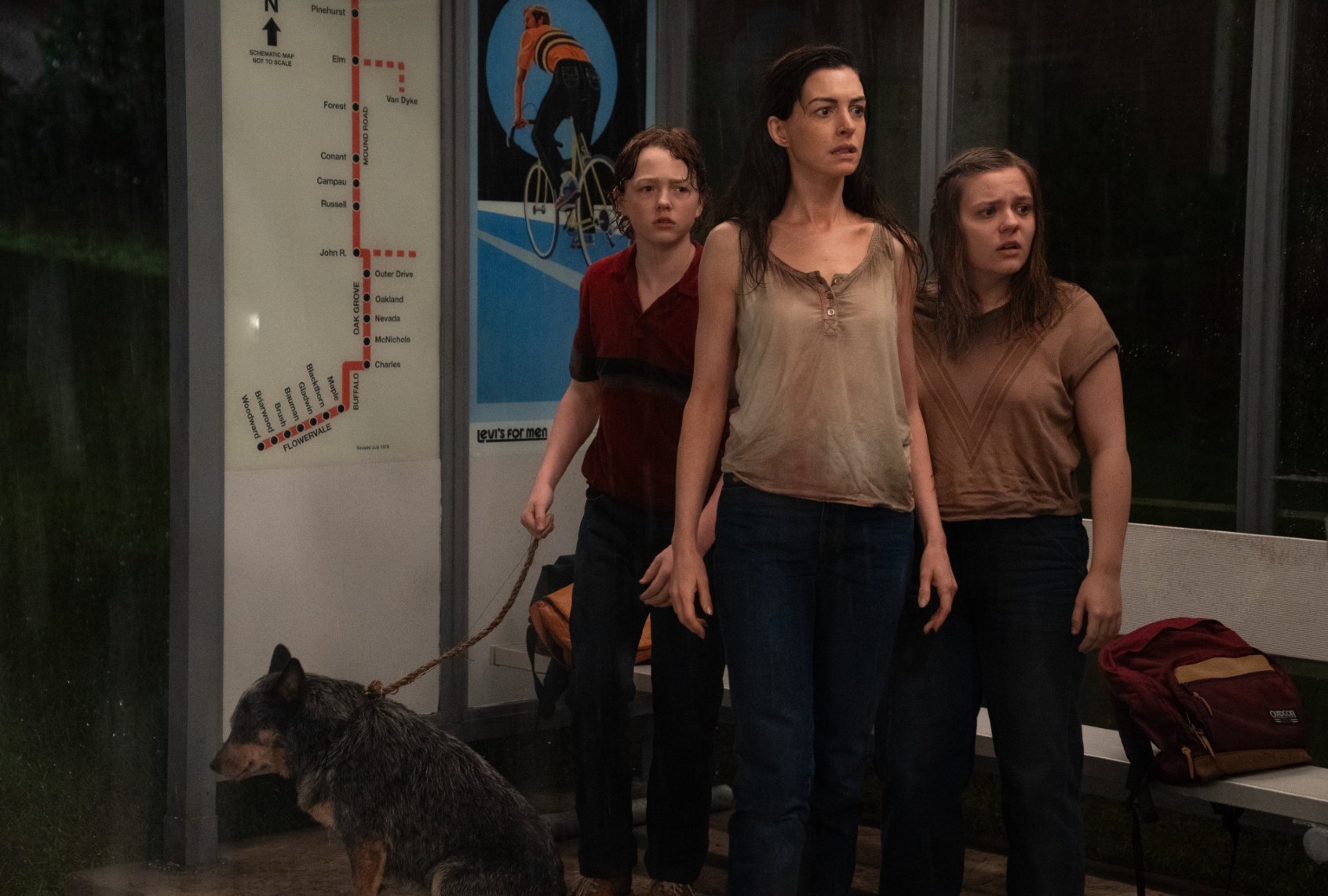
(Daniel McFadden/Warner Bros. Pictures) Christian Convery, Anne Hathaway and Maisy Stella in “The End of Oak Street”
So much recent blockbuster filmmaking has been about embedding heart-wrenching pathos into the nostalgic elements we know and love. But more often than not, the combination comes off forced; corny at best, insipid at worst.
From here, Robert carefully stacks a Jenga tower of suspense-laden set pieces and surprisingly moving family drama, without so much as letting the structure teeter. Where other filmmakers would painstakingly elucidate every thematic detail to make their silly popcorn movie “say something,” Mitchell restrains himself. “The End of Oak Street” doesn’t need to be “about” anything, which is the best way to make a film feel like it’s actually about several things.
On one hand, “The End of Oak Street” exists to be entirely what it is and nothing more. It’s a piece of delicious, fluffy cotton candy, sweet and quick-dissolving. On the other hand, when a director isn’t trying so hard to convey a message, that’s typically when they can conjure an emotion to fill the space left empty by thematic contrivance. This movie is about family dynamics and love, sure. It’s even got a dash of trauma. But Mitchell says so much more by saying nothing overt about those things, and instead, depicting a family who wants nothing more than to get out of the bind they’ve found themselves in. It’s as if he recognizes that so much recent blockbuster filmmaking has been about embedding heart-wrenching pathos into the nostalgic elements we know and love. But more often than not, the combination comes off forced; corny at best, insipid at worst.
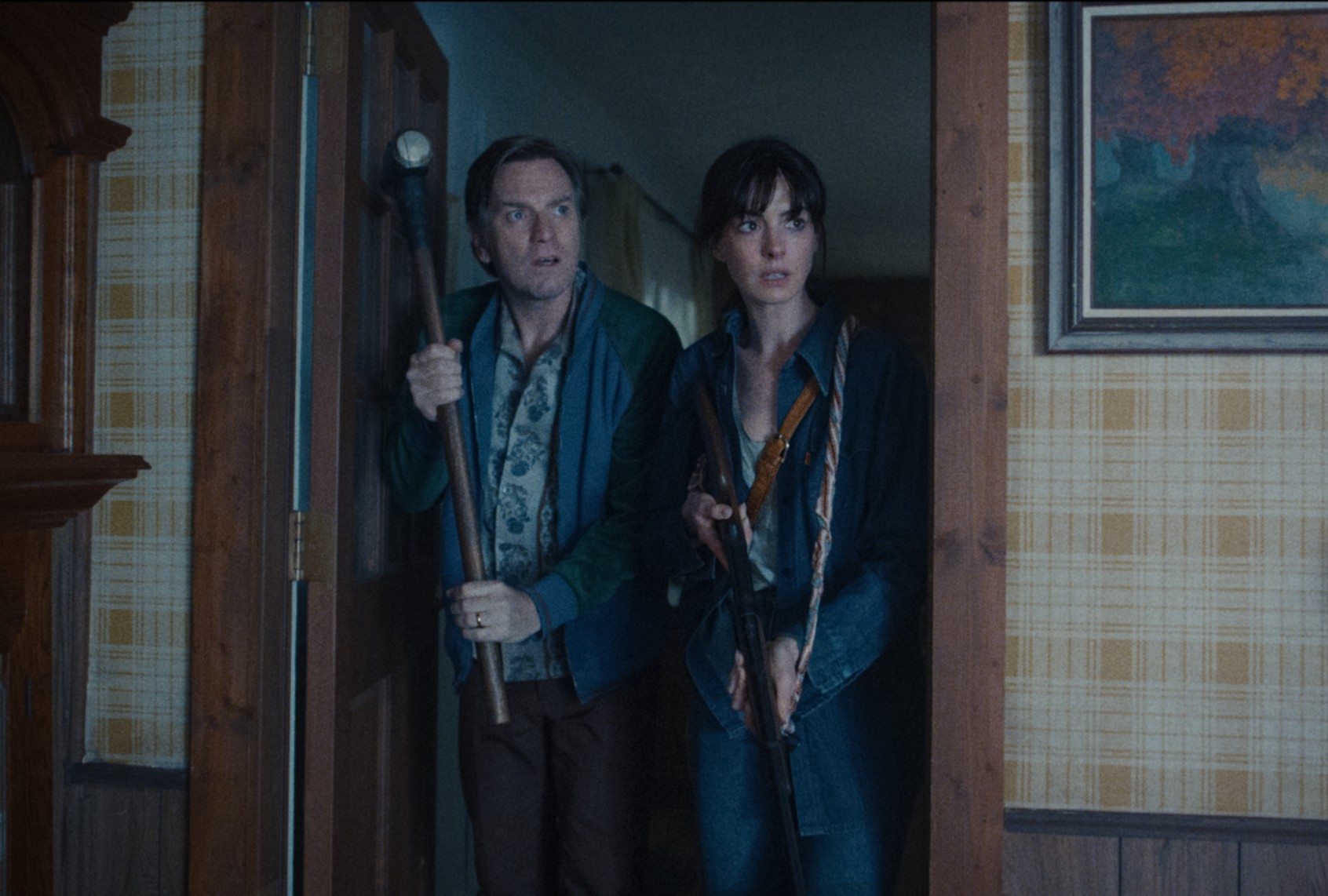
(Warner Bros. Pictures) Ewan McGregor and Anne Hathaway in “The End of Oak Street”
Mitchell’s self-imposed moderation might not look radical at first. But in a blockbuster landscape like the one we’re in now, thoughtful constraint is welcome and needed. I’m reminded of “The Odyssey,” which felt, to me, crushed by its own ambition, hoping to be everything at once simply because it could be. “The End of Oak Street” couldn’t be more different. It’s just as ambitious and loaded with ideas and surprises, but Mitchell isn’t trying to make this story anything more than it needs to be.
As with his last two films, “It Follows” and “Under the Silver Lake,” Mitchell has found a winning, thrilling formula in throwing ordinary people into extraordinary situations and searching for the resonance in the results, even if the answer is simple. That’s the real key in making something feel nostalgic, without nostalgia-farming. His latest film succeeds because it’s not trying to make audiences say, “I like this, because it reminds me of that.” Rather, “The End of Oak Street” recalls a time when both life and the movies seemed simpler, but were really much more complex than most people remember. They just didn’t feel the need to spell it out for us, allowing the movies to do the talking instead.
Read more
about old-school-style blockbusters worth your time


Discussion about this post