
Changes to lifejacket rules worry professional rowers
Changes to lifejacket rules have made a splash, with professional kayakers worried the bulky vests will slow them down.
Lifejackets are now mandatory for anyone using a vessel shorter than six metres.
Water Safety NZ chief executive Glen Scanlon told Morning Report the updated rules could save a dozen lives each year.
“We estimate that up to 12 lives a year will be saved, and, look, at the moment we have on average 85 New Zealanders drown a year, so it really is the next big step in reducing our drowning toll. It is as big for us as seatbelt legislation was for cars,” he said.
But retired canoeist and four-time Olympic gold medalist Ian Ferguson said for experienced athletes lifejackets could be more of a hindrance than a help.
“It really is difficult for kayakers in the heat of the day, wearing a lifejacket, and doing hours on the water – they’re going to get rashes and it’s going to be uncomfortable,” he said.
“You’re just twisting and your arms are spinning around the whole time, there’s absolutely no way you’re not going to get a rash if you continue paddling with one on.”
A former club president who asked to stay anonymous said it was like “using a sledgehammer to break a walnut”.
“A stand up paddleboarder that’s out on the board with a leash attached to a flotation device, when they’re on the surf they’re not considered to need a lifejacket, but as soon as they go for a little paddle down the beach, all of a sudden they need to wear a lifejacket – it doesn’t make sense,” he said.
“But equally I see people out on dinghies, wearing swandries and jeans, standing up fishing with no life jacket and you just go ‘you’re kidding me’, so you know, it’s a hard one.”
Water Safety NZ chief executive Glen Scanlon said the updated rules could save a dozen lives each year.
Water Safety NZ
Steve Cooper, the president of the Kiwi Association of Sea Kayakers, is also a member of the Safer Boating Forum involved in the law change.
He said it cleared up years of confusion.
“Before the rules were brought in, various regions already had legislation that required wearing lifejackets, but it varied region to region,” he said.
“This takes away a lot of that confusion.”
Cooper wasn’t convinced that athletes would be hampered by the change.
“I don’t believe that wearing a correctly fitted, appropriately designed lifejacket should necessarily restrict any athletes in particular,” he said.
“Whether you’re a professional athlete or a recreational kayaker, if you fall in the water you need something to help you stay afloat.”
People training for an approved sporting event were excluded from needing to wear a lifejacket, but Ian Ferguson worried that carve-out was too narrow.
Instead, he was floating the idea of a swimming test to separate amateur canoeists from the pros.
“I see the way around this is just that clubs have got to do a test for each person who wants to train without a lifejacket, and that would simply be swimming 400 metres under a certain time,” he said.
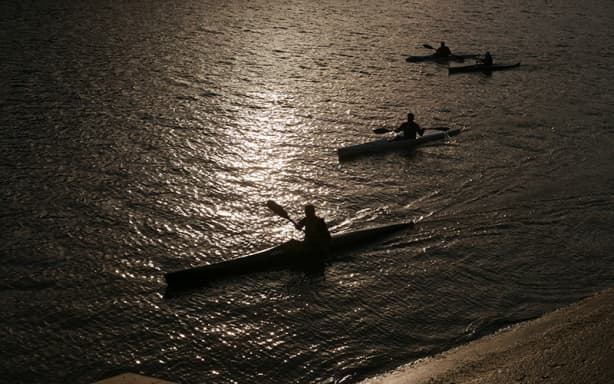
Professional rowers are worried the bulky vests will slow them down.
“Like surf life savers, they have to do it under nine minutes.”
If someone couldn’t prove they were a strong swimmer, he said they should absolutely wear a lifejacket.
But he said there was a world of difference between professional training and recreational boating.
“If you’re training you’re doing a special thing, you’re not there playing just recreationally like any Joe Blow, you’re a serious athlete who should be able to look after himself in the water,” he said.
“But I’ve been wearing my lifejacket today with the kids, we were sea biscuiting and they all had their lifejackets on, so you’ve got to be sensible.”
Maritime NZ’s principal adviser for recreational craft, Matt Wood, said sporting organisations would be able to apply for an exemption.
“Provision has been made for high performance sport in the rules, so we’re really supportive of high performance sport,” he said.
“National sporting organisations can apply to Maritime NZ for an approval for their activity, and what they do is they demonstrate an equivalent level of safety, and once established it means their athletes don’t need to wear lifejackets.”
Wood said raising the minimum standards for lifejackets would ultimately save lives.
Discussion about this post