
Summary:
AI in logistics utilizes machine learning, predictive analytics, and agentic AI to automate supply chain operations. This includes automating everything from demand forecasting and route optimization to warehouse robotics and last-mile delivery. Unlike traditional logistics, which relies on manual planning and historical data, AI-powered logistics systems process real-time information to predict demand, adjust inventory, and act on risks before they escalate.
Artificial intelligence (AI) is one of the most game-changing technologies in history. It benefits businesses all around the world by improving productivity and reducing costs.
Like any other industry, AI has also made its way into logistics and supply chains, and the pressure to adopt it has only grown as customers expect faster and more transparent delivery. Adopting advanced artificial intelligence technologies like agentic AI helps organizations match customer expectations by going a step further.
It independently executes multi-step actions like rerouting a shipment, adjusting inventory, or triggering a reorder without waiting for human sign-off. This shift is what’s making AI the driving force behind the industry’s biggest operational gains.
As it unfolds, this shift brings several advantages, such as greater efficiency in management operations like order fulfillment, enhanced inventory accuracy, shorter delivery times, and more accurate forecasting. Agentic AI pushes automation further by not just forecasting demand or flagging a delay, but by acting on insights in real time. The scale of this shift is already visible in the market.
Let’s look at some recent figures to understand the scenario more clearly.
What the Numbers Say: Artificial Intelligence in Logistics Industry
- According to Fortune Business Insights, the global AI in logistics market was valued at $8.65 billion in 2025
- The report also states that the market is expected to grow at a CAGR of 41.50%, from $12.23 billion in 2026 to $196.61 billion by 2034.
- Mordor Intelligence highlights that North America captured the largest share, accounting for 41.83% of 2025 global agentic AI in logistics revenue.
- According to Food Logistics, 69% of supply chain leaders are prioritizing AI and digital tools, 59% are focusing on adaptive resource allocation, and 58% are strengthening forecasting and risk management.
Traditional Vs AI-Powered Logistics
Before exploring how AI transforms the logistics industry, let’s take a glance at the core differences between traditional vs. AI-powered logistics processes:
| Aspect | Traditional Logistics Management | AI-Powered Logistics Management |
| Demand Forecasting | Relies on historical data and fixed forecasts | Predicts demand using real-time and historical data |
| Route Planning | Depends on manual planning and fixed routes | Optimizes routes based on changing conditions |
| Fleet Management | Uses predefined schedules and manual tracking | Improves vehicle allocation and fleet utilization |
| Inventory Management | Maintains stock using fixed thresholds | Adjusts inventory based on predicted demand |
| Delivery Estimates | Uses standard routes and historical averages | Generates dynamic ETAs from real-time conditions |
| Risk Detection | Relies on manual monitoring and predefined rules | Identifies potential risks and operational anomalies |
| Decision-Making | Depends on reports and human judgment | Provides real-time insights and recommendations |
| Exception Handling | Teams manually identify and resolve issues | Detects exceptions and triggers appropriate actions |
| Data Analysis | Uses spreadsheets and periodic reports | Processes large datasets continuously |
| Workflow Automation | Follows predefined automated workflows | AI agents can coordinate and execute multi-step tasks |
The Advantages of Integrating AI in the Logistics Industry
Artificial Intelligence can bring many advantages to the logistics and shipping industry. This includes a mix of technologies, machine learning, predictive analytics, computer vision, and increasingly agentic AI, each playing a different role. Some of them are:
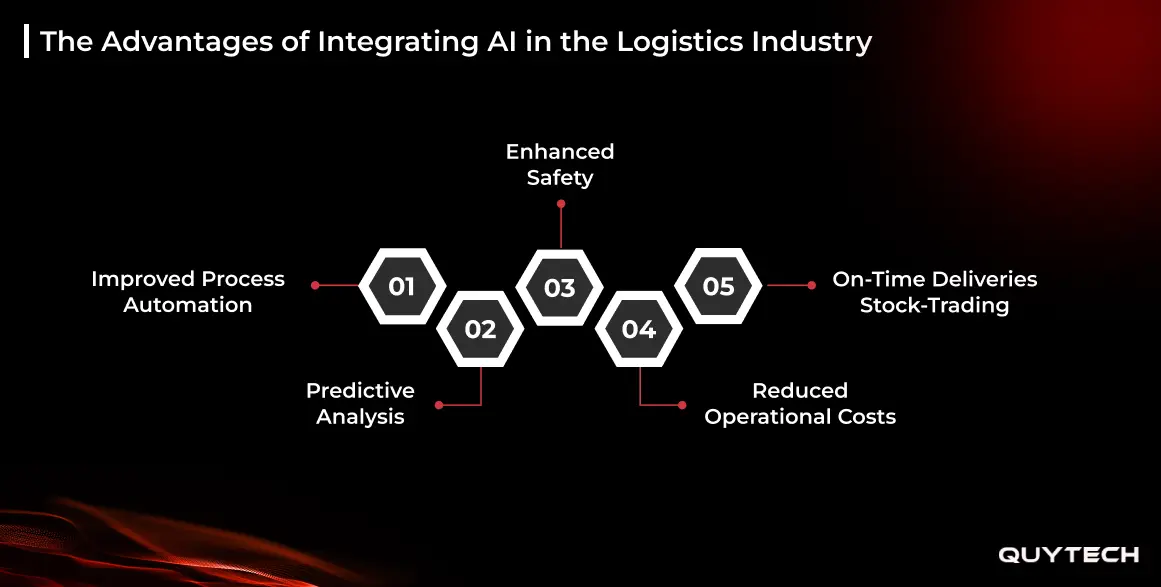
1) Improved Process Automation
AI can help in the automation of processes and the reduction of manual intervention required in logistics operations. It utilizes machine learning, computer vision, and agentic AI to detect data patterns, automate scanning and sorting, and take the appropriate action autonomously.
This naturally improves operational accuracy and efficiency, resulting in higher production and decreased costs. Through its ability to handle and interpret vast volumes of data quickly, it allows better decision-making.
2) Predictive Analysis
Anticipating demand based on past data might help keep inventories in check and improve operations, potentially changing the logistics business. This data analysis can be performed by AI at many levels and intervals.
Furthermore, analyzing massive amounts of data using machine learning and other approaches ensures that mistakes are fewer than 1% and that human labor may be employed more effectively. Optimizing supply chains using AI and analytics can also help in risk mitigation and forecasting for increased profitability.
With predictive analysis in place, shipments can be strategically planned via optimal routes, making the entire process smoother and simpler. By making informed decisions, other means of transportation may also be examined and optimized for better end outcomes.
Also Check: AI Theft Detection System Development Guide for Enterprises in 2026
3) Enhanced Safety
AI-powered automated technologies can assist with smarter planning and more effective warehouse management, which can improve worker and material safety. AI can evaluate workplace safety data and alert producers to any potential hazards.
It is capable of recording stocking parameters and updating operations, as well as providing appropriate feedback loops and preventative maintenance. Implementing technologies like agentic AI shortens the loop, moving from alerting a supervisor to actually triggering a maintenance request or pausing a process automatically. It enables businesses to respond quickly, ensuring that warehouses are secure and comply with safety regulations.
4) Reduced Operational Costs
Here’s one obvious advantage of AI systems for logistics and supply chain management. From customer service to the management of warehouses, automated intelligent processes can run error-free for extended periods of time, reducing the number of manual supervision-led errors and worksite catastrophes.
Furthermore, warehouse robots can deliver increased speed and precision, resulting in higher levels of production, all of which will result in lower operational expenses.
5) On-Time Deliveries
As previously noted, Artificial Intelligence solutions assist in lessening reliance on manual labor, making the entire process faster, safer, and smarter. This facilitates prompt delivery to the customer in accordance with the agreement. That is how companies like Amazon can deliver orders to their Prime members in just 24 hours.
Traditional warehouse operations are accelerated by automated technologies, which remove operational impediments in the value chain with minimal effort to meet delivery goals.
Use Cases of Artificial Intelligence in the Logistics Industry
AI has the capacity to completely guide and alter a product’s supply chain. This would assist in speeding up work in a company while also ensuring that the product in demand is made and supplied effectively. Let’s look at some AI use cases in logistics to see where it may be applied.
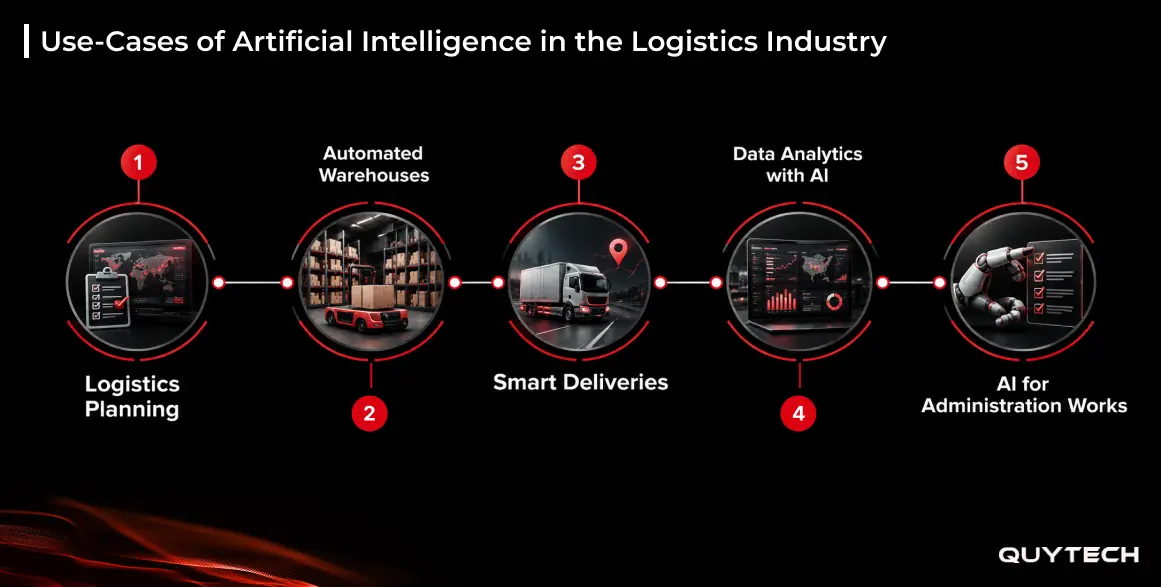
1) Logistics Planning
Even the best army will get defeated if it goes into combat without a battle plan; Similarly, no e-commerce retailer would be able to survive if it goes into the business without logistical planning.
Logistics planning is a sort of logistics management in which a concerned person plans how to deliver the appropriate items to the right customer at the appropriate moment and for a minimal cost. The purpose of logistics planning is to create a lean and cost-effective logistics organization capable of meeting service standards at all times and surviving supply chain interruptions.
Without logistical planning, company owners face costly shocks, inefficiencies, and the inability to efficiently expand their business – especially when times are tough.
How can Artificial Intelligence help? – AI systems can help with planning because they are strong at scenario evaluation and quantitative analytics, both of which are significant in planning.
Thus, AI along with machine learning and deep learning can help with:
Organizations may leverage real-time data in their forecasting attempts thanks to AI capabilities. As a result, when compared to traditional forecasting methods such as ARIMA (AutoRegressive Integrated Moving Average), AI-powered forecasting of demand approaches considerably lower error rates.
Artificial intelligence can aid enterprises with real-time demand analysis, allowing them to dynamically adjust their supply management factors to enhance supply chain efficiency. With technologies like agentic AI, automation does not stop at triggering alerts but goes beyond that by handling tasks like moving stock between warehouses or placing reorders. Businesses consume fewer resources while using dynamic supply planning because dynamic planning reduces the amount of waste.
2) Automated Warehouses
With AI, logistics businesses can make their warehouses more efficient, reduce the chances of theft, and save money and other resources. For warehouse automation, businesses require:
A few of the logistics giants, like Amazon, are already using AI-driven warehouse robots to perform their day-to-day tasks. As of today, AI robots are assisting employees in picking, sorting, delivering, and storing items in 26 of Amazon’s 175 fulfillment facilities.
AI can be used to automate mundane logistical jobs like data input, labeling, and packaging. AI robots can decrease errors and enhance accuracy by automating certain procedures, saving time and money.
- Damage Detection Systems/ Quality Control
Damaged items can lead to unsatisfied consumers and falling sales numbers. Thus, businesses can utilize AI-powered Damage Detection Systems such as computer vision technology to detect defects that may be undetected by humans and provide quality control in warehouse operations.
Later, logistics managers can assess the extent and kind of damage and take steps to prevent additional damage to the goods.
Logistics companies can face heavy losses, sometimes in millions, if their machines break down even for a few minutes. Machinery breakdown can be the worst nightmare for any logistics company owner. To tackle these types of scenarios, Predictive Maintenance can play a crucial role.
Predictive maintenance is the process of forecasting possible production breakdowns by evaluating real-time data acquired from IoT sensors in equipment.
Analytics solutions driven by AI and machine learning improve predictive analytics and find patterns in sensor data, allowing technicians to take action before a malfunction occurs.
Good Reads: AI in Banking: How AI is Disrupting the Banking Industry
3) Smart Deliveries
AI-powered self-driving vehicles and drones can be employed to improve consumer last-mile delivery services while saving money, labor, and other resources.
Autonomous vehicles eliminate the need for manual work and improve the efficiency and cost-effectiveness of the logistics and supply chain. This is why several business titans such as Tesla, Google, and Mercedes-Benz are significantly investing in the notion of autonomous automobiles. It is only a matter of time before we see autonomous trucks on all the roads of the world.
On the other hand, AI-powered delivery drones are valuable equipment when businesses like FedEx need to deliver items to locations where ground transportation is not safe, dependable, or sustainable.
Delivery drones can help companies decrease waste costs and avoid expenditures in costly storage facilities, particularly in the healthcare industry, where pharmaceutical supplies have a limited shelf life.
- Real-time Shipment Tracking
Artificial intelligence can be employed to build real-time tracking and visibility systems that provide clients with up-to-date information about their orders. AI-powered trackers may be utilized for tracking incoming shipments, detecting potential delays, and updating consumers about the status of their purchases automatically. Some providers have pushed this further so the tracker itself rebooks a carrier slot when a delay looks likely, rather than just reporting the delay after the fact.
Also Check: AI in Supply Chain Management: Navigating the Future of Logistics
4) Data Analytics with AI
Many logistics companies find it difficult not just to gather massive volumes of data, but also to make sense of it and use it in the appropriate context. As a result, they are not making the most of their expanding information resources.
But the good news is that this can be overcome by implementing AI solutions in the existing systems. AI is revolutionizing analytics by providing levels of speed, size, and granularity that are not humanly achievable. AI employs complex algorithms that businesses may utilize to examine previous consumers, competitors, staff members, and other behavior to make optimal conclusions about what could happen in the future or what has to be done to effectively handle issues and opportunities.
AI-driven Analytics can be used by Logistics enterprises for:
AI can collect supplier data to generate a thorough risk profile. Using AI-driven analytics, it is feasible to identify potential problems with suppliers sooner and assist in decreasing the risk of supply chain outages before it gets too late.
Artificial intelligence (AI) models can work with firms in analyzing current routing and tracking for route optimization. According to the companies that provide mobile app development services, Shortest-Path Algorithms are used to determine the most effective route for logistics trucks. As a result, the company will be able to minimize transportation expenses while also speeding up the shipment process.
5) AI for Administrative Work
In the logistics industry, there are numerous logistics-related forms, like a bill of lading, from which structured data needs to be extracted correctly. And most businesses do this manually. Thus, it is very time-consuming, and there is always a chance of errors which can cost a lot to the company.
Artificial Intelligence can ease the burden of administration by:
- Automated Document Processing
Documents such as invoices, bills of lading, and rate sheets facilitate communication among customers, suppliers, and logistics service providers. AI-powered document automation systems can improve the efficiency of employees by automating data entry, error reconciliation, and document processing.
- Automating Manual Office Tasks
With AI technologies like agentic AI, Logistics companies can automate various back-office tasks, such as scheduling transportation, organizing cargo pipelines, assigning and managing staff to certain stations, and tracking goods in the warehouse.
Furthermore, AI solutions are able to auto-generate reports, evaluate their contents, and email them to interested parties based on the information the reports contain.
Customer service plays an essential role in logistics organizations since customers will contact them if they have issues related to order delivery. AI-powered customer service chatbots are capable of performing low-to-medium contact center duties like:
- Making a delivery request
- Modifying an order
- Package tracking
- Solving Frequently Asked Queries
- Fraud Detection and Prevention
In the logistics and supply chain industries, artificial intelligence may be utilized to identify and prevent fraud. This is accomplished by analyzing client data and detecting any anomalies or suspicious conduct, thereby assisting businesses in reducing the risk of fraud and protecting their consumers.
Also Explore: AI in Healthcare: Drives Potential Enhancements across the Healthcare Sector
Future Of Artificial Intelligence in the Logistics Industry
The logistics industry has seen a significant transition as a result of artificial intelligence. According to the most recent Accenture research, the future of AI in logistics is nothing short of exciting, with experts projecting that by 2035, it may enhance logistics productivity by a staggering 40%.
Agentic AI is expected to run entire workflows end-to-end, from demand sensing to procurement to delivery rerouting in the future. Hence, the future holds agentic AI-powered automation balanced with a human in the loop who steps in only when something falls outside expected limits.
Apart from bringing long-sought automation to life, the future also holds the utilization of digital twins of warehouses, fleets, and full supply chain networks becoming standard practice. This will let companies test a new route, supplier, or warehouse layout in simulation before committing to it in the real world.
Another future trend that AI holds for logistics is Physical AI. Instead of fixed-arm and wheeled robots confined to their own lanes, general-purpose humanoid robots are emerging that can share the same aisles and shelves as human workers, with no warehouse redesign required.
Build your AI-powered Business With Quytech
Quytech is the best AI app development company, providing the latest and cutting-edge technologies to businesses all over the world. At Quytech, our AI technologists attentively grasp your business and needs, and then thoroughly assess them to provide the finest solutions for your company.
Our AI professionals provide cutting-edge AI technologies like Machine Learning, Deep Learning, Artificial Neural Networks, and Cognitive Computing to help you compete in this technology battle. So, what are you waiting for? Get in touch with our experts to integrate Artificial Intelligence solutions into your business and get an unbeatable competitive advantage.
Frequently Asked Questions
The cost for implementing AI in logistics can be anywhere from $50,000 to $200,000 depending on the type of technology you want to implement, the complexity of your solution, and the scale you want to deploy it for.
The time duration for implementing AI in logistics depends on multiple factors, like the type of solution, complexity, scale, and many others. Roughly, the time can be 4 to 12 months based on all the factors mentioned above.
Not Necessarily. AI in logistics can be implemented by small businesses as well. For this, you can either partner with an AI development company or hire AI developers.
This depends on the vendor and deployment model. Partnering with a company like Quytech that complies with data protection laws ensures that your data remains secure. We follow data encryption, strict access control, and regular audit practices that ensure that your data is safe.
Here are some factors that help you choose the right AI development partner for logistics:
– Logistics-specific domain expertise
– Track record
– Pilot-first approach
– Integration compatibility
– Support & maintenance
– Pricing transparency
Post Views: 7,049
Discussion about this post