





JUST IN: Army Learning Chilling Lessons in the Arctic
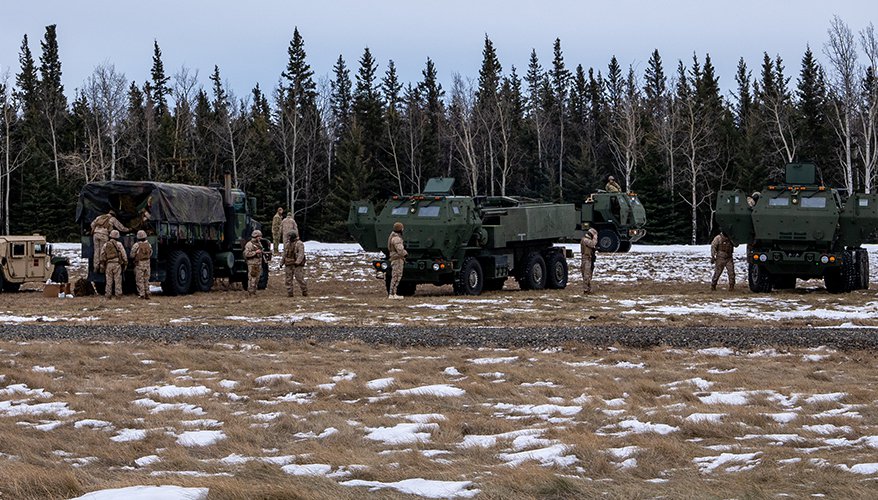
Defense Dept. photo
The Army’s 11th Airborne division, its newest division based in Alaska, just completed a joint, multinational training exercise that spanned the state and 80-degree temperature swings, and the service determined that not all its equipment and tactics are ready for Arctic warfare.
Maj. Gen. Brian Eifler, commander of the division headquartered at Joint Base Elmendorf-Richardson, Alaska, told reporters during a conference call that the Army tested about 40 pieces of equipment during the division-level exercise that involved air-assault insertion against a large, well-equipped adversary force capable of denying communications and aerial supremacy.
“It’s very hard to be camouflaged like we used to,” he said. “In some spectrums, you’re observed — whether it’s electronic, whether it’s physical, informational,” cyber, space or communications, “you really can be observed. So that’s really a test that we added to this.”
For communications and command and control, the Army relied on what it has rather than any new Combined Joint All-Domain Command and Control systems, he said.
“What we’re able to do is take the communications, beg, borrow and steal for this headquarters because it doesn’t have all the requisite communications that it needs to communicate,” he said.
“What we find in some of these environments is how do you negate some of the adversary’s counter capabilities to interdict [command and control] and to prevent good command and control, whether it’s jam GPS, jamming FM, jamming electronic warfare in general,” he said.
“We found that … the enemy had the capability to do jamming,” he continued. Blue forces resorted to what he described as a digital wavelength technology to communicate digitally in some cases. “And that was being jammed. And so, at one point, the brigade that was fighting had to use runners to get their … orders out to their units. And they literally sent people out on either snow machine or CATV to go to their lower battalions to get information out.”
Thus, the Army needs the equipment and training to be able to switch from digital to full manual mode, he said.
“I think the greatest gain we’ve got out of this would be able to fight regardless with our great top-of-the-line equipment. But if that gets degraded, we can still fight.”
During the exercise in conditions that ranged from minus 40 to 40 Fahrenheit and included mud, snow and hurricane-force winds, troops tested maneuvering on snowmobiles to send hunter-killer teams into remote areas to conduct anti-tank operations using Javelin missiles, he said.
“Going up against a mechanized and armored force and being able to go through the woods and over the hills, through the valleys and get in a position to fire the Javelin and take out the armor was absolutely validated,” he said. “Both the enemy and the friendlies were able to do that very well.”
That will feed into tactics, techniques and procedures. “It also helps with, OK, how many snow machines should an Arctic force have, one that has to force project? So, we are gonna increase our need for snow machines, not just for that mission, but also for sustainment of what that does for casualty evacuations and mobility on the battlefield.”
Because of the changing weather and snow conditions, the Army didn’t do a lot of testing of new skis, but the skis are “very promising,” he said. “It’s a better ski, a better binding that fits any boot, which is great for the American Army. Our Norwegian and Finnish partners and allies — Swedish, I believe as well — all wear the same boot. So regardless of the temperature, they wear that boot to ski with. As we figured out, we have to have various levels of boots, and so we need a binding that you can work with any boot. And so that has been very helpful.”
While the Army didn’t test any ground robots during the exercise, it did use small UAS, including some small swarms “to flood the battlefield.” Other uses included dropping Nerf footballs on troops to simulate an enemy attack and capturing battlefield imagery for after action review, he said.
“We as an Army are getting better developing those capabilities and especially in the Arctic,” he said. Some previous systems like the RQ-7 Shadow didn’t work well in freezing temperatures “because of the ground control station, it needed a good runway and all that stuff. But up here, you gotta have a vertical takeoff capability and something that we can withstand the extreme temperatures.”
Also during the exercise, the Army tested its five Cold-Weather All-Terrain Vehicles, or CATV, an unarmored, tracked vehicle designed to operate in water, mud and snow.
“The CATV performed very well,” Eifler said. “It’s a pretty good vehicle. There’s a couple of little minor things that we have to tweak with it, but overall, it did very good.”
“We used that extensively as a command-and-control node, which was really good for the brigade as well as sustainment of troops,” he added.
Some of the tent systems the Army tested “really didn’t hold up well,” he said.
The division is looking at tents used by allies, as the U.S. tent has a big stove and weighs up to 150 pounds, he said. “It’s not conducive to force projection, can’t jump that out of a helicopter very easy or out of an airplane, paratrooper-wise. So, we gotta have something that will fit in a rucksack, both for emergency that could keep a soldier and his or her buddies warm at minus 40-50 degrees, but then not overburden us with fuel and heavy equipment.”
Both Norway and Finland have tents that could be a model, but the division is also working closely with the Army Combat Capabilities Development Command on solving some of these problems, he said.
“They’re working on things like that because if we’re gonna force project, we need to be lighter, but we also need to have the capability to be warm in an emergency.”
The harsh temperatures exposed some other problems that need to be solved, he said.
“The equipment that we have to pound steaks in the ground in the permafrost doesn’t really work no matter how hard — even if you’re John Henry and you’re slamming your hammer, it’s not gonna go through that,” he said.
“And so, the locals said, ‘Hey, you gotta use this drill,’ which sounds intuitive, but you gotta have a nice drill to drill in your tent stakes.
Otherwise, that tent is gonna blow away, especially in 80-knot wind.”
“So, a lot of the things even like the Next-Generation Squad Weapon was tested up here, they realized some of the parts retain the cold so much that you can get frostbite from touching the weapon,” he said.
“So, things like that — if they’re tested up here, they can get fixed. So, we’re looking forward to testing the autonomous stuff up here,” which will put batteries to the test, he said.
“Batteries go really quick … less than hours and more into seconds and minutes. So those challenges of keeping batteries warm and battery-operated vehicles and stuff like that are really put to the test up here because of the environment.”
Even flying helicopters require different procedures, he added.
“Starting them in subzero temperatures, you have to do some things that are just not in manuals to figure out how to fly and maintain,” he said.
“We had a couple of our warrant officers come up with a white paper recommendation to the engineers and the Aviation Center of Excellence to put in manuals because the things that they have to do to fly and operate are not in manuals,” he said.
Topics: Army News









Discussion about this post