





The news industry in Canada expects Google and Facebook to start paying publishers between CA$100-150m (up to £88m) a year as its government prepares to launch Australia-style regulation on the tech giants in 2022.
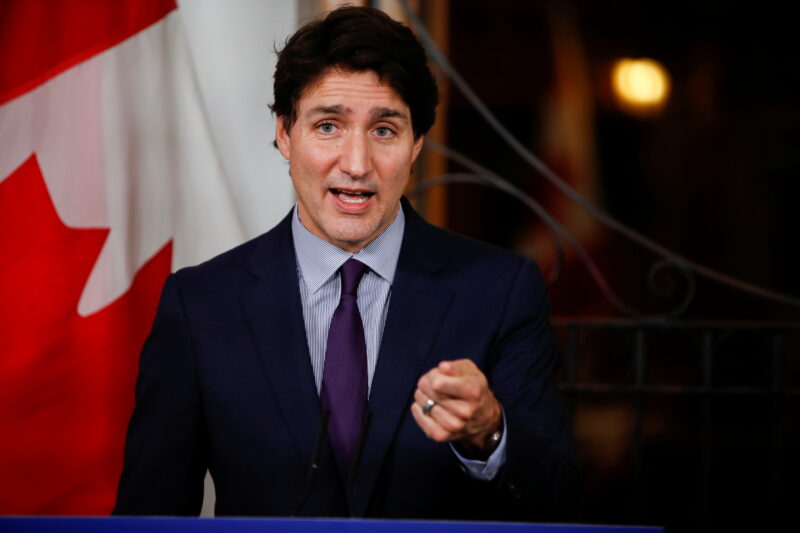
Prime minister Justin Trudeau (pictured) has pledged to introduce a news media bargaining code for Canada within the next two months. And senior industry sources spoken to by Press Gazette expect the legislation to come into force by the summer or early autumn.
Like Australia, Canada will seek to compel Google and Facebook to pay news publishers for the use of their content. It will grant collective bargaining powers to Canadian publishers, and will threaten platforms with compulsory arbitration if they cannot agree deals with news companies.
If and when the law passes, Canadian news publishers will expect to start striking valuable, long-term deals with the technology companies.
A recent Press Gazette investigation found evidence that Australian publishers are being offered more generous deals to join Google’s News Showcase scheme than their international peers. Canadian publishers will expect to be offered similar terms and will likely be paid more than news companies in other countries.
There is some evidence to suggest that the threat of this legislation is already paying off for Canadian publishers. One senior industry source told Press Gazette that Google, perhaps in anticipation of Ottawa’s crackdown, has already started offering more generous payments for signing up to News Showcase.
Ultimately, Canada’s publishers expect the tech giants will be persuaded to pay the equivalent of 30% of their annual newsroom costs. Under this estimation – which is based on figures that have leaked from Australian deals – Google would cover 20% of editorial costs and Facebook 10%.
A senior and well-placed industry source told Press Gazette that, as a result of the incoming legislation from Ottawa, Canadian publishers are anticipating annual payments worth a total of CA$100-150m from Google and Facebook (equivalent to US$78-117m or £59-88m).
Canada’s news media ‘crisis’
Canada’s news businesses, like their peers across the world, have suffered significant financial setbacks in recent years. Print circulations and advertising sales have plummeted, and digital revenues have so far failed to compensate.
Google and Facebook, the duopoly of the digital advertising market, have taken much of the blame. According to a recent report from the Canadian Media Concentration Research Project, their share of the domestic digital ad market was 80% in 2019.
Canadian publishers believe Google and Facebook benefit significantly from news content and should therefore contribute to the cost of newsgathering.
Last year, the Covid-19 crisis accelerated issues for the Canadian news industry, strengthening the argument for regulatory intervention.
“It definitely hit us very hard in terms of a drop in advertising,” said Rick O’Connor, the president and chief executive of Black Press Media, a local news publisher based in British Columbia.
“If you look at 2021, since the spring, we’ve seen a significant uptick in revenue. And I’m projecting that we’re going to see another uptick in revenue next year because there’ll be more business and tourism activity.
“So I’m hoping for a 10% increase next year in revenue. We’ve had an increase this year. But we’re not going to get back to pre-Covid levels for, I think, a few years yet.”
In its submission to a government consultation on tech regulation in September, News Media Canada said that its industry is in “crisis” and that the Australian model “remains the best solution”.
John Boynton, the vice chair and president of digital for Nordstar, which owns Toronto Star publisher Torstar, told Press Gazette: “In order for the industry to survive in a digital world, it needs a healthy supply chain.
“For publishers, we have two ways of selling our product, our journalism. One is directly to the consumer – and so the industry is pivoting heavily to digital subscriptions, which does look like it will be a good, long-term revenue stream…
“The second way is a distribution channel through another company to the consumer. And so there are organisations who would like our content – and either grab it from us or arrange to have it transferred to them from us.
“A healthy ecosystem is where those who want to use another’s product actually pay for it. Then they can either give it away for free – that’s their business – or they can resell it for a higher margin.
“We just need a healthy ecosystem where we can go direct or we can go through a channel. But the channel needs to pay. And I don’t think there’s any business in the world anywhere where they put their product through a channel and get paid nothing, and that channel becomes the dominant channel.
“That does not exist anywhere in the world. So it’s just normal, standard and common sense.”
How news media won big tech pledge from Trudeau
The Canadian news media’s call for regulation gained weight in January 2020 when a government-commissioned report recommended that Ottawa introduce levies on “media aggregation and media sharing” platforms.
The review – titled “Canada’s Communications Future: Time To Act” but informally known as the Yale Report because it was led by communications lawyer Janet Yale – suggested that “some or all of the levies” should “contribute to the production of news content”.
Following publication of this report, and amid the Covid-19 crisis, the Canadian news industry stepped up its lobbying campaign.
It sought to persuade the government to act fast and to closely follow the Australian news media bargaining code, which passed into law in February 2021 after years of preparation.
In October 2020, News Media Canada sent the government a memorandum titled: “The Australian solution to the Google/Facebook problem: How to make it work in Canada.” In May this year, the organisation provided Ottawa with the proposal for a draft “Digital Platforms Act”. Both of these documents were drafted by Peter Grant, a retired communications lawyer who also worked on the Yale Report. Grant is today working with News Media Canada on a pro-bono basis.
Also this year, newspapers across Canada ran blank front pages that encouraged readers to “imagine if the news wasn’t there”. The campaign called for the government to force Google and Facebook to pay for news.
Today’s Record and newspapers across the country have been intentionally left blank as part of the Disappearing Headlines campaign, calling on Ottawa to act to keep companies like Google/Facebook from using news content produced by local journalists without paying for it. pic.twitter.com/gn7NnIWzGo
— Chris Seto (@SetoRecord) February 4, 2021
By the summer of 2021, the government appeared determined to act, but it had not finalised its plans. Between August and September, a government consultation indicated that Ottawa would either follow Australia, by introducing a “mandatory code and arbitration regime”, or introduce rules that would force tech platforms to make “mandatory financial contributions” to be “distributed by an independent fund”.
News Media Canada’s response to this consultation, submitted on 15 September and seen by Press Gazette, argued strongly for the Australian model.
“[The] mandatory code and final offer arbitration regime, modelled on the Australian approach, remains the best solution to the Canadian crisis for news media,” wrote Paul Deegan, NMC’s president and chief executive.
“While the arbitration regime could be supplemented by government funding to address issues of equity, the Australian approach has proven to be effective and its implementation in Canada is therefore crucial.”
Deegan said that NMC does not view the independent fund approach as “an appropriate substitute for the mandatory code and arbitration regime, which is a market-based approach that does not require political judgments”.
The Canadian news industry scored a major victory in September when, ahead of a snap federal election, Justin Trudeau’s Liberal party pledged to introduce Australian-style legislation within 100 days of being sworn in.
The Liberal party triumphed and Trudeau’s cabinet formally took office on 26 October, giving the government until 3 February to meet its 100-day pledge.
News leaders say they have been told that this legislation is a priority area for Canadian Heritage, the government department that covers media issues. Publishers are now confident the rules will come into force either by June or the early autumn after the Ottawa parliament’s summer break.
The detail: What will Canada’s code look like?
In his campaign promise document, Trudeau set out the fundamental principles of his government’s news media bargaining laws.
The Liberal party stated that, if re-elected, it would introduce legislation, “within 100 days, that would require digital platforms that generate revenues from the publication of news content to share a portion of their revenues with Canadian news outlets.
“This legislation would be based on the Australian model and level the playing field between global platforms and Canadian news outlets. The bill will also allow news publishers to work together to prepare for collective negotiation.”
It is not yet clear how the legislation will differ from Australia’s code. But Peter Grant – the communications lawyer who worked on the Yale Report and wrote News Media Canada’s draft Digital Platforms Act – believes that few changes would be required.
“In fact, the Canadian legislation would be a bit simpler,” he told Press Gazette.
He explained that Australian legislators had to devise a system to determine whether journalism organisations qualify for the benefits of the code. The Canada Revenue Agency already has a categorisation for “qualified Canada journalism organisations”, and Grant believes this could be used to determine whether companies qualify in his country.
Canada, like Australia, would have to provide news publishers with an exemption to competition rules to give them collective bargaining rights.
“This is particularly important for the smaller newspapers, who don’t have the clout,” said Grant. “In order for the smaller media to benefit, they really have to group together and negotiate as a group. Because they just don’t have the size or the influence of the major papers.”
Under Grant’s proposal, the Canadian government – like the Australian government – would have the power to “designate” tech companies as platforms to make them liable to arbitration.
In Australia, the news media bargaining code was included as an amendment to the Competition and Consumer Act 2010. Grant suggests that Canada could simplify its legislation by making it a “standalone statute”.
How did Google and Facebook react in Australia…?
In the months after Australia announced its plans for a news media bargaining code, Google and Facebook dished out a series of threats to Canberra.
Google warned it could ‘leave’ Australia, while Facebook briefly removed professionally-produced news from Australian users’ newsfeeds.
However, as the News Media and Digital Platforms Mandatory Bargaining Code became an inevitability, the companies changed tact.
Both Google and Facebook swiftly agreed confidential deals with Australia’s largest publishers, including News Corp, Seven West, Nine and ABC.
Google’s deals – which were ostensibly built around the company’s new aggregation service, News Showcase – are understood to have been larger than Facebook’s offers in most cases.
A recent Press Gazette investigation into News Showcase suggested that Australian publishers are being paid significantly more than news companies in other countries. News Corp, Seven West, Nine and ABC are each understood to have agreed eight-figure annual deals.
Publishers’ success in these negotiations has been widely attributed to the threat that the news media bargaining code poses to Google and Facebook.
So far, Google and Facebook have technically avoided Australia’s news media bargaining code because neither company has been “designated” as a digital platform by the Canberra government.
Critics of the code say this is because Google and Facebook have independently agreed private deals with Australia’s most influential publishers. Now that News Corp and others are satisfied, they argue, there is less pressure on the government to act – and, in fact, doing so could jeopardise big publishers’ deals with Google and Facebook.
But Australia’s legislation has also allowed smaller publishers to band together for negotiations with the tech giants.
Country Press Australia used collective bargaining rules to negotiate a deal for 70 of its local news members to join News Showcase. And last month, 18 small titles clubbed together to form the Public Interest Publishers Alliance for collective negotiations.
News Media Canada has made clear to the Trudeau government that it believes the Australian model has worked well for news companies.
In its 15 September submission to the government inquiry on tech regulation, Deegan said the code has been “a stunning success for local news media in Australia. To avoid binding arbitration, both platforms have negotiated contracts with the news media that provide meaningful remuneration.
“Although the actual terms are confidential, and some contracts are still being negotiated, News Media Canada understands that Google is paying in the range of 20% of the cost of each full-time journalist and Facebook is paying in the range of 10% of that cost.”
Citing the Country Press Australia deal struck in September, Deegan added: “The threat of arbitration is leading to real dollars to news publishers in Australia, both large and small.”
… and how are they reacting in Canada?
It remains to be seen how Google and Facebook will react to the threat of similar legislation in Canada.
In March, Facebook hinted that it might be forced into blocking news content sharing in Canada, as it did in Australia.
But there are signs Google and Facebook have already accepted that Canada will follow Australia in forcing through the legislation.
Google launched News Showcase in Canada on 27 October, the day after Trudeau’s government was sworn in. Publishing partners include the Globe and Mail, Torstar and Black Press Media.
One industry source, who asked not to be named, said that Google’s News Showcase offers have improved as legislation has neared. This appears to mirror the situation in Australia, where News Showcase deals were struck in the months leading up to the code’s introduction.
“I think any publisher that’s done a deal since the end of Q1 or early Q2 probably has benefited from the threat of legislation,” the source said.
“In countries where the threat of that binding arbitration or legislation doesn’t exist, Google and Facebook have no incentive to do anything.
“And I think that in itself is the most damning, overwhelming evidence that there is not a good balance of power and that legislation is needed to even things out.”
In response to this article, a Google spokesperson told Press Gazette: “Google cares deeply about news in Canada and is committed to supporting Canadian journalism of all sizes.
“This past year, we launched Google News Showcase in partnership with 11 publishers which represent over 100 publications across the country in both official languages.
“We’ve also supported hundreds of publications through programs such as the North American Innovation Challenge and Journalism Emergency Relief Fund, and have committed to training 5000 Canadian journalists over the next three years on digital skills.
“We remain in active conversations with government, industry and others on supporting a thriving future of news in Canada.”
Facebook, which recently rebranded as Meta, this year launched the News Innovation Test in Canada. The scheme will “pay participating publishers for the ability to link to additional news stories not already posted on Facebook”.
‘Canada can be a real model for the world’
News Media Canada’s Deegan said that the nation’s largest publishers remain determined to push for legislation for the good of smaller news companies and the industry overall.
“They are still four-square behind collective negotiation,” he said. “Every single member that we have, even those who have signed [licensing deals], have said that ultimately one-offs may be good for a particular publisher, but the fact of the matter is Google and Facebook aren’t calling the little guys.
“There are tonnes of small publishers that are important to communities across the country, and if those publications go the way of the dodo bird, we’re going to wind up with these massive news deserts across the country.”
O’Connor of Black Press Media described his deals with Google and Facebook as “fair”. But he is concerned for other publishers, particularly those with smaller online audiences.
“I don’t think they’re going to be fair to every publisher in Canada,” he said. “Therein lies the rub.”
Boynton of Torstar predicts that Canada’s news publishers will ultimately have a smoother ride than their peers in Australia because Google and Facebook have already begun to accept their legislative fate.
“I think anything that’s nascent, and that fundamentally changes the way economics work, always goes through a rocky period,” he said.
“I think as what seems brand new and radical becomes more normal and pervasive – and as it spreads from country to country as a normal way of doing business – cooler heads prevail. And people will start to work together in partnership. I think that’s probably going to be the Canadian way.”
“Canada can be a real model for the world,” Deegan added. “We’ve had discussions with publishers throughout the Americas and the world. And everyone is watching Canada.
“They admire the commitment that Justin Trudeau and his government made to level the digital playing field, and we all want to see it happen.”
Photo credit: REUTERS/Kevin Light









Discussion about this post