





Audio By Vocalize

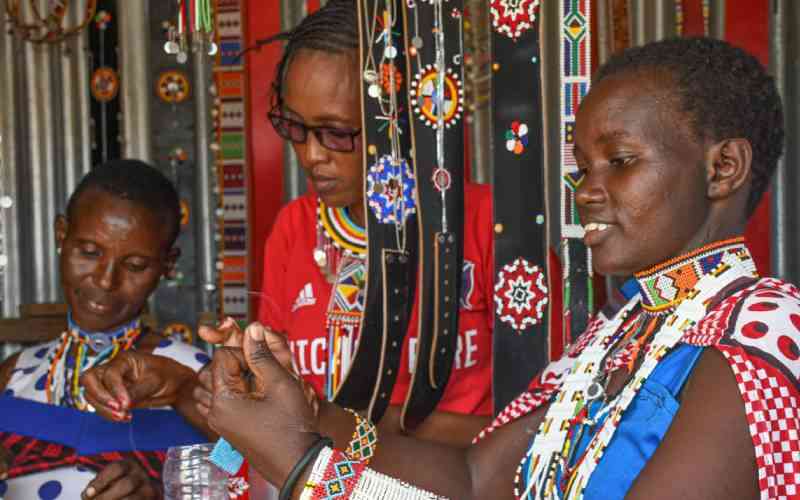
Nkinyia Kereto (right) and Irine Nashipae engage in beadwork as an economic empowerment activity in Elang’ata Wuas, Kajiado County.
Persistent gender-based violence and harmful traditions targeting women and girls are driving renewed campaigns to push communities to abandon the practices.
This is even as Kenya records a femicide toll that activists describe as a country at war against its own women.
Rights advocates say the abuses continue to undermine the safety, dignity and opportunities of women and girls, particularly those living in poverty and social exclusion.
The renewed push coincides with global calls for stronger action to protect women and girls as the world marks International Women’s Day.
Kenya recorded 579 femicide cases in 2024 and 129 in the first quarter of 2025 alone, according to UNESCO’s regional office for Eastern Africa.
Many cases remain unreported or misclassified, masking the true scale of the crisis.
Men were responsible for 85 per cent of the killings in the first quarter of 2025, with half linked to domestic disputes and 72 per cent occurring inside the home, according to ActionAid.
A report by the Federation of Women Lawyers in Kenya (FIDA Kenya) found that femicide cases rose 10 per cent between 2022 and 2024, driven by patriarchal norms, economic dependency, harmful cultural practices and weak family structures.
Campaigners say sustained community engagement, stronger legal protections and shifts in social norms remain critical to ending violence and discriminatory practices that deny women equal participation in society.
ActionAid International Kenya (AAIK), a development organisation operating in the country for more than five decades, says it reached 538,526 people through its women’s rights and anti-violence programmes over the past three years.
The organisation works with traditional and religious leaders, community groups and government institutions to challenge female genital mutilation (FGM), child marriage and other harmful practices while advocating stronger legal protections.
“Advancing women’s rights is not debatable. It is urgent, deliberate and unapologetic. Real change happens when women, especially those living in poverty and exclusion, lead the way in shaping their communities, claiming their rights and challenging systems that have held them back for generations,” noted Judith Wambura, interim programmes and strategy lead at ActionAid International Kenya.
Efforts to confront the practices include working with community leaders, youth groups and women’s networks to promote girls’ education, support survivors of abuse and strengthen women’s leadership and participation in decision-making.
Stay informed. Subscribe to our newsletter
The government has established 12 specialised gender-based violence courts to fast-track justice for survivors.
Cabinet Secretary for Gender and Culture Hanna Cheptumo says the Protection Against Domestic Violence (Amendment) Bill, 2025 is being prepared alongside the digitisation of GBV case handling.
However, advocates warn the response remains inadequate. Kenya’s shelters for GBV survivors are collapsing under budget cuts, key reforms have stalled and misreporting of GBV data persists, leaving women and children exposed even as femicide rates rise and digital violence intensifies.
Of 95 mapped shelters nationally, only two for men and boys are operational, while most shelters for women operate without sufficient resources.








Discussion about this post