





SINGAPORE – The Omicron variant has spooked many, borders have been tightened swiftly, and the easing of social measures has understandably been halted. But the Republic’s resolve to return to life as it once was pre-pandemic, is still the long-term goal.
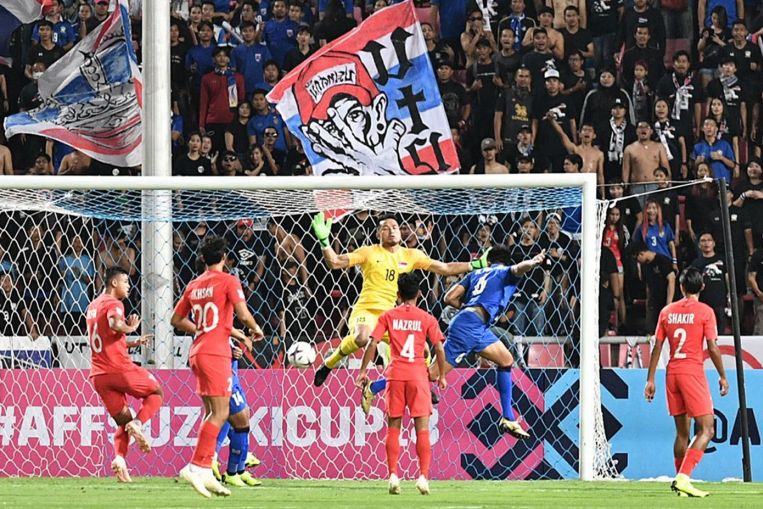
To that end, observers say Singapore’s hosting of the Suzuki Cup, which kicks off on Sunday (Dec 5), can play a big part in helping the nation move forward.
Three years ago, at the last edition of the Asean Football Federation (AFF) Championship, the region’s biggest soccer tournament, over 750,000 fans attended 26 games played in 10 cities.
This time round, total attendances will be far more modest.
Last week, the Football Association of Singapore (FAS) – which in September lobbied hard to earn the nod from the AFF to host the tournament – announced that 10,000 fans would be allowed to catch games at the 55,000-capacity National Stadium, one of two venues for Suzuki Cup games. The other is the 6,000-seater Bishan Stadium, which will welcome a maximum of 1,000 fans.
The sheer scale of the 10-team tournament and the potential five-figure spectatorship – the largest in-person gathering for any activity here since the pandemic began – is a clear sign of Singapore’s determination to learn how to live with Covid-19, said Deloitte South-east Asia sports business group leader James Walton.
“It’s a big signal that Singapore is open for business, that tourists can come, and that we can learn to live with the (virus) as endemic,” he said. “In sport, business and (entertainment) we are signalling to the world that while we will take precautions with different testing regimes and measures, we are… going in the right direction.”
Last week, popstar JJ Lin performed in front of 2,000 fans at the Sands Theatre at Marina Bay Sands under vaccination-differentiated safe management measures which allowed concert-goers to sit alongside one another without the need for social distancing.
Two weeks prior, the Bloomberg New Economy Forum welcomed 300 international business and government leaders to Sentosa’s Capella hotel, with strict testing requirements for delegates so as to allow for business networking.
Professor Paul Tambyah, deputy director of the Infectious Diseases Translational Research Programme at the National University of Singapore (NUS) Yong Loo Lin School of Medicine, said the Suzuki Cup is “very significant” in Singapore’s road to normalcy as it is “one step up” from the JJ Lin concert and Bloomberg forum.
“Now we will have a larger number of people outdoors and the safe conduct of this event will give the authorities more confidence to progressively open up now that we have reached a high vaccination rate, and (considering the fact) for 98 per cent of those found to be infected, the disease is mild,” he said.
Sources told The Straits Times that having fans at stadiums was not a key consideration for the AFF as it decided the hosting rights. Having the tournament run smoothly and safely, was.
Singapore had successfully hosted sporting events featuring international athletes earlier in the year – most notably the Singapore Tennis Open in February and mixed martial arts events organised by One Championship – which demonstrated the robustness and efficiency of protocols put in place.
A limited number of fans were also allowed to attend selected matches or events under pilot programmes, with no cases of infection arising from any of them.
Singapore beat football-mad Thailand – where 40 million tuned in to the Suzuki Cup the last time they won in 2016 – to become host city, and Prof Tambyah said the region’s top administrators will no doubt be taking notes on Singapore’s hosting of the tournament.
“The world has to learn to live with the virus and this is a good event to show how this can be done,” he said.
Former national defender R. Sasikumar noted that Singapore was one of the last Asean nations to resume its professional football league after the pandemic began, and authorities have kept up the careful, cautious approach which has proved prudent.
Now running a sports marketing agency, he had first-hand experience of the opposite approach when he spent September in Spain on a work trip, and said he was struck by how unaffected people there seemed.
Spain was still reporting over 6,000 cases a day when he arrived but numbers dropped to just over 2,000 by the time he left to return to Singapore.
Said Sasi: “I was watching Champions League games in the Nou Camp (stadium of Spanish giants Barcelona) with no mask, no social distancing, none of that stuff. No masks were required outdoors and in a sense it was liberating.
“They still had cases but nobody really talked about it… If you talked about Covid, you’d be the only one. I guess in Europe they moved on fairly quickly… and when I came back and learnt we were going to host the Suzuki Cup, I saw it as a sign we were going to as well.”
But such laxness across many nations in Europe, has come with a cost.
Dr Alex Cook, Associate Professor and Vice-Dean (Research) from the Saw Swee Hock School of Public Health, NUS, noted that the continent’s approach led to thousands of additional cases arising from the European Championship – held in June and July across 11 cities.
Concern about hosting the South-east Asian equivalent is “natural”, said Dr Cook.
“But… we (won’t) see spectacles like the (67,000 Hungarian stadium) Puskas Arena full to the brim with mask-less spectators, at Kallang or Bishan,” he added.
“There will be safe management measures in place and restrictions on total numbers, so I personally would feel very comfortable attending.”
The participants – up to 400 players, coaches and officials are expected to converge for the Suzuki Cup – will also be managed carefully.
The Timor Leste Under-23 team have remained in Singapore since completing an age-group competition in late October, and it is understood their squad for the Suzuki Cup will largely feature the same players but for a handful of additions.
Their squad, like Singapore’s, have been placed in a bubble with strict restrictions on movement which allows them to train while quarantined, with selected public stadiums – closed to the public in the mornings and evenings for most of the next three weeks – serving as training venues.
The foreign teams arriving are also required to self-isolate in their hotel rooms to await a negative polymerase chain reaction test result before they are allowed to step out.
Despite the strict measures, there are still lingering concerns.
Given the costs involved, Walton does not expect many foreign fans to travel here but said there would likely be a few “hard-core” ones who will stay for the duration of the tournament to “get their money’s worth”.
Unlike the teams, these fans, as well as foreign journalists covering the event – estimated to be over 100 – will not be in a bubble or have their movements restricted.
Prof Tambyah added that “hidden communities”, comprising “groups of people who are marginalised and often out of sight from our excellent public health services” such as dormitory workers and social hostesses – who were two groups that experienced clusters earlier – should be observed.
“In this case (the Suzuki Cup), the group I am most concerned about would be short-term pass holders from the Asean countries who may not have been vaccinated (and) who may come to the games and slip through the testing regimes which are not 100 per cent perfect,” he said, despite rules stating only those fully vaccinated are allowed to attend games.
“As long as there is good contact tracing for anyone who may be infected after the games, I think that this is a small risk that can be taken and also mitigated.”
Arrangements in place for the Suzuki Cup
For teams
– After arriving, squads have to self-isolate and await a negative polymerase chain reaction test (PCR) result before they are allowed to step out of their hotel rooms.
– Once the PCR test returns a negative result, they can go into a bubble which allows them to leave for regular training.
– Their movement is restricted to either the hotel, training venue, or match venue.
– Public stadiums, closed to the public in the mornings and evenings for most of the next three weeks, serve as training grounds.
– Throughout their time in Singapore, they will undergo PCR tests every three days, and antigen rapid tests on match days.
For spectators
– Capped at 10,000 in the 55,000-capacity National Stadium, and 1,000 for the 6,000-seater Bishan Stadium
– All spectators must be fully vaccinated. Refunds will not be issued to those who fail to provide proof of vaccination and are denied entry.
– Fans to sit in twos at the National Stadium, with one-metre safe distancing between pairs. Single-seating at Bishan.
– At the National Stadium, fans will be assigned to sectors with no more than 500 people each, with no mingling allowed across sectors.
– This will be enforced through the use of coloured wrist tags for each spectator, which will also serve as identification that allows re-entry into the stadium for that match day.









Discussion about this post