






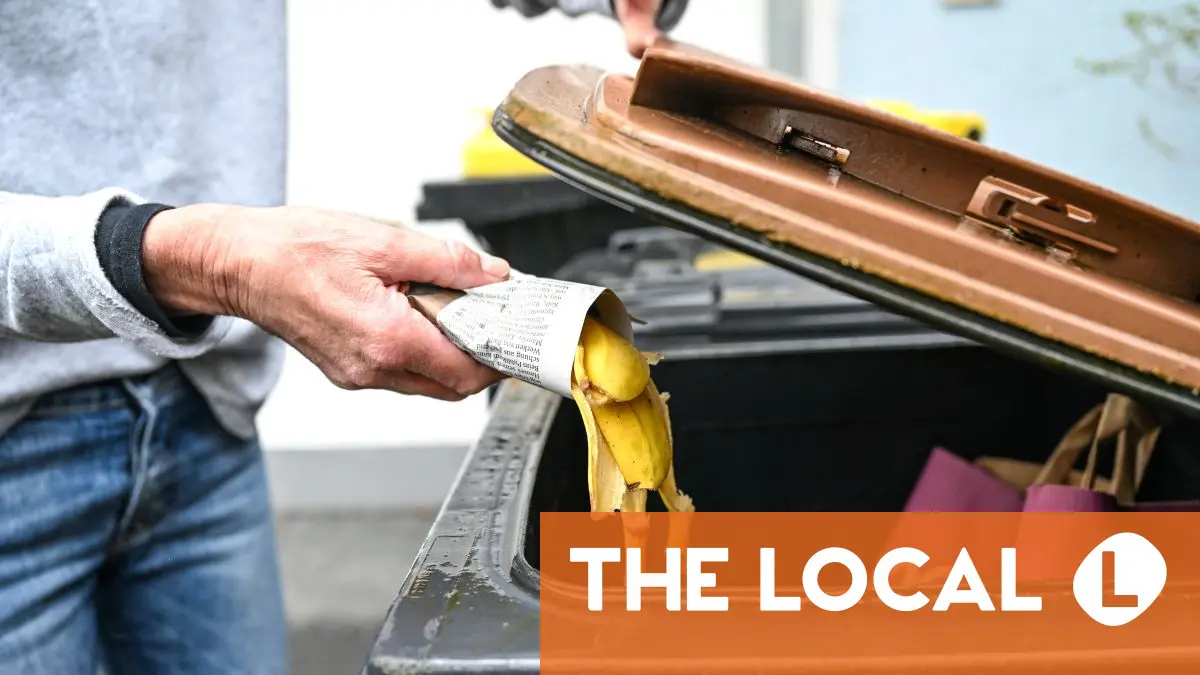
Waste management companies in around 40 German municipalities have plans to stop collecting biowaste bins that contain too many impurities. Here’s where enforcement is being tightened, and why you’ll want to sort your compost carefully.
Since May residents of Germany have been warned to take extra care in separating biowaste (Biomüll or Bioabfall), also called organic waste or compost. Specifically, high penalties of up to €2,500 were introduced that could be applied to households when plastic is found in the compost bin.
This change came as part of a new biowaste ordinance that was implemented nationwide.
As of September 15th, around 40 German municipalities are upping their enforcement of waste separation rules with plans to simply leave offending bins unemptied.
What are the current rules for biowaste?
The recent rule changes are intended to decrease the amount of other waste that ends up in the biowaste bins.
Plastic and metals in particular create problems when mixed into biowaste, because they don’t break down in the same conditions.
Other common contaminants include; glass, tin cans, nappies or diapers, cat litter, lacquered wood and leather. Bags made of “compostable” bioplastics are also not welcome, because they also don’t break down in standard industrial composting conditions.
Only food waste from the kitchen and green waste from the garden should go in a household biowaste bin.
The current rules maintain that in terms of weight, organic waste must not contain more than one percent plastic and no more than three percent of foreign substances in total.
Advertisement
Since earlier this year, offenders may face fines of up to €2,500 if plastic or other foreign objects are found in their biowaste bins. But in many parts of the country enforcement protocols have not necessarily been in place so far.
READ ALSO: Why Munich is planning to change its recycling rules
Now, a number of municipal waste companies around the country plan to hold offenders to account.
The remains of plastic and ‘bioplastic’ bags are seen in an industrial compost pile. Photo: picture alliance/dpa | Uli Deck
Bins left unemptied
According to German media reports, the Wirfeurbio association in Elmshorst – which represents a number of municipal waste companies – has said that going forward if a biowaste bin contains too much plastic or other impurities, it will not be emptied.
Checks are to be carried out in cities such as Lübeck, Göttingen, Magdeburg, Kaiserslautern and Ulm as well as in numerous districts across Germany.
In some cases garbage workers will be tasked with making a judgement call. In other places sensors on the garbage truck are set to detect the presence of impurities above the threshold.
Bins with too much of the wrong kind of waste will be returned to the street unemptied with a red tag or sticker. Residents must then take care to sort their waste better, or else the bin may later be disposed of as residual waste, which would cost €40.
It’s unclear if offending bin owners would also be slapped with further fines. But, in accordance with the new rules introduced in May, they certainly could be.
READ ALSO: Why you’ll have to take more care sorting your biowaste in Germany from May
Which cities are affected?
According to a report by Echo24, the following cities and districts can expect waste checks from September 15th:
- Bad Segeberg
- Delmenhorst
- Heidekreis
- District of Dithmarschen
- District of Pinneberg
- District of Schleswig-Flensburg
- District of Steinburg
- Emsland district
- District of Osnabrück
- District of Uelzen
- Lübeck
- Minden-Lübbecke
- Ostholstein
- Duchy of Lauenburg + Stormarn
- Dessau-Roßlau
- Goettingen
- Hattingen (Ennepe-Ruhr-Kreis)
- District of Göttingen
- Dorsten (Recklinghausen district)
- District of Gütersloh
- District of Paderborn
- District of Warendorf
- Magdeburg
- Main-Kinzig district
- Schmalkalden Meiningen
- Wetteraukreis
- Witten (Ennepe-Ruhr-Kreis)
- Alb-Donau-Kreis
- District of Alzey-Worms
- Aschaffenburg
- District of Aschaffenburg
- District of Böblingen
- District of Ebersberg
- Kaiserslautern
- District of Kaiserslautern
- Ulm
Advertisement
Proper sorting
Improperly sorted waste is often a problem at large apartment buildings. Here it can be impossible to discern who is responsible for a wad of foil in the compost, for example. But fines levied on the building can quickly add up to increased living costs if the landlord passes them on to the tenants, so it’s good to be proactive.
READ ALSO: ‘Nachzahlung’ – What are the rules around additional housing costs in Germany?
Incorrect waste management is often a consequence of ignorance. And a simple printed sign – especially one with images for easy comprehension – can help.
Keeping organic scraps out of the landfill is also important for reducing climate-harming greenhouse gas emissions. Food waste left in the landfill breaks down in a way that creates methane emissions, which have a much stronger greenhouse effect than carbon dioxide.









Discussion about this post