





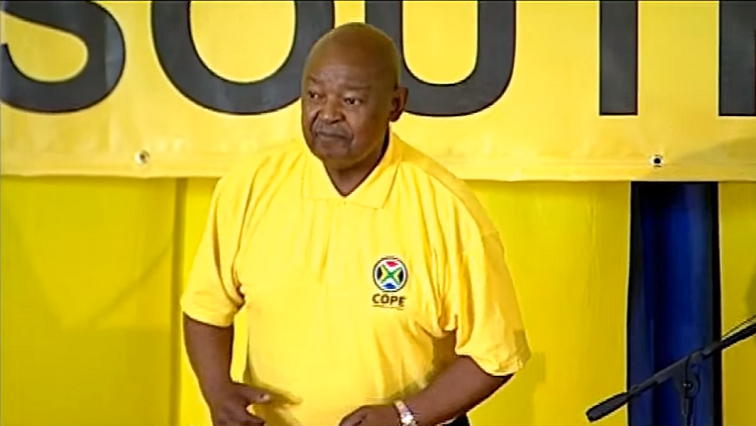
COPE co-founder Mosiuoa “Terror” Lekota has died at age 77.
We mourn the passing of Mosiuoa “Terror” Lekota, a devoted servant of our democratic transition and a comrade whose life was deeply intertwined with the pursuit of a free South Africa. To those of us who had the distinct honour of working alongside him—from the trenches of our first democratic elections to the complex theatres of the African continent—he was a principled partner in the painstaking, collective work of statebuilding.
Our collaborative work began long before our time in the Cabinet. Leading up to the historic 1994 elections, we worked closely together as the Deputy Coordinators of the African National Congress’s National Elections Commission. In those days of immense hope and logistical complexity, we learned the profound importance of dialogue between all South Africans. Terror understood that our liberation required not just mobilisation, but the meticulous, unifying work of bringing people from all walks of life into the democratic fold.
This shared understanding of collaborative reconstruction found its ultimate expression during our time in the executive. The facilitation of dialogue across the continent, and the pursuit of peace in the Great Lakes region, was spearheaded by the President of the Republic, Thabo Mbeki. It was the President’s driving vision of an African Renaissance that anchored our mandate. This continental mission was a profoundly collective effort carried out alongside dedicated colleagues in the executive. The relentless shuttle diplomacy of Dr. Nkosazana Dlamini-Zuma and the late Deputy Minister Aziz Pahad laid the vital groundwork, keeping fragile political dialogues alive. Upon that diplomatic foundation, Terror and I frequently found ourselves working side-by-side to translate the presidential vision into reality on the ground, particularly through the South AfricaDemocratic Republic of Congo Bi-National Commission between 2004 and 2006.
Crucially, we did not approach our work on the continent with a paternalistic mandate; rather, we worked in deep partnership with our Congolese and Burundian counterparts to assist in rebuilding their sovereign institutions. Terror grasped the critical importance of Disarmament, Demobilisation, and Reintegration. He knew that true stability required more than the cessation of hostilities—it required an ongoing commitment to dialogue
and the careful reintegration of former combatants into a cohesive, democratic framework.
While he worked closely with his counterparts in defence across the region to manage the complex Disarmament, Demobilisation, and Reintegration processes and secure the environment, my department (DPSA and SAMDI) worked concurrently alongside our Congolese counterparts to rebuild the civil service, map the public administration, and restore the state’s functional capacity. It was a mutual effort. Terror’s collaborative approach to securing the physical space allowed us all to rebuild the administrative heartbeat of the state together, proving that military stabilization and administrative state-building must walk hand-in-hand.
This shared success was not an isolated achievement; it served as a living proof of concept that fundamentally shaped continental policy. The hands-on lessons we learned in Kinshasa and Bujumbura directly informed the broader African Peace and Security Architecture. When the African Union gathered in Banjul, The Gambia, in July 2006 to adopt the landmark Policy on Post-Conflict Reconstruction and Development, the methodology we had championed was codified into continental doctrine. We had practically demonstrated to the African Union that peace cannot be sustained by
soldiers alone. Terror’s success in managing military integration, paired concurrently with our work to rebuild the civil service, proved exactly why the new policy had to mandate that security and administrative governance are inseparable.
He was, at his core, an uncompromising constitutionalist. He firmly believed that the military, the civil service, and political organizations must all remain subordinate to the Constitution. Whether he was facilitating dialogue among former adversaries on the continent or navigating the shifting political landscape here at home, his standard never
wavered.
We have lost a patriot, a colleague, and a man who understood that building a nation requires both the bravery to secure the peace and the humility to sit down and construct the state together.
Hamba kahle, Terror. You have served the Republic, and Africa, with distinction.






Discussion about this post