






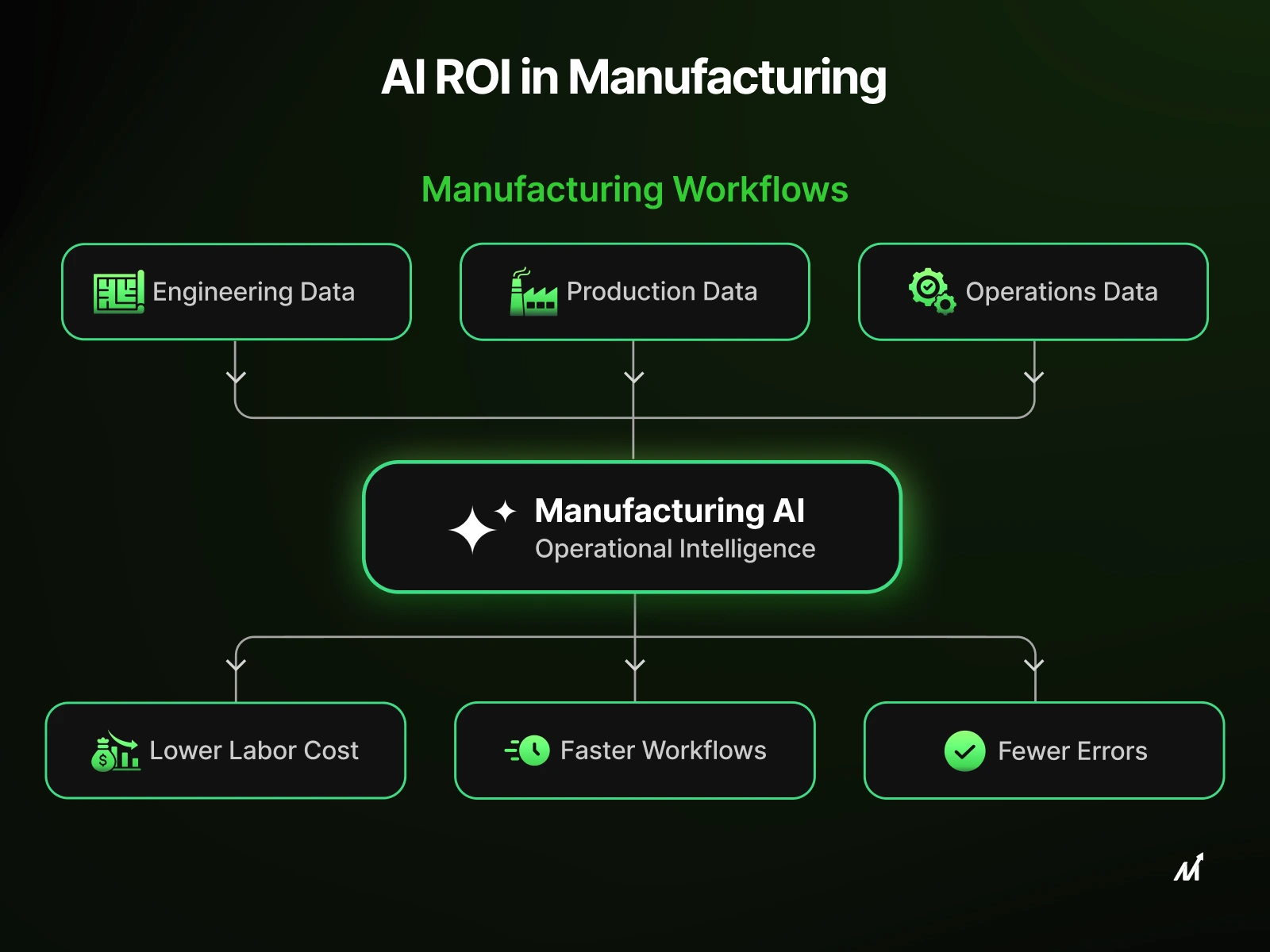
Manufacturing leaders are no longer asking whether AI works. They are asking something far more specific: what will it actually cost us, and what will we get back? That shift in the conversation signals a turning point. AI in manufacturing has moved from pilot programs and proofs of concept to board-level budget discussions, and the pressure to justify every dollar is real.
The challenge is that ROI in manufacturing is rarely straightforward. It hides inside slow workflows, manual errors, delayed quotes, and rework cycles that teams have simply learned to live with. When AI removes those friction points, the returns show up across engineering, operations, procurement, and production, all at once.
In this blog, we break down where AI delivers its highest return in manufacturing, what the numbers actually look like, and how manufacturers can build a credible ROI case before they invest. Let’s get into it.
What ROI Really Means in a Manufacturing Context
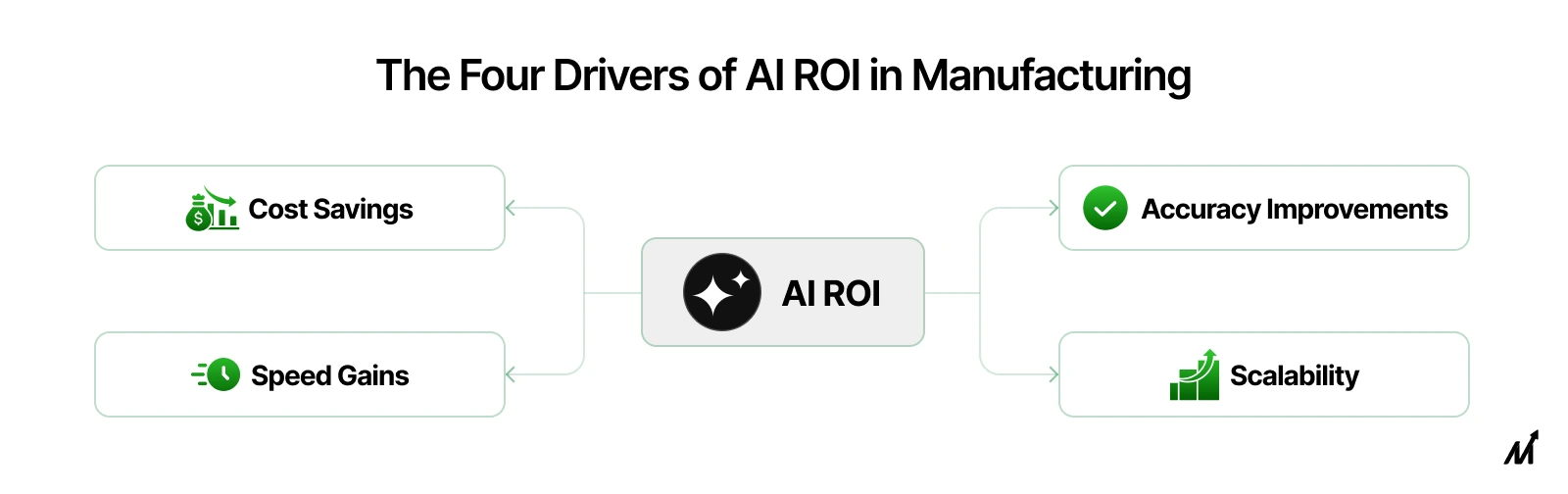
Return on investment in manufacturing AI is not a single number. It shows up across four dimensions, and the strongest business cases account for all of them.
- Cost savings are the most visible: fewer labor hours spent on manual data entry, less rework from interpretation errors, and reduced scrap from incorrect tolerance readings. These are measurable and often immediate.
- Speed gains are just as important but harder to quantify upfront. When a quoting team can respond to an RFQ in hours instead of days, or when a production plan gets finalized without waiting three rounds of drawing review, the downstream value compounds quickly, more bids submitted, more contracts won, faster time to revenue.
- Accuracy improvements protect the margin. A single misread GD&T callout or an incomplete bill of materials can trigger production delays, emergency sourcing, or costly rework. AI does not eliminate human judgment; it removes the variability that causes inconsistent outcomes between engineers, shifts, and teams.
- Scalability is where AI separates itself from traditional process improvements. A well-implemented AI system processes one drawing or a thousand with the same accuracy, without adding headcount. That is a different kind of ROI, one that grows as the business grows.
Understanding these four levers helps manufacturers move beyond vague ROI promises and identify where their specific operation stands to gain the most.
Where AI Delivers the Highest ROI in Manufacturing
Not every AI application delivers equal returns. The areas below represent the broadest and most consistently proven ROI opportunities across manufacturing, from engineering and quality to operations and sustainability. We go deeper into the workflows where blueprint intelligence plays a direct role.
1. Engineering Drawing Analysis and Blueprint Interpretation
Manual blueprint reading is one of the most persistent bottlenecks in manufacturing. Engineers zoom into PDFs, interpret GD&T symbols by hand, and record tolerances into spreadsheets — a process that is slow, inconsistent, and prone to error. When two engineers read the same drawing differently, decisions about machining, inspection, and costing diverge before production even begins.
AI-powered blueprint interpretation uses computer vision and language models to read drawings the way an expert engineer does — recognizing GD&T symbols, identifying features, extracting tolerances, and understanding relationships between components. The result is consistent, structured data in a fraction of the time, with far fewer errors reaching downstream teams.
2. BOM Extraction and Management
Bills of Materials are only as good as the data feeding them. When BOM creation depends on manual extraction from CAD files and technical drawings, small errors create large problems — wrong parts ordered, production delayed, procurement costs inflated.
AI BOM management automates extraction directly from engineering documents, linking components, quantities, and specifications accurately across varied formats and design styles. This removes the manual clerical layer that silently consumes engineering hours and introduces errors that ripple through the supply chain.
3. RFQ Automation and Quoting Speed
Winning a manufacturing contract often comes down to who responds first with a credible quote. Manual RFQ preparation, reviewing drawings, identifying features, estimating costs, and compiling the response can take days. AI accelerates this by delivering structured parts data directly from blueprints, enabling estimators to generate accurate quotes faster and handle more bids simultaneously.
4. Quality Inspection and Defect Detection
Traditional quality inspection depends heavily on manual review, which means accuracy varies across shifts, inspectors, and production volumes. Defects that go undetected at this stage are significantly more expensive to fix later, whether at final QC, during delivery, or through warranty claims.
AI-powered inspection systems analyze every unit against defined quality parameters in real time, flagging surface defects, dimensional deviations, and assembly errors consistently. For manufacturers in aerospace, automotive, and precision engineering, this also reduces compliance overhead by generating automatic traceability records for every inspection.
5. Predictive Maintenance
Unplanned equipment downtime is one of the most expensive events in a manufacturing facility. AI-driven predictive maintenance models analyze sensor data from machinery to flag potential failures before they occur, allowing maintenance teams to intervene proactively rather than reactively.
6. Production Scheduling and Capacity Planning
Manual production scheduling is a constant balancing act, and when it goes wrong, the cost shows up as idle machines, overtime labor, and missed delivery windows. AI scheduling systems optimize production sequences in real time, factoring in machine availability, workforce capacity, material lead times, and order priorities simultaneously.
For high-mix, low-volume manufacturers, common in aerospace, defense, and industrial equipment, this optimization can meaningfully reduce idle time and improve on-time delivery rates. The ROI is felt both in direct cost reduction and in customer retention, where delivery reliability is a competitive differentiator.
7. Demand Forecasting and Inventory Accuracy
Overproduction and underproduction are both expensive. Excess inventory ties up working capital and warehouse space; stockouts trigger expedited sourcing at premium cost and damage customer relationships. AI demand forecasting models analyze historical order patterns, market signals, and supply chain variables to produce significantly more accurate production and procurement plans.
For manufacturers managing hundreds of SKUs across multiple product lines, even modest improvements in forecast accuracy translate into meaningful reductions in carrying costs and emergency purchasing — two line items that erode profitability quietly but consistently.
8. Energy Optimization and Sustainability
Energy is one of the highest and fastest-growing operational costs for heavy manufacturers. AI energy management systems monitor consumption patterns across production equipment, HVAC, and facility systems, identifying optimization opportunities that manual monitoring consistently misses.
Beyond direct cost savings, this has growing relevance for US manufacturers facing ESG reporting requirements and customer-driven sustainability commitments. Demonstrating measurable energy efficiency improvements through AI has become both a cost management tool and a commercial advantage in regulated industries.
The Hidden Costs of Manual Engineering Workflows
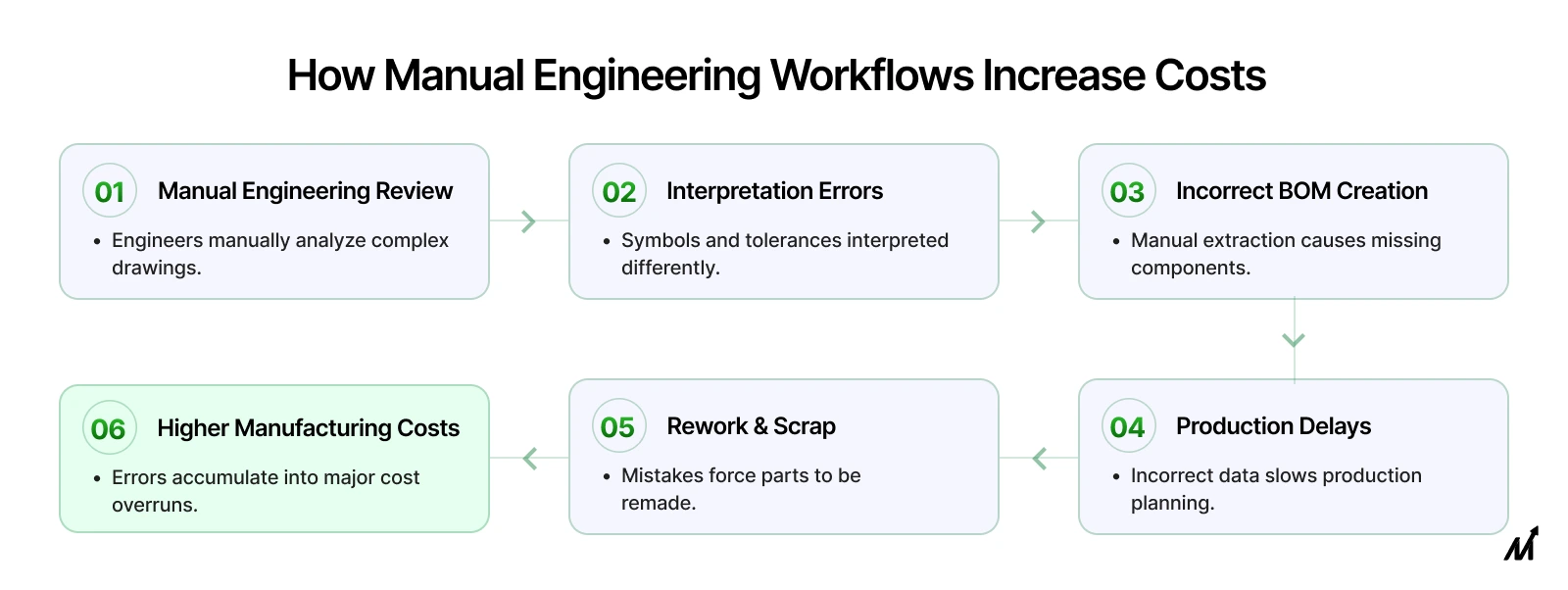
Before manufacturers can build an accurate ROI case for AI, they need to account for what manual workflows are already costing them. Most of these costs are invisible on a profit and loss statement — they show up instead as slow cycle times, lost bids, rework hours, and narrowing margins.
Consider a typical engineering workflow without AI:
- An estimator spends four to six hours reviewing a complex blueprint manually before producing a quote
- Two engineers interpret the same GD&T callout differently, leading to a machining setup that requires rework
- A BOM is compiled by hand from a CAD export and a PDF drawing — and a missed component causes a production line to wait on emergency sourcing
- A supplier dispute over tolerance specifications takes a week to resolve because the interpretation of the records is inconsistent
None of these appear as a line item labeled “manual process cost.” But they accumulate, bid after bid, drawing after drawing, until they represent a significant drag on profitability and competitiveness.
For a deeper look at how manual errors translate to financial impact, see our post on BOM discrepancies.
Real ROI Examples from AI in Manufacturing
Industry data now covers a wide enough range of AI applications that manufacturers can benchmark expected returns by workflow — not just rely on broad platform-level projections.
At the enterprise level, manufacturers applying AI across interconnected production workflows have reported significant three-year ROI, driven by compounding gains across quality, maintenance, scheduling, and engineering, not just isolated use cases.
Predictive maintenance implementations have demonstrated reductions in unplanned downtime of 30–50%, with maintenance cost savings of 20–25% from planned versus reactive intervention.
AI quality inspection has shown scrap rate reductions of 20–35% in automotive and electronics manufacturing, with warranty claim cost reductions that often exceed the direct inspection savings.
Demand forecasting improvements have reduced excess inventory carrying costs by 15–30% in high-SKU manufacturing environments, while improving fill rates and reducing emergency sourcing premiums.
At Markovate, our own implementations have delivered measurable outcomes across blueprint-driven workflows:
- 80% reduction in manual marking errors — minimizing mistakes that previously required costly rework cycles
- 30% faster plan reviews — compressing engineering timelines and accelerating project kick-offs
- 15% lower labor costs — reallocating skilled engineering hours from repetitive extraction tasks to higher-value work
These numbers reflect what happens when AI is applied to the specific workflows where manufacturers lose the most time and accuracy — not as a broad platform deployment, but as targeted, workflow-level automation.
To put this in practical terms: if an engineering team spends 30 hours per week on manual blueprint review and drawing extraction, a 30% reduction in review time saves roughly 9 hours weekly. At a fully loaded engineer cost of $75 per hour, that is $675 per week, or approximately $35,000 per year, from a single workflow improvement in a single department.
Challenges Manufacturers Face When Implementing AI
A realistic ROI discussion has to include what makes AI implementation difficult. The returns are real, but so are the obstacles.
Data quality and availability remain the most common barriers. AI systems trained on clean, well-annotated engineering documents perform significantly better than those working with inconsistent legacy data. Manufacturers with years of varied drawing formats, mixed file types, and undocumented revision histories need to account for data preparation as part of the implementation effort.
Integration with existing systems is the second major challenge. ERP, MRP, and PLM platforms vary widely in their openness to external data inputs. AI-generated BOM data or blueprint extraction outputs need a reliable path into these systems to deliver their full value. Without clean integration, teams end up maintaining parallel workflows — exactly the inefficiency AI was meant to eliminate.
Legacy drawing formats present a specific challenge in heavy manufacturing and aerospace, where decades-old prints, scanned PDFs, and non-standard annotation styles are common. AI models need to be trained on this variety to perform reliably, which requires domain expertise alongside technical capability.
Change management is underestimated. Engineering and estimating teams that have relied on manual workflows for years need to see AI as a tool that makes their work better, not a replacement for their expertise. Implementation that includes team involvement and validation builds adoption faster than top-down deployment.
How to Measure AI ROI Before You Invest
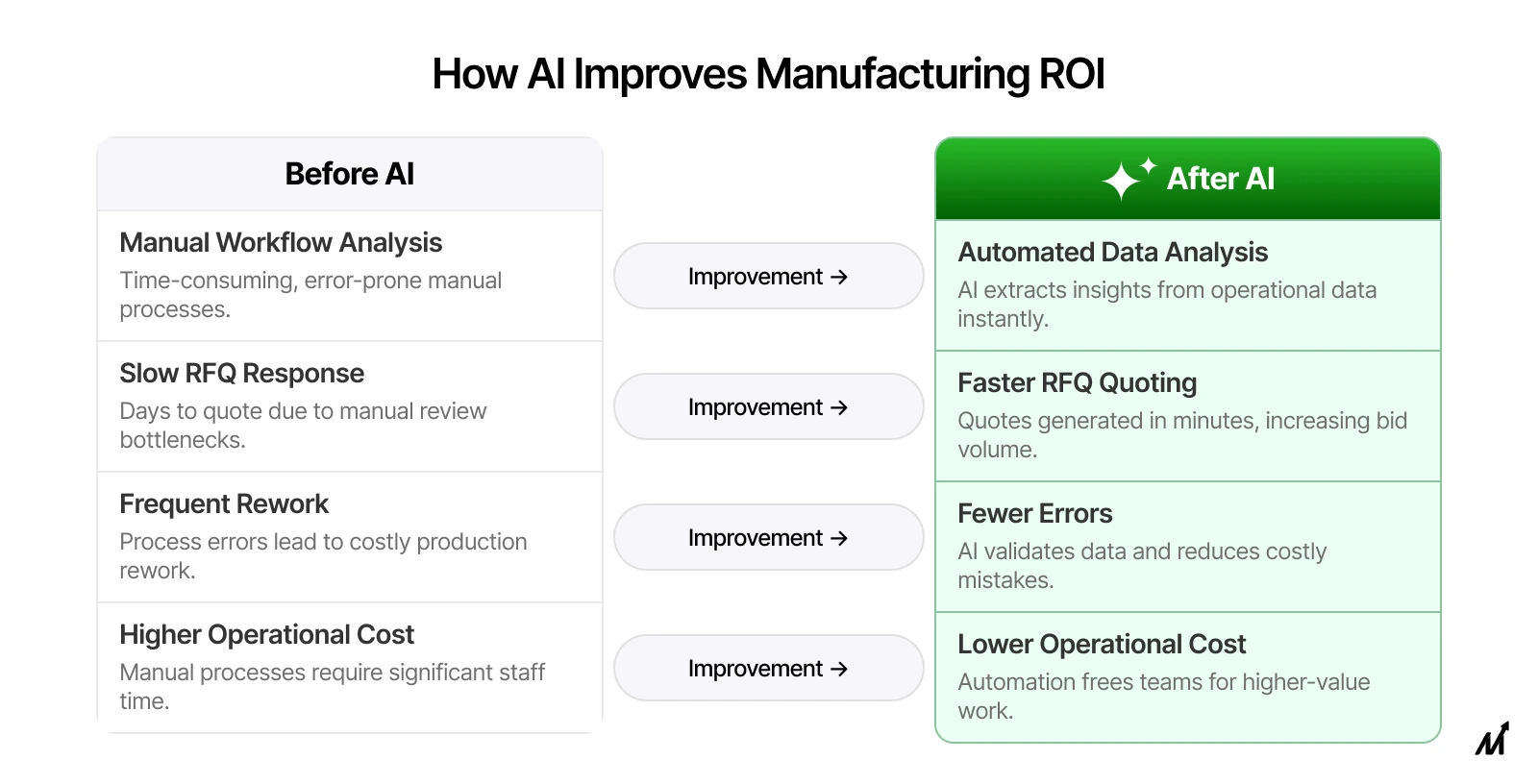
Manufacturers do not need to wait for implementation to build a credible ROI case. A simple workflow-level analysis can produce a reasonable estimate before any contract is signed.
| Workflow | Current Weekly Hours | Estimated AI Reduction | Hours Saved/Week | Annual Savings (at $75/hr) |
| Blueprint review & extraction | 30 hrs | 30% | 9 hrs | ~$35,100 |
| Manual BOM compilation | 15 hrs | 50% | 7.5 hrs | ~$29,250 |
| RFQ preparation | 20 hrs | 40% | 8 hrs | ~$31,200 |
| Drawing revision reconciliation | 10 hrs | 60% | 6 hrs | ~$23,400 |
| Quality inspection logging | 12 hrs | 45% | 5.4 hrs | ~$21,060 |
| Production scheduling adjustments | 8 hrs | 35% | 2.8 hrs | ~$10,920 |
This kind of analysis is not meant to be precise; it is meant to anchor the conversation in operational reality. When a manufacturer maps their own hours against these categories, the cumulative ROI case is often significantly stronger than any single workflow suggests on its own.
Beyond labor savings, the analysis should also factor in error costs (rework, scrap, delayed deliveries), revenue upside from faster quoting and better delivery reliability, and scalability value as production complexity grows.
How Markovate Helps Manufacturers Achieve ROI from AI
Among the ROI areas covered above, Markovate’s deepest expertise lies in the engineering and blueprint intelligence layer — the workflows that sit at the start of the manufacturing process and determine the accuracy of everything that follows.
At Markovate, we built the AI Blueprint Classifier specifically for manufacturers who need faster, more reliable insights from complex engineering drawings. Our solution combines advanced vision-language AI with deep manufacturing domain expertise to automate the workflows where ROI is highest — blueprint interpretation, GD&T compliance, feature recognition, and BOM extraction.
What Our Solution Delivers
- Automated GD&T Interpretation — reads tolerances, geometric controls, and feature callouts directly from drawings, eliminating manual extraction and interpretation variability
- Blueprint Parsing and Feature Extraction — identifies parts, assemblies, and relationships across scanned prints, CAD exports, and legacy formats
- Structured, Machine-Readable Outputs — ready for BOM generation, cost estimation, and RFQ workflows without additional manual processing
- Scalable and Consistent — processes one drawing or thousands with the same accuracy, ensuring enterprise-grade reliability across teams
Proven Impact
- 80% reduction in manual marking errors
- 30% faster plan reviews
- 15% lower labor costs
These outcomes are specific to blueprint and BOM workflows — and they compound when connected to downstream processes like quoting, procurement, and production planning. Manufacturers who start here build a data foundation that makes every subsequent AI investment more effective.
Manufacturing operations that implement AI at the workflow level — starting with blueprint interpretation and BOM management — build a foundation that scales across engineering, estimating, procurement, and production. That foundation is where durable, compounding ROI comes from.
Connect with us to explore how AI can improve ROI across your manufacturing workflows.
Conclusion
The ROI of AI in manufacturing is not theoretical; it is already visible in faster quote cycles, fewer rework events, more accurate BOMs, reduced defect rates, lower maintenance costs, optimized production schedules, and engineering teams that spend their hours on decisions instead of data entry. The manufacturers who see the strongest returns are not those who deploy AI most broadly, but those who identify the specific workflows where manual effort, error, and delay are costing them the most, and address those first.
Building the ROI case starts with an honest look at where time and money are actually going today. When that picture is clear, the value of AI becomes straightforward to quantify, justify, and act on.
FAQs: ROI of AI in Manufacturing
1. How long does it take to see ROI from AI in manufacturing?
ROI timelines vary depending on the workflow and implementation scope. Manufacturers that start with targeted automation, such as blueprint interpretation or BOM extraction, usually see measurable reductions in time and errors. These improvements often appear within the first few months of deployment. Broader enterprise-wide returns compound over one to three years as AI integrates deeper into production and procurement workflows.
2. Which manufacturing workflows deliver the fastest ROI from AI?
Predictive maintenance and quality inspection often deliver the fastest measurable returns. They address high-frequency, high-cost issues such as unplanned downtime and defect-related rework. Because of this, the before-and-after results are easier to measure. Engineering workflow automation, including blueprint interpretation and BOM extraction, also delivers fast ROI in operations where quoting speed and drawing accuracy directly affect win rates and production efficiency.
3. Does AI in manufacturing require replacing existing systems?
Not necessarily. Well-designed AI solutions integrate with existing ERP, MRP, and PLM platforms, adding an intelligent data layer rather than replacing core systems. The key is ensuring that AI-generated outputs, structured BOM data, extracted tolerances, and feature lists flow cleanly into the tools teams already use, so adoption is smooth, and the benefits are immediate.
4. Does AI ROI in manufacturing depend on company size?
Not necessarily. While large manufacturers have more data and more workflows to optimize, mid-size and smaller operations often see faster ROI because the impact of a single workflow improvement is proportionally larger. A 30% reduction in blueprint review time means more to a 10-person engineering team than to a 200-person department, and AI solutions today are increasingly designed to be deployable without massive IT infrastructure.









Discussion about this post