




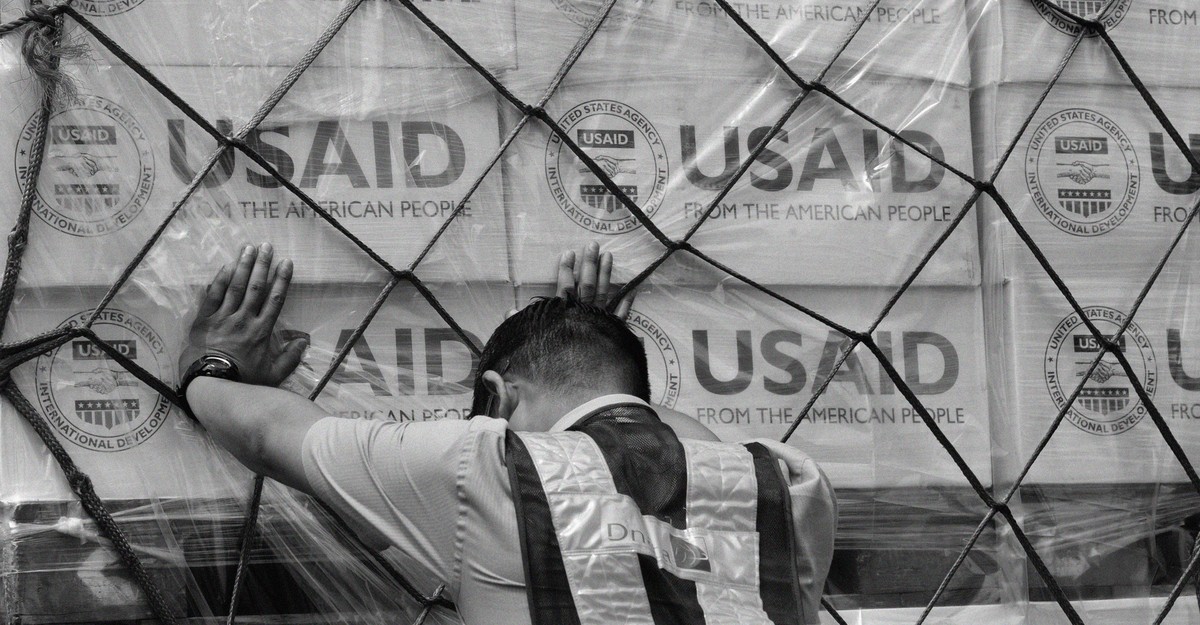
Last summer, the Dalai Lama was having a party in Dharamshala for his 90th birthday, and Bethany Morrison, a newly appointed State Department official, was eager to meet with him there. Inconveniently, the United States had recently canceled about $12 million worth of annual foreign aid benefiting Tibetan-exile communities as part of the implosion of USAID. This, Morrison and other State officials thought, would not make a particularly good impression on His Holiness, according to a former State and a former USAID official.
Prior to the Dalai Lama’s birthday, the two former federal employees told me, they had spent months lobbying for Donald Trump’s administration to restore at least some Asia-based aid projects. They had argued that these projects passed Secretary of State Marco Rubio’s new litmus test for overseas spending: They would make America “safer, stronger, and more prosperous.” Nothing changed. (Like other aid workers I spoke with for this story, the former employees requested anonymity because of fear of professional reprisal.)
But as the party’s date approached, Jeremy Lewin, the new head of U.S. foreign assistance at the State Department, was suddenly persuaded to resurrect aid to Tibetans, and had seemingly little regard for where, exactly, the money would be going, the former employees said. In a June email to other State Department officials, Lewin wrote that he wanted to “give some good news ahead of the trip.” Days before the party, the State Department allocated nearly $7 million to support Tibetan exiles in South Asia. (A State Department spokesperson, who did not give their name, told me in an email that many programs were paused in early 2025 as part of a foreign-assistance review “conducted to ensure that the American taxpayer’s hard-earned dollars were being spent efficiently” but declined to comment on the specific circumstances of Tibetan aid being reinstated ahead of the party.)
For the past half century, the U.S. has pursued, however imperfectly, a straightforward ideal of foreign aid that has been codified in laws passed by Democrats and Republicans alike: Resources should be deployed wherever they are needed most. Under this administration, funding for overseas aid is being evaluated by a different measure—using “dealmaking and transactions as near-exclusive metrics of success,” as the Center for Strategic and International Studies, a centrist think tank, put it in November.
Foreign aid has always, to varying degrees, been a political project, meant to accrue soft power by forwarding America’s vision for itself and winning over people abroad. In the past year, though, some aid agreements have been nakedly transactional (the U.S. helping finance malaria drugs in exchange for access to minerals, for instance); others, such as those that preceded the Dalai Lama’s birthday party, simply highlight how haphazardly programs have been picked for survival. The overall result is that, instead of being directed at where they can save the most lives, U.S. humanitarian efforts now seem to be aimed primarily at where they can advance the Trump administration’s other priorities.
When the Trump administration suddenly ended most foreign-assistance programs early last year, governments around the world had little time to adjust budgets or make contingency plans. This gave the U.S. new and pointed leverage over most other countries, which it seems eager to exploit. On July 1, the day that some remnants of USAID were officially absorbed by the State Department, Rubio wrote on Substack that the administration’s foreign-funding thinking “prioritizes our national interests.” Talking points distributed widely within the State Department around that time, obtained by The Atlantic, clarify that under the new “America First” approach, the department plans to award funding to two main types of aid: programs that are strategic and programs that are lifesaving. The talking points emphasize that both categories are “not global charity” but rather “a tool of strategic engagement.”
The State Department spokesperson did not dispute this characterization. “President Trump’s National Security Strategy is very clear: the United States will partner with select countries to reduce conflict and foster mutually beneficial trade and investment relationships, shifting from a traditional aid-focused approach to one that strategically leverages foreign assistance to support economic growth,” they wrote. They added that the U.S. “remains the most generous nation in the world for lifesaving humanitarian assistance.” Notably, the president proposed slashing foreign aid by 70 percent in fiscal year 2026; Congress quietly rejected the cut.
Some of the foreign aid disbursed in the second half of last year appears to have been straightforwardly treated as a bargaining chip. Another senior State official described the department’s approach to me as “Can we cut a tariff deal with this country? Okay, we’ll increase the aid going to them. Are there critical mineral rights that we would like to discuss?” Foreign aid might lubricate that conversation too. The State Department hasn’t been shy about this strategy: In a September memo to Congress, which I obtained after its existence was first reported in The Washington Post, the department says it intended to use foreign-assistance money to incentivize other nations to “support U.S. immigration priorities” and diversify “critical mineral supply chains.”
Weeks later, Equatorial Guinea, a small country on the west coast of Africa, agreed to accept U.S. deportees who are not its citizens; in return, it received $7.5 million from a government fund meant to assist refugees and victims of conflict. Eswatini and Rwanda have signed similar deals. Last month, the State Department made the release of funds to fight malaria, tuberculosis, and HIV in Zambia contingent on its government agreeing to terms “for collaboration in the mining sector” and other economic reforms. The Zambia health-financing agreement is one of more than 50 that the State Department plans to sign with low- and middle-income countries in the next few months. Earlier this month, Mike Reid, the chief science officer for the President’s Emergency Plan for AIDS Relief, acknowledged in a post on his personal Substack that the global-health deals put aside “long-standing, epidemiologically sound priorities” and are “transactional”—but he wrote that he ultimately rooted for their success.
Prior to this administration, the U.S. had generally distinguished a country’s government from its people when making aid decisions. The U.S. led the global effort to reduce the humanitarian crisis in Iraq caused by the near-total sanctions that had been levied on the country after President Saddam Hussein ordered the invasion of Kuwait. American taxpayers even fed North Korea during its late-1990s famine. “Showing that the United States stood in solidarity with the world’s most vulnerable people, regardless of what their government did or did not do, was kind of a goal in and of itself, as a projection of American values,” the senior State Department official told me. In some cases, that still appears to hold true: This month, for example, the U.S. announced that it is working with the Catholic Church to deliver food and supplies to Cubans, despite the State Department’s allegations that Cuba’s government sponsors terrorism and concerns about “diversion by the illegitimate regime.”
But neutrality as a rule in aid decisions “no longer exists,” the senior official said. Concerns about diversion and terrorism have been used to justify shutting down all assistance to Afghanistan and Yemen—countries where urgent intervention is needed to prevent deaths from malnutrition, according to the federal government’s famine data. And Rubio justified a muted response to Myanmar’s request for help after a major earthquake last spring in part because “they have a military junta that doesn’t like us.”
Meanwhile, countries that have a history of advancing U.S. security interests have been rewarded: Last month, for instance, as Rubio signed a deal contributing $1.7 billion to Kenya’s health system, he expressed his appreciation for the country leading a United Nations peacekeeping force in Haiti, a country the Trump administration hopes to stabilize to prevent would-be migrants from attempting the 600-mile trip to Florida. In April, funding was restored for a desalination plant in Jordan, a country where water scarcity is severe but relatively few people die for want of water—and that happens to be the U.S.’s main Arab ally, and is known to collaborate closely with the CIA. Jordan has benefited from its allyship before: In 2022, a federal watchdog determined that, by sending more funding for clean water and sanitation to Jordan than any other nation, the U.S. was subverting the spirit of the law. But if the old system was slanted by strategic interests, the new one has keeled over in pursuit of them. Jordan now appears to be the one of the only—if not the only—countries where the U.S. has reinstated a water-infrastructure project, despite having abandoned more than 20 half-finished drinking-water and sanitation systems around the world.
Sometimes, the administration’s vision of aid seems to be not “America First,” but “Trump First.” For example, in March, a Vietnamese official announced that work on a suspended USAID project to clean up toxic chemicals would resume, one day after Vietnam’s prime minister reportedly met with a representative of the Trump Organization. Soon after, Vietnamese officials argued that the organization should be allowed to skip meeting several legal requirements to begin constructing a new golf resort in Vietnam on an expedited timeline that would “capitalize on the support of the Donald Trump administration” and be more convenient for Trump’s son Eric, who planned to attend the ground-breaking in May. (The State Department spokesperson said that the chemical project was “a high priority for this Administration” but did not answer followup questions about the relationship between the project and the Trump Organization representative’s meeting with the Vietnamese prime minister. The Trump Organization did not respond to a request for comment.)
The Trump administration’s approach to foreign aid may gain more resources for the U.S. in the short term, but it also risks sacrificing other goals. The American intelligence community has long known that insurgent groups—many of which openly seek the destruction of the United States—rely on desperation, food insecurity, and hopelessness to gain recruits. USAID’s collapse has greased their efforts. The State Department spokesperson wrote that the department works with partner governments to “strengthen local security capabilities, improve intelligence-sharing, and disrupt terrorist networks before they can exploit instability.” But after U.S.-funded health and counterterrorism programs in Mozambique were cut last year, ISIS surged into the vacuum. When Trump hastily shut down all foreign aid to Afghanistan, the State Department said its “primary humanitarian objective” in the country was to prevent the resources left behind from going to terrorists. Instead, armored vehicles that American taxpayers had bought for humanitarian workers—along with 147 pieces of sensitive security equipment—were seized by the Taliban. (The State Department spokesperson did not directly address the incident. “The Trump Administration will not allow U.S. taxpayer dollars to be used to enable the Taliban’s heinous behavior,” they told me.)
The United States’ new approach to foreign aid brings the nation in line with authoritarian countries that have historically prioritized strategy over charity. Russia’s grain diplomacy functions with the understanding that food today means military bases tomorrow. China subordinates the goal of improving foreign populations’ health outcomes to establishing dependency on its medical tech. The Trump administration may not have wholly forsaken the extraordinary idea that the United States should spend money to save the lives of ordinary people in foreign countries. But it has trampled on the humanitarian pretense for doing so.






Discussion about this post