









As demand grows and carriers continue to add new routes and planes, they will need more flight crews to work them.

Taylor Rains/Insider
A significant labor source for airlines is flight attendants.
Robert Alexander/Getty Images
Consumer and market data company Statista says the North American aviation industry will need 170,000 cabin crew members over the next 20 years to keep up with demand.
Tunvarat Pruksachat/Getty Images
Source: Statista
Training includes everything from emergency procedures and self-defense to customer service and medical treatment.
Marielle Descalsota/Insider
Arriving at the center, I was impressed by the size of the facility, which had a reception area, classrooms, cabin mockups, and a large lounge area.
Taylor Rains/Insider
Anne-Maree O’Leary, ANZ’s cabin crew training manager, told Insider the site welcomes up to 120 new hires a month, with an average of 20 a week starting every Monday, though some weeks they have 40.
Taylor Rains/Insider
“We’re bringing intakes from off-the-street, so new into the aviation industry or they have worked for other carriers many years ago, but they aren’t rehires,” she said.
Taylor Rains/Insider
O’Leary explained that the number is significant because pre-COVID they were hiring about 200 crew members per year across all fleets.
Taylor Rains/Insider
Aspiring crew members must complete four weeks of vigorous training before working a commercial flight, which includes emergency procedures, first aid, security, and customer service.
Taylor Rains/Insider
While new hires go through the facility, current flight attendants will also visit for annual recurrent training to keep their certificates up to date.
Taylor Rains/Insider
Moreover, flight attendants who are upgrading to serving business class or becoming a flight lead will need specific training for the role.
Taylor Rains/Insider
Ground personnel, mechanics, and some engineers will also use the facility for various purposes.
Taylor Rains/Insider
The first stop on our tour was in the Cabin Emergency Evacuation Trainer, which employees named Athena.
Taylor Rains/Insider
The mock cabin resembles an Airbus A320 airliner, which is the workhorse of ANZ’s narrowbody fleet.
Taylor Rains/Insider
A320 aircrew trainer Melissa Gerritsen-Fridh told Insider that the cabin is a hybrid between two A320 variants, meaning the two sides of the cabin are slightly different.
Taylor Rains/Insider
ANZ also uses the cabin for some widebody training, but the company is soon getting a new, larger mockup that will have two aisles to replace its old widebody training cabins.
Taylor Rains/Insider
The A320’s several rows of seats mean the cabin could double as a training classroom to discuss the procedures and expectations.
Taylor Rains/Insider
There was also a galley area in the front and aft of the cabin…
Taylor Rains/Insider
…a cockpit with two pilot dummies at the controls…
Taylor Rains/Insider
…a lavatory, complete with one of ANZ’s signature wallpaper designs…
Taylor Rains/Insider
…overhead bins, only two of which could open and hold emergency equipment…
Taylor Rains/Insider
…TV screens for presentations and warnings…
Taylor Rains/Insider
…evacuation doors, which trainees must master how to use…
Taylor Rains/Insider
…a panel to control things like lights, doors, and temperature…
Taylor Rains/Insider
…and a station to simulate emergencies, like fires, water landings, and depressurization.
Taylor Rains/Insider
When the alarm sounded, crew members shouted specific commands, like “stay seated,” then one opened the door, and, in unison, they all instructed us to evacuate the plane.
Taylor Rains/Insider
We left through the left-side emergency door towards the aft of the airplane as smoke filled the cabin.
Taylor Rains/Insider
On the floor, ANZ has painted a slide to give a visual reference of what it will look like when deployed as passengers will use this to exit instead of just walking out.
Taylor Rains/Insider
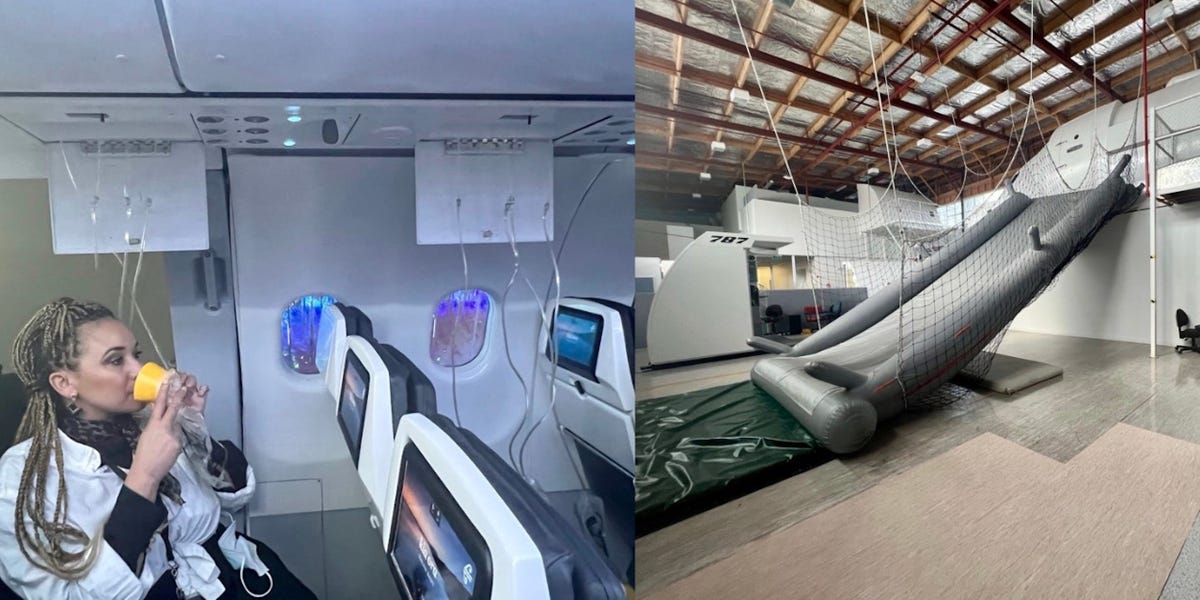
After we re-entered the mockup, Gerritsen-Fridh dropped the oxygen masks and a loud voice came over the speakers with instructions on how to use the them.
Taylor Rains/Insider
Unfortunately for the trainers, the masks do not automatically retract, so they have to manually put them back.
Taylor Rains/Insider
Trainers will also simulate anomaly events, like jammed evacuation doors and failed slide deployments to ensure flight attendants are ready for anything.
Taylor Rains/Insider
Because Athena is on the ground, trainees cannot actually deploy the slides, so that is done in a different room with an elevated cabin, which is the current widebody mockup.
Taylor Rains/Insider
Trainees will also learn how to operate the doors on widebody planes, including the Boeing 777 and Boeing 787.
Taylor Rains/Insider
O’Leary told Insider that customer service training is not required by law, but ANZ requires it annually to maintain a high standard of service.
Taylor Rains/Insider
ANZ has three medical trainers that are EMT qualified, meaning they are the best of the best for this highly important course. O’Leary said trainees can ask in-depth questions to give the context of why they perform certain treatments.
Taylor Rains/Insider








Discussion about this post