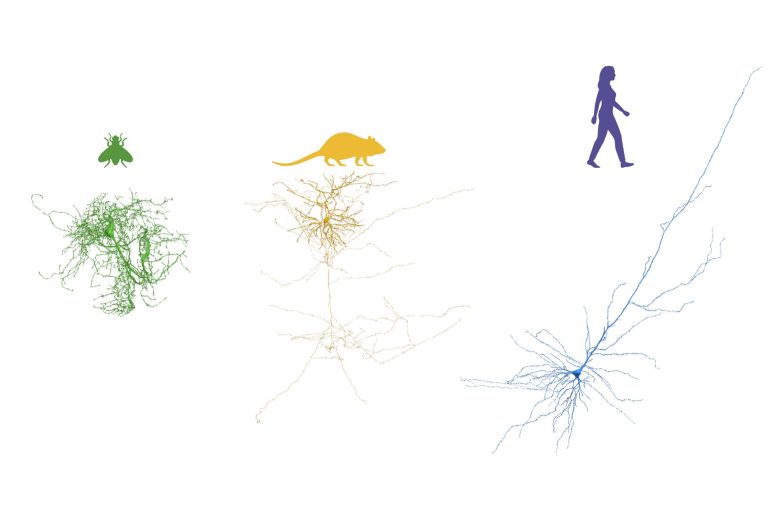
Researchers at Northwestern University have discovered that the structural features of the brain are near a critical point similar to a phase transition, observed in various species such as humans, mice, and fruit flies. This finding suggests a universal principle may govern brain structure, which could inspire new computational models to emulate brain complexity.
The brain exhibits structural criticality near phase transitions, consistent across 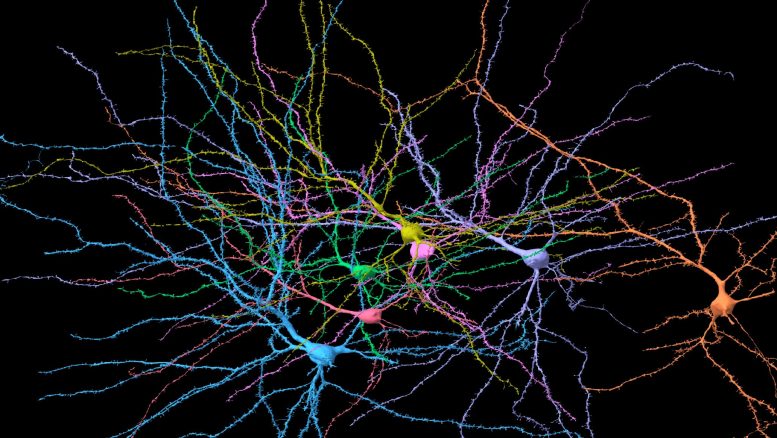
3D reconstruction of select neurons in a small region of the human cortex dataset. Credit: Harvard University/Google
Brain Structure and Computational Models
“The human brain is one of the most complex systems known, and many properties of the details governing its structure are not yet understood,” said senior author István Kovács, an assistant professor of physics and astronomy at Northwestern.
“Several other researchers have studied brain criticality in terms of neuron dynamics. But we are looking at criticality at the structural level in order to ultimately understand how this underpins the complexity of brain dynamics. That has been a missing piece for how we think about the brain’s complexity. Unlike in a computer where any software can run on the same hardware, in the brain the dynamics and the hardware are strongly related.”
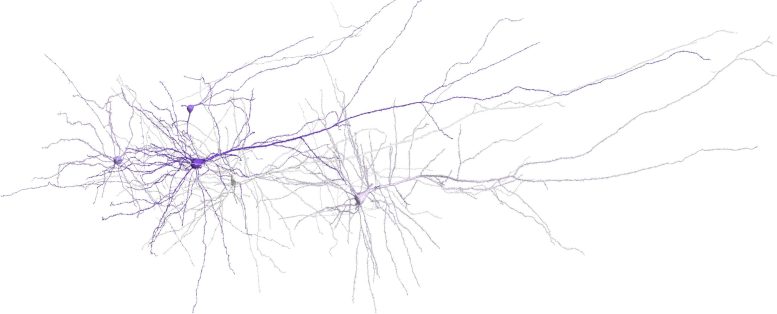
3D reconstruction of select neurons in a small region of the human cortex dataset. Credit: Harvard University/Google
“The structure of the brain at the cellular level appears to be near a phase transition,” said first author Helen Ansell, a Tarbutton Fellow at Emory University who was a postdoctoral researcher in Kovács’s lab during the study. “An everyday example of this is when ice melts into water. It’s still water molecules, but they are undergoing a transition from solid to liquid. We certainly are not saying that the brain is near melting. In fact, we don’t have a way of knowing what two phases the brain could be transitioning between. Because if it were on either side of the critical point, it wouldn’t be a brain.”
Applying Statistical Physics to Neuroscience
Although researchers have long studied brain dynamics using functional magnetic resonance imaging (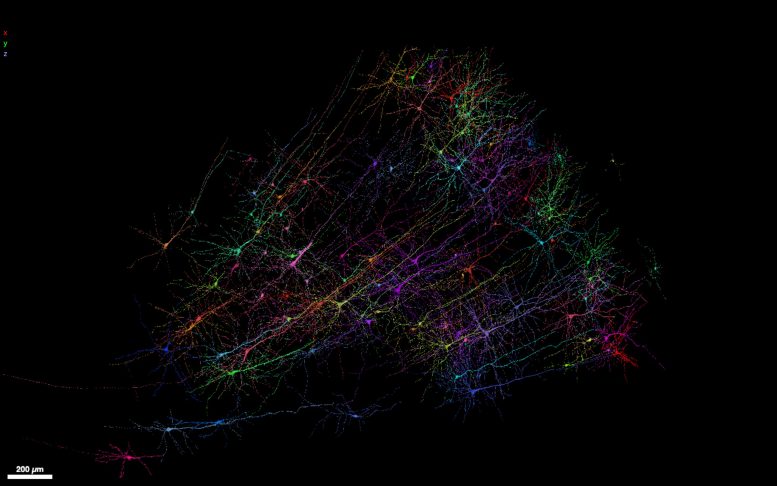
Snapshot of select neurons from the human cortex dataset, viewed using the online neuroglancer platform. Credit: Harvard University/Google