










The JOIDES Resolution in 2012 off the coast of Costa Rica, on an expedition to understand how earthquakes form
Arito Sakaguchi & IODP/TAMU via Wikimedia Commons
In July 2022, a football-sized, soft-sided UPS package from Germany arrived in my office mail room at the University of Wisconsin-Madison. I was expecting the package, but I was surprised at just how insubstantial it seemed. I thought a firm cardboard box or container reinforced with foam padding would arrive. After all, it contained 89 sediment samples that I’d need to carefully analyze to find out about the past behavior of continental ice sheets in the Northern Hemisphere.
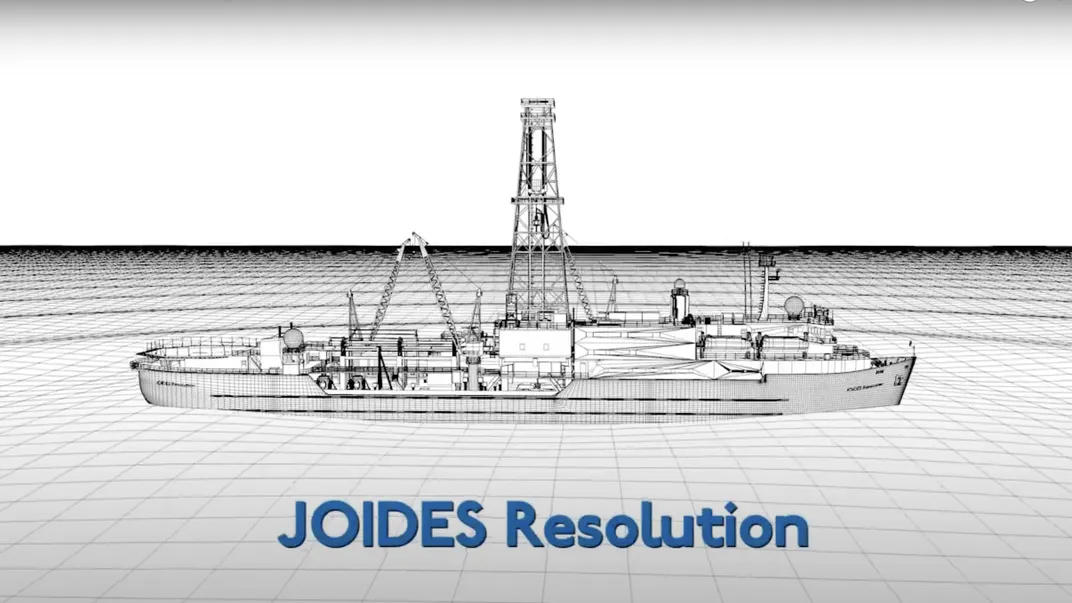
The sediment samples were quite valuable because of the cost of collecting them, but they were free to me as part of an international effort to learn more about the workings of our planet. These particular samples came from a deep-sea sediment core drilled out of the ocean floor in 2004 in the Labrador Sea, between Greenland and Canada, by the JOIDES Resolution, a specialized deep-sea scientific drilling ship run by the U.S.-led International Ocean Discovery Program.
Deep-sea scientific drilling is the process of retrieving cores, cylindrical tubes about 2.5 inches in diameter of both soft sediment and solid rock, from the material that makes up the ocean floor.
On the JOIDES Resolution, or J.R., as scientists who work on the ship call it, computer-controlled thrusters hold a precise position on choppy waves. Meanwhile, the crew assembles 30-foot sections of metal pipes into a long tube capped with a drill bit until it reaches the seabed. Once the structure contacts the ocean floor, the team sends hollow plastic tubes down the pipe, which fill with sediment and rock as the drilling commences.
The J.R. can drill in water up to about three and a half miles deep and then over a mile into the seafloor.
JR In a Minute Core Drilling
Onboard, teams of scientists working 12-hour shifts in the J.R.’s laboratories split open the tubes and begin to analyze the cores right away. Carl Brenner, who coordinates U.S. involvement in international scientific drilling efforts, says the scientists “descend on them like piranhas.”
After the J.R. docks following an expedition, the crew sends the cores to one of three international repositories—in Germany, Texas and Japan. Once the scientists on the expedition get the samples they need for their research, technicians archive the cores. Then, researchers can request pieces of a core, and approved samples are mailed out, like those that I received a couple years ago.
Unfortunately, the J.R.’s funding is expiring, and the ship won’t be drilling any new cores after this year for the International Ocean Discovery Program. While the ship’s exact future is uncertain, scientists will likely have to turn to new sources of deep-sea samples for their work.
The JOIDES Resolution set sail on its first expedition to collect scientific samples from the deep seafloor in January 1985. Since then, the J.R. has sailed on 194 expeditions, drilled at over 1,000 sites, and collected almost 250 miles of sediment and rock cores from beneath the seabed.
From those samples, scientists have confirmed the theory of plate tectonics, unraveled millions of years of Earth’s climatic history and found life in unexpected places.
“I always point out that journal Nature called it arguably the most successful international science collaboration of all time,” says Brenner, “and I think I think that’s a fair assessment.”
But, with domestic funding and international partnerships both dwindling, the J.R.’s current expedition in the Arctic Ocean will be its last as the flagship of the International Ocean Discovery Program.
The unexpected end comes years ahead of the scheduled expiration of the ship’s environmental impact statement, which offered a clean bill of health for the vessel until 2028. “Many in the community were sort of shocked by that decision,” says Maureen Walczak, a paleoceanographer at Oregon State University. “We sort of all assumed that it would continue to be supported through the end of that environmental impact statement.”
With no workhorse vessel to anchor the U.S.-led scientific seafloor drilling mission for at least the next 10 to 15 years, the future of the program is uncertain. Not since the Nixon administration kicked off the International Decade of Ocean Exploration for the 1970s has the U.S. been without a flagship drill ship.
Nick Pisias, a retired oceanographer at Oregon State University who sailed on his first scientific drilling expedition on the J.R.’s predecessor and served as head of the drilling program in the late 1990s, says the decision to dock the J.R. leaves the scientists who work with deep-sea samples in the lurch. “What would happen if you took all the observatories away from the astronomers?” he asks. “The impact of the drilling program to the earth science community has been huge.” If the J.R. does not somehow gain new life, researchers will still have access to other, smaller drill ships. But the unique capabilities of the J.R. cannot currently be replicated by any other vessels.
When the J.R. became the primary vessel of U.S. deep-sea scientific drilling in the mid-1980s, the field had already been developing for several decades. In 1961, the writer John Steinbeck sailed aboard the first major U.S. scientific drilling operation, called Project Mohole. The CUSS I, filled with scientists and technicians, drilled about 600 feet into the ocean floor near Guadalupe Island in the Pacific Ocean. For the first time, scientists penetrated the soft sediments that blanket the seabed and into the solid crust that lies beneath it. Samples taken during that groundbreaking discovery are now held in the collection of the Smithsonian’s National Museum of Natural History.
This accomplishment proved scientific drilling could be successful, and in 1966 the National Science Foundation signed a contract to fund the Scripps Institution of Oceanography in San Diego to lead U.S. drilling efforts. This program, called the Deep Sea Drilling Project, was carried out aboard the Glomar Challenger.
The Challenger made its first scientific sojourn in fall 1968. On its third expedition, in spring 1970, it confirmed a then paradigm-shifting understanding of how the Earth works: the theory of plate tectonics. At the time, only indirect measurements of the ocean floor supported the now common idea that new ocean crust was created at mid-ocean ridges, pushing the continents apart and leading to the processes that create deep ocean trenches, volcanoes and mountains.
But, says Brenner, the samples collected through deep-sea drilling in the middle of the Atlantic Ocean directly showed the planet’s surface was made of tectonic plates that split apart, grinded against each other, and dramatically collided. “It wasn’t until we actually drilled those sediments,” he says, “that it was proven.”
The Challenger made its final voyage as the United States’ primary drill ship in November 1983. By that time, drilling technology had improved to the point that it made sense to upgrade to a larger, more advanced platform—the JOIDES Resolution—in 1985.
The J.R. drilled deeper than the Challenger, and it didn’t churn up the sediment and its original structure. Since ocean sediments settle to the bottom of the sea in layers, newer sediment buries and preserves older material. These layers contain information about what conditions were like in the atmosphere, on land and in the ocean.
These advances in deep-sea scientific research have allowed scientists to reconstruct a clear image of the history of the planet’s climate going back millions of years. “The wealth of information you can get from [deep-sea scientific drilling] is incomparable to anything else,” says Walczak.
A drill bit from the J.R. The bit surrounds the hole where deep-sea cores are collected and retrieved through a pipe. UCL Mathematical & Physical Sciences from London, UK via Wikimedia Commons under CC BY 2.0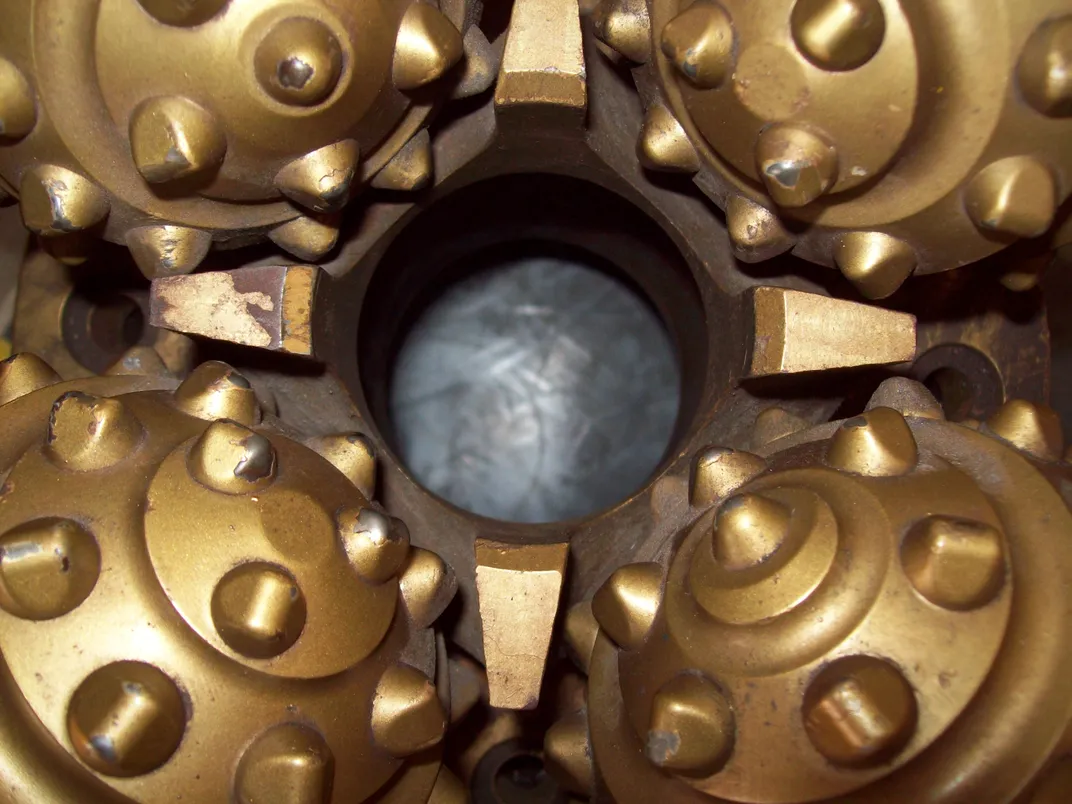
Walczak knows the value of the J.R.’s capabilities based on personal experience. In the late 2000s, Walczak was working on her PhD analyzing a 40-foot-long sediment core taken from the Gulf of Alaska by another ship. The core was just a fraction of the depth of sample the J.R. could extract from the seabed. She used samples from that core to reveal new details about how the western United States and Canada responded to the warming at the end of the last ice age. The sample allowed her to look back 15,000 years.
Then, in 2013, Walczak sailed as a scientist on the J.R. The expedition returned to the site of the smaller core, with the goal of going even deeper down in the seafloor and thus further back in time. Almost immediately after the drill reached the seabed at the site, the crew pulled up the first of many sections of core. Already, they’d drilled as deep as the entire core Walczak previously worked with.
“Then they shot another core, and then another core, and then another core, and they just brought up 90 to 100 meters of seafloor, and all of it was unexplored,” Walczak says, “it kind of blew my mind.”
The crew drilled deep enough at that site to get about 50,000 years of high-resolution information about the climate and history of the mountainous areas of North America that drain to the Gulf of Alaska.
And the J.R. has been the vessel for discoveries far beyond those tied to understanding the Earth’s past climate. Over the course of the ship’s journeys, scientists have unexpectedly found living microbes buried under almost a mile of sediment, gained insights into origins of life at hydrothermal vents, found direct evidence of the impact crater from the meteorite that killed the dinosaurs, and discovered data to help better predict coastal earthquakes and tsunamis. Nevertheless, a funding shortfall is making the continuation of the program in its current form untenable.
Currently the U.S., through the National Science Foundation (NSF), contributes about $48 million each year to the J.R., which costs $72 million annually to operate. The remainder is supposed to be made up by international partners. The problem, says Brenner, “is that their contributions have been declining, and so NSF can’t afford to do it on its own.”
Last year the National Science Foundation decided to end the agreement that funds the scientific use of the privately owned J.R., making the current expedition its last for the program. “For want of a few tens of millions of dollars,” says Brenner, “it’s a painful loss.”
Lauren Haygood, a doctoral candidate at Oklahoma State University, planned to be onboard the J.R. for this voyage. Unfortunately, a last-minute illness forced her to get off the ship just before it left port. But she’s still actively involved in the research and working closely with those onboard. She says the scientists involved with this expedition are acutely aware it will be the last for this program—though whether the vessel could continue somehow in another arrangement, at least through the expiration of its environmental impact statement in 2028, is unknown.
What the plan for deep-sea scientific drilling for American scientists will look like in the future isn’t yet clear. Brenner says the National Science Foundation plans to continue supporting different forms of scientific drilling at the same level, $48 million, in the short term.
In the long term, conversations about funding the creation of a new, replacement vessel for the U.S. scientific community are ongoing. “You’re talking 12 to 15 years for something like that,” Brenner says. “We can’t afford to wait that long to acquire new core. We need to figure out a way to keep the momentum.”
Without a dedicated vessel, like the J.R., researchers will contract other, smaller, research vessels on an individual basis. “Hopefully, as many as two or three a year if the money goes that far,” Brenner says. But these ships won’t have the full suite of onboard scientific laboratories boasted by the J.R.
Both Brenner and Walczak stress that scientists are going to get creative and develop new technologies that enhance the capabilities of sampling the depths of the seafloor. They point toward the development of robotic seafloor landers that might be able to drill in hard-to-reach places. Other scientists, like me, will turn to the vast archives of cores retrieved by the J.R. to ply them for answers.
In the meantime, in a world with a changing climate spurred by the burning of fossil fuels, Walczak says, understanding how the Earth responded in the past to abrupt climate change by looking at deep-sea sediments is more important than ever.
This crucial expedition of the J.R. illustrates her point. The goal is to gather evidence of past ice sheet retreat in the Arctic in hopes it will help us better understand the glaciers currently melting in Antarctica. “That could give us more insight into sea level rise and climate,” says Haygood, “and what might happen in the future.”









Discussion about this post