
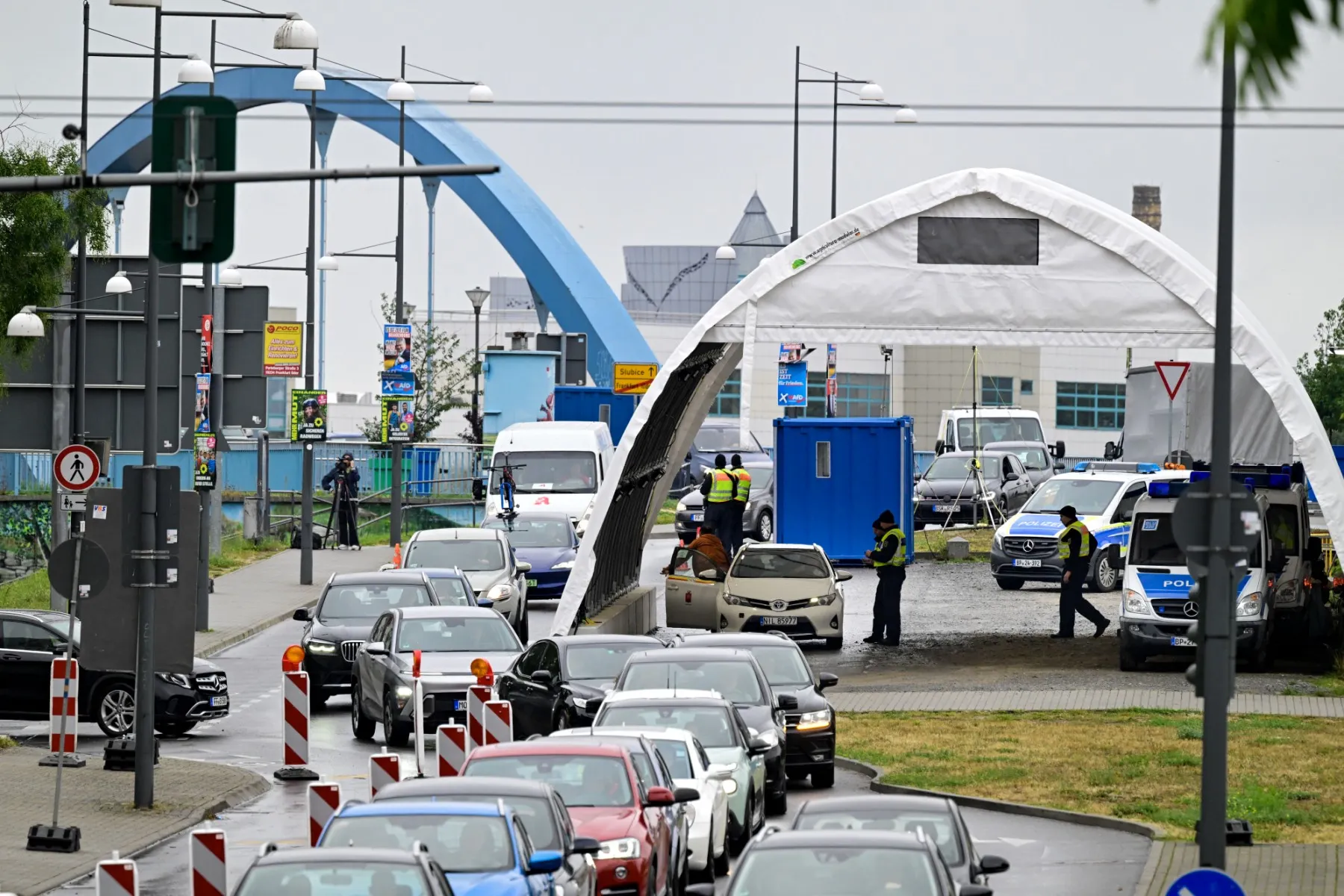
Germany, along with a number of its neighbours, has recently introduced stricter border checks, which will likely result in longer journey times, especially if travelling overland by road or rail this summer.
What’s happening?
Germany has had reinforced border checks in place at all land borders since autumn 2024. This shift was initially introduced under then-Interior Minister Nancy Faeser (SPD) as a temporary six-month measure.
The checks are aimed at enforcing the new government’s policy of pushing back anyone trying to enter Germany without the necessary documents, including most asylum seekers.
However, since the government changed in spring 2025, Faeser’s successor, Alexander Dobrindt (CSU), has significantly expanded the policy.
Germany now carries out checks at all land borders. Hundreds of additional police officers have been stationed at key crossings, particularly busy ones such as Frankfurt an der Oder (Poland) and Kiefersfelden (Austria).
The new measures include mobile units and temporary checkpoints, including at minor crossings. These changes are expected to remain in place for the foreseeable future.
Advertisement
Every land border is affected. German authorities have imposed additional checks at the borders with France, Denmark, Belgium, the Netherlands, Luxembourg, Poland, the Czech Republic and Switzerland. In addition, Germany has been carrying out spot checks at the border with Austria since 2015.
READ ALSO: Which European countries currently have extra border checks in place?
The enhanced checks mean many travellers going into Germany are asked to present documents – a situation the creation of the borderless Schengen Area was meant to avoid.
What about Germany’s neighbours?
Two states bordering Germany have imposed similar restrictions. In the Netherlands, Dutch authorities are conducting random checks along the border with Germany. Checks also occur on some international trains and flights.
In France, authorities have imposed random checks on travellers entering by road, air, rail and sea.
Advertisement
Free movement continues into Germany’s seven other neighbours, according to the EU Commission. In practice, that means that travellers coming from Denmark, Belgium, Luxembourg, Poland, the Czech Republic, Austria and Switzerland will likely only be checked going into Germany.
What do the enhanced checks mean for me?
Travellers planning a holiday abroad this summer should expect identity checks and delays, particularly if travelling by land.
Commuters and frequent travellers may face delays, especially at major crossings during peak times. Wait times of over 30 minutes at road crossings are becoming increasingly common, according to motoring groups.
Major delays have been reported at road crossings including:
- Suben (Austria)
- Walserberg (Austria)
- Kehl (France)
- Breitenau/Schönwald (Czech Republic)
- Frankfurt an der Oder (Poland)
- Konstanz (Switzerland)
Even smaller border towns like Selb, Schirnding, and Waidhaus (all on the Czech border) are seeing longer wait times.
Trains may also be stopped at the border, while arrivals on flights from Schengen countries may also be checked.
What documents do I need?
If stopped, you’ll need to present a passport or ID card valid for at least three more months. If you are a non-EU national resident in Germany, it’s a good idea to have your residency card or visa to hand too.
This rule applies regardless of whether you’re traveling by road, rail, or air.
Why are controls back?
The Schengen Agreement, signed in 1985, aimed to abolish border checks among many EU states.
However, it allows governments to reimpose controls when they deem public security to be at risk.
States including Germany, France, and the Netherlands now argue that current levels of illegal migration justify such measures.