
To many young Egyptian-Canadians in Canada, the World Cup meant more than cheering for Egypt. It was about how watch parties across the Greater Toronto Area transformed into spaces of connection, cultural pride and rediscovery.
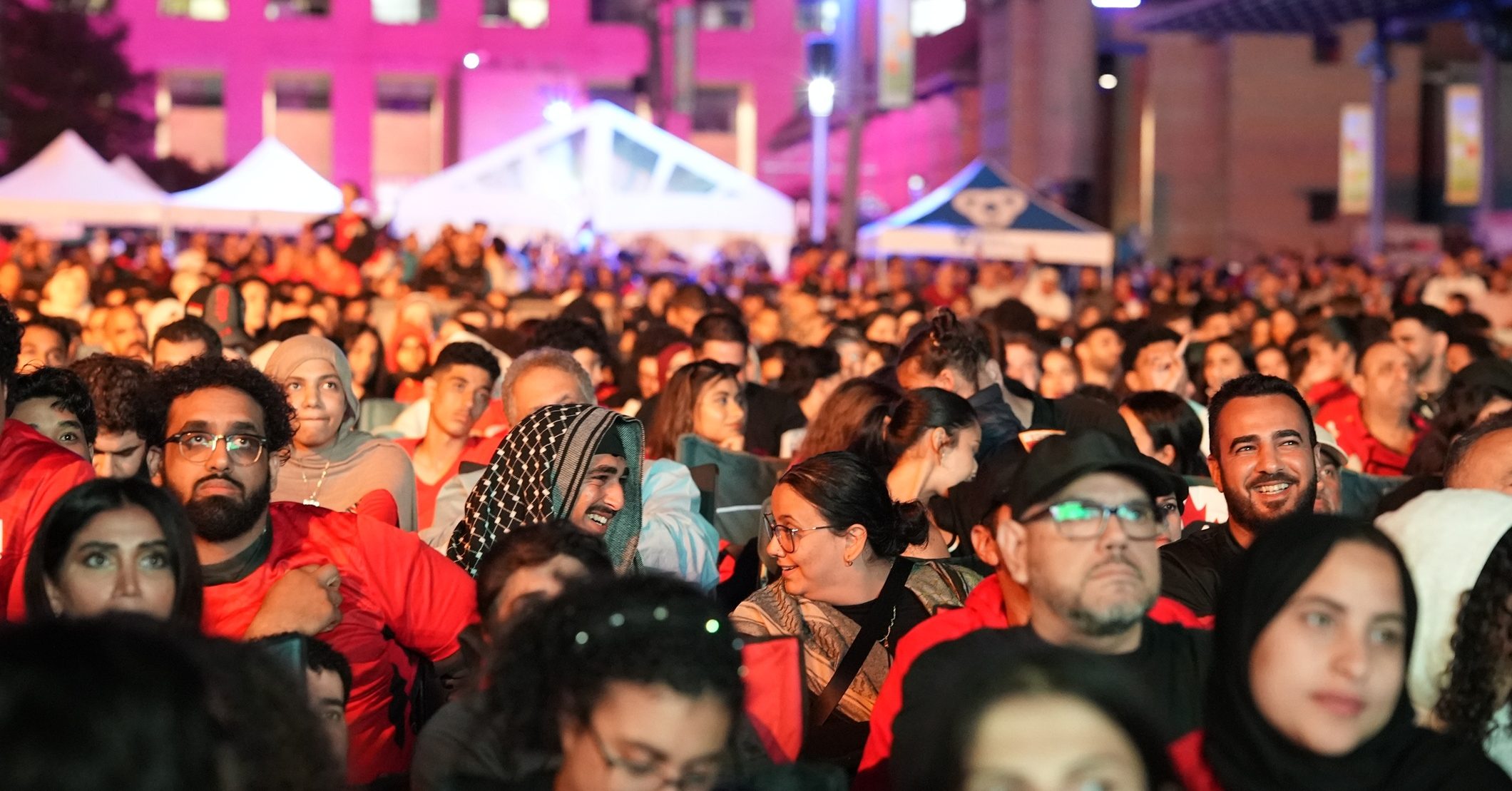
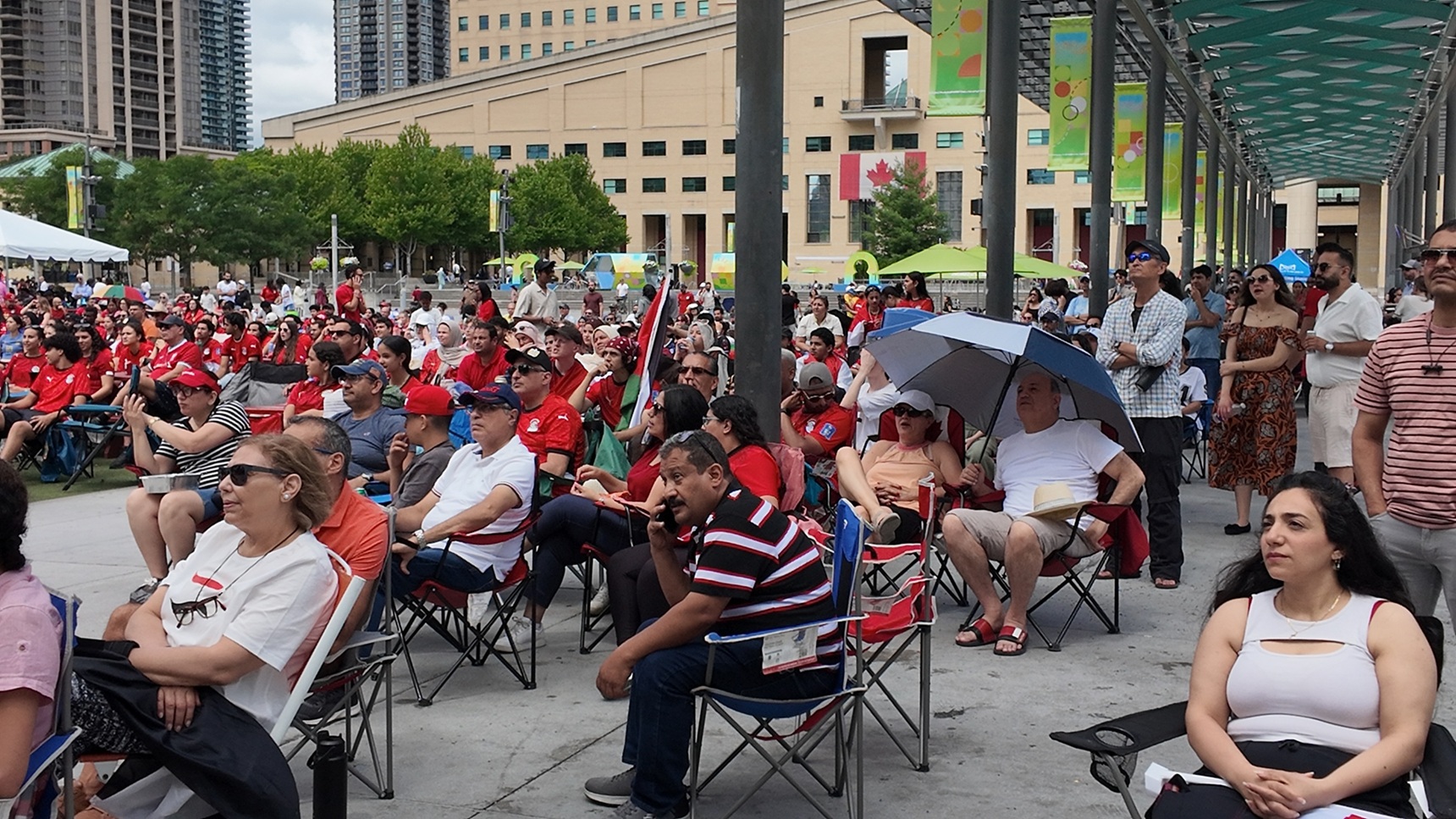
Children waved their little flags as Arabic chants echoed across Mississauga Celebration Square. Friends greeted one another with hugs before posing for photos, their shoulders draped in red, white and black, while thousands of supporters packed the square to watch Egypt face Iran at the FIFA World Cup.
Then came a moment that brought the square to a standstill. Iran appeared to score a second goal. Then came the wait. Thousands stood frozen, eyes fixed on the giant screen as the goal was being reviewed. That did not last long as the Video Assistant Referee (VAR) ruled the goal offside, and the crowd erupted.
“We were all waiting in anticipation to see if the VAR thought it was offside or not,” said Egyptian, Toronto-born Tamara El Shawish. “Everyone was just hanging on, seeing if it was gonna happen. When they said it was offside, the crowd went wild. That was the best part, to be honest.”
Across the Greater Toronto Area, similar scenes unfolded throughout Egypt’s World Cup run. What began as modest gatherings inside restaurants and cafes quickly expanded into celebrations that filled public squares with thousands of supporters. In Brampton City, more than 2,000 people packed Garden Square, dancing to Egyptian music played by DJ WIWA as Egypt secured a historic place in the round of 32 after a draw against Iran.
But the gatherings meant a lot more than observing football. The watch parties provided something that many young Egyptian-Canadians had not anticipated. Thousands of kilometers away from home, it was an opportunity to reclaim a connection with their culture and discover the true extent of the community that makes them feel like they belong.
“For a few hours, it didn’t feel like Mississauga. It felt like Cairo,” said Mariam Ihab, a 24-year-old content creator who moved to Canada at 14.
Those moments of belonging did not happen by luck. Behind every sea of red jerseys filling watch parties were organizers who found themselves scrambling to keep up with a demand they never expected. As Egypt advanced in the tournament, the challenge was finding a space that was large enough to hold the fans, rather than inviting people to attend.
No one experienced that more than Mohamed Salah, owner of Masrawy, a restaurant that became the starting point for gatherings, soon outgrowing every venue available.
The watch parties began inside the restaurant before expanding onto the patio and into the parking lot. As Egypt continued winning, attendance surged. One proposed venue attracted about 2,000 registrations within 24 hours, before permit issues forced organizers to relocate. A second location reached roughly 4,000 registrations in just 30 minutes before logistical challenges caused that plan to collapse.
“I was getting ready to announce to people, ‘I’m sorry, I have failed you. I couldn’t secure a location big enough to support all of these people who wanted to cheer on Egypt together,’” said Salah.
Facing the possibility of cancelling the event altogether, Salah contacted Mississauga Mayor Carolyn Parrish late in the evening. By the next morning, the city had agreed to host the watch party at Celebration Square. At the same time, Brampton approved a second watch party at Garden Square that was temporarily renamed “Egypt Square” by Mayor Patrick Brown.
“No one, and I mean no one, could have foreseen 10,000 people showing up to Celebration Square… It wasn’t because of us. It was because we all wanted a place to be together.”
The overwhelming turnout transformed what began as grassroots watch parties into a civic event.
To accommodate the gathering, Mississauga made an exception to its usual policy prohibiting projections after 11 p.m, allowing the watch party to continue at Celebration Square. According to Mayor Parrish’s office, the event generated no known complaints and contributed to “civic spirit and community building.”
The decision revealed that the Egyptian community was not recreating Egypt inside Canada. It was making its presence visible within Canadian public life.
The power of the watch parties at Celebration Square served as a reveal of the size of a community that a younger generation of the Egyptian diaspora in Canada had not fully realized existed.
“I think the momentum is going to carry. A lot of people might have only just discovered how big the Egyptian community is in the area through the games,” said Ezzeldin Al Zokm, co-president of Toronto Metropolitan University’s Egyptian Students’ Association (TMU ESA).
“Maybe they’ve never been exposed to Egyptian events, and they just pulled up to Celebration Square one day and saw thousands of people there watching the game, and that might have piqued their interest,” he added.
He believes the tournament permanently changed expectations for future community events. “I really think that from here on out, Egyptian community events are going to be a lot bigger.”
For some, however, finding that community had never been easy. Growing up in Scarborough district in Toronto, El Shawish said she rarely encountered other Egyptians.
“I live in Scarborough, not Mississauga, where all the Egyptians live, so it’s hard to find Arabs in general, let alone Egyptians.”
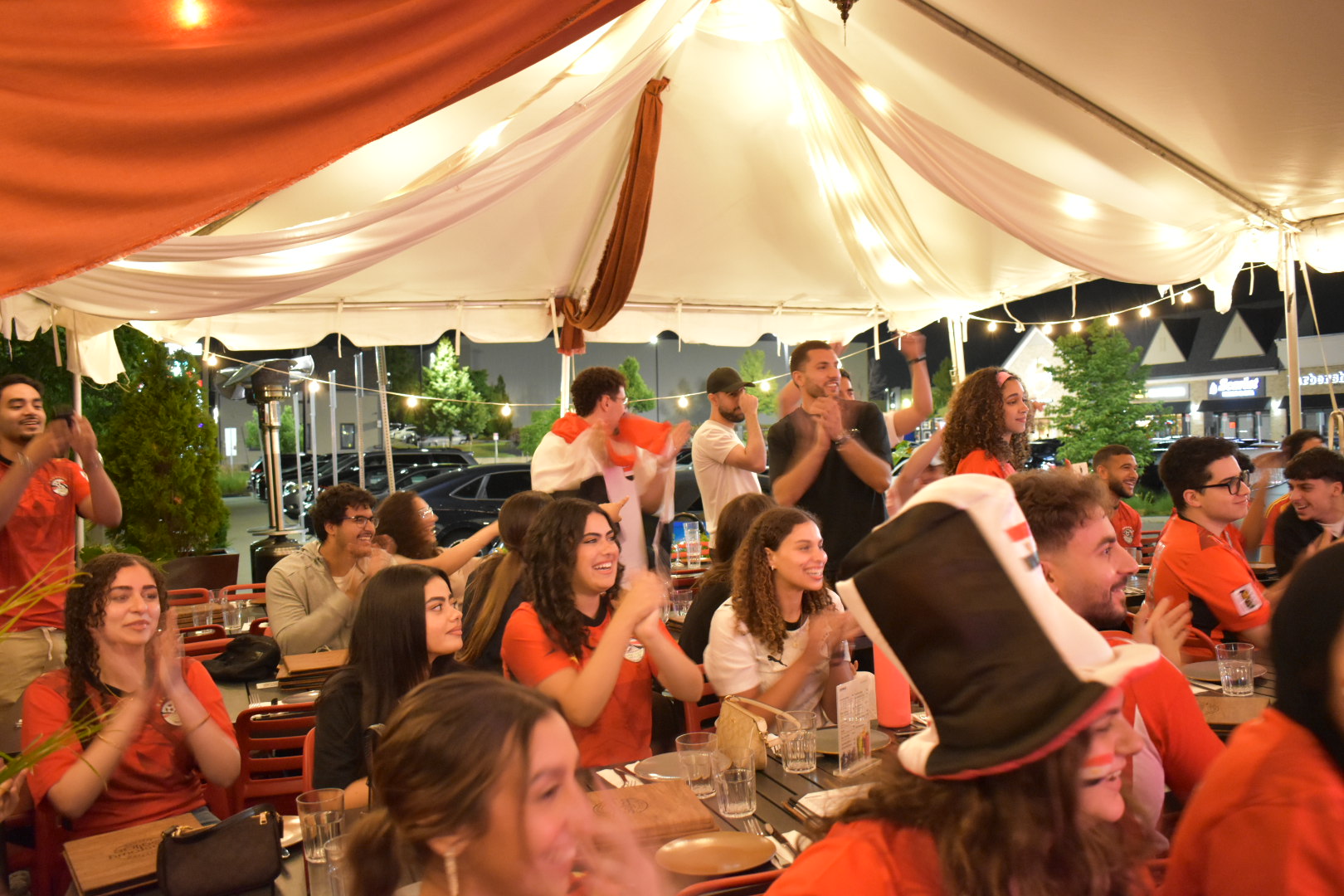
Away from loud gatherings in public squares, another event unfolded just a few kilometers away. The TMU ESA partnered with Masrawy to host a smaller gathering for students in the restaurant’s patio, creating a more intimate space where young Egyptian-Canadians could meet beyond the excitement of the match.
“Our event was mostly catered for people our age,” said TMU ESA co-president Sara Karanib. “People you can relate to, people you can meet and make connections with.”
Students travelled from universities across Ontario, including the University of Waterloo, to attend. For Karanib, that reflected the tournament’s lasting impact. “It kind of reminded everyone how big the Egyptian community is in Canada.”
While the Egyptian community received a lot of attention from massive festivities on social media and through word of mouth, student-led events showed how those larger celebrations could translate into lasting human connections. The success of these events was not just measured by attendance but by the memories people created once they arrived.
For Ihab, every watch party became an opportunity to reconnect with people from different stages of her life. “I saw people from the university, from high school and middle school, and it made me reconnect with a lot of people.” Seeing many familiar faces gathered in one place made her feel closer than ever to the community.
“It didn’t feel like I was away from my family,” she said. “It felt like everyone was there.”
Toronto-born 18-year-old Zaina Harhash believes the World Cup was a reflection of Canada’s multicultural identity that allows people from all backgrounds to come together and celebrate their team.
“We’re able to find ourselves more in these spaces and practice our culture,” she said.
Harhash added that these gatherings allow young Egyptian-Canadians to celebrate their identity without making them any less Canadian.
Egypt’s World Cup journey came to an end in the Round of 16 with a 3-2 loss to Argentina that sparked controversy online. However, the tournament has left a lasting mark on young Egyptian-Canadians.
For Salah, the World Cup was proof that the community’s desire to come together extended beyond the result of the match. He said, “I really hope that we keep this unity after the World Cup. Whether we become champions or get eliminated, I hope we continue to gather and support one another.”
Harhash said the tournament reshaped Egypt’s representation in public. “It’s so refreshing to see everyone mention Egypt, or any of our neighboring countries, in a positive light. Everyone’s so happy to be out there. Win or lose, go Egypt.”
For Ihab, the loss to Argentina served as a reminder of what these gatherings truly are about.
“After the match between Egypt and Argentina, we sent a message to the world. We showed them how we celebrate. We showed them how loyal we are to our country. We showed them how much we support our team. We were with them in good times and bad. No matter what happens, we’re still behind them.”
After the loss, the giant screens went black. Celebration Square has returned to its usual rhythm and is no longer filled with thousands of supporters cheering. Masrawy’s patio has returned to serving meals rather than hosting watch parties.
What remains are the strangers who became friends, the familiar faces that found a place to reconnect, and the realization that community had never been absent. It had simply been waiting for a reason to gather.


Discussion about this post