
The 401(k) has become a normal part of saving for retirement in America. You’ve been saving and investing in this account your whole career, but what do you do when it’s time to quit or retire? You may want to roll it over to your new employer or IRA.
Before you start moving money around, there are several key factors to consider first. This is a major decision and deserves your attention to key pros and cons.
What Is a 401(k) Rollover?
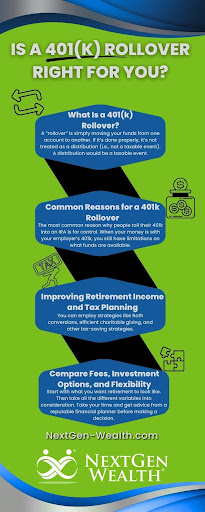
In short, a “rollover” is simply when you move your funds from one account to another. The key aspect of a rollover is that, if it’s done properly, it’s not treated as a distribution (i.e. not a taxable event). A distribution would be a taxable event.
This allows you to move your money to another financial institution while continuing to defer taxes. You can keep your money invested, except for the short time it takes to transfer. However, this usually happens pretty quickly.
How a Rollover Works
You have two options for rolling over your 401 (k). You can have the money distributed to you and then deposit the money, but this isn’t preferred because you’ll have to withhold taxes. The better option is to complete a direct rollover.
You’ll need to have a “like-item” account open at the receiving institution first. For your 401k, you’ll need to roll into an IRA or another 401k. If you’re retiring with both traditional and Roth 401k balances, you’ll need both a traditional IRA as well as a Roth IRA.
Common Reasons People Roll Over Old 401(k)s
The most common reason why people roll their 401k into an IRA is for control. When your money is with your employer’s 401k, you still have limitations on what funds are available. Traditionally, these are also more expensive than what you could invest in on your own.
Another reason is if you want to work with a financial planner. For most financial planners, you’ll roll your 401k to an institution where they have an established relationship.
The money remains in your account, and they’ll have “discretionary” authority to make trades, rebalance, and make distribution requests on your behalf. Many financial planners can also withdraw their fees directly from your account, called an assets under management (AUM) billing model.
Simplifying Your Retirement Accounts
Many retirees enter retirement with multiple employer accounts. You might have a 401k, a pension lump sum, and another account like a 403b, 457, or even another IRA. Picking one account to roll everything into greatly simplifies your financial life.
Instead of rebalancing each account individually, you can manage one account. This will also greatly simplify things when it comes time for required minimum distributions (RMDs). You must calculate the RMD for each individual account (usually done by the custodian where your money is held).
Expanding Your Investment Options
Another big reason to do a 401k rollover is to expand your investment options. In most cases, your employer plan will have a standard set of target date funds as well as a handful of other mutual and index funds. It can be difficult to find the right mix of low-cost funds to meet your needs.
For most folks in their accumulation phase, a target date fund is a great option. However, these are typically fairly safe options with slightly lower yields than you might get otherwise. You or your financial planner may be able to design a better low-cost, diversified portfolio to match your retirement wants and needs.
Improving Retirement Income and Tax Planning
Once you reach retirement with all the funds you need, taxes become one of your biggest hurdles. There are a variety of tax-saving strategies for retirees, but it can be confusing to know which one is best for you. In many cases, planning early can save you a significant amount of money on taxes in retirement.
You can employ strategies like Roth conversions, efficient charitable giving, and others. You’ll always have taxes to contend with, but you don’t want to pay extra.
When You May Want to Keep Your 401(k) Where It Is
In some cases, it may be better to leave your 401k right where it is. It’s best to evaluate this decision with eyes wide open on each possible option.
Access to Low-Cost Institutional Funds
As time goes on, more and more 401k providers are offering lower-cost fund options. It used to be common to see expense ratios of 1% or more. This is less and less common today.
Many target-date, index, and mutual funds are available in employer plans at competitive expense ratios. Many of these might be well below 0.5%. However, the 401k plan may have additional administrative or advertising fees (12b-1 fees) baked in.
Check your employer plan documents and each individual fund prospectus to see what fees you’re paying. Most seem minimal, but once you add them all up, it could be more than you think.
Creditor Protection and Plan-Specific Benefits
For most people with a large 401k balance, bankruptcy isn’t a primary concern – at least initially. With the high cost of medical care and uncovered long-term care expenses, the threat of bankruptcy is probably slightly more than zero.
Employer-sponsored plans, such as 401 (k) accounts, are generally fully retained in bankruptcy proceedings. This potentially gives a 401 (k) a much higher bankruptcy-protection limit than an IRA. However, the limits remain fairly high, currently set at $1,711,975 for 2025 through 2027, with the next adjustment in 2028.
Rule of 55 Considerations
If you’re thinking about retiring before reaching age 59-1/2, then you may want to consider the “rule of 55” before you complete a 401k rollover. In short, the rule of 55 is an exemption to the early withdrawal penalty. If you terminate employment after age 55, you can make penalty-free withdrawals from your 401(k).
You may also be able to complete a partial rollover. This would allow you to move most of your money into your IRA, leaving your living expenses covered until you reach age 59-1/2 in your 401 (k).
Key Tax Traps to Avoid
As with any movement of money, there’s generally a little risk involved. However, if you plan it out, you shouldn’t have much trouble.
Rolling Pre-Tax Money Into the Wrong Account
The biggest mistake folks make is rolling funds into the wrong type of account. The best way to avoid this is to make sure you know what “flavor” of money you have. You want to roll traditional “pre-tax” money into a regular, traditional IRA – not a Roth IRA. If you make this mistake, it’ll be treated as a Roth IRA conversion and be a taxable event.
On the other hand, you want to make sure to roll Roth 401k balances into a Roth IRA. Just remember to match “like items” across different types of accounts.
Missing the 60-Day Rollover Window
Another mistake is missing the 60-day rollover window. If you opted to have your 401k distributed to you and then deposit the check yourself, you run the risk of missing the 60-day rollover window. There are waivers to the 60-day rollover window, but we’d recommend not chancing it.
We recommend a direct rollover, so you’re never in the middle of the transaction. You may need to complete some additional paperwork or get a special type of verification called a Medallion Signature, but it’s worth the hassle.
How to Decide What’s Right for You
At the end of the day, you need to come back to what’s best for your personal situation. It may mean leaving your money right where it is. It could also be rolling over to a different financial institution, so you or your advisor can manage it the way you want.
Compare Fees, Investment Options, and Flexibility
It’s best to look at all the numbers first. Check fees in your current 401k (including the fees within individual funds we talked about) and compare those to other options you might have in your IRA. However, higher fees don’t mean it’s all bad if the fund options are good.
The next step is to look at which funds will give you the best options. Keep in mind, nobody can guarantee performance, and just because a fund did well in the past doesn’t mean it will continue to do so. Make sure you compare the same timeframes (e.g., 10-year returns for both funds).
Consider Your Retirement Timeline
The first variable you should start with is what you want retirement to look like. It’s not simply a matter of not working anymore. You’ll fill your days with something.
Start exploring and planning your retirement timeline. In other words, carefully define what you’re retiring to, not just what you’re retiring from.
Talk Through the Decision Before Moving Money
Finally, we recommend getting advice and counsel from a variety of sources. What to do with your 401k may be one of the largest financial decisions you’ll ever make. It’s best to get as much info as possible, take time to sleep on it, and then make an informed decision.
This article reflects the insights and opinions of its author and is not a recommendation or endorsement of their views or services.

Clint Haynes, CFP®
Helping you build a retirement with pleasure, purpose, and peace of mind.
Clint Haynes, CFP®
| NextGen Wealth
Discussion about this post