Categories
Business Asia

China’s Plan for Winning the AI Race Hinges on the Token Economy, Not Chips – The Diplomat

Categories
Business Asia

Sri Lanka’s trade deficit contracts for the third consecutive month

Colombo, July 12 (AdaDerana) – The import expenditure declined, while earnings from exports increased in May 2022, year-on-year, extending the contraction in the trade deficit for the third consecutive month.

Meanwhile, tourist arrivals slowed in May 2022, compared to the previous month. Workers’ remittances increased in May 2022, compared to April 2022. Foreign investment in the government securities market and the Colombo Stock Exchange (CSE) recorded marginal net inflows during May 2022.

Subscribe to our Telegram channel for the latest updates from around the world

Considering the liquidity pressures witnessed in the domestic foreign exchange market, the Central Bank imposed cash margin requirements in May 2022, while the Government introduced restrictions on open accounts and consignment payments terms, among others.

These measures were expected to curtail activity in the informal foreign exchange market and narrow the gap between the official and grey market exchange rates.

Meanwhile, the weighted average spot exchange rate in the interbank market remained stable around Rs. 359 per US dollar during the month, helped by the measures introduced to manage pressures in the domestic foreign exchange market, along with the market guidance.


Merchandise Trade Balance and Terms of Trade

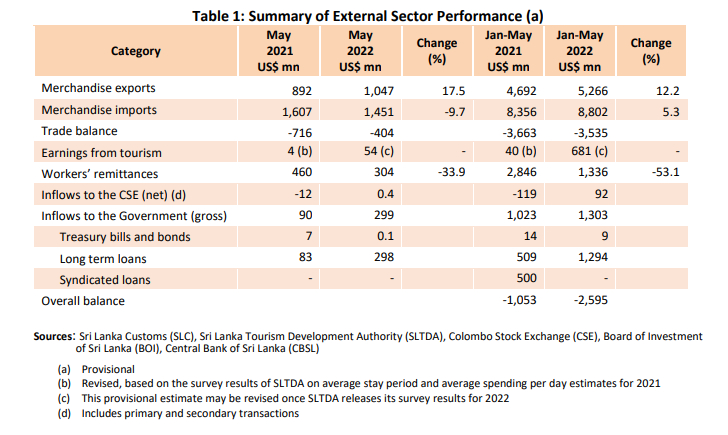
Trade Balance: The trade deficit recorded a decline for the fifth consecutive month on month-on-month basis and for the third consecutive month on year-on-year basis in May 2022, supported mainly by the policy induced moderation of imports, along with the notable growth momentum of exports.

The trade deficit narrowed to US dollars 404 million in May 2022, compared to the deficit of US dollars 716 million recorded in May 2021. On a cumulative basis, trade deficit narrowed on a year-on-year basis for the first time in May during this year.

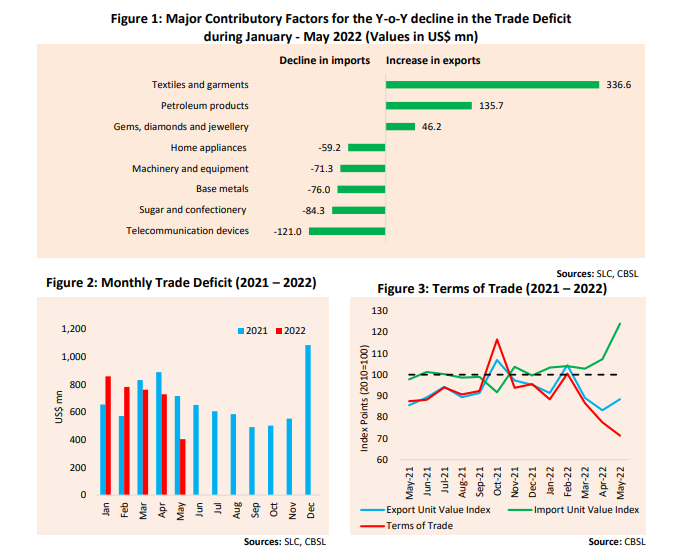
Accordingly, the trade deficit during January-May 2022 narrowed to US dollars 3,535 million, from US dollars 3,663 million recorded over the same period in 2021. The major contributory factors for this decline in the cumulative trade deficit are shown in Figure 1.

Terms of Trade: Terms of trade, i.e., the ratio of the price of exports to the price of imports, deteriorated notably by 18.5 per cent in May 2022, compared to May 2021, as the increase in import prices surpassed the increase in export prices.

For similar articles, join our Telegram channel for the latest updates. – click here

Categories
Business Asia

Public awareness in relation to the use of virtual currencies in Sri Lanka

Colombo, July 13 (AdaDerana) – Considering the recent developments in relation to virtual currency usage in the international and domestic markets as well as the inquiries related to virtual currency, the Central Bank of Sri Lanka (CBSL) wishes to inform the public of the following.

Virtual Currencies (VCs) are largely unregulated digital representations of value that are issued by private entities and can be electronically traded.

For similar articles, join our Telegram channel for the latest updates. – click here

As informed to the public previously by CBSL through press releases in 2018 and 2021, CBSL has not given any license or authorization to any entity or company to operate schemes involving VCs, including cryptocurrencies, and has not authorized any Initial Coin Offerings (ICO), mining operations or Virtual Currency Exchanges. Furthermore, as per the Directions No. 03 of 2021 under Foreign Exchange Act, No. 12 of 2017 issued by the Department of Foreign Exchange of CBSL, Electronic Fund Transfer Cards (EFTCs) such as debit cards and credit cards are not permitted to be used for payments related to virtual currency transactions. Therefore, VCs are considered as unregulated financial instruments and have no regulatory oversight or safeguards relating to their usage in Sri Lanka.

The public is therefore warned of the possible exposure to significant financial, operational, legal and security related risks as well as customer protection concerns posed to the users by investments in VCs. The public is also warned not to fall prey to various types of VC schemes offered through the Internet as well as other forms of media.

Subscribe to our Telegram channel for the latest updates from around the world

Categories
Business Asia

Why the euro has tumbled to parity against the US dollar

July 15 (Bloomberg) – As the US economy went into meltdown during the 2008 global financial crisis, one euro was worth about 1.6 times the US dollar.

Now a combination of Europe’s front-line exposure to Russia’s war in Ukraine and the European Central Bank’s tardiness in raising interest rates have driven it to parity, or a 1:1 ratio with the dollar.

For similar articles, join our Telegram channel for the latest updates. – click here

It’s the first time the euro has sunk to that level since 2002, in the early years of the currency’s existence. 

WHY IS THE EURO SINKING?

Europe suffers most from the war, which has sparked an energy crisis and could lead to potentially a long and deep recession.

That places the ECB in a difficult position – trying to curb inflation and cushion a slowing economy – as it aims to raise borrowing costs for the first time since 2011.

At the same time, the US Federal Reserve is raising interest rates much faster than the 19-nation euro area. That makes yields on US Treasury bonds higher than those on Europe’s debt, driving investors to the dollar and away from the euro.

What’s more, the greenback benefits from its status as a haven, meaning that as the war drags on and the fallout gets worse, the euro keeps sliding.

READ: Why is the UK economy suffering more than other countries?

WHY IS A WEAKER CURRENCY A PROBLEM?

For years, policy makers in many countries have welcomed weaker currencies as a means to stimulate economic growth, since it makes their exports more competitive.

But now, with inflation in the euro zone at the highest since such records began, its weakness is undesirable as it fans price gains by making imports more expensive.

In June, euro-area consumer prices jumped 8.6 per cent from a year earlier. Some policy makers have highlighted a weaker euro as a risk to the central bank’s goal to return inflation to 2 per cent over the medium term, although the ECB does not target the exchange rate.

Still, when measured against other currencies apart from the dollar, the euro looks more resilient. 

READ: U.S. consumer inflation rises to highest annual rate since 1981

IS THE 1:1 LEVEL IMPORTANT?

Yes. It’s a psychological threshold for the market.

The first time the euro fell to parity with the dollar was in December 1999, not even a year after its inception. Just like now, analysts then pointed to a widening in the spread between German and US bond yields and stronger US growth.

It was a dent in the pride of Europeans, who saw the common currency as an important political project and a rival to the dominant dollar.

Today, the euro is considered one of world’s key currencies for transactions and reserves, though hitting parity is still symbolic.

For the financial markets, currency traders expect turbulence around the 1:1 level given that billions of euros in options bets are linked to that big line in the sand. 

WHERE’S THE FLOOR?

It’s hard to say. Some analysts predicted the common currency could slide to 90 US cents if Russia escalates the crisis by withholding more gas supplies to Europe.

Since the start of July, options traders have been laying more bets at around the US$0.95 level, with US$0.9850 potentially acting as a short-term bottom, according to trade data from the Depository Trust & Clearing Corporation.

Deutsche Bank strategists have calculated that a slide to US$0.95 to US$0.97 would match the all-time extremes seen in exchange rates since the 1971 end of the so-called Bretton Woods system, which linked the value of many currencies to the US dollar.

Still, those levels could well be reached if there is a recession, they said. 

WHAT COULD SPARK A TURNAROUND?

The key is narrowing the interest-rate differential with other global bond markets.

By the time the Fed had delivered 150 basis points of interest-rate hikes in just three months, the ECB had yet to move, keeping its key rate negative.

While Europe’s rate setters have signaled the start of their hiking cycle – including a potential 50-basis-point increase in September – doubts are brewing over how long they can sustain it. Raising rates is harder for the ECB than other central banks.

That’s because the borrowing costs of more indebted euro-area nations risk spiraling out of control if investors begin to question their ability to sustain debt loads.

Even the hint that policy makers were planning to tighten policy quicker than some expected in June sent the Italian 10-year yield surging above 4 per cent for the first time since 2014.

Since then, investors have been more or less reassured by promises of a new tool to prevent unwarranted spikes in bond yields. But if that plan disappoints markets, they could begin to doubt how much tightening the ECB stands to deliver. 

IS THIS AN EXISTENTIAL CRISIS FOR THE EURO?

No, although aside from pressure on its value, the common currency has faced challenges as a concept in the past.

Since its formation, naysayers have pointed out the difficulties of managing a monetary union of disparate economies. That became apparent most prominently during the euro zone’s 2012 sovereign debt crisis, as investors started to shun the assets of more indebted countries such as Greece, Italy and Spain.

The rise of euroskeptic politicians in Italy and elsewhere has also provoked concern over the resilience of the bloc.

A defining moment was in July 2012, when ECB President Mario Draghi pledged to do “whatever it takes” to save the common currency.

Still, direct intervention to support the euro in the foreign exchange markets is rare, although central banks did take action in 2000. 

WHO BENEFITS FROM A WEAKER EURO?

On a broader level, the euro’s weakness against the dollar helps European exporters as it makes their products more competitive and boosts earnings.

The Americas account for more than 40 per cent of sales for 70 European large companies, including Sanofi and Aegon NV. It also comes as a relief to US travelers to Europe, reducing the cost of their trips, and assists Americans at home battling their own imported inflation.

Subscribe to our Telegram channel for the latest updates from around the world

Categories
Business Asia

Gautam Adani overtakes Bill Gates to become 4th richest person in the world

July 22 (Business Standard) – India’s Gautam Adani on Thursday overtook Microsoft co-founder Bill Gates to become the world’s fourth richest person, according to Forbes’ Real-Time Billionaires list.

Adani is worth $115.7 billion and Gates $104.6 billion. In the last 24 hours, Adani gained $337 million, Forbes’ website showed. Tesla and SpaceX founder Elon Musk, tops the list with wealth put at $235.8 billion.

For similar articles, join our Telegram channel for the latest updates. – click here

Bernard Arnault, founder and chairman of Louis Vuitton SE, comes second on the list with the wealth of $156.7 billion, followed by former Amazon CEO, Jeff Bezos, with a wealth of $148.4 billion.

Mukesh Ambani, chairman and managing director (MD) of Reliance Industries, is 10th on Forbes’ list with a total wealth of $90 billion. Adani and Ambani are the only Indians in Forbes’ top 10 list.

Adani is chairman of chairman and founder of Adani Group, which has businesses in airports and ports, generating and distributing electricity, and coal and gas trading. The conglomerate is participating at an auction of 5G airwaves by India scheduled for later this month.

READ: ‘Panic’ in Pakistani markets as rupee slides further against U.S. dollar

“Some of Adani Group’s listed stocks have soared more than 600% in the past two years on bets his push into green energy and infrastructure will pay off as PM Modi looks to revive the $2.9 trillion economy and meet India’s carbon net-zero target by 2070,” a Bloomberg report had stated recently.

“In barely three years, Adani has gained control of seven airports and almost a quarter of India’s air traffic. His group now owns the country’s largest airport operator, power generator and city gas retailer in the non-state sector,” it said.

In September 2020, Adani Group acquired a 74 per cent stake in the Mumbai International Airport, becoming India’s biggest airport operator.

In May 2022, Adani Group acquired Holcim’s stake in Ambuja Cements and ACC, in the biggest cement deal in the country worth $10.5 billion. He is now the second biggest player in the cement industry in the country.

Adani Ports and Special Economic Zone Limited (APSEZ) in Israel, the company, jointly with Israel’s Gadot Group, won a tender to privatise Haifa port, the second largest port in Israel for $1.18 billion, on July 14.

Also, Adani Group has sought a loan worth Rs 14,000 crore for setting up a new PVC plant in Mundra, Gujarat.

Subscribe to our Telegram channel for the latest updates from around the world

Categories
Business Asia

End of an Era: The ‘Big Bull’ Rakesh Jhunjhunwala passes away at 62

August 14 (Business Standard) – Veteran stock market investor Rakesh Jhunjhunwala has passed away at the age of 62 in Mumbai. Jhunjhunwala, over the years, invested in many well-known and established companies, and also in upcoming startups.

Often referred to as India’s Warren Buffett, and the Big Bull of Indian markets, Jhunjhunwala’s net worth was $5.8 billion, as of August 2022. He invested in his individual capacity, and via his firm Rare Enterprises.Low-cost carrier Akasa Air, which is backed by Rakesh Jhunjhunwala, was inaugurated on August 7.

Jhunjhunwala was India’s 36th richest person in 2021 and 438th richest man in the world, so far in 2022, according to Forbes.

His portfolio includes companies like Star Health, Titan, Rallis India, Escorts, Canara Bank, Indian Hotels Company, Agro Tech Foods, Nazara Technologies, Tata Motors. Overall, he had stake in 47 companies at the end of June quarter.

He has holding in around 19 companies, including Tata Communications, Titan Company, Bilcare, Va Tech Wabagh, Federal Bank, Aptech.Born on July 5, 1960, Rakesh Jhunjhunwala grew up in a Rajasthani family, in Bombay, where his father worked as a Commissioner of Income Tax.

He graduated from Sydenham College and thereafter enrolled at the Institute of Chartered Accountants of India.Rakesh Jhunjhunwala entered the stock market with just Rs 5,000 in 1985. At that time, Sensex was at 150 points.

Prime Minister Narendra Modi expressed grief over Jhunjhunwala’s passing. He tweeted, “Rakesh Jhunjhunwala was indomitable. Full of life, witty and insightful, he leaves behind an indelible contribution to the financial world.

He was also very passionate about India’s progress.His passing away is saddening.My condolences to his family and admirers.Om Shanti.”

Condoling the demise of the Big Bull, Nirmal Jain, founder of IIFL Group said, “He understood the markets better than anyone else. He took risks and contributed immensely to the capital markets. Transparent in his behaviour, he spoke from his heart. Whenever you met him, he came across as a man full of life. He partied hard when he partied.

He radiated positivity and cared deeply about everyone he knew. His advice was heartfelt and was ever eager to help. In short, a man with a heart to gold”.

Home Minister Amit Shah tweeted, “Anguished to learn about the passing away of Rakesh Jhunjhunwala Ji. His vast experience and understanding of the stock market have inspired countless investors. He will always be remembered for his bullish outlook. My deepest condolences to his family. Om Shanti Shanti.”

Categories
Business Asia

Britain launches trade system for developing countries including Sri Lanka

Colombo, August 17 (AdaDerana) – Britain has launched a scheme to extend tariff cuts to hundreds of products, such as clothes and food, from developing countries including Sri Lanka, part of London’s post-Brexit efforts to set up systems to replace those run by the European Union.

“The UK’s new Developing Countries Trading Scheme (DCTS) is one of the most generous sets of trading preferences of any country in the world, and will benefit Sri Lanka by boosting the economy and supporting jobs,” the British High Commissioner in Colombo Sarah Hulton said.

For similar articles, join our Telegram channel for the latest updates. – click here

She said Sri Lanka will continue to benefit from duty free exports to the UK on more than 80% of products and that the DCTS will remove tariffs on over 150 additional products. 

It will also simplify some seasonal tariffs, meaning additional and simpler access for Sri Lanka’s exports to the UK. 

In June, British Prime Minister Boris Johnson said he wanted to start a new trade system to reduce costs and simplify rules for 65 developing countries to replace the EU’s Generalised System of Preferences, which applies import duties at reduced rates.

Trade minister Anne-Marie Trevelyan said the Developing Countries Trading scheme (DCTS) would extend tariff cuts to hundreds more products exported from developing countries, a system, she said, that goes further than the EU scheme.

“As an independent trading nation, we are taking back control of our trade policy and making decisions that back UK businesses, help with the cost of living, and support the economies of developing countries around the world,” Trevelyan said in a statement.

“UK businesses can look forward to less red tape and lower costs, incentivising firms to import goods from developing countries.”

The DCTS covers 65 countries including Sri Lanka, simplifies rules such as rules of origin, which dictate what proportion of a product must be made in its country of origin, and removes some seasonal tariffs, such as making cucumbers tariff-free in the winter.

Products that are not widely produced in the UK, like olive oil and tomatoes, will also have lower or zero tariffs, making them cheaper to import.

The scheme also simplifies complex trade rules, including so-called rules of origin, making it easier for businesses in countries like Bangladesh to export clothes to the UK.

Duties will also be reduced by 14 per cent on bikes from the South Asian nation, 12 per cent on T-shirts for Cambodia, 12 per cent on baby clothes from Sri Lanka, eight per cent on roses from Ethiopia and eight 8 per cent on onions from Senegal.

Broadly, the scheme will ensure British businesses benefit from more than £750m a year of reduced import costs, which the Department for International Trade said would lead to more choice and lower costs for UK consumers to help with the cost of living.

Trade Secretary Anne-Marie Trevelyan highlighted the fact the scheme goes further than its EU equivalent, adding: “As an independent trading nation, we are taking back control of our trade policy and making decisions that back UK businesses, help with the cost of living, and support the economies of developing countries around the world.

“UK businesses can look forward to less red-tape and lower costs, incentivising firms to import goods from developing countries.”

The scheme replaces the UK Generalised Scheme of Preferences, which was rolled over from EU membership, and will come into force in early 2023.

It covers 37 countries in Africa, 18 in Asia, eight in Oceania and two in the Americas. 

Sri Lanka is among 8 countries under the scheme’s Enhanced Framework that will receive a preference of “0% import tariffs on two-thirds of product lines”.

Bolivia, Cape Verde, Kyrgyzstan, Mongolia, Pakistan, Philippines and Uzbekistan are the other countries under the Enhanced Framework.

The scheme reduces and removes those tariffs reduced or removed by the EU GSP.

Read the UK government policy paper on Developing Countries Trading Scheme here.

Subscribe to our Telegram channel for the latest updates from around the world

Categories
Business Asia

Elon Musk says he is buying Manchester United

Aug 17 (Reuters) – Elon Musk, the world’s richest person, on Tuesday tweeted that he was buying football club Manchester United Plc (MANU.N), without offering any details.

Musk has a history of being unconventional and making irreverent tweets, and it was not immediately clear whether he planned to pursue a deal to secure Manchester United.

Subscribe to our Telegram channel for the latest updates from around the world

“I’m buying Manchester United ur welcome,” Musk said in a tweet. The team is controlled by the American Glazer family. Neither the family nor Musk immediately responded to a request for comment.

British newspaper The Daily Mirror reported last year that the Glazers were prepared to sell the club but only if they were offered in excess of 4 billion pounds.($4.84 billion)

Musk is currently trying to exit a $44 billion agreement to buy the social media company, which has taken him to court.

Manchester United is one of the world’s best supported football clubs. They have been champions of England a record 20 times and have won the European Cup, the most prestigious club competition in the global game, three times.

Dissatisfaction among fans at the Glazers’ perceived lack of ambition to bring in top players intensified after the club finished sixth in the English Premier League last season, while crosstown rivals Manchester City won a second successive title.

The football club had a market capitalisation of $2.08 billion, as of Tuesday’s stock market close.

Manchester United fans have in recent years protested against the Glazers, who bought the club for 790 million pounds ($955.51 million) in 2005, due to the team’s struggles on the pitch.

The anti-Glazer movement gained momentum last year after United were involved in a failed attempt to form a breakaway European Super League.

Some fans have urged Musk to buy Manchester United instead of buying Twitter.

Musk has a history of unconventional actions and comments, making it difficult sometimes to tell when he is joking.

His ambitions range from colonising Mars to creating a new sustainable energy economy, and in the process he has built the most valuable car company in the world, electric vehicle maker Tesla, rocket company SpaceX, and a slew of smaller firms. One is a tunnel maker called the Boring Company.

Musk has appeared to smoke marijuana in a podcast and fought U.S. regulators over his comments about his plans for Tesla, including an abandoned effort to take it private.

For similar articles, join our Telegram channel for the latest updates. – click here

Categories
Business Asia

Forced Labor, Taiwan and the Implications of the US-Malaysia Trade Agreement – The Diplomat

Categories
Business Asia

Myanmar buys Russian oil as emerging markets take shunned supply

August 18 (Bloomberg) – Myanmar is set to join a growing list of developing countries that are warming up to Russian oil imports amid growing shortages across some of the most impoverished parts of Asia. 

The military-led government bought Russian fuel oil and the cargoes will arrive in phases from September, said junta chief Min Aung Hlaing this week. Ties between the two countries have strengthened on the back of a defense partnership, with Russia supplying arms, ammunition and training to Myanmar. 

For similar articles, join our Telegram channel for the latest updates. – click here

“We discussed buying and distributing fuel oil from Russia months before our head of state’s visit to Russia in July,” junta spokesman Zaw Min Tun said on Wednesday in a press briefing. “During his visit, the deal was successfully done. We aim to buy high-quality fuel oil at a cheap price from the country where we can get it quickly.”

Shunned shipments of Russian oil, gas and coal have made their way to countries such as Sri Lanka and Pakistan, where soaring fiscal deficits are weighing on local currencies. Some suppliers have stopped offering to poorer nations on concerns over their ability to pay, even as marketers of Russian barrels continue to court these buyers. Shipments from Russia tend to be cheaper than other supplies after western buyers stopped direct purchases due to sanctions and restrictions. 

Myanmar will directly import oil and petroleum products from Russia at a reasonable price for nationwide distribution, said Min Min, permanent secretary at the country’s commerce ministry who’s also part of a 10-member committee set up for the purchase, storage and distribution of Russian oil. 

It remains unclear how fuels from Russia will be transported to Myanmar. The two countries have previously considered supplying Russian energy via a pipeline through India or China, according to a media report.

The committee held a meeting this month but has yet pin down details on the number of cargoes, cost and arrival dates of Russian oil into Myanmar, Min Min said by phone. 

The official didn’t reveal which entities will be involved in importing the fuel, but an order by the State Administration Council showed that representatives from four private companies — Star High, Brighter Energy, Best Oil, and Yetagun Energy Trading — are members of the committee. A media report said a son of the junta chief and partners were coming together for a similar purpose. 
 
Russia is among a handful of countries that have strengthened ties with Myanmar after the 2021 coup. Earlier this year, the regime began talks with Moscow for fuel shipments following power outages, and as global firms including TotalEnergies SE and Chevron Corp began distancing themselves from the regime.

Recent media reports highlighted snaking queues at pump stations, rolling blackouts and fuel rationing efforts across parts of the country even as the cost of gasoline and diesel crept higher. Junta spokesman Zaw Min Tun, meanwhile, have dismissed rumors about fuel shortages, saying it had enough fuel reserves.

Subscribe to our Telegram channel for the latest updates from around the world