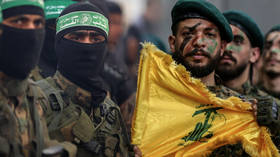
Israel’s military said Thursday that it had struck “dozens of headquarters, weapons storage facilities, launch sites, and anti-tank missile positions” belonging to the Iranian-backed Hezbollah group in Lebanon over the last 24 hours.
The IDF said it would continue to “operate decisively against the Hezbollah terror organization” in Lebanon “to remove the threat posed to Israeli civilians.”
Israel rapidly stepped up its operations in Lebanon in parallel with its joint strikes with the U.S. against Iran, as Hezbollah joined Iran in launching retaliatory missile and drone attacks at Israel.
Israeli forces had launched raids into southern Lebanon for years, during the war against Hamas in Gaza, and then as the current Iran war began, but the operations have expanded significantly in recent weeks.
Israeli Minister of Defense Israel Katz said Tuesday that the IDF would establish a security zone inside Lebanon after the Iran war “and will maintain security control over the entire area up to the Litani,” referring to a river that runs east-west about 20 miles north of the Israeli-Lebanese border.
Katz said hundreds of thousands of Lebanese civilians ordered by Israel’s military to evacuate northward over the last month from the area would be “completely prevented” from returning to their homes until the security of northern Israeli residents is guaranteed.
He added that “all the houses in the villages adjacent to the border in Lebanon will be demolished,” mirroring actions by Israel in the Palestinian territories of the West Bank and Gaza.
As of Wednesday, the Lebanese Ministry of Health said at least 1,318 people had been killed by Israel’s operations in the country since the Iran war began, including 125 children and 91 women.
NASA’s Artemis II mission will send the astronauts around the moon and back, farther from Earth than any previous human spaceflight. Among the crew is Canadian Jeremy Hansen who is set to become the first Canadian to reach deep space.
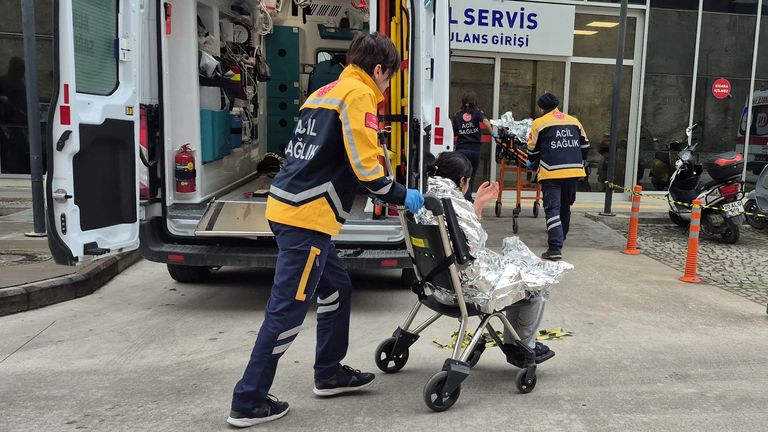
A rubber boat carrying migrants has capsized off the Turkish holiday resort of Bodrum after a high-speed chase, killing 18 people, officials have said.
The vessel, detected by authorities in the early hours of Wednesday, had ignored repeated warnings to stop, according to the Turkish coastguard.
Officials said in a statement that the boat, which had attempted to flee at speed, capsized and sank in rough seas.
A coastguard helicopter from Izmir was sent to the area along with three boats, and 21 migrants were rescued from the Aegean Sea, according to officials.
Image: A survivor is taken to hospital in Bodrum, Turkey. Pic: Reuters
The statement did not say where the boat had departed from, or its destination, and the nationalities of those who were on board are not yet known. Search and rescue operations are continuing.
The Greek island of Kos, an entry point into the European Union for people fleeing conflict and poverty in the Middle East, Africa and Asia, lies 13 miles from Bodrum. Other nearby islands include Kalymnos, Leros and Symi.
Read more from Sky News: What we know about the kidnapping of US journalist in Iraq Dwindling diesel and jet fuel supplies prompt EU warning
While the journey across the Aegean Sea is relatively short, it can also be treacherous. Many of the boats are unseaworthy, or set out in bad weather, and fatal accidents have been common.
Turkey hosts millions of refugees from Syria, Iraq and Afghanistan.
THIS is the moment a Russian tourist has been brutally choked out by a Bali local after being accused of inappropriately touching women.
The Balinese man could be heard threatening the captive Russian, saying “I will finish you”.
Sign up for The Sun newsletter
Thank you!
A tourist has been choked out by a Balinese man after allegedly touching a woman inappropriatelyCredit: Instagram/belda_brig_sandoThe Balinese man has been identified as Belda Brig Sando – local gym owner and fighterCredit: Instagram/belda_brig_sandoThe Russian man lay unconscious on the ground momentarily after the brutal scuffleCredit: Instagram
The shocking video shows the moment the men fell to the ground on the side of the road, locked in battle.
Surrounded by other furious locals in Uluwatu, a man – identified as Balinese fighter and gym owner Belda Brig Sando – had the Russian traveller in a headlock from behind.
The pair writhed on the ground for a few moments as Sando continued to squeeze the man’s neck.
Background audio of the video caught bystanders saying: “He’s out, he’s out” repeatedly.
MOB BOSS ARREST
Notorious Brit gangland boss pictured in orange jumpsuit at Bali police HQ
SEA TRAGEDY
Brit tourist drowns after being pulled out to sea by wave on holiday island
Another person can be heard shouting “Respect local”.
The Russian man continues to tap on Sando’s arm and point at other bystanders, trying to escape the predicament.
The muscly gym owner continued to choke out the man who quickly went red and then fell unconscious.
Sando explained to onlookers what was happening.
“Yeah look, this is one of the drunk Bule, touching a girl and having no respect,” he said.
“Don’t touch girls like that.
“I’m not [fighting] for nothing,” he added.
“Respect to locals. 100 per cent never do that.”
“Bule” is the Indonesian word for “white person” or “foreigner”.
Bystanders continued to try and defuse the situation before Sando eventually released the man’s neck, leaving him lying motionless on the ground.
“Bali is safe. Bali people are nice. You can do whatever you want in Bali but respect [our] locals,” Sando said.
The man remained still for just a moment, before he regained consciousness.
The brawling pair had been surrounded by other angry locals in UluwatuCredit: InstagramA bystander caught the moment the pair fell to the ground on the side of the roadCredit: InstagramWitnesses attempted to defuse the situation as the Russian man began to pass outCredit: Instagram
He was heard slurring his words as he attempted to speak.
“I got it, I got it,” the man said.
“If I punch you, I can finish you. But I choked you till you understood. Where are you from?” Sando said.
“I understand bro. I’m from Russia,” the man said.
“Are you from Russia? [There’s] many Russian people doing s**t here, don’t be one of them.”
Sando extended his hand to the man, who began questioning who he had allegedly touched.
“Bali is nice, but if you’re not nice, we can smash you here. Shut up and go home.”
The fight coach and founder of Zando Fight Club later addressed the shocking interaction.
He called out foreigners “who come here and act without respect.”
“This guy was drunk – touching people, walking in the middle of the road, stopping strangers, and even slapping heads like it’s normal,” he said in a statement to social media.
“No one said anything until he touched one of my friends. That’s when I stepped in, and it turned into a fight.
“What I did may not have been right, and for that I apologise. I’m human – sometimes emotions take over. But I didn’t start it. He crossed the line first.
“Bali is a beautiful place, and the people here are kind and respectful. That’s what we want everyone to experience.
“But respect goes both ways. I’m tired of seeing some foreigners come here and act without respect. Let’s keep Bali the way it should be – good people, good energy.”
The incident comes amid growing scrutiny of Bali’s nightlife.
The popular holiday destination has increasingly become the scene of unruly tourist behaviour.
Earlier in the year, a group of tourists were filmed brawling outside a small supermarket in Kuta, where locals were forced to step in.
Sando has since backed his actions in a statement to social mediaCredit: Instagram
Ilia Malinin celebrates after winning his third Figure Skating World Championships in Prague on Saturday.
Michal Cizek/AFP via Getty Images
hide caption
toggle caption
Michal Cizek/AFP via Getty Images
American figure skater Ilia Malinin won his third consecutive world title this weekend, just weeks after missing the podium at the Winter Olympics.
The self-proclaimed “Quad God” was a heavy medal favorite going into Milan, but finished in eighth place after an uncharacteristic series of stumbles, which he later blamed on the pressure and expectations.
Six weeks after one of the most shocking twists of the Olympics, Malinin rebounded with a literal roar at the World Championships in Prague. He delivered two clean, quad-heavy programs to win gold by over 20 points, capping off the season on a note as high as his infamous jumps.
“I felt relieved that the season’s finally done after a long up and down for this whole season,” Malinin told U.S. Figure Skating, calling worlds a “change in mindset” from the Olympics. “All I wanted to do was skate for myself, enjoy every moment on the ice and just have fun out there, and that’s exactly what I did.”
Malinin skated the same routines that he brought to Italian ice — in the individual and the team event, in which he helped Team USA win gold — minus the visible nerves and mistakes. He earned a personal best score in his short program on Thursday to enter the second half of the competition in first place.
And he held onto that lead with a dazzling free skate on Saturday, even as he played it safe by his own standards.
Malinin wowed the crowd with his signature backflip and “raspberry twist” sideways spin, and landed five quadruple jumps. It’s an eye-popping number, but not his upper limit: He made history at a competition in December by landing all seven jumps as quads.
He fell short of that all-time high score but still won handily, by 22.73 points, becoming the first U.S. skater to three-peat at worlds since Nathan Chen.
Men’s world medalists Yuma Kagiyama, Ilia Malinin and Shun Sato (L-R) celebrate on the podium in Prague, Czech Republic on Saturday.
Michal Cizek/AFP via Getty Images
hide caption
toggle caption
Michal Cizek/AFP via Getty Images
Japan’s Yuma Kagiyama won silver and Shun Sato won bronze, in a repeat of the Olympic podium. (Mikhail Shaidorov, the panda-cosplaying Kazakh skater who shocked the world and himself with a gold medal in Milan, withdrew from worlds as is common practice for freshly-crowned Olympic champions who tend to prioritize rest, recovery and other obligations.)
“This was a competition where I wanted to just relieve all the pressure from the Olympics, to just come here with a fresh new mindset and just enjoy everything that I love about this sport,” Malinin told Olympics.com, adding that it was “probably one of the easier world championships I’ve been to” for that reason.
Malinin didn’t attempt a quadruple axel — the jump that only he can do — in competition in Prague, as was the case in Milan. But he did bust one out at the exhibition gala on Sunday, to onlookers’ surprise and delight.
There, Malinin was crowned the International Skating Union’s “Trailblazer on Ice” for his record-breaking seven-quad program (he also won “best costume” at its awards show later that day). The 21-year-old from Virginia, who is also the four-time reigning U.S. champion, reflected on the highs and lows of his season in an interview shortly afterward.
“Part of it was just knowing that it’s part of the deal,” Malinin said. “It’s part of what we signed up to do as figure skaters and athletes … There’s always going to be disappointing times and things that don’t go your way, but we always have to learn to get up and use that as motivation or information to understand what we can do better in the future, and that’s exactly what I did.”
A mixed bag for other Americans
Amber Glenn was emotional after a series of mistakes in her free skate in Prague, where she ultimately placed sixth in women’s singles.
Michal Cizek/AFP via Getty Images
hide caption
toggle caption
Michal Cizek/AFP via Getty Images
Malinin wasn’t the only American aiming for redemption after Milan.
Amber Glenn, the reigning three-time U.S. champion who is beloved for her outspoken LGTBQ and mental health advocacy, had hoped to recover from her Olympic disappointment.
The medal favorite missed the podium in Milan due to a costly mistake in her short program that put her in 12th place. She followed it up with a sensational free skate that catapulted her into a fifth-place finish.
Unfortunately for Glenn, the reverse happened in Prague.
She nailed her short program — including the jump that gave her trouble at the Olympics — and headed into the free skate in third place. On Friday, she started strong with a triple axel but under-rotated several jumps as a pained crowd cheered her to the end of the song, at which point she knelt down on the ice, covering her face.
Glenn finished in sixth place overall, but quickly took to social media to reassure her fans.
“I’m okay! If anything I’m mentally, emotionally, physically exhausted after a season of extreme highs and lows,” wrote the 26-year-old. “I did what I set out to do 6 years ago. Land a Triple axel and go to the Olympics and nothing will take that away from me.”
Japan’s Kaori Sakamoto reacts after her triumphant farewell free skate on Friday. She leaves Prague with her fourth and final world title.
Michael Cizek/AFP via Getty Images
hide caption
toggle caption
Michael Cizek/AFP via Getty Images
The women’s gold medal went to beloved Japanese skater Kaori Sakamoto, who now retires as the four-time reigning world champion. She earned a personal best score in the final skate of her competitive career, to an Édith Piaf medley including “Non, Je Ne Regrette Rien” — “I regret nothing.”
The 25-year-old, who is known for her endearingly emotive reactions to her scores, jumped up and ran around the “kiss and cry” before breaking down in relieved tears as her coach plied her with tissues.
Sakamoto was a favorite for gold, having won three straight world titles, until American Alysa Liu broke her streak last year and then won gold to her silver at the Olympics. Sakamoto has spoken about being disappointed with her results in Milan.
“This season was much harder than I had ever imagined,” Sakamoto told Olympics.com after her win in Prague. “There were times when things didn’t go the way that I wanted, but at the end, really at the end of this season, everything came together. I’m very happy to be able to put this closure on my career.”
Sakamoto’s fellow Japanese skater Mone Chiba finished second, and Nina Pinzarrone of Belgium finished third. Just off the podium in fourth place was Isabeau Levito of the U.S. — a marked improvement from her 12th-place spot in Milan.
(Reigning Olympic champion Liu didn’t compete; she was busy with post-gold medal opportunities like presenting Taylor Swift with the Artist of the Year Award at the iHeartRadio Music Awards.)
In ice dance, American duo Emilea Zingas and Vadym Kolesnik won bronze in their world championship debut, capping off a breakthrough season that saw them finish fifth at the Olympics.
According to U.S. Figure Skating, this is the 11th straight World Championships where at least one U.S. ice dance duo has won a medal. The most recent three went to Madison Chock and Evan Bates, who withdrew from worlds after taking silver at the Olympics.
What’s next for figure skaters (and their fans)
Alysa Liu, pictured presenting Taylor Swift with an award at the iHeartRadio Music Awards in Los Angeles on Thursday, started her off-season early after her Olympic victory.
Jon Kopaloff/Getty Images
hide caption
toggle caption
Jon Kopaloff/Getty Images
The World Championship marks the end of competition for the 2025-2026 figure skating season and this “quad,” as the skating community refers to the four-year cycle culminating in a Winter Olympics.
This is the window, especially in an Olympic year, when skaters traditionally take at least some time off to rest and recover.
Many will return to the rink later this spring for shows and tours. The most prominent one, Stars on Ice, will visit cities throughout the U.S. from mid-April through the end of May. Malinin, Liu, Glenn, Leviteau, Chock and Bates are already on the roster.
“I’m definitely going to celebrate this moment by doing a bunch of shows and starting so many new projects off the ice and on the ice,” Malinin said this weekend.
Kaori Sakamoto takes a selfie with fellow figure skaters at the Olympics exhibition gala in Milan last month.
Jamie Squire/Getty Images
hide caption
toggle caption
Jamie Squire/Getty Images
Summertime is when skaters typically develop new skills and routines (and change coaches as needed) for the upcoming season, which officially starts on July 1.
U.S. Figure Skating has announced nearly two dozen qualifying events across the country from July through October, with its finals in November serving as one of the main pipelines to the U.S. Figure Skating Championships. Those will be held in Salt Lake City in January 2027.
There are also six International Skating Union (ISU) Grand Prix events every season, each hosted by a different country, including the U.S. This Grand Prix season will kick off with “Skate America” in Everett, Wash., in late October, and culminate in a final that is typically held in December (details for the upcoming season have not yet been announced).
The second half of the season, in early 2027, sees other major ISU events, including European Championships, which are headed to Lausanne, Switzerland, in late January. There’s also the Four Continents Figure Skating Championships, featuring top skaters from America, Asia, Africa and Oceania. World Championships in Tampere, Finland, will cap it all off in March 2027.
A fresh round of Israeli missiles hit the Rehab neighbourhood in Beirut this morning amid an intense firefight in South Lebanon. While Israeli Prime Minister Benjamin Netanyahu has asked his army to expand the ground invasion in the region, Hezbollah says they fighting back against the occupation of their land.
Missiles landed in the Rehab neighbourhood near the Kuwait embassy in Beirut. The scale of damage and casualties was not immediately known. Ambulances and fire engines were seen rushing to the site of the impact.
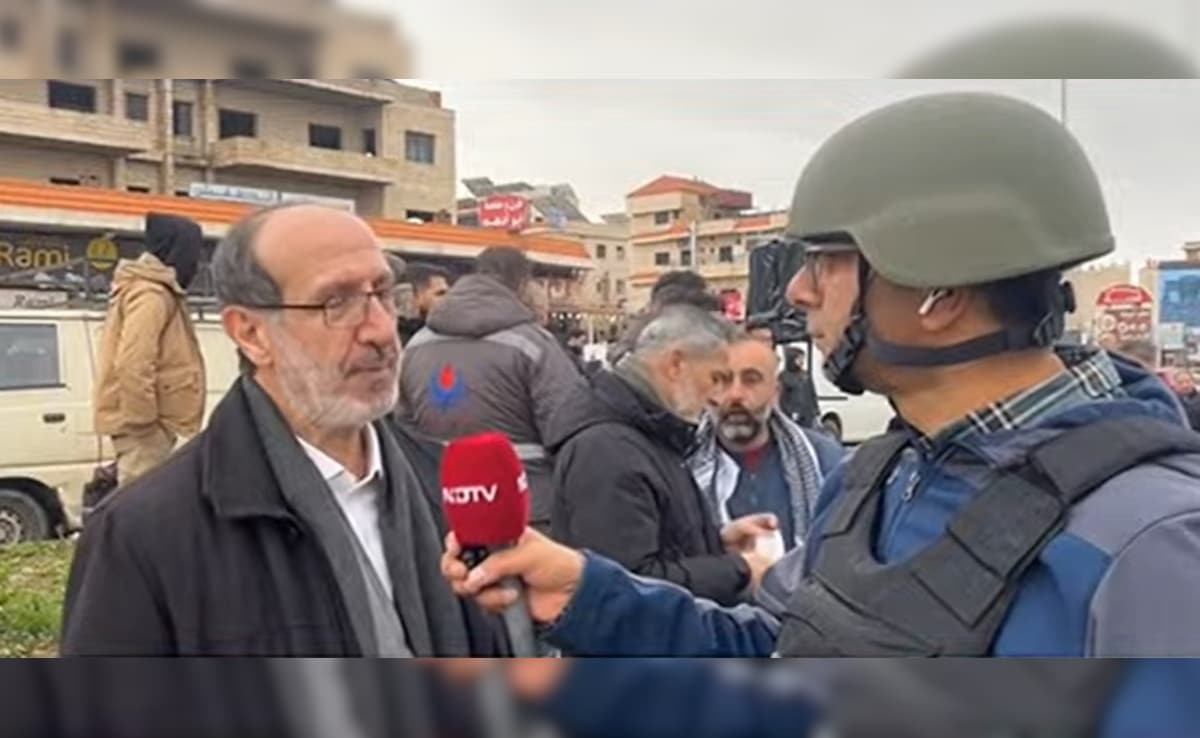
Amid the chaos and panic among the local residents after the bombing, NDTV saw ambulances evacuating affected people. The attack indicates that Israel is targeting areas in Beirut that were not hit since the conflict began.
🎯STRUCK: A cell of Hezbollah military operatives who were dressed as paramedics and operated near an ambulance in southern Lebanon.
The military operatives systematically used ambulances to transfer weapons between northern to southern Lebanon. Additionally, dozens of rockets…
Over the past 24 hours, nine health workers and a member of the UN peacekeeping force are among the several people killed in the fresh wave of attacks in Lebanon. Six Israeli soldiers have been injured in the Hezbollah attacks. Israel has claimed the health workers were Hezbollah military operatives dressed as paramedics.
More than 12 lakh people have been displaced in the past month, and about 1,100 have been killed. Among the victims are more than 100 children, health workers and journalists.
I strongly condemn Sunday’s incident during which an Indonesian peacekeeper of @UNIFIL_ was killed amidst hostilities between Israel & Hizbullah. Another Indonesian peacekeeper was seriously injured in the same incident.
UN Secretary-General Antonio Guterres has called for accountability after a member of the peacekeeping force was killed in Lebanon and called on all sides to uphold their obligations under international law and to ensure the safety and security of UN personnel and property. “I strongly condemn Sunday’s incident during which an Indonesian peacekeeper of @UNIFIL_ was killed amidst hostilities between Israel & Hizbullah. Another Indonesian peacekeeper was seriously injured in the same incident,” he said in a post on X.
Hezbollah has claimed that it has carried out rocket strikes and drone attacks on Israel after Netanyahu instructed the Israel Defence Forces to expand the invasion into south Lebanon.
According to reports, Hezbollah has said it fired rockets at Metula town in northern Israel and also targeted Israeli soldiers in the east of the Khiam in southern Lebanon. Israel has confirmed injuries to six soldiers in the latest firefight.
מהצהרתי מפיקוד צפון:
הנחיתי כעת להרחיב עוד יותר את רצועת הביטחון הקיימת. אנחנו נחושים לשנות את המצב בצפון מיסודו ולהחזיר את הביטחון לתושבי הצפון.
לא נשלים עם מציאות של איום מתמשך על יישובינו ואזרחינו. נמשיך לפעול בעוצמה, בנחישות ובאחריות עד שנשיג את המטרה.
— Benjamin Netanyahu – בנימין נתניהו (@netanyahu) March 29, 2026
In a video statement from Northern Command, Israeli Prime Minister Netanyahu said, “I have instructed to further expand the existing security buffer zone. We are determined to fundamentally change the situation in the north.”
TEL AVIV, Israel — Israeli police prevented Catholic leaders from entering the Church of the Holy Sepulchre to celebrate a private Mass on the Christian holiday of Palm Sunday for the first time in centuries, setting off a wave of criticism from the United States and others.
The Latin Patriarchate in Jerusalem called the police decision “a manifestly unreasonable and grossly disproportionate measure.” It prevented two of the church’s top religious leaders, including the Latin Patriarch, Cardinal Pierbattista Pizzaballa, and the head of the Custos in the Holy Land, from celebrating Palm Sunday at the place where Christians believe Jesus was crucified.
Palm Sunday commemorates Jesus’ triumphant entry into Jerusalem and launches the Holy Week commemorations for Christians which culminates in Easter.
Israeli police said they had notified church authorities on Saturday that no Mass could take place on Palm Sunday because of safety considerations, the lack of access for emergency vehicles in narrow alleys of the Old City and lack of adequate shelter.
However, the Latin Patriarchate said the Church of the Holy Sepulchre had been hosting Masses that aren’t open to the public since the Iran war began on Feb. 28, and it was unclear why Sunday’s Mass and access by the two priests was any different.
“It’s a very, very sacred day for Christians and in our opinion there was no justification for such a decision or such an action,” said Farid Jubran, the spokesperson for the Latin Patriarchate of Jerusalem.
Jubran said that the church had requested permission from police for a few religious leaders to enter the church for a private celebration on Sunday — not one that was open to the public. The Patriarchate said that the decision impeded freedom of worship and the status quo in Jerusalem.
The traditional Palm Sunday procession normally sees tens of thousands of Christians from around the world walk from the Mount of Olives down the narrow, hilly streets toward the Old City, waving palm fronds and singing.
The Patriarchate canceled the traditional processional last week because of safety concerns, and has held Masses limited to fewer than 50 worshippers in compliance with the Israeli military’s guidelines for civilians.
Pizzaballa celebrated Mass in the nearby St. Savior’s Monastery, a soaring marble church which is located next to an underground music school that the Israeli military has deemed a safe shelter space. Later on Sunday, Pizzaballa held a prayer for peace at the Dominus Flevit Shrine on the Mount of Olives, but kept his homily concentrated on Jesus and didn’t mention the morning’s incident.
Pope Leo XIV, at the end of Palm Sunday Mass in St. Peter’s Square, prayed for all Christians in the Middle East who he said were living through an “atrocious” conflict. He said that “in many cases, they cannot live fully the rites of these holy days,” though he didn’t elaborate.
The Vatican spokesman didn’t immediately respond when asked to comment on the Jerusalem incident.
The closure sparked a wave of criticism that Israeli authorities had gone too far in restricting worship, including from Israel’s top ally, the United States.
U.S. Ambassador Mike Huckabee said the incident was “an unfortunate overreach” that was hard to justify.
He noted in a statement that the proposed prayer with Pizzaballa and the others was well below the 50-person limit for gatherings. “For the Patriarch to be barred from entry to the Church on Palm Sunday for a private ceremony is difficult to understand or justify,” he wrote.
French President Emmanuel Macron condemned the incident, which he said had added to the “concerning increase in violations of the status of the Holy Sites in Jerusalem.” In a post on X, Macron wrote: “The free exercise of worship in Jerusalem must be guaranteed for all religions.”
Italian authorities across the political spectrum condemned the move to restrict Pizzaballa, an Italian cardinal considered a leading papal contender in the 2025 conclave, to access the church.
The Italian government formally protested the incident to Israeli authorities and summoned Israel’s ambassador to Rome for clarification.
Premier Giorgia Meloni said that the police action “constitutes an offense not only against believers but against every community that recognizes religious freedom.”
Meloni’s conservative government tried to keep a balanced position with Israel during the war in Gaza, supporting Israel’s right to defense but condemning the toll on Palestinians. The Italian leader has also said that Italy won’t participate in the Iran war, while affirming that the Islamic Republic can’t be allowed to possess nuclear weapons.
Israeli Prime Minister Benjamin Netanyahu said there was no “malicious intent” and that the cardinal was prevented from accessing the church because of safety concerns, but that Israel would try to partially open the Church of the Holy Sepulchre in the coming days.
“Given the holiness of the week leading up to Easter for the world’s Christians, Israel’s security arms are putting together a plan to enable church leaders to worship at the holy site in the coming days,” Netanyahu wrote on X.
The Western Wall, the holiest site where Jews can pray, is also mostly closed because of safety issues, but authorities are letting up to 50 people at a time pray in an enclosed area adjacent to the plaza.
Smaller churches, synagogues, and mosques are open in Jerusalem’s Old City if they are located within a certain distance of a bomb shelter deemed acceptable by Israel’s military and, if gatherings are kept under 50 people.
The Pentagon is preparing for weeks of ground operations in Iran, U.S. officials said, as thousands of American soldiers and Marines arrive in the Middle East for what could become a dangerous new phase of the war should President Donald Trump choose to escalate.
Meta CEO Mark Zuckerberg arrives for a meeting on Capitol Hill on March 26, 2026.
Andrew Harnik | Getty Images
A bad week for stocks was particularly rough for tech investors, as the Nasdaq suffered its worst weekly drop since April 2025. Meta and Micron saw double-digit drops, but the pain was felt across the board as concerns about the Iran war drove up energy prices.
The Nasdaq dropped 3.23% for the week. The last time the tech-heavy index witnessed such a sell-off was in April after President Donald Trump’s threats of sweeping tariffs led to a near panic in the market.
Google parent Alphabet fell nearly 9% and Microsoft sank almost 7% this week, while Nvidia and Amazon slipped about 3% each. Tesla slid almost 2%. Among tech’s megacap companies, Apple held up the best, notching a slight gain for the week.
Meta had the worst week in the group, dropping more than 11% after two stinging court defeats added to the social media company’s challenges. Both trials — one in Santa Fe, New Mexico, and the other in Los Angeles — pointed to the struggles Meta has faced to adequately police Facebook and Instagram, which remain the primary cash engines as the company chases Google, OpenAI and Anthropic in artificial intelligence.
Meanwhile, investors rotated out of memory maker Micron, which has been one of the market’s standout performers in the past year due to a shortage caused by soaring demand for AI processors.
Micron shares plunged more than 15% for the week, though they’re still up almost 300% over the past 12 months. The sell-off started last last week, after Micron’s blowout second-quarter earnings report. Revenue almost tripled to $23.86 billion in the latest quarter, and the company issued strong guidance, projecting gross margins of about 80% for the next quarter.
“Memory today is very tight supply and supply cannot be brought up that easily, and you are seeing that in our results,” Micron CEO Sanjay Mehrotra told CNBC’s “Squawk on the Street” after the report.
But with global markets feeling the pain of rising fuel costs and uncertainty about when the conflict in the Middle East may settle, Micron’s results did nothing to soothe Wall Street’s nerves.
Oil prices on Friday closed at their highest in more than three years after incidents in the Strait of Hormuz exacerbated investors’ energy supply concerns. In a Truth Social post, President Trump suggested he’s seeking an end to the war in Iran, as rising costs weigh on sentiment and create a growing problem for Republicans in Congress heading into the midterm elections.
With investors bailing on tech this week, attention turns to Elon Musk, the world’s richest person, and what comes next for his trillion-dollar companies. SpaceX, which was valued at $1.25 trillion last month after merging with Musk’s xAI, is expected to file for an IPO very soon in what could be the largest offering on record. And Tesla, Musk’s electric vehicle company, is slated to report quarterly deliveries next week.
WATCH: Regulatory pressure to follow after landmark social media verdict: Legal Analyst
Choose CNBC as your preferred source on Google and never miss a moment from the most trusted name in business news.
The pseudo-negotiations between Washington and Tehran are not real diplomacy, and the result could shake the world
What is now being described as a negotiation process between Iran and the US is, in reality, not a genuine negotiation at all. There is still no full-fledged direct dialogue, no mutually accepted framework, no visible readiness for reciprocal concessions, and no sign of strategic trust between the parties.
What exists instead is a fragmented exchange of signals through intermediaries, accompanied by military escalation, public warnings, political maneuvering, and demands that remain fundamentally irreconcilable. Washington continues to suggest that diplomatic contacts are moving forward, while Tehran insists that the mere transmission of messages through mediators cannot be called negotiations.
The phantom negotiations
Iranian Foreign Minister Abbas Araghchi has stated quite clearly that Iran is not negotiating with the US. According to him, the fact that messages are being sent through various intermediaries does not mean talks are underway. This is an important clarification, because it strips away the illusion that a structured peace process already exists. At this stage there are no negotiations, only consultations, probes, and attempts by both sides to test each other’s intentions without assuming any political obligations.
Negotiations imply a shared understanding that diplomacy is the preferred instrument. What is happening now suggests the opposite. Diplomacy remains secondary to pressure and deterrence.
This alone tells us much about the current balance of interests. If one side speaks of progress while the other refuses even to recognize what is happening as negotiations, it means the diplomatic track is shallow and politically fragile. The US appears eager to preserve the appearance of movement, while Iran is determined not to offer Washington even a symbolic political success by acknowledging that talks exist in any meaningful sense. The process is therefore less about actual peacemaking than about messaging, positioning, and buying time.
Why the US needs the peace process more…
The US appears to be more interested in this process than Iran. Washington has stronger reasons to seek at least the appearance of diplomacy, because it is the Americans that now face a growing accumulation of strategic risks. The war is becoming broader, more expensive, and more unpredictable. The regional environment is deteriorating, the danger to maritime routes is increasing. The military logic of escalation is beginning to outpace the political logic that initially justified pressure on Iran. In such circumstances, Washington needs an off ramp more urgently than Tehran does, even if it is not yet prepared to pay the political price of a genuine compromise.
The first reason for this is obvious. The conflict threatens the security of the vital Strait of Hormuz. For the US, any prolonged instability around the Strait means constant strategic pressure. Even if Iran does not fully close it, the very possibility of disruption raises insurance costs, destabilizes oil markets, alarms allies, and compels Washington to devote additional military resources to maintaining navigation and reassuring partners. This is a concern that strikes at the core of American regional policy, which has long rested on the promise that the US can guarantee stability and preserve the existing balance of power in the Gulf.
The second reason is both military and political. The more the conflict expands, the harder it becomes for Washington to control its consequences. Air strikes, missile exchanges, covert actions, and naval deployments can be presented as limited instruments of pressure. A wider war cannot. If the crisis deepens into a confrontation requiring more troops and potentially more direct involvement on the ground, the political burden on the US will rise dramatically. American casualties would become harder to justify, public support would weaken, and the administration would face growing questions about the strategic purpose of the campaign. This creates a powerful incentive for Washington to keep a diplomatic channel alive, even if that channel remains largely theatrical.
The third reason is that the US has broader regional obligations and vulnerabilities than Iran. American bases, personnel, naval assets, and allied infrastructure are spread across the Middle East. Iran, despite its own vulnerabilities, operates closer to home and within a security environment shaped by geography, asymmetric capabilities, and networks of regional partners. The US therefore carries the heavier strategic burden. Every new phase of escalation risks exposing American personnel and assets across multiple theaters. In that sense, Washington has more to lose from prolonged instability and more reasons to seek at least a temporary reduction in tensions.
…but there should be no illusions about Iran
Iran, however, also needs peace. No serious analysis should deny that. Iran has suffered from sanctions, isolation, repeated military pressure, and the threat of a larger war that could inflict severe damage. Tehran does not seek endless conflict for its own sake. It understands the costs of war and the dangers of uncontrolled escalation. Yet the kind of peace Iran appears to want is not the same kind of peace that the US seems prepared to offer. Iran does not appear interested in a fragile pause that would merely allow its adversaries to regroup and strike again later under more favorable conditions. What Tehran wants is a more durable and politically meaningful settlement, one that would reduce the risk of renewed attacks and provide some degree of strategic assurance.
This concern is entirely understandable. In Tehran, there is a strong suspicion that any ceasefire lacking firm guarantees would offer only temporary breathing space before a new round of pressure or direct military action. Iranian decision makers are clearly aware that a weak truce could help the US and Israel replenish stockpiles, improve operational coordination, build a broader coalition, and prepare a more aggressive phase of confrontation. That is why Iran may be softening certain rhetorical edges while refusing to move on the core issues. It may lower the temperature of its public language, but it is not prepared to lower its guard.
This is also why reports that Iran would prefer a channel associated with Vice President J. D. Vance are politically significant. Vance is widely seen as more cautious than some other American figures when it comes to large-scale military adventures, and in Iranian calculations he may appear more capable of supporting a less reckless line inside the US administration. Tehran may hope that such a figure could advocate not simply for a pause in hostilities but for a more durable settlement. Even so, this should not be misread as a sign that negotiations are already underway. It merely suggests that Iran is searching for a potentially more rational interlocutor within a divided American political establishment.
The problem is that the substantive positions of the two sides remain extremely far apart. The US seeks a settlement built around rollback, restraint, and strategic reduction of Iranian capabilities. In practical terms this means restrictions on the nuclear program, pressure on missile capabilities, limitations on Iran’s regional partnerships, and guarantees for maritime security that would sharply reduce Tehran’s leverage in the Gulf. Iran, by contrast, demands an end to military pressure, guarantees against future strikes, recognition of its sovereign rights, and conditions that would preserve rather than dismantle the foundations of its deterrence.
Washington wants Iran to accept weakness as the price of peace. Tehran wants security as the precondition for peace. Each side therefore interprets the central demand of the other as a form of strategic deception. From the American perspective, Iran seeks to preserve the means of future coercion while escaping the consequences of its actions. From the Iranian perspective, the US seeks to strip Iran of its defenses under the false banner of diplomacy, leaving it more exposed to future pressure, sabotage, or direct attack. Under such conditions, room for compromise is almost impossible to see.
Is a genuine peace even possible?
That is why the chances of achieving genuine peace and de-escalation appear minimal. The current process is not moving the parties closer together. It is merely revealing more clearly how far apart they remain. Public statements, military deployments, indirect contacts, and mediated messages all point in the same direction. There is no emerging middle ground. There is only a widening gap between what each side needs and what each side is willing to concede.
This leads to another alarming possibility. The US may not be using this diplomatic track primarily to reach peace but to gain time: time for additional military assets to arrive, for regional allies to coordinate, for pressure to intensify, for operational planning to mature, for Washington to present itself internationally as reasonable and restrained before potentially moving toward a broader military phase. This possibility cannot be ruled out and may be increasingly plausible. A state that keeps talking about diplomacy while simultaneously improving its military posture may be preparing not for compromise but for escalation under more favorable conditions.
Where the dangers lie
One of the most dangerous scenarios in this context is a possible American attempt to establish direct control over key areas linked to the Strait of Hormuz, including Iranian islands or nearby strategic positions. The logic behind such a move would be clear. By taking control of locations that dominate maritime routes, Washington could seek to reduce Iran’s capacity to threaten shipping, increase the security of commercial traffic, and demonstrate that it is willing to use force to impose a new reality in the Gulf. Yet such an operation would be extraordinarily dangerous. It would be a high-risk military undertaking in an environment where Iran has every incentive and every means to inflict pain.
Any ground operation involving the seizure of Iranian islands would likely lead to serious American losses. The terrain may seem limited on a map, but strategically it would be one of the most dangerous battlefields imaginable. US forces would be exposed to anti-ship missiles, drones, naval mines, coastal fire, swarm tactics, and layered asymmetric attacks. Even if Washington succeeded tactically, it could still pay a very high human price. A localized operation could quickly become a symbol of strategic overreach, especially if it failed to deliver lasting security while generating casualties that the American public was never prepared to accept.
The broader danger, however, extends far beyond Hormuz. If the conflict is not resolved, if pressure on Iran intensifies further, and if one or more Gulf states become fully involved in the confrontation rather than remaining in the background, the conflict is highly likely to widen in another direction as well. In that event, the Yemeni movement Ansar Allah (the Houthis) would almost certainly be drawn more directly and more decisively into the war. Such an escalation would open a second major maritime front and dramatically expand the crisis beyond the Gulf.
This would have enormous consequences. A deeper involvement of Ansar Allah could lead to a much more serious threat to the Bab el Mandeb Strait and to navigation through the Red Sea. That, in turn, would create a shock even greater than the disruption already feared around Hormuz. The Bab el Mandeb is one of the key gateways connecting Europe, Asia, the Middle East, and East Africa through the Suez route. If traffic there were heavily disrupted or temporarily blocked, the impact would not be confined to oil prices or tanker insurance. It would affect container shipping, industrial supply chains, delivery times, food markets, manufacturing costs, and the entire architecture of global trade. The world economy is already living through a period of structural fragility. A simultaneous crisis in Hormuz and the Red Sea would send it into a far more acute and dangerous phase.
In such a scenario, energy markets would certainly experience another severe shock, but the disruption would be much broader than energy alone. It would strike at the circulation of goods on which the modern global economy depends. Freight routes would lengthen, shipping costs would surge, supply chains would fragment further, and international commercial confidence would deteriorate. The consequences would be felt in Europe, Asia, and beyond. What begins as a regional military escalation could quickly mutate into a global economic crisis.
This is one of the strongest reasons why the present pseudo diplomatic process should be treated with extreme seriousness, but not with false optimism. The current trajectory suggests that the failure of diplomacy may unleash a chain reaction that neither side will be able to control. Hormuz would not be the only flashpoint. The Red Sea would become part of the same crisis system. Once that happens, the conflict would no longer be a narrowly defined confrontation between Iran and the US. It would become a multi-theater regional war with direct consequences for global energy security, maritime trade, political stability, and military deterrence.
The statements made by Iranian officials reinforce this dark assessment. Abbas Araghchi has insisted that this is not truly Iran’s war or America’s war alone, but part of a broader geopolitical design driven by Israeli priorities and by Washington’s commitment to Israel’s security. Whether one fully accepts this interpretation or not, it is clearly central to Tehran’s strategic thinking. Iran sees itself not merely as confronting the US, but as facing a wider coalition whose goals may extend beyond a ceasefire or de-escalation. That perception further reduces the chance of compromise, because it convinces Tehran that any limited arrangement with Washington may prove hollow if the broader strategic campaign continues through other actors or by other means.
This is why Iran’s desire for peace should not be confused with readiness for surrender. Tehran does want the war to stop, but it wants a peace that can endure. It does not want a temporary pause that merely postpones the next bombardment. It does not want a diplomatic ritual that hides preparations for a more dangerous offensive. It wants a settlement that is politically meaningful, strategically reliable, and durable. The US, by contrast, appears to be more interested in short-term stabilization on terms that would sharply weaken Iran’s long-term position. That basic contradiction lies at the center of the impasse.
The overall conclusion is bleak but difficult to avoid. The positions of the parties remain too distant, the strategic mistrust is too deep, and the military context too volatile for meaningful compromise in the near future. The so-called negotiation process is therefore better understood as an unstable exchange of messages under the shadow of possible escalation. It reflects above all the growing American need to manage the risks of a widening war, while Iran continues to insist that only a solid and lasting peace would be worth pursuing. However, there is currently no evidence that such a peace is within reach.
If nothing changes, the chances of de-escalation will remain extremely low. The crisis will deepen further, and with every new stage the risks will multiply. A wider war in the Gulf could lead to a direct struggle over maritime chokepoints. Greater pressure on Iran could trigger stronger involvement by Ansar Allah and endanger the Bab el Mandeb and the Red Sea. The full involvement of Gulf states would transform the conflict into a broader regional confrontation. Energy prices would surge, global trade would suffer, and the political consequences would radiate far beyond the Middle East.
In the worst case, continued escalation could push the entire region toward a catastrophic breakdown of deterrence. The result would not simply be another Middle Eastern war. It would be a systemic crisis capable of shaking the global economy, destabilizing multiple theaters at once, and bringing the region to the edge of a truly historic disaster. That is why the present situation looks so dangerous. Peace is urgently needed, but the diplomatic foundations for peace are almost absent. The rhetoric of talks still exists, but the substance of peace does not. And unless that changes soon, the world may discover that what looked like a manageable crisis was in fact the opening stage of something far more destructive.
The final and perhaps most important point is this. Iran did not start this aggression. It was the US and Israel that set this escalation in motion, pushing not only Iran but also the Gulf monarchies and, in a much broader sense, the entire world to the edge of catastrophe. Once again, the global public has been forced to confront an old and bitter truth. International law does not function when confronted by raw power. Supranational institutions do not restrain aggression when the aggressors belong to the dominant camp. What is constantly presented as a rules-based order appears, under the pressure of war, to be little more than a political fiction serving the strong against the weak.
What lies ahead
The world is now standing on the threshold of profound change. The outcome of the war against Iran will shape the future of the entire region and may influence the direction of international politics for years to come. If Iran emerges from this war in a relatively strong position, this will accelerate the visible decline of American and Western hegemony and strengthen the movement toward a more multipolar system of international relations. In that case, Tehran will not only preserve itself. It will reinforce its regional standing, deepen its global significance, and become an even more important symbol of resistance to coercive Western power.
If, however, Iran is broken or brought down, the consequences will also extend far beyond its borders. The same logic of pressure, punishment, and destruction could then be applied to other regional powers that fail to meet the standards of loyalty demanded by the US on the global level and by Israel on the regional one. In such a scenario, countries like Türkiye and others across the region could one day find themselves facing similar methods of coercion. A defeat of Iran would therefore not produce peace. It would merely consolidate, for some time longer, a destructive form of Western domination and encourage further aggression against the non-Western world.
The peoples of the Global South would pay the highest price. More countries would be crushed by external pressure, more societies would be destabilized, and more nations would be forced to live under the permanent threat of war, sanctions, humiliation, and dismemberment. That is why this conflict must be understood in its full historical dimension. It is not simply a war between Iran and the US. It is not even only a regional war. It is a geopolitical war over the future structure of the world order. What is being decided here is larger than the fate of governments, larger than the question of maritime routes, and larger than the immediate balance of power in the Middle East. What is being decided is whether the coming international system will remain captive to violent hegemony or move, however painfully, toward a more plural and genuinely multipolar order.