Categories
Investing

The EASIEST Way to Get into Real Estate Investing With NO Money

Choosing to wholesale real estate might be the EASIEST way to kick-start your real estate investing journey. You don’t need a ton of money and you don’t need to take on debt. And with a couple of deals under your belt, you’ll have the money to buy your own investment properties!

Welcome back to the Real Estate Rookie podcast! Today, Amina Stevens is an investor, wholesaler, and the host of First-Time Buyer’s Club on the Oprah Winfrey Network. But only a few years ago, Amina was a high-school educator who was teaching kids to “follow their dreams” without following any of her own. So, she left her “safe” career, got her license, and found a real estate mentor who showed her the ropes of wholesaling land.

Want to invest in real estate but feel you don’t have the money or connections to start? Wholesaling could be the perfect strategy to get your foot in the door! In this episode, Amina shares how she chose her market, found sellers and buyers, and built a six-figure real estate business from the ground up—everything you could need to get started today!

Ashley:
This is Real Estate Rookie, episode 366. Today, we are bringing on Amina Stevens. She’s a former teacher and turned into a full-time real estate investor and agent, and she’s going to talk to us about her market, Tampa Bay, Florida. She’s also the host of the First-Time Buyer’s Club, which is a TV show on the Oprah Winfrey Network. This is where she guides some first-time home buyers, like a lot of you guys, through every stage of the journey to build wealth and reduce the housing disparity in her own community. She makes the dream of the homeownership a reality for everyone. No, I didn’t make that up, that’s a tagline from her own show. I’m Ashley, and I am joined with my co-host, Tony J. Robinson.

Tony:
Welcome to the Real Estate Rookie podcast where every week, twice a week, we bring you the inspiration, motivation, and stories you need to hear to kickstart your investment journey. Now, obviously, Amina has built a very successful real estate business today, but she started off in a super safe, super secure career that a lot of people wouldn’t have had the confidence to step away from, and we want to get into how she made that leap. First, Amina, welcome to the Real Estate Rookie podcast.

Amina:
Hi. Thank you, guys, for having me. I’m super excited to talk to the rookies. We were all there, and every day there’s something to learn, so I’m excited to be here.

Tony:
Amina, if I’m not mistaken, you started off with a career that a lot of people go into spend 20, 30, sometimes 40 years retire from, you stepped away from that. What was that career? What was the motivation, the spark to leave that and get into real estate investing?

Amina:
I got into teaching because I grew up in a family of educators and I loved education and I loved learning, and it just seemed like the right thing to do, but the closer I got to getting into education, the more I started hearing people, like my mom who was a teacher, say, “Hey, you know what? You might want to think about something else.” I couldn’t figure out what else I would want to do. I got into teaching and I absolutely loved teaching, but I realized what she meant, that the system of education is different. I realized that I love teaching, but I didn’t love being a teacher. At the time, I was teaching 12th grade, I taught eighth, 10th and 12th grade, and I realized that I was helping them fill out their resumes and apply to colleges. I was helping them follow their dreams, but I wasn’t following my own.
I realized this is not quite the right fit. The final straw was when I had a lesson plan that I did for administration where many people know that teachers get evaluated and they give us grading and rankings to see how we can do better or where we’re at. When I tell you, this lesson plan was everything, it was everything and more. It had every standard. I was like, you know what? They’re going to rename the school after me after this lesson plan. I remember I went in, it was towards the end of the year and I went in to do this final evaluation and I’m just waiting to get my trophy. They gave me just one notch under exemplary, which is the highest ranking. I asked the assistant principal, I said, “Why? I feel like I’m looking at the rubric, I’m looking at my lesson, what’s going on?” She said, “Just newer teachers, they just don’t get exemplary.”
I was like, “Okay, that’s it.” I’m over here killing myself, and I have some of the highest test scores in the school and I’m doing all these things and I’m capped already. They’re telling me I’m already too good and I can’t get that recognition maybe for another five, 10 years. That was my inspiration to look into something else. The only other thing that I had liked was real estate. I didn’t even know at the time to call it real estate. To even think I was that green in the past is crazy. I was just like, yeah, I like watching those house shows. I like watching Flip or Flop, I think it was, growing up and things like that. I researched how to get into real estate, and one of the first things I came across was going to real estate school. I just joined real estate school, and that’s how it started.

Ashley:
When you were a teacher and you made that decision that you wanted to pursue real estate, at any time were you afraid that you wouldn’t have that security anymore as a teacher? In New York State, at least, teachers have a very nice pension set up for them. A lot of teachers I know, they don’t want to leave because they work for so many years and then they’re set up and they have their pension for however many years or whatever. It’s very hard for them to wrap their mind around the leaving because of those long-term benefits of being a teacher in New York State. I don’t know what it is in Florida, if it’s any different. How did you change your mindset to leave any kind of security that your job offered?

Amina:
I would say that the benefits probably are a little bit better in New York, but I also was a rookie, I would say. I’ve only been teaching for a couple of years, so I didn’t have that long history ahead of me, but I did have a sentiment that I wanted to have an impact. I was teaching at Title I schools, which are some of the most high-risk schools that need passionate and educated teachers. They were like, “You’re the teaching Beyonce.” I felt like I was having an impact. The legacy that I knew I could have in education and the legacy that was in my family was what I was leaving, this history of being in education. I realized that as I was educating my students, I really wanted them to learn from me.
I wanted them to follow their dreams. I wanted them to do what made them happy, and I felt like I was a hypocrite. I couldn’t go every day telling my students something that I wasn’t doing myself. That was gnawing at me, and I was afraid, I would say to get into entrepreneurship, which is what I learned real estate was because I still to this day, hardly know any business owners from my past life, from my upbringing. It was a completely new world to me, and I wasn’t sure what was going to be next, but I knew that I had to follow my gut instinct that there was something more.

Ashley:
Well, we are going to take a short break. Amina, when we get back, I want to hear what is that next thing, who was the person, what was the business, what was the thing that propelled you into real estate. We’ll be right back after the short break. We are back with Amina, and she has shared with us her teaching journey and now we’re starting into the transition into real estate agent and real estate investors. Amina, what was that breaking point and what were some of the things that happened during your life that propelled you into your real estate journey?

Amina:
As I mentioned, I started in education and I decided to take that leap into real estate. In between teaching and real estate, I took another job in between as an insurance adjuster. I felt like I learned some systems and processes and how to manage a high caseload of claims, which I didn’t realize later would help me with the real estate investing and the retail real estate side. I just was like, hey, if I’m going to go into entrepreneurship full-time, I don’t want something that’s as time demanding and as soul draining/aliving. It was like, it’s both sides as a teacher, as education. I got a job in the middle and I started to research what path I wanted to take in real estate. A lot of people don’t know this, but early on in that journey, I came across wholesaling on YouTube and I was like, wow, this is interesting. There’s Max Maxwell and there’s all these people that are doing amazing things.
I had a little bit of identity crisis because I was like, okay, do I want to get into real estate as a real estate agent and just have this new career and it looks good on paper, or do I want to do this real estate investing thing that maybe isn’t as popular or as common as what I was seeing people do in regards to the retail side? I was researching both things and I always researched a lot about real estate investing, but I put that on the side until I got into the real estate retail side, started doing some deals. Then I came across a friend of mine named Francisco, and he told me about the Wholesaling Land Queen, the Wholesaling Land Queen is what I’ll call her. Her name is Dherby Laraque. He was like, “You got to talk to Dherby. You got to talk to Dherby.” I said, “You’re doing well on the retail side.” I started building my business that way.
He’s like, “There’s something else that you should be looking into.” I’m like, “Do I get distracted?” A lot of times people will tell you, focus on one thing and do that well. I had been doing that for two, three years at that point, doing it well. I finally talked to Dherby and I found out that she was wholesaling land. I thought that was interesting because I was really interested in wholesaling, but I saw all the things online and on YouTube about how difficult it can be. You got to do the ARV and the X, Y, Z, then you got to do the walkthroughs and all these things. Dherby was teaching the strategy that seemingly made wholesaling a lot more accessible. That’s what set the light bulb off that maybe there’s a way that I can do both retail and wholesaling without it killing me and without it maybe taking all of my attention in one direction or another.

Tony:
Amina, let me ask, because it sounds like, and just to clarify, when you say retail, you’re talking wholesaling, traditional single-family homes, is that what you mean when you say retail?

Amina:
Well, I’m a real estate agent, my day job.

Tony:
You hadn’t even started wholesaling yet, you were just selling homes as a realtor, as an agent?

Amina:
Exactly. I was networking and I was meeting people and I came across a friend that put me onto my real estate investing mentor, I would say.

Tony:
Gotcha. If you were doing well as an agent, why even think about adding on the additional workload of wholesaling land? Obviously, it’s still in real estate, but those are two completely separate skill sets to be able to find sellers and buyers as an agent and connect those and negotiate and all those things and then doing wholesaling. That’s like a whole different beast. I guess, why even step into the world of wholesaling if you were doing well as an agent?

Amina:
As I said earlier, I like to follow my gut. Remember, at that point at which I entered real estate, I was doing all my research and very early on I found out about wholesaling. Something just told me, you need to look into that. I put that on the back burner because I felt like the more traditional real estate agent route was something that was a little bit easier for me and something that mimics a little bit of that career focus that I had from teaching to real estate, but I still had that interest in wholesaling. I was on forums and things like that, like Bigger Pockets, and I would listen to different YouTubers. I realized that I’m an entrepreneur, I don’t have to pick one lane and stay in that. I want to learn everything that there is to know about real estate and figure out how to diversify my income and have multiple streams of income, as we all say.
I felt like it was something that I was interested in, but also that I should be doing. I shouldn’t just pigeonhole myself as a residential real estate agent. I should figure out how I can get into investing myself. What was really interesting about wholesaling, and many people know this, is that it’s a lot of times, a new real estate investor’s way to build capital in order to invest in real estate. Remember, I was saying back in the day and growing up, I loved all the flipping shows and things like that. At the time, I didn’t know much about creative financing or anything like that, and I know I needed to make a decent amount of money to be able to do fix and flips or builds or anything like that. Wholesaling seemed like a really great entry point to be able to get into the real estate investing side and then later, become a real estate investor myself.

Ashley:
Amina, Tony and I hosted this rookie meetup at a conference once and someone asked the question and said, “I just don’t know what value I bring to the table as a rookie investor.” We asked that person, we said, “What job do you do now?” He goes, “I’m a project manager.” We said, “Who here would like somebody to manage all their projects?” Every hand shoots up. With being a teacher, an educator, what are some of the skills that you had developed from that career that transferred over into real estate? I

Amina:
I think one of the keys to success in any industry, but particularly in entrepreneurship, is to not allow the fact that you’re green or you’re a rookie or whatever, to make you forget who you are. You are a whole human being. You have skills, you have assets, you have aptitudes that have transferable value and skill sets in any industry. I think that I brought my education self into real estate by first of all, learning a lot of things. I didn’t realize that a lot of people just learned this and then learn that, and then they went on to this and then they need a mentor for that and a mentor for this. I’m like, what’s going on here? I’m in real estate now. Let me learn all there is to know. I think that just being a wealth of knowledge helped me figure out how to navigate complex situations or problem solve or find my value proposition in whatever kind of sector I was in.
Specifically, I’m really good at breaking down complex processes. I’m really good at talking to people and managing emotions. I think a lot of times people don’t realize that there’s a lot of psychology that goes into real estate transactions, like getting people to sign. For example, on the wholesaling side, we like to call it an agreement, not a contract. Because an agreement seems a lot more amenable, like, oh, I’m just going to sign an agreement, versus sign this contract right now. I’ve never seen you before. I don’t even know who you are. You’re some person that says that you’re going to buy my house for cash or my land for cash. I think that I was really good at just educating myself so that I could educate others and then using systems and processes to break down the process so that I can help other people.

Tony:
Let’s talk a little bit about the systems and processes, because Ash and I are both big, like operational people, and we want to systemize things as much as we can so that the management is easier, the execution is easier. As you transitioned into wholesaling land, what were some of the systems, the processes, the SOPs that you put in place to usher you through that process? Because there’s a lot that goes into it. You’ve got to market to find, the sellers, to find the motivated sellers. You’ve got to have a process for outreach once you identify those people. You’ve got to have a process for communicating. There’s the negotiation steps, there’s the disposition. There’s a lot that goes into wholesaling one transaction. Walk us through what your checklist looks like.

Amina:
When I decided to embark on the wholesaling land part of my business, I brought in my best friend who knew nothing about real estate. Because I said, I’m still a residential real estate agent and I want to make sure that we can do this business, we can scale it, but also the experience isn’t horrible because I’m doing a hundred things at once. I actually brought in a complete real estate rookie who never even thought, hey, I’m going to go ahead and get into real estate. I just was like, hey, I like their hustle. I know you’re smart. I know you can catch on and I’m going to teach you how to do this. That emphasized the importance that I had to document the processes because she knew nothing about real estate. She didn’t know anything about a CRM, anything about contracts, anything about a contract management system, anything about any of that.
To your point, I first had to document what is our process going to be? Part of that started with learning exactly what the steps are that I’m sure we’ll talk about in a little bit in regards to wholesaling land, and then putting that into an SOP, so writing down first we do this, then we do that, et cetera. Then I knew that I needed to look to technology to figure out how I can make it easier for us to do this because I didn’t want her calling me every five minutes trying to figure out what we should be doing or how to respond to the seller or how to find their contracts. I knew that we needed technology. The two or three key pieces of technology that really helped us was a CRM. That’s where we texted the sellers and called them and kept all of the information about all of the leads and the parcels that we had, as well as a contract management system.
We use Dotloop, but there’s a ton of them. There’s PantaSign, there’s DigiSign, there’s DocuSign, there’s all types of contract management systems. Then we also use a project management system. I had started using this on the retail real estate side because there’s so many different parts of my business, marketing my business and my sales and all that. When you use the project management system, it can help you keep all that in one place. The project management system that we use is called ClickUp. There are other project management systems, there’s Trello, there’s monday.com, there’s Asana. We use ClickUp because in ClickUp, I don’t want to just write down the SOPs, let’s put all the SOPs in ClickUp, and then I had them all organized by day. On Mondays, this is what we need to do. Tuesdays, Wednesdays, Thursdays, Fridays, and then we connect it. Another system that we use is Zapier, which connects all the systems and makes them talk to each other, so we connect it.
When we finally get a contract signed through our document signing platform, it automatically transfers that file and that alert that, hey, you have a new contract, into ClickUp. Then we have a board on ClickUp that says, first, you need to make sure everything on the contract is signed right. Then make sure it gets to the title company. Then make sure that the seller deposited or the buyer deposited the earnest money deposit. Then make sure that they passed the feasibility study or the inspection period. I found that I was able to through the systems, of course, it’s the whole point of them, make it easier for myself, but then also, turn my best friend into a beast. At some point, she’s pretty much, she’ll tell you this, she’s like, “I need to be on this podcast.” I was running a lot of the company, but it was true that with my connections, I was able to put together this system that now a complete real estate rookie was able to take and help us scale to six figures in a few months.

Tony:
We want to touch on what your checklist for actually buying the land looks like. You touched on a lot of these pieces already, but at least on the acquisition side. Before I do, you mentioned that you brought in your best friend. I’ve struggled with that personally in my business where I’ve tried to bring in close friends and family, but it’s just like not everyone has that desire, I guess, like that drive, that hunger to really want to put in the work to be successful in this. I tried to launch, actually a wholesaling business with my friends. We did a couple deals, we made over six figures on a few deals, but he just fizzled out. Tried to bring someone else in to help with launching my property management business, someone that I knew and worked with in the past before, fizzled out. I don’t know, did you struggle with that bringing that person in or was this someone who was just very intrinsically motivated that was able to latch on and execute well?

Amina:
You have to be honest with yourself in regards to whether or not you’re ready to bring on someone. Because sometimes you can say, hey, I want to bring on a friend, and it’s just because you want them to do all the work. If you don’t bring them on and have, for example, systems and processes in place, it will be more difficult. Now, sometimes you got to just walk before you can run, but I would say that the better prepared you can set them up for success, the more likely they are going to be successful. Imagine if you’re, any job, everybody can imagine if they haven’t even worked there, what it’s like to work at McDonald’s. I haven’t worked there, but I can imagine. It’s like, imagine you go into McDonald’s and they’re like, “Hey, start making some fries and turn out that patty.” You’re like, “What’s going on? I have no idea where the buns are. Where’s the grease?” I feel like that’s one thing, is that if you’re going to bring in friends and family, you got to have something to bring them into.
Then I would also say that you have to be honest with yourself about whether or not they are the type of person that you think will survive in this industry. I think with her, she had the natural tenacity and go-getter mindset. We definitely had our ups and downs and our struggles, but I think that she was motivated enough to say, you know what? I see this opportunity and even when it’s tough, if we can figure this out, it’s going to work out. Sometimes it doesn’t even necessarily have to be a super extremely long-term partnership. You can make some money together and then figure out, which is one of the things we did, let’s get a virtual assistant. Now the virtual assistant is running most of that and now we’re managing the virtual assistant. Or maybe, hey, we did this partnership for a year or two, now we don’t want to do it and we want to move on to something else. I think just going into it with the right expectations is very helpful.

Ashley:
Amina, you had mentioned briefly that this was a six-figure business for you. Can you go into more of how you made that happen and what timeframe was that? Was that pretty rapidly that with your systems and processes and your skills that you were able to make six figures?

Amina:
I would say the bulk of our outreach and acquisition efforts were made, let’s say in January of that particular year. I would say almost all the money, I would say we made a lot of money or a lot of contracts, a lot of dealings, a lot of relationships in that January, February timeframe, and then they were just closing after that. They started closing in January. Some of them were quick contracts and then so on and so forth. After that, we continue to do some deals, but at that scale, because really, I was like, hey, I want to get into this, I want to do some of it. I was like, we can do this. Let’s put in a lot of effort these next couple of months.
Then we started to see a lot of success. I would say a testament to having that clear vision to begin with. Then for me, I had the confidence. Once I knew, okay, you solved that problem that I felt like in wholesaling, which was a ton of time, a ton of effort. You’re doing all this outreach, you’re building your buyer list, you don’t know if they’re going to buy it, if they’re not. She simplified this process so much that I was like, okay, if we do what she says, we’re going to make money, so let me make sure we have the backend operations to support that. Once we figured that out, like I said, it was pretty easy from there.

Ashley:
That’s amazing, to be able to figure that out in a couple of months and you’re already getting contracts signed just starting in January. How did you know what your target audience was? How did you know who’s going to be your seller and how to find your buyers? How did you determine that?

Amina:
The whole idea is that you find your end buyer first. Of course, in real estate investing and in wholesaling in general, there is this idea of building your buyer’s list so that it’s easier for you to disposition properties and things like that. You can’t go to step two until you have buyers and you know their criteria, you know where they are building, you know exactly what they want, you know exactly what they’re going to pay for it. You’ve even sent them maybe some tests, you can even make it up. You sent them some test emails or some test properties to see if they’re going to buy. Once you have your three to five, let’s say, builders that you feel like are solid, that you know that if I bring you exactly what you told me you wanted, you’re going to buy it, then you increase your marketing efforts and you go supply them with what they’re looking for.
We particularly focus on infill lots or spot lots or just single lots. We have come across some deals that we’ve been trying to put together on larger parcels and subdivisions and things like that. Initially, the focus is on those single lots. Thankfully, one of my fortes, I would say, or one of my specialties in real estate on the resale side, on the real estate agent side, is new construction. I know a lot about different builders and I know the different areas where there are single lot developments or where there are subdivision developments. I remember this particular area was about an hour and a half away from Tampa, but I remember every time I went out there, because I do have a wide radius.
I just remembered that’s the type of building they do out there. I think for us, one thing that really helped us is that we were very quickly able to identify our market, which is the number one thing you want to do in this reverse wholesale or this land strategy is identify your market and your buyers. I was able to tell her, like I didn’t need to do research. I’m like, we’re going here, this is where we’re going. All the builders, let’s kill it here. You know what I mean? I would say that’s the key to our success because I have friends that have started this strategy and they spend months trying to find that area that they feel confident in to go ahead and call those builders, invest that time and do that marketing. I was certain because I already knew it.

Tony:
Amina, you hit on an incredibly important point of choosing your market and really nailing that piece because not all strategies work well in all markets, so you really want to make sure that the city aligns. I definitely want to get into how you chose your market, what data you looked at, what made you feel confident to make that decision. First, we’re going to take a quick break and hear a word from our show sponsor. All right, Amina, you just broke down an amazing process of how you’ve built your business, and right at the end, you mentioned the importance of choosing the right city. First, I guess tell us what city you were operating in and then second, what was the, I guess the data points you were looking at or just what went into your decision to say, okay, this is the city that I want to work in.

Amina:
I don’t usually give my secrets away, but I’ll give it. I feel like there’s a few people there now. One of the things is trying to find that key market and then not necessarily giving that away to everybody because you want to build those relationships and you want to have those builders. I will say that at the time, we were operating in Poinciana, Florida. It’s in an area outside of Kissimmee, which is close to Orlando, for those that don’t know Florida.

Tony:
I think that’s the beauty of investing in real estate. There’s 19,000 cities in the US, and me being in California, Southern California, there’s a bunch of cities over here that Ashley, being in Western New York, has never heard of. There’s a bunch of cities in Western New York that I’ve never heard of. Same thing going on in Florida, there’s so many places that you wouldn’t know unless you’re in that area. The city itself isn’t as important, I think what’s more important is what did you see in that city that made you say, okay, cool, this is where we want to put our flag in the ground and build our business.

Amina:
Because a part of the strategy is identifying the market, of course. What you’re looking for is what you’re looking for. You have to believe that there are people out there, there are a bunch of builders out there that build single lots or they want to buy five lots in this area or 10 lots or 20 lots or 30 lots, and you just have to find where that activity is happening. You can use different tools. You can use Zillow, you can use Zillow to see. If you can’t find the lots, you can find the new construction that looks like this archetype of a home that she’s talking about. Not to necessarily in some huge subdivision, but just a single new construction lot in a particular area. You’re researching different areas where you see a lot of that type of development.
Again, you can use tools. The free ones are Zillow. As a real estate agent, I have a few other tools that come with my MLS and things like that, so I was able to use some more tools. I think as I was saying before the break that I already knew it, I was certain because I had been out there. I go out to Orlando and I shop with buyers for new construction. It’s funny, because the area that we decided to focus on, I found out about it because it’s in between, like I said, semi-Orlando, and one of my clients that was shopping in that area was like, “I will not live in Poinciana. I don’t care what you tell me. I don’t like Poinciana.” Because it’s interesting, it’s like a little city, but it’s one way in and one way out.
It’s just like, the traffic is not the best. It’s interesting. I said, for anybody that knows that if you know, you know. She’s just like, “I will never live there.” I remember she got desperate because the market was crazy and we went there. I was able to go there with her and look at houses and I saw all these different single lot new construction homes, and I just noted that. Then after that time period, I had been there a few other times, so I just knew that there was a lot of development there. Like I said, as soon as I found out, hey, the first step is to identify the market where people are building these type of homes. I’m like, I already know. I already know, but it was solidified by us researching and making sure that we could find builders in the area that were actively still acquiring land.

Ashley:
Amina, I have a resource that I’ve used before. I don’t know if it would work for single family as much, but more for commercial development, like apartment complexes or things like that, is looking at the crane index. It’s like rlp.com, I think, and you can actually see how many cranes are in a city and if the amount of cranes have decreased or increased, which shows you how much actual development is going on in that city right now, too. That’s like a cool virtual tool that you can use to see the development of a city. What about job industries? Were there any job industries in that city that drew you to that?

Amina:
Not particularly. I mean, of course, there’s job industries that draw people to the Greater Orlando and Greater Tampa area. Education, healthcare, finance, these are major industries here that draw people from all over the country. Then what happens is because of affordability, that area is more affordable. Because of affordability, people are pushed to the outskirts of the particular city center or outskirts in the metropolitan area. That’s why you’ll see a lot of development happening in between two major cities. The industries flow over into the surrounding areas.

Tony:
When I think about that part of Florida, I mean obviously, I think about, I don’t know, Disney comes to mind and all the vacation and tourism. Are there any other big economic drivers in that area that you saw that was driving a lot of that new construction?

Amina:
I would just say we have Disney. We obviously have, I mean, come on, we got the beach, we got the weather. People always want to come. Who doesn’t want to live where it’s like 24/7 summertime and the living is easy? Sometimes we don’t think about the weather as an industry, but it really is. It promotes tourism and it promotes people that just want to come and retire here or want to relocate here if they are remote. Then also, I would just say education and healthcare are huge here. We have some of the biggest schools in the country, primary, secondary level, to the college level as well. We have the biggest colleges and universities in the country. A lot of them fall in Florida, in the Central Florida region as well.

Tony:
One thing I’m curious about, because where I live, and I’m in Southern California, outside of Los Angeles, a suburban town, there’s just not a lot of infill development. There’s big subdivisions being built all over the place, but you very rarely see a single lot that someone is developing into a home. It just doesn’t happen as often. I guess, is there a way to even know, and maybe you touched on this a little bit already, but it’s a slightly different thing to look at, but just like how do you even know if there’s enough lots in your land to buy or in your city to buy? Is there a way to look that up?

Amina:
That’s why choosing a market is very important. Some people just say, hey, I want to choose my market. As I told you, Poinciana is about an hour or so, hour and a half away. I’m not wholesaling land in Tampa, mostly. You know what I mean? Every now and then, there’s a deal that comes up. You have to find that market because we’re densely populated. You can tear down a house and build on it, but we don’t just have a ton of lots just sitting around. You have to find that market. One of the ways that you can do that, like I said, is going on Zillow, like I said, and seeing where these other, again, it doesn’t necessarily have to be a lot.
It can just be where all the other infield, single new construction homes popping up. That indicates to you that there’s land around there somewhere. Then also, you can use tools like PropStream, LandGlide, LandVision. These are all three tools that you can use to look for lots. What we usually do is first, try to identify the areas that you likely should dive a little bit deeper into where you see some of this development. Then you use tools, like I said, PropStream, LandGlide, LandVision, to really try to find the property owners.

Tony:
Amina, I love that you mentioned PropStream. Ash and I talk about PropStream a lot. I know in that tool, you can actually filter by parcel type, and land is one of those. Vacant land is one of those options. I guess, if you were to go into your city, go into your town or whatever city you’re thinking about and you see very minimal results when you filter it down to vacant land, that could be a telltale sign that maybe your city isn’t the best one. I think about Ashley, where you’re at, there’s probably, I don’t know, a bunch of land, but it’s all like 300 acres out there if you want to go out there and do it in your neighborhood. I guess, every city is going to be a little bit different.

Amina:
That’s what I was going to say, not just hyper-focusing on the land itself. I think the light bulb moment came when I realized, let me just focus on the product. I’m looking for people that build, or I’m looking for what will ultimately be a new construction home on a lot maybe that’s not in some big subdivision. We do that as well. I mean, depending on your area, that might be more what you find. Once you find that, it’s like, where there’s smoke, there’s fire. It’s like the smoke was, hey, they’re building a lot of what we see on Zillow, that there’s a bunch of those homes in this area, so that means there’s got to be some land, or we’re going to try to find the land in that area. We’re going to try to find the builders in that area. Then some of that confidence that you’ll get is when you call the builder and you ask them, for example, one of the key questions I like to ask is, how many parcels are you looking to acquire this year, or are you still buying in this area? What’s your capacity?
Because you might think, oh, my gosh, I got this. I found this builder. I’m going to find them a bunch of land. You start spending all your marketing dollars, marketing the sellers. You bring them 10 lots or two lots, and they’re like, yeah, we’re good with our quota for this year, for this quarter. Part of the strategy is finding, again, that area, finding the builders in the area, and then also, qualifying these builders. Making sure that you don’t just go to an area and spend all your money and your time and you have somebody that might buy one lot. You know what I mean? Find the builders that are like, hey, I want to buy 20 lots in this area, 30 lots. I’ll buy as many as you’ll bring me. That’s what you want to hear. Then you know, okay, if I get five, six builders that are telling me that they have a lot of capacity and then I’m in this area where I know there’s land and I see that there’s a development popping up, this is a good area to focus my efforts in.

Ashley:
Are there opportunities that you’re seeing out there right now that are being missed by other real estate investors?

Amina:
A lot of people are focusing a lot on homes, but land is a really repeatable and scalable strategy. One of the beautiful things about it is that you don’t have to worry about a lot of the things that you have to worry about when you’re focusing on houses. Because again, houses are great as well. Obviously, I’m a real estate agent, I know that. What’s cool about land is it really simplifies it and I do think it’s a great strategy for rookies. Because when we’re talking about ARV, you know what the ARV is? What the builder tells you, they tell you, these are my parameters to buy in this area. Of course, you’re going to qualify, you’re going to ask some of these questions, so these are the type of questions you’re going to ask.
How big do you need the lots to be? Do they have utilities or not, or do you require them to have utilities or not? If it has an endangered species on the lot. Will you buy it or not? If so, how does that change the price? What’s your maximum price in this area? Once you do all that qualification, you’re not really trying to underwrite the deal, you’re underwriting it to the needs of your client. Because essentially, it becomes your buyer when you realize, hey, I have somebody that told me if I can find them this, this, this and this, I will buy it. You feel so much more confident trying to put together your deals, trying to find that land when you know for a fact they’re going to buy it if I give them what they’re looking for. I honestly forgot how I got off on this tangent, but just remember that.

Ashley:
I do want to know, have you bought a lot with an endangered species on it?

Tony:
That’s right. I was literally thinking the same thing.

Amina:
We learned the hard way, right? One thing you’ll see a lot in this region is turtles or turtle nest. What will happen is that turtles are an endangered species, and you can’t just say, hey, I’m going to buy a lot, clear the land, and to hell with these turtles. You’re going to be in somebody’s jail. PETA is going to get you. You got to make sure that the lot doesn’t have this, doesn’t have any kind of endangered species like turtles, or if it does, a lot of times they cost a lot. They cost a lot of money to remove. They have to bring in a separate company to come in, remove the nest, remove the turtles one by one. It could be upwards of like $7,000 plus per turtle. You can imagine, if you think you have this deal, you’re good, you’re going to make this money, you got it. Now you have to go back to either the buyer and say, hey, it has turtles. Do you want it?
Of course, either some builders don’t deal with it at all, so you need to know who just is out if there’s this endangered species or if they do, they’re going to come down and have you lower the price dramatically. Usually, even more than what is required, just in case. Now you got to go back with your tail between your legs to the seller and try to keep the deal together. That’s definitely a pro-tip, is making sure that you’re asking those questions when you’re talking to sellers, or even preparing them. Expectation setting is a part of systems that people may not talk about, setting expectations on how the process is going to go. When I’m talking to the sellers, I’m like, hey, here’s how it’s going to go. We’re going to get the deal. We’re going to close it in this amount of time. However, we have this what we call feasibility study, which is the inspection period on land.
During this time, we’re going to make sure that the land is suitable to build. Some of the things that might come up that would make the land unsuitable or not suitable would be if it’s a wet land and we’d have to build up the land to a certain point to even build. Or if there’s an endangered species, we would have to maybe significantly come down on the price or cancel the deal altogether. Do you know if there are any endangered species on your lot? Have you ever heard about any nests on your lot? When’s the last time you’ve been to the lot? There’s certain indications as well that you can have that tell you, hey, maybe I need to go and drive that lot. Because you can do this virtually, and your market doesn’t have to be anywhere near where you are. You can be in Tokyo, wholesaling land in Orlando.
If you have some indications that there may be an issue with the lot or maybe there’s something you need to go and look at, that’s when you want to say, hey, let me drive the lot. Let me send somebody out there to drive the lot. Or what I love about a lot of builders is that they have their own land acquisition specialists or whatever, so they go drive the lot. Again, another barrier to entry is absolved there because a lot of times with wholesaling houses, you’re hoping that the inspection of the walkthrough goes well. Whereas a lot of times before you even get the landowner contracts, a lot of the builders will already have one of their representatives go and put their eyes on it. You feel very confident and like, this deal is going to go through. I’m giving them the price that they want. It’s in the area they want. They’re building a bunch of other houses over here, and somebody’s already put their eyes on it. Now, let me just make sure I don’t mess this up on the backend.

Ashley:
We had something happened at a property we purchased. It wasn’t an endangered species, it was more of a nuisance. We had beavers that had taken over three of the ponds while they would dam up the drainage flow that went under the driveway and shove all their mud and sticks in there. My business partner would be out there some days with a shovel, dig it back out or whatever. Well, it ended up overflowing, wash out our $27,000 driveway, flooded one of the cabins, and our brand-new cabinets had been in there, but luckily, they didn’t get ruined. They were over to the other side, but completely washed out the driveway. With the beavers, you can’t really do anything with them. You have to hire a certified trapper, somebody who has a trapper’s license to trap them and either take their fur, remove them from the property. It was a huge hassle and ordeal. We eventually found somebody who was a licensed trapper to come, and they do it as a hobby, but we are finally beaver free, I’ll say.

Tony:
Since it’s story time, I got to share my story. We also had an endangered species at one of our properties, but it was actually a plant. We invest near a Joshua Tree, and the Joshua Tree is an endangered species in California. We had one in our front yard, and we’ve had a few issues with this tree. The first issue was that we had a septic issue at that property, and we had to dig to get to the septic tank, but they wouldn’t let us dig because the tank was too close to the Joshua Tree.

Amina:
Oh, my God.

Tony:
Before any plumber could go in there and do work, we had to get a certified arborist. How you become a certified arborist, I don’t even know. They gave us, no, there’s not even a list of the county to say, hey, here are the people that you should, so we just had to ask around the city to say, who knows a certified arborist? They came in and did whatever they had to do to approve it. The last part of the story is that the tree eventually fell over. There was super high winds in Joshua Tree one day, and the tree literally just fell over on its own. It was out of the ground. The roots were up. It was just laying there sideways.
We couldn’t even move the tree without getting approval. This whole endangered species thing is pretty crazy, pretty real. If the real estate business ever goes belly up, I know I can go trap beavers, I could go move turtles or I could move some Joshua Trees, and I’m probably doing just fine. Amina, you shared a lot of great content on today’s call. Really appreciate that. I guess what I’m curious with is what do you feel is next for you in real estate investing now that you’ve done this a few times, you’ve built a successful business, what’s next?

Amina:
I really want to develop. I want to get into, I was thinking about the fix and flip strategy, but the more that I work with developers on both the wholesaling side and on the residential real estate side, I’m just really attracted to creating a product that an end buyer, like a retail buyer would love. I want to bring homes to the market, and I want to partner with some of the industry professionals and providers and things like that, that I’ve met along the way to make that happen. I don’t know exactly when that’s going to happen, but I’m super excited to figure out how I can get there and put a product on the market that I would love, that I would love to sell to my retail buyers.

Ashley:
Well, Amina, thank you so much for joining us today. Is there any last tips that you have for a first-time home buyer?

Amina:
I would say that my favorite quote is that if you can see it in your mind, you can hold it in your hand. I think that my entire journey started with just this thought that maybe there was something more. I didn’t look at the top of the mountain and think, you know what? I’m going to be there tomorrow. I just took it step-by-step with a simple Google search, how to get into real estate. Then I kept an open mind and I allowed it to take me in so many different directions. When I first started, I never thought that I would build a business in real estate on the residential side, that I would have 70 agents that I recruited to the brokerage that I would work for, that I would have a TV show about first-time home buyers, that me and my best friend would partner to start a wholesaling land company.
It all started with just that thought and not psyching myself out. I love the stories that you guys gave about how you navigated some of those endangered species and some of those problems, because I think a lot of times when new agents or new investors come across an issue, they think that, that’s the end of me, or Amina wouldn’t go through this, or Ashley and Tony, if I was better, if I was more like them, they wouldn’t go through this. It’s like, these things happen. You just got to charge it to the game, and if you can stay in it, then you can be successful. You just got to find your way.

Tony:
Amina, I love, love that advice. Now, one last question, and I think this might be the most important question of the show. Now, you host a TV show called First-Time Home Buyer’s Club, and I happen to know that this show is on Oprah Winfrey’s network. We’ve been trying diligently to get Oprah on this Rookie Podcast. Can you make the connection for us?

Amina:
You know what? This business is all about building relationships, and you never know when it’s going to come in handy. I’m going to put that in my pocket and when I meet her, because I haven’t yet, I might just have to slip her your names.

Tony:
Slip the name in there. There you go.

Ashley:
Your phone number, Tony.

Tony:
We need Auntie Oprah on the Rookie podcast, so get her over here.

Ashley:
Well, Amina, just to wrap up, thank you for the mini-masterclass on exactly the systems you use to build out your processes. I don’t think we’ve ever had such a great breakdown, and then sharing your experience with having a mentor and how important that can be. Then also, just learning about land deals and doing your due diligence, what you need to know when you’re considering purchasing property, whether to wholesale, to flipper, whatever to build on. Thank you so much for everything that you’ve shared with us. If you want to learn more about Amina or you want to check out her TV show, we’re going to link all of her information into the show notes. You can find them in the description below on your favorite YouTube channel, Real Estate Rookie, or on your favorite podcast platform. I’m Ashley, and he’s Tony. Thank you, guys, so much for listening, and we’ll see you on the next episode.


Help us reach new listeners on iTunes by leaving us a rating and review! It takes just 30 seconds and instructions can be found here. Thanks! We really appreciate it!

Interested in learning more about today’s sponsors or becoming a BiggerPockets partner yourself? Email [email protected].

Note By BiggerPockets: These are opinions written by the author and do not necessarily represent the opinions of BiggerPockets.

Categories
Investing

When to STOP Investing and Start Saving Cash Instead

Do you have a cash flow problem? You’re not alone! Dan invests in real estate, has a great W2 job, and maxes out his investment accounts. He wants to hit financial independence by forty, but his lack of cash is making things difficult. Something’s got to give, and Mindy and Scott are here to help!

Welcome back to the BiggerPockets Money podcast! Dan has done an amazing job investing for the future and house hacking throughout his 20s. But now he’s got a MAJOR problem on his hands. Although he and his wife earn around $200,000 per year, they have little to no cash available. With real estate debt, hospital bills, and new baby expenses, Dan is starting to feel the pressure. That extra cash he was able to accumulate only a few years ago? It’s not so easy to find anymore.

In this episode, Mindy and Scott take a deep dive into Dan’s finances to help solve his cash flow problem. Should he follow his real estate dream and pause his retirement account contributions or pivot to a job that will increase his income by another $50,000 per year? Stay tuned to find out!

Mindy:
Hello, our dear listeners, and welcome to The BiggerPockets Money Podcast. My name is Mindy Jensen and with me as always is my money savvy co-host Scott Trench.

Scott:
Thanks, Mindy. Great to be here with my you-can-always-bank-on-her co-host Mindy Jensen.

Mindy:
Oh, I like that.

Scott:
All right. Hi, Mindy. We’re here to make financial independence less scary. Let’s just for somebody else to introduce you to every money story including Dan’s today because we truly believe financial freedom is attainable for everyone, no matter when or where you’re starting.

Mindy:
On today’s episode, we are talking to Dan about how he can reach his financial independence goal in 10 years by working strategically to decrease his spending and increase his income. This is a great real-life case study of a family that has a solid income and some assets, but needs a bit of a reset on the basic fundamentals and needs to do the hard work of committing to the long-term resource allocation decisions.

Scott:
Yeah, I think it’s likely that a lot of people are struggling with the same high-level questions that Dan and his wife are struggling with, and specifically in this episode, we’re going to talk about and reveal the struggle and the tough choices you need to make to free up cashflow and fortify your day-to-day financial position and the equally hard and even more important, arguably, long-term decisions about how to direct the large, often automated flows of cash to the investments that are truly congruent with your long-term goals, right? Is that should you be always on with that 401k or should you be directing those flows to real estate?

Mindy:
Dan, welcome to The BiggerPockets Money Podcast. I am so excited to run over your numbers and dive deep into your financial situation. So let’s jump right in. We are going to look at your income. I see a grand total household of $8,700, that’s $4,500 for you and $4,200 for your wife. Dan, you also have not one but two house hacks. Can you explain the cash flow situation in those house hacks?

Dan:
Yup. So the first one is completely rented out. That was my first house hack and it brings in about $3,900 a month in rent, and after all said and done, the true cash flow is around 400 a month. And then the second house hack, which is also a duplex and about a street over is about $4,900 a month in mortgage and I’m getting 2,150 for rent of the first unit and living in the second unit.

Mindy:
Okay, so they’re paying a portion of your mortgage. That’s great. Monthly expenses, I see a total of $6,500 including 2,800 in mortgage, 600 in groceries and eating out, 200 in electricity, 100 in internet, cable and subscriptions, $1,500 in fun money, which isn’t really broken down so much. It just says fun. So that’s a category that I would encourage you to really dive into just to see if there’s anything to cut out. But again, $1,500 all-encompassing doesn’t seem like such a huge amount. $45 for a gym membership, $140 for 529 plan contributions, $500 for debt payback, $500 for savings contributions, and the big whopper, childcare at $2,300 a month. So that all equals up to just about what’s coming in, not much left over for savings with the exception of the $500 that you are contributing to your savings as part of your expenses.
Debts, I have a HELOC on your first property of $33,000, hospital debt of $7,000. Your first property, you have a mortgage of $444,000 approximately and your second property you have a mortgage balance of around $700,000. Your net worth, you’ve got some equity in these houses, $216 in the first property, $100,000 in the second property. Your investments total $215,000 between you and your wife and that split up between the 529 plan, a Roth 401k, a Roth IRA. Oh, you are singing Scott’s song, Acorns and Coinbase savings and house reserves. So a total net worth of about $530,000 at age 30.
Here’s a spoiler. You’re doing way better than I was when I was 30, so you’re in a good situation, although there’s not a lot of opportunity for savings right now. Dan, what are you looking to get out of this phone call?

Dan:
Yeah, so I’ve always had this idea in my head that I wanted to reach buyer by 40. So I just turned 30 in September. I am at that weird early midlife crisis I guess where I have 10 years where I feel I want to make the next 10 years intentional and I feel that, yes, I’ve done well in my 20s and I figured some stuff out, but I feel like that next step is just very confusing and I’m lost in that sense. And so I am trying to figure out a good slow FI plan for a 10-year period I guess, and yes, my expenses are going up so that’s why I’m like not 100% sure what to do.

Mindy:
Have you determined what your FI number is? You have a 10-year goal, but do you know what that number is going to be?

Dan:
Basically, that 10 year goal to me isn’t necessarily like … I guess it isn’t true FI in the sense of where I’m legit stopping, I’m not doing anything else. I want to reach 10,000 a month in passive income, somewhat passive income $10,000 a month and then really just have the ability to … I think I’m just a worker bee. I’m always going to do something that’ll realistically make money, but is that something that I feel has to be $200,000 a year or is that something that’s just a $30,000, $40,000 a year extra of just more that little play money I guess? So that’s really my goal by 40, $10,000 a month.

Scott:
Okay. And just observing the overall position, it looks like we went from being able to accumulate a few thousand dollars pretty comfortably a month in cash to being break even. Is that feeling stressful a little bit right now or is that another issue we should tackle?

Dan:
Yes, absolutely. So my last year, 2023, my wife and I were definitely on a solid pace where we were putting money into our ally HSA and tackling some of those savings costs that we knew were going to come like our yearly car insurance or house stuff or whatever and that felt very comfortable and then we’re also throwing a lot at the debt. Now we’re at the point where we just had our first daughter, which was very exciting, but she decided to come very, very early. So she’s going to be in the NICU the next couple months and we will 100% … We pretty much already hit that out-of-pocket in the first month, so we’re expecting those expenses on top of my wife and I lived in the hospital all December, so that was likely going to hit last year’s out-of-pocket.
So my debt is definitely going to increase and I’m not a person who takes that lightly. So yeah, definitely feeling a little bit more constrained now.

Scott:
Remind me how much cash you have on hand right now.

Dan:
Not ton, honestly. I don’t like to even really think about the house reserves as me having it on hand because it’s for the house, but I have close to $10,000 for that between the two houses. And then personally in savings, in my high yield savings account have about 7,000 and then in just I guess the random make of America account that we just never got rid of, there’s probably like 2,000 or 3,000. So nothing crazy, nothing substantial. We’ve been pretty much playing a lot of offense the last couple of years, I would say, and putting it back into the house and putting it back into paying off the HELOC and stuff. So now I feel like I need to play a little bit more strategic defense, but still grow.

Scott:
I think that you’re thinking about this in the overall right way. That’s what jumps out to me here is, right now, the last few months and the next few months are about, “How do we preserve the cash position and get baby home from the hospital and set up into the new normal stable environment that we’re going to be transitioning to in the next few months?” What do you expect your out-of-pocket costs for healthcare to be in the next few months?

Dan:
So for the family plan we’re on, it is 6,200, so I definitely expect that 6,200 to come up. We’re still trying to figure out what last year technically was because my wife and I both were on separate plans and we both had HSAs and definitely meet the deductible with all the baby stuff, but then the out-of-pocket costs, we’re still trying to figure that out because this all happened in December, so there’s about three weeks where her hospital stay was like $115,000, and obviously, we’re not paying all that, but there is a chance that we could have to pay a large sum from that for the out-of-pocket costs. So I would say at least right now the 6,200.

Scott:
Okay, so we’ve got 6,200, maybe as much as another 10,000. I’m making that number up, but just to be very conservative, there could be another expense on top of that that will come out of cash. I assume you do not have childcare yet until baby comes home from hospital?

Dan:
Yes, correct. So realistically, childcare, so the budget I have essentially that you guys went through is what will be moving forward once baby Savannah comes home from the hospital and then my wife and I will both be on maternity leave for about two months. So realistically, if all goes well, she’ll come home April, so wouldn’t have to start that until probably two months after give or take.

Scott:
All right, so look, we’ve got $10,000 in cash. We are going to be cashflow negative for the next several months while we figure out the hospital bills and then we’re going to be cashflow neutral following that. And that’s the challenge. I think we have two challenges here to work through. One is, how do we manage cashflow for 2024 so that you’re not dipping into investments or doing that as minimally as possible and feeling comfortable like you’re on a pace to accumulate? And the second is, how do we then transition that to a 10-year plan that’s going to put you well beyond millionaire status, so you’re FI by 40? Is that the game in a nutshell?

Dan:
Yup, pretty much.

Scott:
Okay, so here are some observations I have about your cash situation. You said $10,000 in total cash for 7,000 in reserve. Yeah, I guess I have $15,000 in total cash right now. The second piece is cashflow. Walk me through your rationale for why you’re contributing, why you’re maxing out your Roth right now with 15 and 18%.

Dan:
So I’m actually not maxing it out because I make … So I make 88,000 a year in salary and then my bonus can definitely fluctuate, but it’s usually 10 to 20-ish percent, so I make a little over 100. So I’m doing 15% of mine, which isn’t the 21 or 22 I think right now maxing now and my wife’s doing about 18. We’ve just been doing that for years now, which is definitely something I would love your opinion on today too is, do I go that route and continue to be pretty diversified with doing a decent amount in index funds every paycheck and then also trying to build somewhat of a real estate portfolio or is that actually hurting me the fact that I’m doing half and half? But yeah, it’s just been something we’ve always done.

Scott:
Look, I think it’s a great move, right? I love contributing to the Roth 401k. This is not a 401k. This is a Roth 401k, correct?

Dan:
Mm-hmm. Correct.

Scott:
So I love the move up until now and so because of what we just discussed. You are going to have a cashflow bind for the next year, right? You’ve got a little one that’s in the hospital, you’re going to have hospital bills and then you have childcare to figure out and smooth out. And until you resolve your core fundamental cashflow, how much cash is coming into your life, I think you’re going to be very stressful and you’re going to be faced with increasingly difficult problems there. So there’s one of two choices you can make here to resolve that. One is to just stop those contributions for one or both of you and put all that cashflow back into your after-tax take home pay. That would go a long way to smoothing out your cash position in the next couple of months.
You’ll lose those six months or a year, whatever it is of investing, which is going to hurt, but it may be a lot less painful than trying to figure out, “We’re going to be break even and we’re not going to make progress on the HELOC and these other debts and we’re going to have very little in the savings account.” So that’s one option. The second option is in between, which is just to switch it. Just make it a 401k contribution instead of a Roth 401k contribution, so it’s pretty taxed. And that will also increase the amount of after-tax take home pay. I can’t run that math easily in my head, but you might get 40% or something like that or 30 to 40% depending on what state you live in and your marginal tax bracket back into your cash flow situation of the combined total amount that you’re currently contributing to your Roth.
So I love the Roth, but those would be two. Mindy looks like she’s going to say something. I’d love to hear what she says and your reaction to that as one easy first step.

Mindy:
Well, I would like to get Dan’s reaction to what you just said first because I’m going to go in a different direction.

Dan:
Yeah. So I hadn’t thought about doing a Roth through just a traditional one, so that I agree. I’d have to look into and see what I would actually get out of that. I have thought about the option of just pretty much completely pausing it for the time being, which I guess at the end of the day is something I will realistically could have to do with these bills and everything. I’ve just obviously been trying as long as possible to not do that, but I understand the situation. It doesn’t necessarily give me that option.

Mindy:
You have a property with $216,000 in equity that brings in $400 a month. That’s not going to help with your cashflow issue necessarily, but if you sold that house, there’s $216,000 in your pocket. That was a house hack, so I’m assuming that that was purchased as a primary residence, and if you have lived there for two of the last five years, you would get the Section 121 exclusion. Did you live there for two years?

Dan:
It may have been just under two years to be honest. I think it was just under-

Mindy:
Move back in.

Dan:
Yeah, it was not-

Mindy:
Is this a property that you see yourself holding long term? What’s the condition of this property?

Dan:
Yeah, so I love this property. Honestly, that one’s my baby. If I had to kill off one of them, it would be this one that I’m currently in. Not that it’s any worse or anything, but that one, I love. That one … I’ve always been the buy and hold kind of guy. I’ve never really made moves for short-term stuff. The condition’s great. We spent a lot of money renovating it pretty much when we first got there, did a lot of stuff as we were living there too and everything. So it’s in great condition. It’s a great area, a solid two-one in each unit that rents really easy. So I haven’t even had to flip or switch out tenants at any point either. So that one I’ve always thought I will never get rid of and I’ve always had the intention with properties that I’ve always told myself I want one per kid, so that I could have the option to either, a, leave it for them or, b, have that pay for their college.
So in my world, I’ll probably have two to three kids. After how this has gone with everything, maybe Savannah will be an only child, I don’t know, but definitely I’ve always said to myself, “Okay, three properties for sure. One for each kid or whatever.”

Mindy:
The issue that we are seeing that Scott alluded to was a cashflow problem and selling that house, like I said, doesn’t really change the cashflow issue. What is your job and are there any opportunities to increase your income and what does your wife do?

Dan:
Yeah, so my wife is in HR. She likes her job a lot. We both roughly make around 100. I don’t see her wanting to leave at any time soon, that particular job. My job, I’m in marketing research and I make roughly around 100. Like I said, that bonus is a huge chunk of it, so that can really sway the needle too. The last couple of years, we’ve done really well, so my bonuses have been 20 to 25%, but this year was definitely a slow year, so I am waiting for that and a little bit nervous that it’s going to be substantially lower. We’re still are getting it, but I don’t think it’ll be that 20.
And that’s definitely something too I’ve been really having a hard time with is I do like my job, I like my team, I like the work-life balance, but I’m really just unsure if … In the marketing research world, how it works is you’re either supplier side, which is an agency or client side, which would be like a Coca-Cola or a Home Depot or something like the corporate side. And on that client side, you make a lot more. And I’m on that agency side right now and I’m just not sure realistically if I should make that switch. I’m at that pivotal part where I have the experience under my belt that it could honestly make me 50 to 90k more if I were to switch into one of those client roles and do relatively a similar role and everything.
So I’ve had a hard time with that because I also have my real estate license, which I got a couple months ago. Thanks to the advice that I got from Mindy a couple years ago. I just didn’t get off my butt and actually do anything about it, but that’s always been on my mind. And so I go back and forth to like, “Do I just want to solely focus on that one income or do I want to take the fact that I do have a good job that pays, could pay more, but I’m not working 90 hours a week?” I am comfortable, I’m happy, I love the team I’m with and everything, but obviously, it’s like, “Do I want that or do I want to work just one job?” because I do a lot of side hustles and stuff like that. So I’m just like, “Okay, is the 10 jobs worth it when I could be making that much at the one and even more realistically?” So that’s definitely something I have had a lot of issues with lately.

Mindy:
So we interviewed A Financial Mechanic on episode 97 and A Purple Life on episode 110 and I’m telling you both of these numbers on purpose because I want you to go back and listen to them. Both of them have a similar story where they would essentially job hop to higher paying jobs and they went from, it’s been a minute since we did these episodes, this is like episode 500 and something, but they went from like 35,000 to 60,000 to 100,000 to 150,000 just because they job hopped every year, every other year and it can be very lucrative to your bottom line and solve this cashflow problem if you change jobs.
And having this opportunity, if there is an opportunity, to go from one team to the other team that has such a different income is something that I think would be worth looking into and exploring just to make sure that the income is there and the opportunity is there. If you’re doing really well on your current team, you can still have lunch with those guys and girls and go make more money on the other side. Just an observation because that would solve your cash problem with an extra $50,000 a year.
I’m looking back at, you said your wife really likes her job right now and that’s awesome. Liking your job is really, really, really important. Have either of you asked for a raise recently? And if you haven’t, why not? And if you have no idea why you haven’t or it’s uncomfortable to ask for a raise, make a list of what the things that you have done that have contributed to your company. Erin Lowry was on talking about her third book, How to Have Uncomfortable Money Conversations and one of them was the asking-for-a-raise conversation. And what her recommendation was is have in your inbox a praise folder. And every time somebody emails you, “Thank you so much, Dan. Your contribution to XYZ project really moved the needle. I’m so thankful for you,” you save that in your praise folder. You say thank you, but you save that in your praise folder.
And then when it’s time to go in and ask for a raise, you go to that praise folder, you print out every one of them. You don’t just forward them to your boss, you print them out and you present them to your boss along with the request for why you want a raise, how much you want, why you think you deserve it, etcetera, etcetera. I’m sure your wife has been the recipient of raise requests and could help you formulate this, but if you haven’t had a raise in a while, that could be something worth exploring as well. But I really like the idea of going, I’m sorry, did you say too client-facing? Is that the one with the more money?

Dan:
Being the client. So right now, I am client-facing. Now, I’m the one who’s working with the client and helping them do whatever they need to do. If you’re on the other side of that and you’re the client, then you make a lot more for sure.

Mindy:
Yeah. So I wonder what it would take to get on the other side and how you could seamlessly, I mean, have a conversation with your boss.

Scott:
I want to go back to your expenses here. Walk me through the math on where you currently live. What is your mortgage and utilities and all that kind of stuff and what is the rent you’re getting from the house hack?

Dan:
Yes, so we use an FHA loan to get into this second house hack. It’s the mortgage which does include the taxes and the insurance is 4,938 a month. And the reason we did get this house was because we’re living in the other duplex, which was two-one on each unit and we knew we wanted to start a family and we knew we wanted to be in this area and we knew we needed more space. So we had it in our mind that, “Okay, the next house hack is going to be one that we can see ourselves in for probably five to 10 years, honestly.” Whereas the first one, I was gung ho on trying to get out of there as soon as possible, not because I wasn’t comfortable, but just because I wanted another one under the belt.
So this one is a duplex and the unit we rent is a two-one and the unit we live in is a four-two, but yeah, so it’s about 4,900 a month and we get 2,150 from the tenants, which is just a young couple. But yeah, so other than that, I get a stipend from work for cable and for internet, so it’s really like 185, but I get 100 bucks for it and then the electricity is about 180.

Scott:
And is the tenant share in that cost?

Dan:
They have their own electric bill. So honestly, in terms of expenses here, so I spent last year about $14,000 between both rentals, that’s both properties for maintenance and repairs. So I do spend a couple grand a year on oil. The first house was only needed to fill it twice a year. It’s great. It heats up, it’s small, it’s easy. This house is much bigger. So I fill it up a couple times a year, and obviously, we all know how expensive oil is.

Scott:
And where’s this located?

Dan:
It’s just north of Boston, Massachusetts, so expensive area to boot.

Scott:
I don’t think a lot of places around the country are … I think it’s normal to just fill up the oil for a house for heating. We don don’t do that out here in Colorado, right? So it’s an interesting way they do it in the northeast.

Dan:
Yeah, it’s expensive, it’s not fun, but yeah, so not too bad. I tell people too, we’re past that, what I refer to as that stabilizing period when you get a house hack. You live in it and you see what’s going wrong and things you need to fix and how much it actually takes to maintain it and everything. And on the first one, it really doesn’t take that much. It doesn’t take that much to maintain. There’s really never any issues or whatever. The second one, spent the last year and a half learning like, “Okay, I went through all the seasons. I see all the things that need to be fixed or replaced or whatever.” So I am hoping that, honestly this year, one of my goals is to keep that maintenance bill under 10,000. And I do think that’s doable with what I have.

Scott:
So look, I’m just going to zoom back out again and reframe the situation as I’ve come to understand it through our conversation. You and your wife both bring home more or less 100k each, right? Fluctuates with bonuses or whatever. You’re putting in about $30,000, maybe even higher, maybe $35,000 to $40,000 into your Roth 401k on an annualized basis right now. Is that about right?

Dan:
Yeah, about 30, yeah.

Scott:
To live, house property number one produces a modest cashflow, net of all expenses, using reasonably conservative assumptions. So it’s a non-factor in the situation. We can just call it zero for now because the cashflow is probably lumpy enough where you can’t really count on it, but it’s not also not burning a hole in your pocket at this point, so you don’t have to sell it to get rid of a negative cashflow situation. It will build wealth and accrete over time from appreciation and rent growth most likely over the next 10 years. House hack number two costs you at least $2,000 a month to live in the net of mortgage and rent received, but probably realistically another 1,000 on top of that between maintenance and oil and those other types of things. So we’ve got a $3,000 monthly housing bill. How am I doing so far?

Dan:
Yup, that sounds pretty correct.

Scott:
Okay, groceries. You guys have mastered your grocery and eating out budget with $600 a month. Good job. Kudos to you guys. Your electricity bill seems reasonable. Your cable and internet seems reasonable. You spend $1,500 a month on fun and for a household earning $200,000 per year, spending $1,500 a month on fun and basically everything else is not unreasonable. You’ve also got $1,000 a month that are coming in that is debt payback and savings contribution. So those are discretionary, those are building wealth in the sense that paying down debt is the equivalent of investing. Depending on the interest rate, it can be one of the most lucrative types of investments. How much of that $500 debt repayment is mandatory versus your voluntary going above and beyond?

Dan:
Yeah, it’s $342 right now, minimum month. Yeah, it’s at 10% interest rate. So that’s obviously gone up too. It was I think 3.5 when I opened it. So that’s definitely where I go back and forth like, “I want to use that.” And the total of the HELOC is 55, so we’ve been paying it down since November 2022.

Scott:
Look, my initial takeaway here is that, in 2024, you need to make one of several decisions. One is, and the easiest and simplest one is stop contributing to the Roth 401ks and put that $30,000 to $40,000 into your savings account, pay off the debt and just refortify your financial position. You just had a baby. There’s some health issues to deal with and that’s going to be the simplest thing. You’re going to lose one year of investing. It’s not the end of the world, but it will drastically fortify your position and probably make you feel better and sleep better at night. From a cash position, you’re not going to run out of cash, which is a real possibility. It’s a real possibility to run out of cash and have to dip into your 401k, your ROTH or take on more debt to some degree.
It’s not the end of the world, but it would stress me out a little bit. And so I like that as the simplest approach to just pausing, resetting, getting through this year and then beginning the new path of accumulating wealth. You guys are doing great. So these are all options, a degree, and because you have such a good net worth, you have a lot of options. The second one is go job hop, right? Another $50,000 a year in pre-tax income goes a long way, right? But it’s probably another $25,000, $27,000 to $33,000 into your pocket after tax and solves the problem that we just discussed the same way.
After that, we then have to think about, okay, once we get through 2024 and refortify the financial position, which I think should be your first priority right now, not more investments, not this other stuff, it’s getting that cash reserve and making sure that you have the rainy day fund set up, then we got to think about what the right way to invest going forward is. And I like your approach at the highest level, right? The Roth 401k is a great one. You might consider doing more of the pre-tax stuff with the 401k and maybe laddering that out because it might be more tax advantaged.
If you truly intend to FI at 40, you can back into that and plan there. So there’s really some really good work from the Mad Fientist and I like your real estate approach and continuing to do that as you accumulate lumps of $50,000, $60,000, $70,000 to put down on the next property, which should happen every 18 months for your household if you decide to prioritize that over the 401k and Roth position. So how am I doing summarizing this so far?

Dan:
Yeah, that definitely sounds great. I guess one of the questions I would have is I understand that this year getting into a solid position with terms of paying off as much debt and having a bit more of a safety net, and then realistically afterwards, do I still continue to take the breaks or take the gas off the 401k stuff and then more focus that towards real estate, I guess that’s too what I’m liking because I’m definitely doing a little bit of both right now. Really do my area for appreciation. I know it’s not a cashflow king here, but the appreciation is insane. It’s nuts. It’s very easy to find tenants and stuff and the rents go up and I would love to continue to invest in this area. I would love to just self-manage a small but mighty portfolio and maybe that will take me longer.

Mindy:
How much time are you spending on your real estate right now? And I ask that from a mom standpoint, not from an investor standpoint. You have a baby who was born early, who is going to be in the NICU until April-ish and then come home hopefully healthy, but there are more issues at stake when you have a tiny, tiny baby. So that’s going to take a lot of time off your plate. I don’t know that I love the idea of adding more properties to your plate at this time, even though there are such great appreciation options.

Dan:
Yes, so I’m happy you asked that. So I love to track my journey on social media and stuff. I’m always arguing with people that being a landlord is not as time-consuming as people make it out to be. So this last year, I tracked up all my landlord hours, I guess how I want to phrase them and it was 40 for the entire year. So 40 hours for the entire year is what I spent on both houses doing landlord-related stuff that doesn’t count as things that I would have to do at a primary residence no matter what. And my second, I mow the lawn. Thank God I have two very tiny lawns. They take me about 15 minutes, but mowing the lawn at this house that I live at, I consider that just a household duty that I would have to do. Mowing the lawn at the other house I consider a landlord duty. So the entire year, it was only 40 hours. So it really was … I consider that when you do that cost breakdown, incredible honestly.
So obviously every property is different and I could have a lot more headaches than that, but yeah, this year, I was very good and I’ll continue to track that too and see if it gets better or worse.

Mindy:
If you have a great property, if you have great tenants who pay their rent on time and, “Hey, I’ve got this little thing,” and you call up somebody and they come fix it and then what was that like five minutes? So yeah, I get that.

Scott:
I’m certainly in camp real estate for you. Sometimes, we get folks on The BiggerPockets Money Podcast and I’m like, “You shouldn’t be in real estate,” but your situation is perfect for it, right? You’re willing to house hack. You guys earn a very high income. It’s very consistent, so you have an income stream to borrow against to buy these properties. You seem to know the area really well. You have a conviction in it at the highest level. What is real estate investing in essence? It’s a long-term bet on appreciation and prices and rents in a local area and you believe that. And you’ve got your training ground with the house hacks and what you’ve got currently. So I think that the challenge here at the highest level is cash accumulation, so that you’re able to continue doing this responsibly. You used the HELOC to buy this next property, is that right?

Dan:
On the first property, yes. So how it worked was I was living in that property, and again, I was so gung ho that I had to buy a second house hack immediately after the first year or whatever and I didn’t luckily because that just wouldn’t have worked for me financially, but I took out a HELOC on that and I did have a ton of equity then, but I told myself I never wanted to be in more debt than X amount and that X amount for me was 55,000. So that was the number I felt like, “Okay, obviously, I don’t love being in debt for 55,000,” but I didn’t want to take out the 90,000 that I had because I just was a little more like, “All right, I don’t trust myself with this.”
So I only took out the 55 and then the rest was savings and that 55 was basically the renovation cost for this second property. So that’s pretty much what I’ve been paying back, is that renovation cost.

Scott:
Awesome. So here’s the problem with that. And when you use a HELOC to buy a property or finance renovations or whatever, you have to think of it as a short-term loan. And the shortest you can think of a short-term loan in my book reasonably is five years, right? Otherwise, it’s a long-term loan. So five years is 60 months, and if you take out $60,000 HELOC, you’re going to be paying back $1,000 a month in principle, right? 1,000 times 60 is 60. What am I doing here? I’m being silly. You’re going to pay back $1,000 a month in principle on a $60,000 HELOC over five years plus interest, right? And right now and today, this is a root cause of the problem we have around your temporary cashflow situation, right?
Again, you’re doing great. We just have to figure out like, “Hey, 2024, we’re going to buff up the reserves and we got to pay back this debt before we can invest.” And so I think your big challenge around real estate investing is cash accumulation, because if you don’t accumulate a lot of cash to put down on the down payment, you’re going to have to use other sources of debt. And that’s actually going to make that next property suck cash out of your life for the next several years, which compounds the strain on it versus if you could put down 150,000, now that property puts cash into your pocket day one with that.
And so that I think is your fundamental challenge for real estate investing in the local areas. How do you divert enough, a sizable chunk of cash over the next two years, maybe away from these Roths, maybe by getting that extra, that additional job, pay off this debt, fortify your position and spend the 24 months needed to probably accumulate $70,000, $80,000, $100,000, $120,000 to buy that next property so it puts money in your pocket day one? That is the approach that I’d feel really comfortable with if I was going to take real estate investing in your shoes and you do that over a period of years as the snowball keeps moving and you probably get reasonably close to your $10,000 a month in passive cashflow after five, six properties that way over the next couple of years.

Dan:
I think I do understand from your point. It sounds like for me, it sounds like my 20s really were about learning, learning as much as I could, getting set up there and it sounds like my 30s just need to be about earning and earning as much as I can and putting those back into investments and everything, but yeah, and that I do agree.

Mindy:
All right, thank you, Dan. Thank you so much for your time today and we will talk to you soon.

Dan:
Yeah, thank you guys so much.

Mindy:
Scott, that was Dan and that was an interesting set of scenarios that he has going on right now. I really loved your outside of the FI scenario suggestion of stopping his retirement account contributions right now or at least stopping the Roth portion, which is quite shocking, Scott, you’re a big proponent of the Roth plan.

Scott:
Yeah, well, look, I just ground the journey to financial independence and wealth building and it always goes back to the very beginning of, “Do I have any bad debts? Okay, I’m going to pay those off. Do I have an emergency reserve? Okay, I’m going to build that up. Then what am I investing in and is it congruent with the goal of early financial independence?” And I think that before we even get to his overall position, yes, the guy’s worth $500,000, yes, he’s doing great, but his baseline financial situation is not strong right now because of the various circumstances that are affecting his life in the back half of 2023 and early part of 2024. And so we got to go back to basics, reset that and then resume our long-term strategy. And that’s just my overall framework.
And then like we said a couple of times in the show, I just think folks in this income bracket, this 100 to 250-range for household income, depending on where you live, it’s great. You’re earning six figures. You’ve got the income to build wealth, but you can’t do it all. You cannot max out your HSA and you take your 401k match and max out your Roth and have a lot left over to invest in real estate in most cases. And you have to choose. And that choice is not being made and I think that that’s creating a compounding scenario of risk creation if he continues to go down the real estate path without making the conscious choice to actually divert several hundred thousand dollars in cashflow to real estate over the next couple of years.
And that’s a problem I think a lot of people listening to BiggerPockets Money and BiggerPockets in general have because it is a painful trade off. It is very uncomfortable to not contribute to your 401k and instead divert that into cash for your down payment of $90,000 on a rental property in a couple of years. But that’s what actually moves you toward that financial freedom state as a real estate investor and that’s the conscious choice I think people need to make if they want to go all in on real estate like Dan said he does.

Mindy:
I like what you just said, Scott, the conscious choice. Don’t just stop contributing to your 401k because you heard Scott say it one time on the show. Make a conscious decision. Dan is potentially going to stop contributing to his 401k to free up some cashflow in his current scenario. He’s got a great income, he’s got a goal in mind and he has a plan to make this happen. He’s not just going to stop contributing to his 401k on a whim and I like that you said that, Scott. I hope that people hear the rest of it too.

Scott:
Yeah, and last, I always want to call out, I love it. Dan’s a BiggerPockets Money listener and so investments are a huge priority. You can tell that because they’re contributing such a huge percentage of their income to their Roth 401ks and have otherwise gotten into real estates, house hacking, all that kind of stuff. But at some point, life comes along and you have to interrupt that flow of investing to some degree and that point has hit for Dan’s family. He’s just needs to take a break here and pause, sit back and say, “Look, we just had a baby. She came very early. We’re going to sit back and we’re going to just pile up a little bit of cash and take a breather for a few months and we’ll resume the investing goals and still get to our path over the next 10 years once we reset.”

Mindy:
Absolutely. All right, Scott, should we get out of here?

Scott:
Let’s do it.

Mindy:
That wraps up this episode of The BiggerPockets Money podcast. He is Scott Trench and I am Mindy Jensen saying TTFN, baby hen.

Scott:
If you enjoyed today’s episode, please give us a five star review on Spotify or Apple. And if you’re looking for even more money content, feel free to visit our YouTube channel at YouTube.com/biggerpocketsmoney.

Mindy:
BiggerPockets Money was created by Mindy Jensen and Scott Trench. Produced by Kailyn Bennett, editing by Exodus Media, copywriting by Nate Weintraub. Lastly, a big thank you to The BiggerPockets team for making this show possible.


Help us reach new listeners on iTunes by leaving us a rating and review! It takes just 30 seconds. Thanks! We really appreciate it!

Interested in learning more about today’s sponsors or becoming a BiggerPockets partner yourself? Check out our sponsor page!

Note By BiggerPockets: These are opinions written by the author and do not necessarily represent the opinions of BiggerPockets.
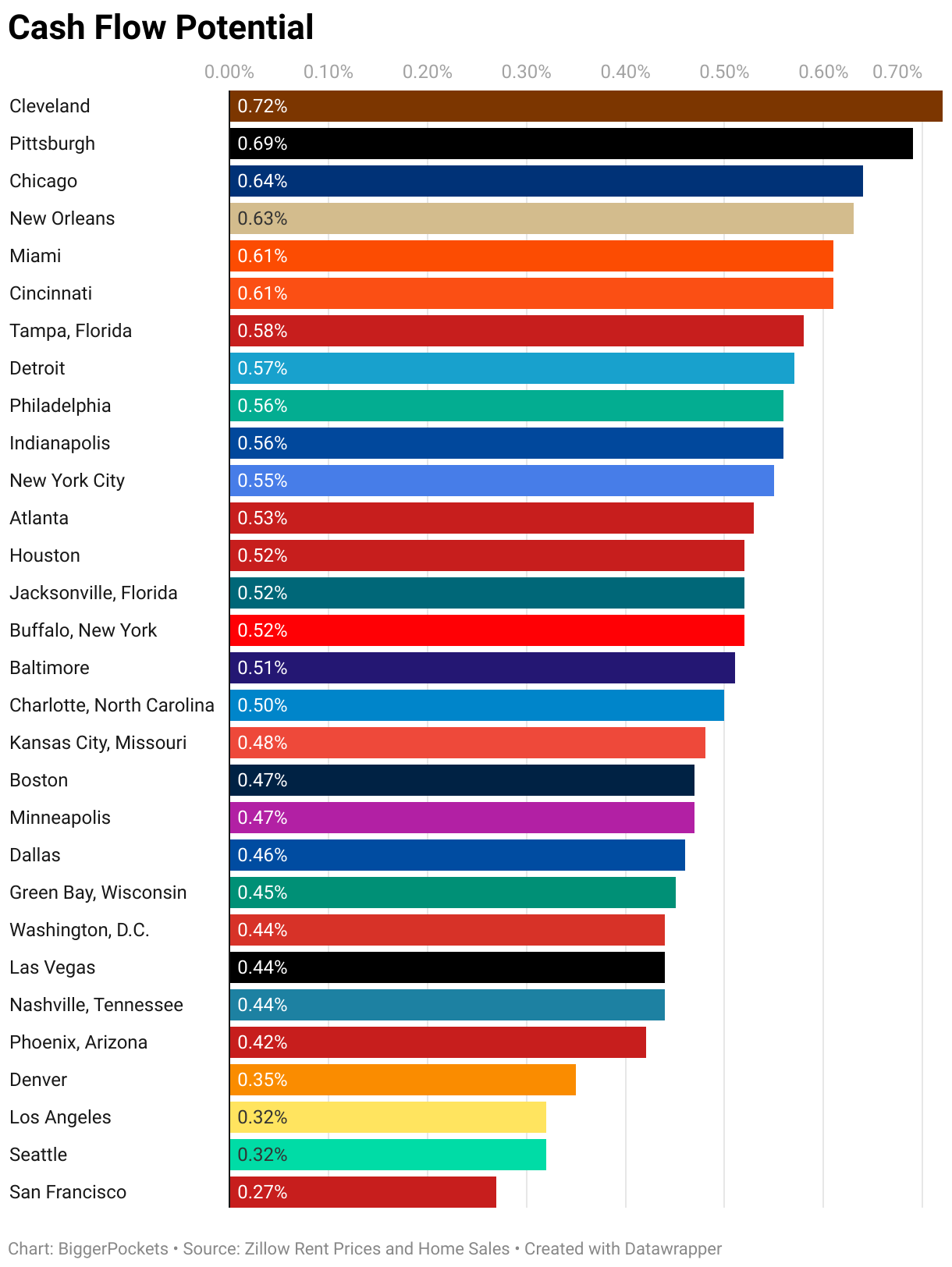
Categories
Investing

We Ranked Every NFL Team’s Real Estate Market and Found the Best Cash Flow Opportunities

It’s that time of year when you’re either super happy that your team made it to the big game, or you’re frustrated with your team’s performance throughout the season (such as my Panthers) or still recovering from a playoff blowout (I’m talking to you, Cowboy fans). Or you could be an Eagles fan and question your existence after what’s happened over the last 365 days (much to my delight).

At any rate, life goes on, and only one team can win the trophy. What we do have more control over, though, is where we place our money in real estate.

Here, BiggerPockets looks at every NFL real estate market, ranking them on a variety of metrics, starting with cash flow potential and ending with my personal take on which markets have the best long-term prospects. 

I’ll start by noting a few exceptions. First, the Rams and the Chargers are both in Los Angeles, and the Jets and the Giants both play in New Jersey. I used NYC metro data, which includes Newark and Jersey City. I, too, believe that the New York Giants should be the New Jersey Giants. 

In addition, many teams, beyond the Jets and Giants, don’t actually play in the city they’re named for. The 49ers, for example, play in Santa Clara, which is more San Jose than it is San Francisco. The Cowboys play in Arlington, the Commanders play in Landover, and so on.

To make things easier and consistent, I used metro data from the city that the team represents in their name. So, for the 49ers, I’m using San Francisco-Oakland data, not San Jose. 

With that cleared up, let’s look at the numbers.

NFL Markets With the Best Cash Flow Potential

To measure cash flow potential, we calculate the rent-to-price ratio (RTP). This is done by dividing the rent price of a market by its median sales price. Ideally, RTPs closer to 1% indicate strong cash flow potential, while values below 0.65% start to get a little iffy.

RTP has fallen in recent years due to rising prices in both the rental market and the sales market, on top of higher interest rates. What that really means is that cash flow is not nearly as easy to come by as it was a decade ago. However, that doesn’t mean it’s impossible to find. Every market has somewhere with cash flow potential, you just need to find it. 

Below is the list of all NFL markets sorted by their RTP.

full

Cleveland leads the list, with a pretty solid RTP of 0.72%. Bottoming out the list is none other than San Francisco, with a paltry RTP of 0.27%. Once again, that’s not to say that San Fran doesn’t have cash flow potential in any part, but you’ll be stretched to find it. Try Oakland, though.

NFL Markets With the Best Prices

A good home price is subjective, but ideally, we’re looking for a place with an “affordable” median sales price with strong long-term growth prospects.

full

Above, you can see all of the markets and their median sales price. Unsurprisingly, San Francisco tops the list with an extraordinarily high price tag of over $1.1 million. The lowest on the list is Cleveland at $185,000, which explains why it has the highest RTP of all markets.

You’ll also notice that Green Bay has the lowest rent price at $1,000, while the highest in New York at $3,100. A takeaway from this data is that there’s a strong correlation between home prices and rent prices up to $2,000 in rent and $400,000 in sales price. Then, after that, the numbers are scattered, with New York being markedly cheaper in home prices compared to that of San Francisco but having higher rent prices.

It further proves the point that real estate is local, but it also gives you a sense of what to expect at certain price points. I’m sure if we expanded this dataset to include more markets, we’d see a similar trendline.

What Markets I Think Are Poised to Do Well

Most of the markets on this list have plenty of investment opportunities and would be perfectly fine to invest in. However, the big standouts to me are Buffalo and Cleveland.

Cleveland’s high RTP and affordability are major draws, especially since it’s an established city in a region of the country that’s starting to see a little bit of revitalization. Many people begin moving there from the more expensive parts of the country, and Ohio as a state is relatively low risk in regards to weather and insurance costs. Plus, since we’re talking about football, I’d be lazy not to mention that Cleveland has a great sports scene, with not just the Browns but the Cavaliers and Guardians.

Buffalo, on the other hand, actually just topped the list for Zillow’s hottest markets of 2024. Why? It’s got a great economy, affordable prices, a very passionate Bills fanbase, and lots of great investment opportunities. It’s been growing for the last few years, both in terms of population and economics, and it looks like things will continue to move in that direction.

Overall, where you invest comes down to your individual preferences and strategies. Long-term holds would do well in most of the markets, but short-term rentals can work in markets like Tampa just as well. 

Enjoy the game!

Take Your Market Research to the Next Level

Need help finding the right market for your next investment? Dave Meyer created our brand new Picking a Market Worksheet to help investors like you identify and analyze the right locations for their next deals.

Download our worksheet today for quick and easy analysis when researching your next market. 

picking a market worksheet

Note By BiggerPockets: These are opinions written by the author and do not necessarily represent the opinions of BiggerPockets.
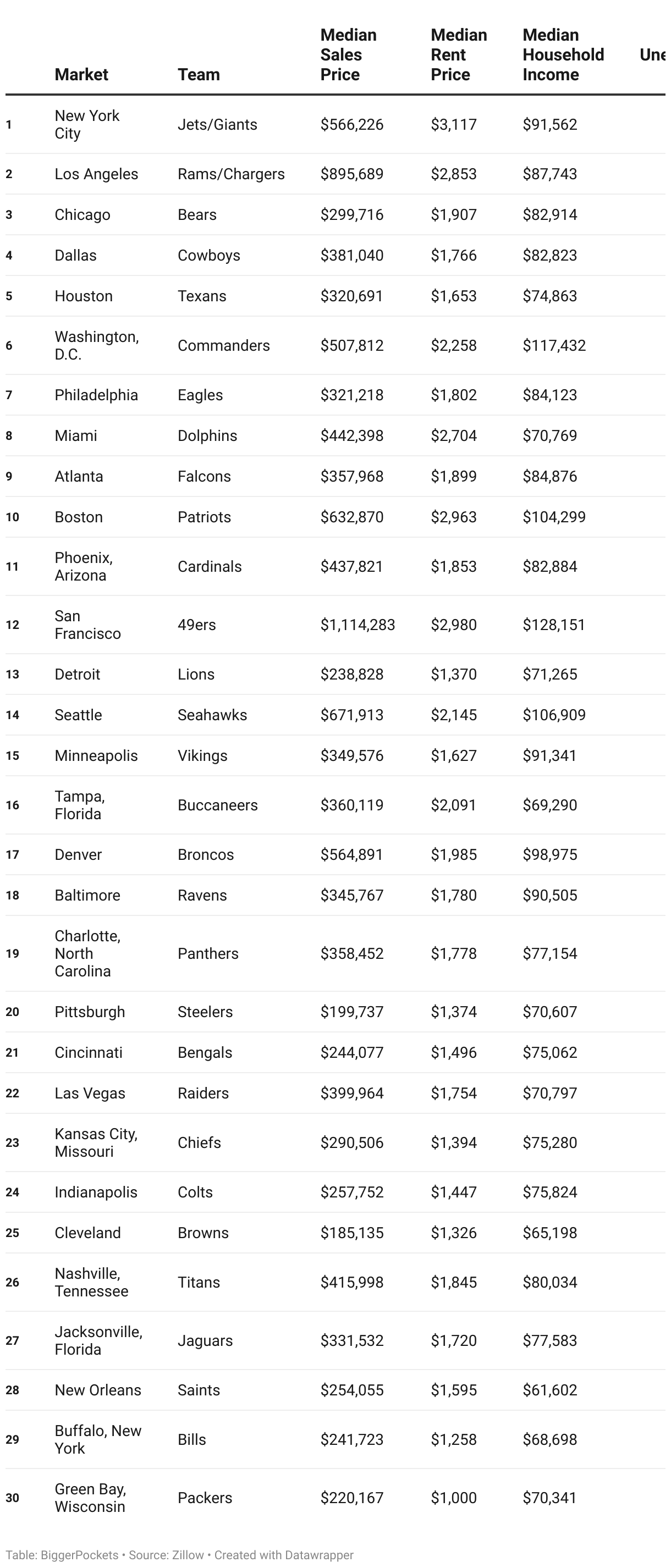
Categories
Investing

Working at Walmart Could Help Make You a Millionaire in Just a Few Years—Here’s How

If you dream of becoming a real estate investor but work at Walmart, you could well be on your way to realizing your dream much sooner than you think. This comes with one important caveat: You’d need to manage a Walmart store to enjoy the financial benefits that could set you up with the cash needed to invest.

Walmart U.S. announced last week that it would be giving its store managers stock grants in the company. The announcement comes after Walmart also made the decision to raise managers’ salaries and introduce a new bonus structure that will allow store managers to earn up to 200% of their salary in annual bonuses. 

How Much Will Walmart Managers Earn? 

The company announced that starting from its 2024 fiscal year, which begins in February, the average store manager’s salary will go up from $117,000 to $128,000. The new salary range will be between $90,000 and $170,000, which raises the starting salary substantially from the previous $65,000 benchmark. In addition, Walmart will do a 3-for-1 stock split at the end of February—something it hasn’t done since 1999.

Where things get truly lucrative is in the new bonus structure and the latest decision to give employees in some categories company stock grants. Under the new policy, managers can earn up to $404,000 per year in total if they get the performance-based bonus on top of their salary. 

The stock grants of up to $20,000 will be issued to Walmart managers, with a vested period of three years. The total amount of the stock grant will depend on the size of the store the employee is managing. 

The full $20,000 will be given to Supercenter managers. Supercenters are the biggest Walmart stores, about 180,000 square feet in size, and require managers to oversee hundreds of employees. Managers of Neighborhood Market stores and Division 1 stores, which are smaller, will get $15,000 in stock grants. Hometown store leaders will get $10,000 in stock grants. 

The beauty of the stock grant program is that it’s essentially free stock given to an employee by the company. You don’t have to buy stock—although that is also an option at Walmart, and the company will match 15% of the employee’s purchase, up to $1,800 a year. With stock grants, the vesting period is the period the employee must remain at the company in order to be able to cash in the stock. Walmart’s managers will be given the stock in installments, one-twelfth of the total each quarter until the three-year period is up. 

So How Does This Help Budding Real Estate Investors?

The biggest stumbling block for people who want to invest in real estate is not having enough cash to invest with. Currently, BiggerPockets recommends saving $60,000 before you begin investing. 

If you were a Walmart manager, how long would it take you to get there? We know that to be able to exchange the stock grant for cash, you’d need to work at Walmart as a store manager for three years. That would get you between $10,000 and $20,000, depending on the type of store you were managing. 

The bonus money is a less reliable figure. First, 200% of your salary is the maximum bonus amount, and the bonus is performance-based. And the $400,000 total would only apply to managers earning at the top of the salary range. 

Instead, let’s take the new average Walmart manager’s salary of $128,000. Imagine that you did get the full 200% bonus for three years straight. That would give you a gross income of $1,152,000. 

But that’s before tax. On average, after tax, you can expect to take home around 75% of that amount. So, in reality, you’d get something like $864,000. How much of that you’d be able to set aside for investing will vary depending on where you live, but let’s say your living costs are close to the national average of $61,334 per year. Potentially, then, you could have a huge $680,000 to play with—and that’s before the stock grant money.

And if you didn’t get the bonus? You would only have $288,000 after tax at the end of the three years, plus the $15,000 (after tax). That’s $303,000; after subtracting your average living costs, you’d still have a very decent $119,000 to play around with. Therefore, in only three years of working as a Walmart store manager, you could have enough cash to build a real estate portfolio. 

Of course, you would likely start off on the lower end of the Walmart manager salary range, at $90,000. But once you break into that average salary territory, you could have substantial amounts of money to set aside for your investments. 

You May Be Closer to Investing Than You Think

The takeaway from this exercise is this: If you have a regular day job, you’re not necessarily locked out of the possibilities of growing your wealth through real estate investing. In fact, the vast majority of Walmart managers (75%) started out as hourly wage workers. 

And while college graduates do work at Walmart, you don’t need a degree. Sure, it may take a while to get promoted to a managerial position, but it’s not out of reach, and it doesn’t require you to go into massive amounts of college debt. 

So if you’re looking for a lucrative career that will help you generate wealth over a relatively short amount of time, working at Walmart could well be it. Or you can use the Walmart example to look for jobs at companies that similarly offer good financial incentives for staff retention, like performance-based bonuses and stock grants.

Ready to succeed in real estate investing? Create a free BiggerPockets account to learn about investment strategies; ask questions and get answers from our community of +2 million members; connect with investor-friendly agents; and so much more.

Note By BiggerPockets: These are opinions written by the author and do not necessarily represent the opinions of BiggerPockets.

Categories
Investing

How Much Money Is Enough to Make You Happy? Most Americans Say $284,000, Others Say $1.2 Million

In the ongoing quest for happiness, a recent Empower poll disclosed that around 60% of Americans believe money can indeed buy happiness

However, the dynamics of money’s role vary from person to person. For 67% of respondents, happiness hinges on the ability to pay bills on time, while more than half prioritize living debt-free and enjoying luxury without financial worry. Another 45% see homeownership as integral to their path to happiness.

Current Financial Realities

Even with a median household income of approximately $74,000 annually, Empower’s findings suggest Americans feel the need for an income of around $284,000 per year to achieve happiness. Respondents believed they required $1.2 million in the bank to feel content ($1.7 million for millennials), surpassing the median net worth of U.S. households, currently standing at $192,900, per the Federal Reserve’s 2022 data.

Moreover, these revelations come at a time when economic stress is on the rise in America. With inflation persisting for over a year, 81% of poll participants feel burdened by rising costs, and 66% attribute their diminished sense of financial well-being to elevated interest rates.

The reality is that the financial landscape is evolving, sparking intriguing questions about the intersection of finance and happiness and reigniting the age-old debate about whether monetary wealth is a genuine gateway to contentment.

Or is there another way to change our relationship with money and its connection to our happiness while we are on our wealth-building journey?

Living Happy Now (and in the Future): The Happiness Formula

Changing your money mindset is a crucial first step to transforming your relationship with money and perceived happiness. The Happiness Formula is based on Vishen’s work, a pragmatic approach to identifying and pursuing true happiness. This exercise transcends wishful thinking, grounded in actionable steps designed to align personal aspirations with a fulfilling life. 

Here are the steps to follow.

Step 1: Name what doesn’t make you happy

Humans are way better at stating what we don’t want than naming what we do want—it’s our brain’s way of protecting us. So why not use this natural instinct to your advantage and create space—mentally or literally?  

On a sheet of paper, jot down all the commitments, people, belongings, and even investments that are weighing on your mind and aspects of your life that bring discomfort. Once you have this list crafted, you don’t actually have to act on anything—yet. By just acknowledging the things in your life that are weighing on you, your brain will start to find ways to help you out—setting the stage for the next crucial step in the pursuit of happiness.

Step 2: Identifying your happiness formula

In this step, grab another piece of paper and answer these questions to craft your unique Happiness Formula based on the experiences, growth, and contribution you want in your life. If you have a partner, spouse, or kids, consider doing this exercise with them after you have taken your initial pass.

  • What do you want to experience? Think of all the experiences—new and old—that you want to bring into your life or that bring joy. Consider all the local, national, and international experiences that you dream of doing. This might range from exploring the vibrant local culture of your community and attending music or cultural events with loved ones to embarking on international adventures that broaden your horizons.
  • How do you want to grow? What makes most people happy isn’t hitting a goal but the change and progress they make along the way to hitting the goal. For this question, reflect on the personal and professional growth you dream of making. Identify the skills, mindset, and knowledge needed to propel yourself forward. Recognize that growth extends beyond the workplace, encompassing personal aspirations that enhance overall life quality.
  • How do you want to give back? When most people consider how they give back, they think they have to donate a sizeable chunk of money or time to a specific cause or charity. However, I challenge you to think of all the ways you can give back—whether through time, money, or yourself.

I’ll also give you a big hint—giving back doesn’t have to be some grandiose gesture. Sure, for most busy people, regularly donating (ideally monthly) to a cause important to you is probably the simplest place to start. However, also think of the impact you can create by sharing your time and expertise with your community—be it writing a blog, attending a meetup, creating a podcast, or if you are a parent, investing more time with your kids. Most importantly, ensure how you contribute aligns with your life vision.

Putting the Happiness Formula Into Action

Now that you have the gist of the Happiness Formula, schedule time on your calendar to regularly check off items, cross off items that no longer align, and add new ones. If you have a partner, spouse, or kids, have each individual complete their own Happiness Formula exercise and come together as a group to see how you can support each other.

Final Thoughts

The Empower poll sheds light on how people think happiness comes with a price, making everyone take a closer look at what really matters to them—thus wrestling with the delicate dance between pursuing financial freedom and living a fulfilling life. 

In the constantly shifting money scene, the Happiness Formula is a down-to-earth approach to steer through personal dreams and cook up some real contentment. In the end, happiness might have a price tag, but figuring out your own special formula could be the secret sauce to unlocking a truly satisfying and happy life.

Protect your wealth legacy with an ironclad generational wealth plan

Taxes, insurance, interest, fees, bills…how can you acquire wealth, let alone pass it down, when there are major pitfalls at every turn? In Money for Tomorrow, Whitney will help you build an ironclad wealth plan so you can safeguard your hard-earned wealth and pass it on for generations to come.  

Note By BiggerPockets: These are opinions written by the author and do not necessarily represent the opinions of BiggerPockets.

Categories
Investing

How Ryan Haywood Used Investing and Deal Generation As a Way to Build Communities and Wealth

“You’re making too much money.”

That’s what echoed in Missouri native Ryan Haywood’s ears after his boss decided to slash his commissions—a “sales haircut,” as it’s bitterly known in the industry. 

This notion of being penalized for success was perplexing for Ryan. Out of all the downsides of his job—the after-hours calls from his boss that he was expected to answer, dealing with poor management, and working up to 80 hours a week—this pay cut was the last straw. He didn’t realize it at the time, but this setback was about to unveil a path that would lead his family toward the future that Ryan and his wife Megan had dreamt about.

Ryan’s story that I’m about to share is not just a testament to his determination to build his wealth on his own terms. This story is about his strategic, practical approach to building a truly successful real estate company in the face of uncertainty, full of solid insights that every investor should hear.

Ryan’s Journey From Sales to Real Estate

It was the end of 2019. Ryan and Megan were in a period that should have been filled with anticipation and joy for their family as they awaited the arrival of their third child. 

Instead, uncertainty loomed. Despite the lucrative nature of his job in the budding field of fiber optics, the instability and lack of appreciation left Ryan yearning for change. He was caught in a dilemma: a high-paying position that offered little in terms of job satisfaction and stability. And to make matters worse, the company he worked for just decided to cut a large chunk of his pay because he was making too many sales.

Ryan knew something had to change; he just hadn’t yet realized what that change would be. Shortly after receiving this news, Megan and Ryan had their third child. This meant Ryan was on paternity leave and suddenly had extra time on his hands. He wasn’t sure what his next steps would be—all he knew was that he couldn’t go back to the toxic workplace at his current 9 to 5 job.

It was during this time that Ryan’s wife Megan stumbled across a 30-day wholesaling challenge on Instagram and brought it up to Ryan. They had dabbled in real estate investing years prior with a couple of rentals but had been paying them very little attention. Ryan wasn’t initially interested in the idea of wholesaling, and the idea of a “30-day challenge on social media” seemed a bit like a gimmick at the moment, so he declined.

But after some thought and some persistence from Megan, he decided to give it a go. As it turns out, this challenge not only introduced him to the fundamentals of wholesaling but also ignited a passion for real estate that was previously untapped.

Initial Steps and Challenges

After pushing past his initial reluctance, Ryan went full steam ahead on trying to win the challenge—this meant landing your first wholesale deal within 30 days. This entailed driving for dollars to find distressed properties, reaching out to the homeowners (in Ryan’s case, via direct mail), and securing a purchase contract from the seller that Ryan would then assign to an end buyer.

Contrary to his later experiences, Ryan’s first deal came from word of mouth (in this case, that meant telling people around him at dinner what he was doing) and did not involve intricate negotiations directly with a seller. Instead, it was the process of learning on the fly—figuring out how to assess the value of properties and the cost of needed repairs with limited prior knowledge in this area. 

Despite these initial uncertainties and the steep learning curve, Ryan’s persistence paid off when he secured his first real estate deal. This pivotal moment was not only a testament to the validity of his new career focus; it also resulted in a significant payoff, earning him an $8,500 finder’s fee. 

Like many investors who came before him say, this deal was massively important. And not just because of the $8,500 check—that was just the icing on the cake. This deal was a proof of concept that wholesaling as a strategy works. In other words, the business model was proven right in front of his eyes.

Ryan admits he was still “terrified” of wholesaling at this point since he still had very little knowledge and understanding of the industry. Nevertheless, with the check in hand, he knew that this was the path forward for him and his family.

When the challenge was all said and done, Ryan ended up landing two deals in 30 days, totaling $28,500. This number was the base salary at his last job. He had successfully escaped the rat race and, as it turns out, would never set foot in his old office again.

Scaling Up and Embracing Technology

Ryan and Megan’s focus at that point then became getting more deals and repeating the process. From the very beginning, they knew that they wanted it to be a family venture, even packing up the kids and bringing them on business trips to ensure that everyone was benefiting from experiencing the lifestyle that was bringing them so much success.

They needed reliable, efficient tech to manage processes and allow them to actually find success while traveling to new markets and cities to explore investment opportunities. Thanks to DealMachine, the tech platform at the center of the 30-day challenge, they were able to travel while still building and working on their business.

Because of their adoption of technology, scaling came naturally for them. Wholesaling is a numbers game—to grow your business; you need more leads, more marketing, and people in key positions to help ensure a smooth pipeline. DealMachine helped them with all of this and then some, allowing the leads to keep flowing and marketing to continue on autopilot while Ryan and Megan focused on the most important parts of the business and spending time together as a family.

To get a deeper insight into how they scaled from getting their first few deals, here’s a breakdown of the numbers in the first couple years of their business:

  • First full year (2020): Achieved 73 wholesale transactions with no standard operating procedures (SOPs) or employees—just Ryan and Megan working together.
  • Following year (2021): Completed 113 wholesale transactions, indicating significant growth. This year also saw the introduction of a transaction coordinator (TC) and a salesperson, though they quickly quit. A new TC was hired, who eventually took on sales as well due to competence in this area.
  • Year after (2022): Conducted 45 wholesale transactions, which might seem like a decrease but was part of a strategic shift to focus on quality and integrate construction into their business model. The team grew to eight people, and the average assignment fee increased to $10,500.
  • Portfolio growth: From seven rentals in 2020 to 12 by the end of 2021, and then expanding their portfolio to 30 properties.
  • Financial highlights: In 2021, they grossed $575,000, and in 2022 broke over the million-dollar mark in revenue.
  • Operational shift: Started their own construction crew in 2022 to better control the renovation quality and timeline of their investment properties.

Networking and Community Building

In their pursuit of growing their business, Ryan and Megan Haywood not only built relationships with city officials but also mended fences with local real estate agents who were initially wary of wholesalers. Their efforts in renovating distressed properties across St. Joseph, Missouri, garnered Ryan the nickname “golden child” from the mayor, underscoring the impact of their work on the community’s fabric. 

This special recognition from city leadership demonstrated the benefits of their strategic relationships, highlighting how working closely with city officials was instrumental in smoothing the path for their projects and fostering an environment of mutual benefit.

These partnerships proved to be highly important in navigating the complexities of real estate development, from regulatory compliance to accessing new opportunities that aligned with their mission to uplift the community. Because the city officials (people who are often the gateway to successfully securing permits and zoning for building projects around a city) could physically see that Ryan was creating positive change, they were happy to help him. 

Some of these officials, with deep knowledge of the city’s housing, even became a source of leads for their business and guided them to properties and areas around St. Joseph that needed change. Alongside this, their engagement with agents eventually shifted from skepticism to collaboration as they demonstrated the value and professionalism they brought to the table with these relationships as well.

For Ryan and Megan, the lesson was clear: Building a network that includes both city officials and real estate professionals can significantly amplify an investor’s ability to effect positive change while scaling their business effectively.

Lessons Learned

Looking at Ryan Haywood’s journey through the real estate landscape, there are several lessons we can learn from them. By achieving over 400 deals so far, Ryan has not only showcased what’s possible with dedication and strategic planning but also exemplified the significance of adopting certain practices for long-term success. 

Here are some key takeaways from his experience, each providing a blueprint for how to navigate the complexities of real estate investing effectively:

Embrace community engagement

Ryan’s success was significantly bolstered by building strong ties with community leaders and real estate professionals. This highlights the value of networking, not just for deal flow but for fostering a supportive ecosystem that can propel your business forward.

Leverage technology for efficiency

Utilizing a real estate tech platform allowed Ryan to scale his operations by streamlining the process of identifying and managing potential deals. For investors, embracing such technologies can enhance productivity, allowing more time to focus on strategic decision-making.

Adopt a mission-driven approach

Having a clear mission, such as improving the community, can differentiate you in a crowded market. Ryan’s focus on revitalization projects earned him the “golden child” nickname, underscoring the impact of aligning business goals with community values.

Final Thoughts

Ryan Haywood’s path in real estate is a compelling story of strategic growth, innovation, and impactful community engagement. His progression from executing individual deals to achieving over 400 transactions is not merely a story of personal success but a blueprint for investors aiming to elevate their business practices. 

Haywood’s story highlights the critical role of embracing technology to streamline business operations, the power of networking in your local community and beyond to unlock new opportunities, and the impact that can come from fostering both business growth and community development.

For investors looking to replicate Ryan’s success, the key takeaway is the value of strategic adaptability—integrating new tools/methods and pushing forward while also remaining rooted in the community’s welfare and having a bigger “why.” This story shows that achievements in real estate require not just good financial judgment but a vision that extends beyond personal gain.

This article is presented by DealMachine

DealMachine

DealMachine empowers real estate professionals to discover and invest in off-market properties with ease, offering a comprehensive app that guides you every step of the way. From identifying potential investments to instantly accessing high-quality homeowner data for informed decision-making, we make investing simple and effective. Click to start expanding your portfolio today!

Note By BiggerPockets: These are opinions written by the author and do not necessarily represent the opinions of BiggerPockets.

Categories
Investing

Which Host City Has the BEST Housing Market?

It’s February, and you know what that means…Groundhog Day! Just kidding, it’s almost Super Bowl Sunday, so we’re tackling some of the top Super Bowl housing markets to see which ones make for a touchdown investment market and which don’t make the team. If you’ve ever wanted to own a rental property within driving distance of the biggest football game of the year, now’s your chance as we review four Super Bowl host cities and give our takes on their investing fundamentals.

Dave and the panel will look at Tampa, Florida; Los Angeles, California; New Orleans, Louisiana; and Miami, Florida. One of these markets is an all-panel hit, while others boast distributing metrics that any investment property owner should look out for. We’ll review each market, sharing their metrics, best strategies, and whether our expert panel would invest in them.

Plus, if you want to hear who WE’RE rooting for in Super Bowl LVIII, stick around, but please DON’T bet on it…we’re investing experts, NOT football experts.

Dave:
Hey everyone. Welcome to On The Market. I’m your host, Dave Meyer. Today we’re going to be talking about the big news everyone’s thinking about, which is of course, the Super Bowl. I don’t know, is everyone thinking about it? Do you guys think about this? Well, Kathy, you clearly do because you’re wearing some sort of football uniform today. What jersey is this?

Kathy:
This is actually the Cardinals, and it is Devon Kennard, who is coming out with a BiggerPockets book very soon.

Dave:
That makes a lot of sense.

Kathy:
And his first interview on real estate was on my show, The Real Wealth Show, so I got this.

Dave:
Awesome.

Kathy:
I don’t think he gave you one Dave when he was on this show though.

Dave:
I don’t have one and I’m glad though because I would not look as cool as you do in your Devon Kennard professional jersey right now. If you guys don’t know Devon, he’s an awesome real estate investor, former NFL player. He is been on this show. He’s written a book for BiggerPockets and apparently, friend of Kathy.

Henry:
I don’t follow football too much. I like football, I understand it, but I have beef with grown men in kids’ uniforms. It’s just weird to me. I’ve never been a jersey guy. Just me walking around with some young kid’s last name on my back just always seemed like a weird thing. I just can’t get with the jerseys. It’s weird for me. I don’t know.

Dave:
Is that all sports or just football?

Henry:
All sports. All sports. It’s like I would get a jersey that you customize and put your own name on the back, but I don’t know.

Dave:
You’re just rooting for yourself. You just want to root for Henry.

Henry:
And then it’s just like everybody’s running around talking about, “We got a game. Who do we play tonight?” Sir, you don’t have a game.

Kathy:
When’s the last time you ran around the block?

Henry:
You’re not on the team. They don’t even know you exist. You got to pick your kids up from daycare and you got a chiropractor’s appointment. You don’t have a game.

Dave:
James, you got to jump in here because I know you disagree.

James:
Oh, I’ve invested some serious money into my jersey game. The Super Bowl is my favorite holiday, so it is the number one holiday. Make sure my calendar’s blocked out and I will be always watching, but unfortunately the Seahawks aren’t in there, but I’m heavily invested in Seahawk swag.

Dave:
Well, that’s perfect for you, James, because today we are going to be talking about different markets that have hosted the Super Bowl. So we aren’t going to dive into the teams that are in the game. This show should be coming out I think two or three days before the Super Bowl. We have 49ers and the Chiefs matching up. But today we’re going to talk about a couple of markets that have hosted them recently and we’re going to evaluate each and every one of them about how good they are for investment or what particular strategies might work in one of those markets.
So each of us is going to take one of the last four hosts of the Super Bowl and we’re going to break them down. So James, hopefully this is an appropriate celebration for you. Henry, you could just sit there mad for the whole time, but you do have to participate because we got a game today Henry, you do have to play it. And before we do it, we also have Super Bowl trivia to talk about to see how well you do. And Henry, I’m going to make you go first.
Do you guys know what year the first Super Bowl was, Henry?

Henry:
1941.

Dave:
Kathy?

Kathy:
I think we should toss this to James. I think he’s going to know the answer, but it’s been some decades.

Dave:
That is true. Very vague but true. James?

James:
I don’t know the exact year, but I know it was somewhere in the ’60s because there was two leagues and they merged them back when there was two leagues. I think Henry was close when there was two, but when the NFL came together, I think ’60s, somewhere in there.

Dave:
All right, James, you’re correct. It was 1967, so it was Chiefs versus Packers in 1967.

Kathy:
Guys.

Dave:
That was the first Super Bowl.

Kathy:
I’m older than the Super Bowl.

Dave:
Well, you’ve been around for some decades also, Kathy.

Kathy:
Thank you. Yes.

Dave:
That’s how old you are, some decades. Could be 20.

Kathy:
Thank you.

Dave:
All right, I’ll ask you one more trivia question and spare you. Maybe I’ll just ask James, see if he knows. Which two starting quarterbacks won the Super Bowl with two different teams?

Henry:
Are they currently playing?

James:
No, they’re not. This is easy though because it’s fairly recent.

Henry:
Okay. Okay. Okay.

Kathy:
This is easy. This seems easy. Yep. I even know this one.

Dave:
Okay.

James:
Two of the greatest. You got Tom Brady-

Dave:
And?

James:
-And Peyton Manning, because Peyton Manning won it with the Colts and the Broncos.

Dave:
Bravo. Well done James. That was a good one.

James:
Can we get Tom Brady on the On The Market podcast? I would love to interview Tom Brady.

Dave:
I don’t think we have that kind of pull, man. Kaylin just slacked us and said that she’s going to work on it.

Kathy:
Oh, he’s probably listening right now. Yeah.

Dave:
Yeah, he definitely listens. So we’ll get him on here any day now.

James:
There’s two man crushes I have, Tom Brady and Mark Wahlberg. Those are the two. Mark Wahlberg, if we could get him on too, that would be a great show.

Dave:
Mark Walberg? Okay. Who knew? All right, well we should probably move on from football, even though I’m excited about the Super Bowl. And what’s cool about the Super Bowl is we’re all going to be together for the Super Bowl this year. We’re going to be together in Denver at a Super Bowl party, which will be very fun. And if any of you by the way are in the Denver area the day after, so the 12th, we’re hosting a BiggerPockets meetup in Denver. So if you’re in the Colorado area, James, Henry, Kathy, myself and the other podcast hosts will all be there. So go check that out.
But we’ve talked enough about football, let’s get into real estate after this break.
All right, Kathy, you are the best dressed for this event today by far.

Kathy:
Thank you so much.

Dave:
For those of you who aren’t watching on YouTube, it’s like full shoulder pads. It is a really good outfit right now.

Henry:
Yeah, it’s a legitimate game jersey. It’s not one you go and buy from the store.

Dave:
It’s like a professional game jersey and-

Kathy:
It shows my guns. Look at that.

Dave:
It does. It does show your guns. And because you’re doing so great today, we’re going to have you go first. Tell us about the market you’ve been researching as a recent host of the Super Bowl.

Kathy:
Well, this city had the Super Bowl five times. The population is 3.2 million and the population growth is 1.9%. Unemployment is at a very low 3.1%. Median income is $60,000 approximately, and the median rent is about $2,000. Rent growth has been 2.7%, which seems low, but maybe high considering this past year. And the median home prices, $372,000 with price growth at a whopping 1%. Who knows what city this is?

Dave:
I do because reading it.

Kathy:
In your notes.

Dave:
Yeah, I’m reading it. Yeah, I could see it. It’s Tampa, Florida. I’ll help you out.

Kathy:
Thank you.

Dave:
Tom. Brady’s most recent Super Bowl winning team.

Kathy:
Yeah, so Tampa, Florida, would I invest there? Not only would I. I do, but not specifically in the city. And I think this is something that people should really pay attention to is they’ll see these big city names as a great place to invest, but oftentimes it’s not actually in the city, it’s in the surrounding suburbs where it just gotten too expensive in the city and people move out and jobs move out because they can get cheaper land and so forth. So we do invest, but not in Tampa, just right outside, mainly St. Petersburg, but in and around Tampa.

Dave:
Kathy, actually tell us a little bit about that because a lot of what we talk about here on the show is sort of at the metro level, like the whole metropolitan area, but you’re talking about differentiating it. So when you first started investing in that area, how did you decide that St. Pete was a better option for investing than the downtown area of Tampa?

Kathy:
Well, when I first, first started investing in Tampa, it was in 2009 when the housing market had completely crashed and I was in a different city pretty much every day just trying to pick up the pieces of that mess. There were whole neighborhoods boarded up, Tampa, most of Florida in fact, was one of the areas that got hit the hardest because it was one of the areas where investors went a little nutty and it was pre-demographic growth there. So they had the right idea, they were just too early basically into Florida. So that area went up the highest and then came crashing down the hardest.
So when I went to Tampa, we were finding properties for 20 to $30,000 if you can believe that downtown. But the issue was crime. So in a lot of these areas where if you have a lot of boarded homes, you’d have vagrants, you’d have drug dealers, it completely transformed what had been a middle class neighborhood into a D class neighborhood. So for me, Tampa was, it was just too scary to invest there in those neighborhoods. So we just needed to look out. Part of what I do is finding property managers and teams, people who can help me at the time find those foreclosures, help me, I live in California, I didn’t want to oversee it myself, so find teams. And one of those teams was showing the growth that was happening in St. Petersburg.
The suburban areas tend to have less crime in general, not always, but it was really just the property manager and local team that I found there that gave me the insight on where they’re investing. And again, that’s how I do it When you’re investigating a city, I think going, walking it, talking to people, going to the Starbucks, learning where do people like to live, but most importantly really getting to know the property managers and where they invest because they know all the secrets. They know where who’s calling and who’s wanting to rent.

Dave:
I mean that’s a great situation. I’m sure people who are listening to this now want to invest in Tampa are a little bit jealous. Are there still good options to invest in either Tampa or St. Pete or in that metro area?

James:
I think Tampa is on the upswing for numerous reasons. A, I still believe there’s a lot of relocation coming out of California, coming out of New York, and Tampa is a very hot place for people to move to. The beaches are awesome, the quality of living’s good, and they’re also improving the city. They announced actually in 2023 that the violent crime rate actually went down. And so they’re really working and I know the whole state of Florida is working on getting the crime down, especially the violent crime, but they’re making progress with their policies. And that’s also why it was ranked number eight is one of the best places to live in America as quality of living.
And so I think with these strides and then still that the attractiveness of Florida from a lot of some of these states with very high income tax, I think there’s still a lot of runway there. I personally would move to Tampa if it wasn’t such a long commute flight to Seattle. And so I still think there’s going to be a migration in. Lower taxes, crime decreasing versus if you look at some parts of California it’s increasing, and so quality of living’s going. It’s just coming around. It’s attractive. I would move there for sure.

Dave:
So what would you recommend Kathy to people who are interested in this area? What kind of tactics work right now?

Kathy:
I think in Tampa city, in the city area, I imagine there’s still lots of opportunity to renovate. If you’ve got the skills of James Daynard or Henry Washington and you have teams set up there and can find older properties, fix them up. It’s a growing city for sure. And James wasn’t kidding, those beaches are gorgeous, but prices have been high. I mean prices have gone up quite a lot since 2009, so it is going to be a little bit more expensive versus again, the suburbs.

Dave:
Tampa, I totally agree. I actually remember, I think it was our second show ever, we all picked markets that we really liked and I think Tampa was the one I picked. There’s a lot to like there on the fundamentals level, but you have to adjust tactics and sort of make sure that you’re using the right ones for an expensive type of market. With that, after we’ve talked about Tampa, let’s move on to our second city. And for that, let’s go to James.

James:
All right, the market I’m covering is Los Angeles, one of the biggest cities in our country. It has hosted the Super Bowl eight times. Their new stadium, SoFi Stadium, is absolutely amazing. I’ve been there a few different times. I do know that they did what Los Angeles likes to do and overspend and overbuild. I think they spent what, $4 billion building the stadium, which was four times what they spent in Atlanta. But anyways, population is 12,872,000, and the concern is the population growth has dropped by 0.77% this year. People are starting to leave California. Expensive life, a little bit more crime, and they’re looking elsewhere to make their dollar stretch. Unemployment is at 4.9% and the median home price, and like Kathy mentioned, it depends if you’re in city or out of city because if you’re in LA proper, it’s going to be substantially more. And then the median rent is at $2,858, with rent growth of 2%.
And now typically, and I’ve seen too with LA, it gets steady, rent growth, because of the regulation to where you can only increase it at a certain points. So there’s very steady, but it’s never really jumping that high. LA is just one of those big cities that you can make a lot of money in, invest in, especially I think if you’re a developer or flipper, it’s kind of the best avenues to look at doing there because there’s still a lot of money pouring in, inventory’s still low. And even with I think some of the issues that LA’s having right now, people are still attracted to it. It’s still that, “Hey, we want to move to LA,” that LA dream. And I think it’s good for the short term.
Personally, I would never invest there long term. There is way too much rent control going on. There’s a ton of regulation. And if I was looking at any So Cal market, I would actually pick Orange County over LA because we are seeing some massive growth in Orange County because the crime that’s going on in LA, people are reloading out, they don’t want to move off that coast of California because they can’t find a better spot, but they are going to places that are a little bit more stable. I know in Newport Beach, we’re seeing prices just climb year over year and it’s all that LA money selling and bringing the cash down south.

Dave:
So long story short James, and thank you for sharing all that information, that’s really helpful, would you invest there?

James:
I would not invest there. For me, I want to invest in climates that welcome development and growth. And there are so many regulations just pumping through California on the regular. In addition to the biggest concern is what is happening in the back end is causing massive problems. You can’t even get home insurance. It is near impossible to get home insurance in California. That is a basic need of investors and homeowners. And when you have a basic need that’s being taken off the table, that can cause issues in the market in general. It is crazy what you have to do to get just even that simplest thing, home insurance. If you want to buy a property, there’s so much regulation between what you can do. So if I was forced to invest there, I would flip and do development. I want to be in and out. I don’t want their hands on me for longer than 12 months and get out. But I would definitely pick elsewhere.
And also tying into the football, I have a fundamental problem investing in LA, the LA Rams, or investing in San Francisco, San Francisco 49ers. I just won’t support them.

Kathy:
Hey now.

Henry:
See, this is the problem with sports fanatics is you’ll make financial decisions about your money and wealth based on absolutely nothing that has to do with finances. The fanaticism is insane to me.

Dave:
I grew up in New York and I’m a big Yankees fan and I for work for a while had to move to Boston. And it wasn’t just financial decisions, I was just a miserable person for six months. I just hated every single thing I saw or did for six months. It really does impact your whole life, Henry. You just start committing yourself to this.

Kathy:
And James, those were fighting words about the 49ers. I’m third generation San Franciscan. Not anymore. I did move to LA County, but I mean what a story though. Come on you guys. You have to admit that the 49er Brock Purdy story is amazing. He was third string, he was considered Mr. Irrelevant. Let Brock Purdy completely inspire you to never give up, never give up.

James:
Very relevant, love the guy’s story, but I hope he gets smashed by the Chiefs in the Super Bowl. There’s a lot of players I like individually on the 49ers, but as a whole they get crushed and I’m happy.

Dave:
Well, I don’t think anyone here is standing up for LA as an investing market. There’s a lot, like James said. Personally, I’ve never spent a lot of time in LA but it does seem like the stats don’t seem overly encouraging.
All right, we are going to take a quick break. Just to remind everyone, we talked about Tampa, which everyone did seem to think had strong fundamentals. Talked about LA next, which probably overpriced. James talked about regulations that probably weren’t good for investing. And after this, I will share the market that I’m going to be sharing, and so will Henry.
Welcome back everyone. Now for our third market, I’ll be sharing, so happy I get this city, it is one of my favorite cities in the country, the world. I love visiting this city so much. It has maybe the best sandwich I’ve ever had in my whole life, and that is not an exaggeration. It is New Orleans, Louisiana, and I know I don’t know how to say it correctly. I’m from the Northeast, I’m proud, I’m sorry. But New Orleans, Louisiana has hosted the Super Bowl a whopping 10 times. It has a large population but it is declining. So that is something that I personally think of as a red flag when I invest anywhere is a population that’s declining. It’s not necessarily something that you can’t invest in, but it’s something that I worry about. Would any of you invest somewhere where the population is declining?

Kathy:
I have. I wouldn’t do it again. What about you Henry?

Henry:
It depends on how long. If it’s a decline, I’m seeing a decline over five years history, then probably not. But if it’s a blip on the radar, then I probably wouldn’t have a problem with it.

Dave:
That’s a good point, Henry, because I wonder how much of it is COVID and migration patterns changed so much, and some of them are proving and looking like they’re permanent, or at least not permanent, but the trends are enduring past just the pandemic. But some of them are starting to reverse. So I do think you probably do want to follow Henry’s advice and look a little bit broader there.
But the one thing that does tend to happen with lower population, lower growth cities is oftentimes you find that there is better cashflow potential. And that stood out to me when I looked at some of the stats here about New Orleans is that the rent to price ratio is about 0.7. That is more than double what it was in LA and significantly higher than it was in Tampa. And so it does allow for interesting cashflow opportunities, but on the other hand it’s experiencing one of the biggest corrections in the entire country with prices dropping over 8% last year. So to me, this is a little bit risky, especially it’s a market I’ve visited and enjoy visiting but don’t know much about the fundamentals. I would probably stay away from this until we saw some sort of bottoming of the market because an 8% drop, that is significant. That’s not a one-year correction. That is something that could really hurt if you were on the wrong end of that decline. Any of you have any thoughts on New Orleans?

Henry:
Well, I think New Orleans as a city is amazing. It’s probably my second favorite city in the country. I think what I want to say about all of these markets is yes, we’re giving our opinion on whether we would invest there or not, but there are investment strategies that would work in all of these markets. In terms of New Orleans, I think you’re 100% right. If you’re looking for a market where you can get cash flow, maybe you live there, it’s in your backyard, you’ve got some sort of advantage and understanding the neighborhoods and having boots on the ground and a team you can build, it’s a decent market for cashflow. New Orleans isn’t going away tomorrow because it’s had population decline, right? It’s around. It’s going to be around. And if you understand the market and you understand how to find deals, I think you can make great cash flow.
Are you getting appreciation right now? No. It’s got negative price growth, but I don’t know that that’s going to last forever as the interest rates come down. But when you look at something like Tampa, what we talked about earlier, you can almost get the best of both worlds in Tampa because of the growth that that market is seeing and because you have positive population growth and you have affordable home pricing, right? You’re at 372 there for median home price, which means you can probably go in there, find an off market deal and get it to cash flow because the median rents are $2,000. Now is going to cash flow a ton? No, probably not. So you can probably get cash flow and appreciation in Tampa if you look hard enough, where Los Angeles, you can’t hold anything there, right? You’re not going to get cash flow, but the margins on flips are amazing.
You can flip one house in California and make what it would take me like five flips to make because of the margins are so large because the home prices are so much more there. But you’ve got an inventory problem, you’ve got 12 to 13 million people, you’re going to be able to sell those homes so you can get great margins if you’re turning money. So there’s strategies that work everywhere. If you’re going to turn money, like I said, you can do a flip. I get jealous every time I see Tareq flip a house out there and make like $250,000 and I’m like that’s six flips for me. So there is a strategy that works in all of these.
In terms of New Orleans, yeah, I think you got to go for cash flow and I think you have to understand the market because another thing that’s going to play in New Orleans is crime, and so you got to understand where am I buying these homes? What’s the crime going to be like? And factor that into your strategy, your purchase price. And I’m not saying you shouldn’t invest in an area where there’s crime. I’m saying A, you got to be built for that, and B, you got to plan it into your numbers. It’s like Walmart. You think Walmart doesn’t plan for stuff to get stolen from stores? They plan it into their numbers when they’re building out stores and figuring out where they’re going to go. So you just have to understand those markets.

Kathy:
Henry, I’m just curious because you said you’d have to do five or six flips to make that same kind of money. Do you think it takes the same kind of money and time and you’re just doing one big flip five different ways and maybe that’s better diversification?

Henry:
I’d say the timeframe is no different really. A big renovation is a big renovation. It takes the same amount of time if you’ve got your teams and your contractors in place. I think the difference is the risk involved when you’re flipping in LA because of the holding costs. So if I’m doing two flips in LA and I paid $600,000 for each one of those houses and I have a 12% interest only loan from James Daynard because he charges me a whole lot of money to do that, then I’m going to have to get them things turned fast or else I’m paying James a lot of my profits.

Dave:
Then James is making the money, not you.

James:
But it may be expenses Henry, but think of your overall cash on cash return. It’s infinite.

Henry:
I keep coming back to you, so it must be good.

James:
And we are dependable. I want to touch on New Orleans real quick because it is an awesome city. I love it. It’s food, the culture, the people. An amazing, amazing city. I think it has just infrastructure problems. I think like what Henry said is really important. You can invest in any market, whether it’s LA, New Orleans, you just want to adjust your strategy. The good thing about New Orleans on flipping is you can get real high cash on cash returns. Entry level price is small. You can get construction loans. They’re usually cheaper, bigger fixture properties. And so you can lever more when you get construction loans so that the amount you’re putting down on a cheaper property at the big rehab, your cash on cash return is going to hit like 50, 60%. And it might not be the same amount of profit, but the velocity in your money is always going to keep moving and growing. And so it’s good for that.
My concern with New Orleans is they have police force problems. It’s a little bit of a lawless city when you go there. Again, I love the city, but they got some infrastructure problems and for me, I’m already an active investor in a market that has crime problems. I don’t want to go into another one. It does cause issues, cause infrastructure, and pick and choose. I’d rather balance into a safer market at that point.

Dave:
Makes sense. All right, well thank you all for sharing your input. I’m going to share one last piece of advice. If you’re in New Orleans, go to a restaurant called Cochon Butcher and get the sandwich called Le Pig Mac. It’s like a high end pig mac with really good pork patties. It is truly one of the best sandwiches I’ve ever had in my whole heart. Go check that out. This is more important to me than real estate. Henry, let’s round it out with our last market. What do you have for us?

Henry:
All right, last market of the show is Miami. Miami, Florida hosted the Super Bowl 11 times. So what about Miami? What I like about Miami here is average home price $473,000, but they’ve seen a 5.9% increase in pricing over the past year. So we’re going up in Miami in terms of values. The sale to list price ratio in Miami is 97.3%, which means things are getting listed and selling for just a little under what they’re getting listed for, which means people are buying the homes there, they’re in demand. And that is because Miami has a very rapidly growing international base that is moving there. You’ve got lots of people moving there from other countries. You’ve got a lot of people moving there, especially from Canada right now. And so you’ve got people who are always migrating into and landing in Miami and they’re buying homes. I think I read here that the demand for homes around that $1 million price point is pretty high, so people with a lot of money tend to move here and they’re wanting to buy these nicer homes.
So in terms of median rent, you’ve got median grant and about $2,700, so just under $3,000 a month for median rent. You got median income at $77,000 and your median home price is around $472,000. So Miami, I think it has some decent fundamentals. You’ve got $472,000 for the average home price, you got about $2,700 for the median rent. So to me that tells me if I can find a decent enough deal, I can probably cash flow a property, maybe break even more likely to break even than cashflow. So not a super great cash flow market, but you’ve got demand there. And I think what you really have here is a market where short-term rentals and midterm rentals would probably do well as long as the rules would allow for you to be able to do that in the different areas around Miami because it is such a tourist destination. You’ve got people always traveling there to go and have a good time.
And so I think we’ve kind of seen markets where each one of the popular real estate strategies would work. I think this is a short-term rental market where you can probably get something to pretty well as a short-term and midterm rental. It’s a flip market. You can make good profits flipping deals here because you’ve got people who want those million dollar homes. And so you could go buy a distressed property for four or five, 600,000, put a couple hundred into it and sell it for over a million because you got demand there. And if you want cash flow, you’re probably going to have to work really, really hard to find a good deal.

Kathy:
Here’s what confused me about Miami. I love Miami. I love to visit. I love Miami Beach and ride my bike there along the beach whenever I get to go there for conferences. So great city. What’s confusing to me is that I think President Biden said that the biggest crisis we have today is climate change, which is there’s a lot of crises, but you hear this and that yet companies are flocking to Miami. I would think that Miami would be number one in climate change crisis potentially, but that city has grown like crazy. So apparently people aren’t paying attention to that or they don’t agree with Biden in that. But that concerns me because it seems like Miami would be right in direct line of hurricanes and then they’ve been saying for years that city’s sinking into the ocean. So I don’t know, maybe it’s not as bad as they say, but that to me is the biggest concern and that probably reflects in the insurance.

James:
And Miami’s insurance has increased dramatically and that’s what makes it hard to be a buy and hold investor there. It’s 31% higher than the national average and is climbing every year, and it’s also another tough state to get insurance in. And so the cash flow is a little bit tight in that market. And then when you start stacking on these insurance costs and the property taxes that are increasing because the market is moving up, it does make it hard to be a buy and hold investor. I do like the fundamentals of quality living, the lower taxes, the attractiveness of the investor, but these costs are a real issue for investors.

Henry:
I just did a quick search and what I’m seeing here is the average cost for a policy with a $300,000 dwelling coverage is approximately $3,500 per year, which is 56% higher than the Florida average and 104% higher than the national average. That’s crazy.

Dave:
104% higher.

Henry:
That’s insane.

Dave:
Okay. I’ve heard from a couple of real estate investors who I know who are trying to get out of Florida buy and hold just because the costs just aren’t worth the taxes and the expenses. It’s really interesting because people tend to want to go to Florida because there’s no state income tax, but states need to raise money somehow. And so they often do that through property taxes and that, especially if you’re an out-of-state investor, disproportionately impacts you negatively, right? Because you don’t get the benefit of no income tax as much as you would if you live there, but you have to pay higher property taxes. Happens in Texas too. So it’s just something that you have to think about if you’re going to consider investing in one of these markets.

Kathy:
Dave, I’m so glad you brought that up because people do give California a hard time. And one thing that we actually do have in our favor is really low property taxes and they stay there. They only go up very small amounts every year. So I do have two short-term rentals in the Los Angeles County area and they’ve performed really well. But there are regulations that people need to be aware of when it comes to short-term rentals and make sure you follow them. But property, I mean our property taxes are 0.07% in Los Angeles County. That’s really low.

Henry:
That’s super low.

Dave:
Yeah. The national average for property tax is about 1% just for record, so 0.7 in California would be below. Just as a benchmark, in Texas it’s 2%. So it’s double that. And that might not sound like a lot, but it can really add up.

Henry:
Oh boy.

Kathy:
And some areas are 3% or 4%, but our insurance in California definitely trumps everyone, even Florida. It’s worse here in California.

Dave:
All right, before we get out of here, I need to know your picks. James, since you’re the only qualified person here, who do you think?

James:
You got to go Chiefs. I fundamentally cannot root for the Niners.

Kathy:
Hey, hey, hey now.

James:
Go Mahomes.

Dave:
All right. Kathy’s a homer, so we already know this one.

Kathy:
Listen, Brock Purdy, he’s the age of my daughter. How can you not love him? You just got to love him. He’s got to … Come on.

Dave:
I’m not really following that logic.

Henry:
Yeah, I don’t know if I’m following either logic.

Kathy:
I mean, okay, so Taylor Swift, I do want to see Taylor Swift in the audience too. So you know what? All good. Both teams, they should both win either way. Let’s make it a tie.

Dave:
One of my buddies is a big Chiefs fan, so I’ll just say Chiefs. What about you, Henry?

Henry:
Well, unlike these two people, I’m actually going to make a prediction based on the football skill that’s involved in playing this game. James won’t pick the 49ers because he can’t, emotionally can’t, and Kathy thinks Brock Purdy is pretty. So I just think Kansas City is the better team. I think Patrick Mahomes is playing phenomenally.

Dave:
So good.

Henry:
He’s one of the best quarterbacks we’ve seen play the game of football in a long time. Yes, you look at some of the greats and I think when it’s all said and done, he’ll be up there with some of the greats. It’s just incredible to watch what he can do with a football. And I think that because he’s dating Taylor Swift, his football skill has been downplayed. So Travis-

Dave:
He’s not dating Taylor Swift. Travis Kelce is dating Taylor Swift.

Henry:
No, I’m talking about … No, that’s where I was going. I transitioned. Because he’s dating Taylor Swift, his football skills have been downplayed, but Travis Kelce is incredible and has been playing phenomenal. I mean look, I grew up a Raiders fan, so I shouldn’t even be allowed to say this, but Kansas City is going to win and it’s pretty cool watching how well they’ve been playing.

Dave:
All right, great. Well, thank you for your predictions, your insights, your real estate discussion, and all the nonsense that went on in the show. It was a lot of fun. Thank you all so much for listening and we appreciate it. I hope you all enjoy your Super Bowl festivities if you’re watching. I know not everyone even likes watching it. To be honest, this will be my first time watching it in like three or four years, but I’m excited to do it with all of you. Again, if anyone’s in the Denver area on the 12th, we’re having a meetup, make sure to just Google that. You can find that on BiggerPockets. Thanks for listening and we’ll see you for the next episode of On The Market.
On The Market was created by me, Dave Meyer, and Kailyn Bennett. The show is produced by Kailyn Bennett, with editing by Exodus Media. Copywriting is by Calico Content, and we want to extend a big thank you to everyone at BiggerPockets for making this show possible.


??????????????????????????????????????????????????????????????????????????????????????????

Help us reach new listeners on iTunes by leaving us a rating and review! It takes just 30 seconds and instructions can be found here. Thanks! We really appreciate it!

Interested in learning more about today’s sponsors or becoming a BiggerPockets partner yourself? Email [email protected].

Note By BiggerPockets: These are opinions written by the author and do not necessarily represent the opinions of BiggerPockets.

Categories
Investing

100% Bonus Depreciation Coming Back? (Do NOT File…Yet)

The biggest real estate tax deduction is coming back. That’s right—100% bonus depreciation is almost cleared for a triumphant return as the House pushed a new tax bill to the Senate, one that includes some massive tax deduction potential for real estate investors and everyday Americans alike. So, why is this SUCH a big deal? We’ve got Brandon Hall, CPA, on to break down why bonus depreciation could save you tens, if not hundreds, of thousands of dollars.

Everyone knows that real estate boasts some of the best tax benefits of any investment in the nation. But, the one tax benefit to rule them all is almost always depreciation. This tax write-off lets you expense a portion of your property every year and can turn your real-life gain into a paper loss, so you keep your cash flow while avoiding taxes. But bonus depreciation is like regular depreciation on steroids. And the tax benefits can be massive.

So, how do you take advantage of this huge tax write-off? What do you need to know BEFORE you take it? And should you hold off on filing before this new bill passes? We’ve got answers to all that and much more in this episode, so stick around!

Dave:
Hey, what’s up everyone? Welcome to the BiggerPockets Podcast Network. My name’s Dave Meyer. I’ll be your host today for this crossover event. This show will be airing both on the BiggerPockets real estate feed as well as on the Market feed because we have breaking news that’s super exciting and interesting for real estate investors. And to help me discuss this, my good friend Henry Washington is here with me today. Henry, how’s it going, man?

Henry:
Hey, man. So good to be here. This is the ultimate asking for a friend episode.

Dave:
I know where Henry’s going with this because we obviously know what the show is about and it’s about taxes, and sometimes I admit I don’t always know what’s going on with taxes even as it relates to real estate investing. Henry, if you were to rate yourself like one to 10, how well you understand taxes as it pertains to real estate, what would you rate yourself?

Henry:
I think I’m a solid two.

Dave:
Okay. Okay. I was doing this exercise myself. I was like, I think I’m a three and my goal for this year is to become a five. And I think if you could get to be a five, you’re probably in a pretty good shape, and that’s what we’re hopefully going to be doing with this episode. I think by the end, you and I, that’s our goal here today and everyone listening to get ourselves to a five out of 10 with real estate taxes because as you probably know if you’re listening to this show, real estate obviously offers cash flow, appreciation, loan payment, all these great things, but tax benefits are one of the most important pieces of the return puzzle for real estate investors.
And there’s been some really interesting news about the tax law as it pertains to real estate over the last couple of weeks. Today we are bringing on Brandon Hall. He is a CPA, Certified Professional Accountant and he focuses entirely on working with real estate investors and he’s going to be joining us today to break down the proposed new law. So without any further ado, all of you listening, me and Henry, we’re going to collectively improve our tax knowledge today with Brandon Hall. Brandon Hall, welcome back to the podcast. Thanks for being here.

Brandon:
Thanks, Dave. Appreciate you having me on.

Dave:
You are always so reliable. Whenever some news comes out about taxes and I just don’t understand them, you are always there to help us make sense of what’s going on and what it means for us real estate investors. So let’s just dig into the biggest headline of recent tax news, which is about bonus depreciation. Now, before we jump into the news element of it, can you just explain to everyone what depreciation is and what bonus depreciation is, and maybe just for a little bonus, why real estate investors care so much about it?

Brandon:
Yeah, sure. So depreciation is a… Actually, I’m going to back up before I explain this. I appreciate that compliment, thank you very much that I’m very reliable, but I have to give credit to my team because these guys are like, I’ve been able to build my firm to a point where I’ve got really smart people working at my firm now and these guys are all over this bill, so thank you. But credit goes out to them. All right. Depreciation, depreciation is a non-cash expense. So when I buy a property, I have to allocate some of the purchase price to land and some in the remainder to the building value. I can’t depreciate land because land does not deteriorate over time, right? Dirt does not fall apart, but my building literally falls apart. And when investors are first learning about depreciation, they get confused because they’re like, well, real estate should appreciate, the value of the property does appreciate, but it is also true that the roof is falling apart, the windows are falling apart, everything inside that property is falling apart over time, just wear and tear.
So depreciation is an expense that you get to claim on your tax returns every single year, in effort to track that wear and tear. It’s an expense that I don’t have to pay for every single year. The calculation is purchase price allocated to building whatever that number is divided by 27 and a half years, that’s my annual expense that I get to claim on my tax returns. Whether I paid cash for the property, finance it 100% or somewhere in between. So depreciation is just this nice shelter, it’s a cash flow shelter. I could have positive cash flow, but then after my depreciation expense comes into play, which again, I didn’t pay for because I paid for it all up front, I could tell the IRS that I lost money. My depreciation expense could cover my net operating income from the property. So it’s nice from that perspective because I get essentially tax deferred cash flow from my rental real estate investing.
Bonus depreciation is like depreciation on steroids. So bonus depreciation enables me to write off a lot more in the year that I acquire a property and place it into service. And when we’re talking about residential real estate, like a single family home, what you would do is something called a cost segregation study, which is the practice of going into a single family home or a multifamily home or any piece of real estate and saying, okay, the building has all of these things that make up the building. It’s not just if I buy a property for 500k and the building values 400k and land is 100k, if I don’t do a cost segregation study, it’s 400k divided by 27 and a half years. But a cost segregation study is going to say, but there’s things in that 400k that are not going to last 27 and a half years.
So let’s identify those components. Let’s assign a better, more accurate, useful life to those components. And if the useful life is less than 20 years after we do that assignment, then I can immediately expense them with bonus depreciation. So when you’re buying single family homes, when you’re buying multifamily homes, you can run cost segregation studies and you can write off a large portion anywhere between like 15 to 30% of the purchase price in the first year of ownership. So bonus depreciation enables you to claw back a lot of that purchase price in the first year as a tax deduction.
And bonus depreciation has been phasing out 2023, it was 80%, 2024, it’s 60%, but 2022 and prior thanks to the 2017 Tax Cuts and Jobs Act, it was 100%. So as it phases out, this whole, I can write off 15 to 30% of my purchase price starts to actually get smaller and smaller. It goes to 12 to 28% and then 10 to 25% and then so on and so on until it’s a much smaller percentage. So that’s why everybody’s talking about bonus depreciation right now because we’ve got a bill that just passed the house that’s going to retroactively make bonus depreciation 100% in 2023.

Dave:
Got it. Thank you so much for that explanation. Really appreciate that. Before we talk about the news and whether this is going to pass, I just want to dig into this bonus depreciation because it’s super important for people. When you say 15 to 30% and there are certain things that can be written off in the first years, what are those things?

Brandon:
Yeah, so it’s going to be… So if I go into a $500,000 acquisition, let’s call it a single family home, we’re going to allocate, call it 400k to the building, 100k goes to land, and then in that $400,000, the cost segregation study is going to pull out components that can be written off over five, seven and 15 years. So five, seven year components are my personal property components. Think like appliances, furniture and fixtures, carpeting, things that can be easily pulled up and moved to another rental without causing damage. So it’s not going to be structural. I can’t go and rip out my plumbing and put that into the next rental. So that doesn’t get a five-year life, that’s going to get a 27 and a half year life. But the cost segregation study is going to identify all those components that we can easily pull off the walls, pull up from the floors, pull out of the house, and move to the next rental without damaging that.
That’s essentially what that personal property is. The 15-year components are going to be land improvement. So if I have parking pads or parking lots or signage or something like that on my multifamily properties, that’s where that 15 year life is really going to come into play. So the cost segregation study is looking at those types of things and it’s saying, okay, of the 400k building value that we started with, $100,000 of it is five year property in 15 year property. The remaining 300k is still depreciated over 27 and a half years, but now we get a $100,000 first year deduction.

Henry:
So I do think that was probably the best explanation I’ve ever heard for how bonus depreciation works.

Brandon:
Appreciate that.

Henry:
Thank you for that. We’ve got a lot more to cover about bonus depreciation and a proposed law that is making its way through Congress as we speak. We will be right back after this quick break.

Dave:
Welcome back to the show. We’re here with Brandon Hall, discussing bonus depreciation and what that actually means for real estate investors.

Henry:
While we’re just on the topic of still discussing what it is and how it all works, I think what a lot of people tend to want to understand too is what’s the long-term implications of bonus depreciation? If I take all this bonus depreciation on the front side, is there something I need to watch out for after 27 and a half years? What happens if I sell that property before 27 and a half years? What’s the long-term picture with bonus depreciation?

Brandon:
That is a great question, and I wish more people asked that question and talked about it openly. So when you take depreciation, whether it’s bonus depreciation or just regular straight line depreciation every time that you’d claim depreciation every single year, what you’re doing is you’re actually lowering the adjusted basis in your property. So if I have this $500,000 property and I take depreciation of expense of $5,000, now my adjusted basis is 495. So if I sell it for $501,000… Actually let’s play it backwards, because this is what’s happening I think with a lot of people with short-term rentals. So let me just give you a more realistic example. You buy a $500,000 property in the Smokies, you run the cost seg, it comes with a bunch of furniture and fixtures and everything. So you’re able to immediately deduct $100,000, thanks to bonus depreciation.
So you bought it for 500, you’re immediately deducting 100k. Your adjusted basis is now 400,000. You bought this thing peak of the market, late 2020, early 2021, now you’re realizing it’s a lot harder to run a short-term rental than I thought it was because it was super easy back then when everybody had all that cash to spend and everybody was staying home and cooped up. They wanted to go out and do something, but now you kind of have to actually run a short-term rental in order to maximize the profit. So now you’re looking at it and you’re like, I don’t want to put in the work and this isn’t performing at the level that I want it to, so I’m going to go ahead and sell it. You put it on market for 520, nobody’s buying it at 520. Your best offer is 470.
All right, so you bought it for 500, now you’ve taken this offer at 470. In your mind, you’ve lost $30,000, right? That’s what most people think. I lost $30,000 on this deal, which is true, you did actually lose 30k, but in the tax world because you bought it for 500 and took bonus depreciation of 100, your adjusted basis is 400, and if you sell it for 470, you have a $70,000 taxable gain. So even though you lost money, you have to tell the IRS you had a taxable gain. That is called depreciation recapture, because all of that gain comes from depreciation. It doesn’t come from market appreciation.
That’s depreciation recapture, and from bonus depreciation, if your recapture is from bonus depreciation, then you’re paying taxes at your ordinary rate, not the long-term capital gain rates. So it’s very expensive and sometimes surprises people on the back end. So whenever you’re taking the depreciation upfront, what we try to advise people is don’t go buy toys with this. This is a loan, right? Every once in a while you get somebody that goes and buys one of those Lamborghini Uruses or something and it’s just like, dude, you need to invest this, right? This is either going into equities or you’re going to lend or it’s going to be another property because you got to grow this capital because at some point you’re going to have to give it back to the IRS.

Henry:
Brandon, you cannot be a self reputable Instagram real estate short-term rental investor who does not A, own a property in the Smokies and B, use the money to go buy a Lamborghini Urus. This is not being… I have to do this for my business.

Dave:
Well, Henry, if you buy a G-Wagon, it’s a tax deal according to Instagram.

Henry:
Yeah, it’s a free G-Wagon according to [inaudible 00:13:04].

Dave:
Yes. Just for everyone listening, there’s this common belief that if you buy a property, I think it’s over 6,000 pounds, you can deduct it and people feel like it’s all of a sudden a good financial decision to buy an incredibly expensive car. And it’s a little bit more complicated than that, to say the least.

Brandon:
Yeah, I mean, those rules exist for the people that are, it’s construction equipment, right? It’s like trucks, like construction trucks. And if you’re a business owner and you’re going to retain this vehicle for a long time, then go for it. But what happens is we get to December 15th and somebody calls up their accountant frantically, “What do I do?” “Buy a vehicle.” “Okay, I’m going to go buy the most expensive I can, G-Wagon,” you go buy that. And then two years later, your business has shifted. You don’t really need the vehicle anymore, but you can’t offload it. You’re going to have a big taxable gain and you’ve got this depreciation hit, like actual depreciation hit, you’ve lost money. So there’s a lot more that goes into it than simply, oh, I get a big tax refund.

Dave:
Actually, one of the things that I’ve encountered many times in my career is that a lot of the benefits to real estate investors in terms of taxes only exist for [inaudible 00:14:14] real estate professionals. And when I say real estate professionals, Brandon could probably give us a better definition, but I don’t just mean I, Dave, talk about real estate as a job. There is a very specific IRS definition of what a real estate professional is and what it isn’t, and I am not one. And so I’m curious about the bonus depreciation. Does this benefit only people who are real estate professionals or does this also apply to people who work full time in some other industry?

Brandon:
Yeah, both. So first, absolutely, if you are a real estate professional or if your spouse is a real estate professional, so you could be working full time in a different industry, a non-real estate industry, but if your spouse is a real estate professional and you’re filing a married filing joint tax return, then we think of it as the entire tax return as a real estate professional return. So yeah, so if that’s the case, then it’s wide open to you. You can acquire property place in service bonus depreciate it, and you can use the tax losses to offset the W-2 spouse’s income. So that’s certainly an option. Now, real estate professional status, you have to spend 750 hours working in a real property trader business, and you have to spend more time working in the real property trader business or businesses than you do anywhere else.
So if you’re working a full-time W-2 job, you’re out. We get a lot of questions from physicians all the time. Well, if I’m 10 days on and 10 days off, does that count? Well, no, because you’re still working 2000 hours for the year and you have to spend an additional 2001 hours in real estate, more time in real estate than you do at your day job. And even if you could do that, I’m an optimist. When I was starting my firm, I was working 80 to 100 hour weeks for a really long time. So I get it, you could certainly do the work, but you’re never going to convince the IRS or the tax court that you did it. So if you’re working full time, you can’t qualify as a real estate professional, but if you are working full time, there is a workaround. You can invest in short-term rentals.
If the average period of customer use is seven days or less, then it’s technically not a rental activity. Real estate professional status only applies to rental activities. So a short-term rental is a workaround to that. I think we actually recorded, last time I was on, we recorded a whole episode on that, so I’m not going to go into all the details there, but if you can do one of those two things, if I can be a real estate professional or if I can buy short-term rentals and qualify for that workaround, then the bonus depreciation is super helpful. However, it doesn’t mean that it’s not helpful for other people. I bought 10 duplexes with my parents and we formed a partnership, we went and bought these 10 duplexes and we cost segged it, and so I’ve got huge passive losses sitting on my returns that are just sitting there.
So it doesn’t really help me because I’m not a real estate professional, neither is my wife, but now I have this padding of suspended losses and I can go sell my three unit that I bought in 2015 that has 200k gain built into it if I so choose to do that. So there are benefits to doing a cost seg study, even if you can’t necessarily capture all the losses today, if you have passive income from other sources or if you have a passive gain from sale from other sources, you can use losses from cost seg studies to offset them.

Dave:
Okay. So I think I understand. So thank you for that explanation. And please, if you’re interested in this, look up what a real estate professional is in the eyes of the tax code. It is super helpful to you to know one way or another if you are or you’re not. But so what it sounds like though, Brandon, is that you can do a cost seg, get your bonus depreciation on, let’s call it property A, and even if you go to sell property B and you have a taxable gain there, you can use the cost seg from property A, even if you’re not a tax professional because they’re both passive losses or both passive income, I should say.

Brandon:
Yes.

Dave:
Is that right?

Brandon:
Yes, correct. Yep.

Dave:
Cool. Thank you for letting me know that.

Henry:
Even if you’re not a professional.

Brandon:
Even if you’re not a real estate professional. So passive income always can be offset by passive losses. And to further that too, it doesn’t even have to be a real estate passive activity. I could invest 100K into a hair salon. This is the example I always use because I really want my local hair salon to call me up and say, we need 100k, they’re great, but anyway, I can invest 100k into this local hair salon and they could use that capital as expansion capital and I could get a share of the profits every single year as a result of my investment.
Now, I’m not doing anything, I’m not going to manage it, I’m not going to be part of voting or anything. I’m just a capital guy. So let’s say that they pass me 10,000 bucks in profits, that is passive income, even though it’s not from a real estate source, that’s still passive income. And then I could go and use my real estate, depreciate it, bonus depreciate it to offset the 10k coming from my business or from that business activity because passive losses offset passive income. And this is something that accountants mess up a lot, especially if they don’t have a large real estate book of clients or if they’re new to the game. But it’s absolutely something that can be done if you really want to be a nerd and dig into section 469.

Dave:
Okay, so now that we’ve talked about what depreciation is, we’re going to get into the logistics of this law right after this quick break.

Henry:
Hello, everyone. Welcome back to the show. Okay, so that was hopefully a ton of great and helpful information for everybody. I’m sitting here learning as we’re listening and taking notes myself. So let’s kind of get back to the proposed law. So what else is in this proposal and what is the likelihood or timeframe that this may actually pass because it’s not in play yet.

Brandon:
Yeah, so the bill, as of this recording, the bill just passed the house and it’s going to go to the Senate next for markup and debate. There are varying thoughts on when this bill will actually pass, but it is supported by the Senate and also supported by the White House. It is a very popular bill, so I think that it will ultimately get through everything. The question is just when? The Senate recesses, I believe on February 12th, and there are now reports this morning, this is February 1st of Senate aides saying that they don’t think that the bill’s going to be up for discussion until after that recess, which then puts us into early March for actually getting this thing passed and signed, which is a huge question of, well, what do all the real estate investors that have bonus depreciation do? Because bonus depreciation is potentially getting rolled back in 2023 to be 100% versus 80.
So right now we’re on a big wait and see, a couple of the guys in my firm think that the Senate will actually fast track this, and it might be done before the recess on February 12th. We’ll just kind of have to see. But what’s in it? The three major things are the child tax credit is indexed for inflation. So that’s a good news. So that’s increasing. The other one is the R&D costs. So R&D costs, I believe it was at the end of 2022. So 2023 was the first year that this hit. It used to be that you could immediately expense R&D costs, which makes sense for the most part, but now they’re requiring a five-year amortization. So what that means is if I am running a technology company and I’ve got a million dollars of cash and I’m spending a million dollars of cash on labor, and so I have zero cash at the end of the day, my $1 million now has to be amortized over five years.
So I can only write off 250k of that today. So even though I have zero cash in the bank, I’ve got to tell the IRS I made 750k this year. Not very good and not ideal, especially now that it’s been a lot harder to raise capital from venture funds. So there’s a lot of panic in the tech space, but what’s in the bill here is basically unwinding or rolling all that back, pushing the start date out of that. So in 2023, you’ll be able to immediately expense all of your R&D costs assuming that this bill gets passed. And then the big one for real estate investors is 100% bonus depreciation. So again, as I mentioned in 2017, the Tax Cuts and Jobs Act implemented 100% bonus depreciation. It was 50% bonus depreciation before that, but starting in 2023, that 100% was supposed to drop to 80%.
And then this year, 2024, 60%, 2025, 40%, and so on and so forth until it reaches zero. Now this bill is basically delaying that phase out, so it’s going to roll back to 2023, make 2023, 100%, and then basically you get 100% for 2023, 2024, and 2025. So it’s just kicking the can down the road. We’ll deal with it later in 2026. So those are the main three things. And there’s some other few things in here too. If you just got done filing all of your 1099s, this bill proposes increasing the cap from 600 to 1000 bucks, so a little bit less reporting for us. But the interesting thing about this bill is that it’s primarily funded from ERC claims, Employee Retention Credit claims. So what was happening during the pandemic is, you could do the PPP loan, you could get the Employee Retention Credit, and over the past two years, promoters of ERC monies basically came out of the woodwork, built massive businesses really fast, and the IRS is estimating, I forget what percentage, but it’s insanely high percentage.
It’s like, I’m going to probably not say this right, so don’t hold me to it, but it’s something like 90%. It’s like insane amount of these claims for refunds are fraudulent, are not good. So the IRS is basically stepping up enforcement, and this bill is basically going to pay for itself with recovering those ERC refunds from taxpayers who claim them. So it’s almost like there’s a very small portion that is actually funded by, it’s like 300 million or something, but the rest of it is all ERC enforcement, which is pretty interesting. So it’s a really small hit to the budget. So with that coupled with it being so popular, people are basically thinking it’s going to pass.

Henry:
And I’m sure that they may fast-track this for the people, not because they themselves own real estate. I’m sure it’s for the people.

Brandon:
Yeah, yeah, right, exactly. There is one other thing too, 163(j), so if you’re a… And I forgot to mention this, but if you are a larger investor, section 163(j) might be of interest to you. So this bill is helping you out there, and I’m not going to go into that, but that is also being worked on too. So you’re going to have a better result with deducting business interest.

Dave:
All right, so it sounds like overall the bill that is getting bipartisan support and looks eventually poised to make its way through the house, the Senate, and get signed into law is overall a net benefit for real estate investors, which is something I’m sure we all want to hear. Is there anything else in this tax bill, Brandon, that just investors or just Americans should know about?

Brandon:
Not really. I mean, there’s some other things in this tax bill, but nothing that is necessarily going to impact your day-to-day life.

Dave:
Great.

Brandon:
Although-

Dave:
That’s what I wanted to hear.

Brandon:
There was an issue with getting this bill across the finish line. There were some holdouts on both sides of the aisle in high-tax states like California and New York. They wanted to put SALT repeal in this bill. So again, back in 2017, the SALT limit, State and Local Tax limit for itemized deductions was set at $10,000. And that crushed people in California and New York, especially in New York City. And so with getting this bill to vote, there were holdouts on both sides of the aisle, both Republican and Democrats that basically wanted to see SALT repeal back into play because they have constituents that are in their minds paying out the nos in taxes and they want to be able to deduct those State and Local Taxes that you’re paying via itemized deductions. They ended up huddling with the house leaders and then they ended up flipping their votes to yays.
So we were thinking, okay, there’s probably some sort of SALT bill that is going to be on the table, and then it was confirmed later that there is a SALT bill now on the table as well. So a SALT bill has been proposed and it would essentially raise the cap only for married filing joint taxpayers, interestingly, at least as of today. But it would raise the cap from $10,000 to $20,000. So now on your schedule A, if you’re itemizing deductions, your property taxes and your state income taxes, you’ve been capped at 10k, but now it might be 20k. So we’re watching that bill too. There’s the possibility that one will get combined with the house bill that just passed if they’re both in the Senate at the same time. So we’ll just have to kind of wait and see on that.

Henry:
And given the timing of this possibly not being signed into law until you said March, we all know taxes are filed in April, what advice would you have for real estate investors who are working with their CPAs now or maybe they’re not. What should they be doing to prepare or be ready for this?

Brandon:
Yeah, first is give your CPA some grace. Man, whenever we have these mid-season swings like this, what happens is there’s a whole bunch of second and third order effects. So it is very easy to just say, yeah, hold off on filing your tax return, which is what you should do. If you have bought property and you are using a cost seg study or you’re bonus depreciating improvements or you bought a vehicle and you’re going to bonus depreciate it, you should seriously consider holding off on filing your returns because 100% versus 80% could be a big swing. If you file at 80 and then it’s retroactively deployed like this bill passes, then you’re going to have to amend and file at 100. So there’s going to be issues, if you bought property placed into service in 2023 and are using 100% or using bonus depreciation, you should hold off filing the return.
But the problem is that if this bill passes, then all the software companies have to update their software. And so it’s not just like, oh, the bill passes, now we can file. No, it’s the bill passes and now we have to wait for all the software companies to update their software to reflect the passage and then we can file. It shouldn’t necessarily stop you from going ahead and starting the preparation process, but I would just hold off on actually green lighting that filing until we know what’s going to happen with this bill, and if it is going to pass, then I would just wait until we are holding off on it with our clients that acquired property and are using bonus depreciation.

Henry:
And just as a point of clarification for people, when you’re mentioning companies updating their software that I’m assuming you’re meaning the companies who do the cost segregation studies, essentially it’s a piece of software that kind of runs this cost segregation analysis, right? And so they would need to update that software to reflect 100% instead of 80.

Brandon:
So that’s a good question. They need to update their softwares, yes. They’re probably not going to rerun the cost seg studies. We could extrapolate what 100% looks like as long as we have the cost seg study. What I’m talking about is the actual tax prep software. So we all use enterprise level tax prep software, right? We use CCH, there’s Thompson Reuters, there’s Drake, there’s all these big software companies that enable professionals to file returns on their behalf. Or even if you’re using TurboTax or H&R Block, however you file your returns, unless you’re handwriting, you’re going to have to wait until that software company updates their software to reflect the changes in this bill. And so that’s just another set of time.
And it’s even worse for GPs of syndicates and funds, because not only do you get to wait until everything’s done, but you also have a bunch of angry investors that want to file their return. So if you are a GP of a syndicate and fund, you should probably proactively go out and say, “Yo, we are watching this tax bill. It’s going to impact how we file taxes. So just FYI, we might not necessarily get it to you by March 15th.”

Dave:
All right, Brandon, thank you for joining us to share your knowledge and coming on so quickly to help everyone make sense of the changing tax landscape right now, especially in the couple of months leading up to a tax season. If you want to learn more about Brandon and his firm, make sure to check out the show notes, we have all the information there. Hopefully, we’ll see you again, real soon for some more updates on the tax code.

Brandon:
Thanks, guys.

Dave:
All right, big thanks to Brandon Hall for joining us. Henry, I want to know, did we achieve our goal? Did you get up from your two out of 10 that you said you were on tax knowledge before the show? Are you at a three now?

Henry:
I would say I definitely have expanded my knowledge. I think, well, first of all, Brandon does such a great job of making complex tax topics understandable for everyone, but he did a great job not just explaining what it all is, but talking about some of the implications of what is the long-term impact of bonus depreciation. And so I learned a lot there.

Dave:
Yeah, same. I think it’s really important to know that taxes, like most things in investing come with trade-offs. There are some short-term benefits. Maybe there’s some long-term downsides and you need to work with a professional and to understand these things to make those decisions for yourself. And hopefully this episode and what Brandon taught us all collectively here today helps us all make better decisions.

Henry:
And one last point of clarification, my knowledge is probably up to a three now, and that is okay because I’m good at hiring tens.

Dave:
That’s so true. Exactly right. All you need to do is be able to understand most of what the people you trust are talking about, and it sounds like you got that a lot down.

Henry:
Absolutely.

Dave:
All right. Thank you all so much for joining us for this episode on the BiggerPockets Podcast Network. If you learn something useful in this episode that you’re going to use in your real estate business or talk to your CPA about, make sure to show us some appreciation, show us some love by giving us a review either on Apple, Spotify or give us that thumbs up on YouTube. Thanks again for listening. We’ll see you next time.


Help us reach new listeners on iTunes by leaving us a rating and review! It takes just 30 seconds and instructions can be found here. Thanks! We really appreciate it!

Interested in learning more about today’s sponsors or becoming a BiggerPockets partner yourself? Email [email protected].

Note By BiggerPockets: These are opinions written by the author and do not necessarily represent the opinions of BiggerPockets.

Categories
Investing

How to Build Generational Wealth Without Losing it

Want to learn how to create generational wealth? You know, the type of wealth that your children’s children’s children’s children can rely on. The type of wealth that allows your family to live a life of financial freedom, pursue their passions, and make a real impact on the world without having to sit behind a cubicle or screen all day long? That’s the wealth Whitney Elkins-Hutten is teaching you how to build in today’s episode.

After achieving financial independence for herself and her family through real estate, Whitney knew that she didn’t want her knowledge to go to waste. So, she developed a wealth-building blueprint for her daughter, which became her new book, Money for Tomorrow. In it, Whitney teaches you how to build a wealth legacy that will endure for generations to come and ensure that your descendants won’t gamble or spend away your life’s work.

To protect your generational wealth, Whitney walks us through the four financial “horsemen” that will drain your savings, crush you with taxes and fees, and lead you to financial ruin. So, if you want to ensure your wealth is built to last and will be there for generations, stick around for this episode and pick up your copy of Money for Tomorrow using code “MFTPOD” for a special discount! 

David:
This is the BiggerPockets Podcast show, 889er. What’s going on? This is David Greene, your host of the BiggerPockets Real Estate Podcast joined today by the handsome, talented, successful, and incredibly wealthy cohost, Rob Abasolo. And we have cooked up a great show for you all today.

Rob:
Wealthy and quaff hair. Listen, I’m in my head today because I don’t know if I wore this shirt on the last podcast that we did, and I only have three or four and I try to cycle them out, so it may look to anyone watching on YouTube that I’m wearing the same shirt for the last month.

David:
Insecure much?

Rob:
A little bit.

David:
My goodness. This is why I introduced you as incredibly wealthy, so people would just assume you’re like Mark Zuckerberg and you wear the same shirt every day.

Rob:
Not wealthy in confidence. But you know what? I am wealthy in an amazing podcast show that we’re going to have today. We’re actually bringing on Whitney Elkins-Hutten, and she’s going to be talking about how to create generational wealth that lasts, and the biggest levers that you can pull to stop losing money while you’re building wealth through real estate.

David:
That’s right. So many investors get into real estate because they have this drive to build wealth, but not just by themselves, but to create generational wealth for the others in their family. And the good news is, even if you don’t have a family, even if you’re brand new to investing, Whitney’s advice is still going to help you build wealth smarter and faster.

Rob:
And listeners may remember Whitney from 340, which resonated a lot with investors, and now she’s written a book. It’s called Money for Tomorrow: how to Build and Protect Generational Wealth, and you can actually pick up a copy over at biggerpockets.com/m40. Use Code MFTPOD for 10% off.

David:
Whitney, welcome to the show. Great to have you back. Okay. So let’s talk about your book. Who did you write this book for and who could benefit from the content?

Whitney:
Well, thank you so much for having me back. It’s been a few years, so I’m super excited to be here. I wrote Money for Tomorrow, originally for myself and my family, and as a blueprint for my daughter, just in case I got hit by a bus, heaven forbid something happened to me, she would have a full understanding on how all the lessons and learnings that I had accumulated over a couple of decades of investing she would… And ordering all the steps on how to create wealth, grow and scale the money in our portfolio as well as protect it. She would have all that laid out for her.
Now, I’m putting together this blueprint for my family, and I’m also mentoring several people on the side on scaling their real estate portfolios, and I kept hearing some of the common themes over and over again like, “I make good money in my job, but I still feel broke. Or I don’t know if I’m doing the right thing when I invest, and will it be enough when I get to retirement. Or I hate talking about finances, I just want to do deals.” And that’s when I realized I’m like, “Wait a second. I have this blueprint, this framework that I’ve been developing for my family. Let me test this out with some of my mentoring and coaching clients.”
Lo and behold, we saw amazing results for it. Now, who does this book most appropriate for? I would say one of two camps of people. And I would say almost every single one of us falls in one of these two camps, and that is somebody who’s just starting off on their investing journey that wants an end-to-end blueprint on how to create wealth, protect it, grow it, and then pass it on. And then somebody who’s more of a seasoned investor that knows a lot of these strategies, these rules of the wealth game already that wants to go back and make sure that they have a very fortified foundation and that are prepping either for retirement or to pass this wealth on to the next generation.

Rob:
Out of curiosity, when you’re working with somebody, do you prefer to work with a newbie investor or a seasoned investor in that? Seasoned investors, I imagine probably have a lot of habits that you may have to correct, but do you have a preference?

Whitney:
Both are fun to work with. I feel like with a new investor, I get to mold them. I get to lead them along the way, but the more seasoned investor, it can be really fun because they tend to have money set aside. They have a war chest of funds ready to deploy so we can get… Once we get the foundation cleaned up and it gets really fun on helping them deploy capital.

David:
Okay. Now, Whitney, you also point out that even for people who build massive wealth, it’s extremely common for them to lose that massive wealth, which frankly is very rarely ever shared on podcasts or something called survivor bias, which basically states that you only hear about the story from the survivor. The people who had a bad experience don’t get a chance to share their side of the story. When people lose money in real estate or lose money in business, they’re not typically going to Instagram to post that information or the worst selfie that they ever took or the snot coming out of their nose pictures.
Everything we see is very carefully curated. Part of what’s working against people is what you call the four horsemen. Can you tell us what those four horsemen are?

Whitney:
Yeah, so I learned about the four horsemen in reading a book published by Garrett Gunderson and then also again from my own mentoring coach, financial coach, Chris Miles. And just really quick to list them out, the four horsemen are interest, insurance, taxes, and fees. So these are four of the big seven gaps that I pretty steadily see in people’s portfolios. And if we can learn how to plug these gaps in their portfolios, fortify what I call your financial emote, not only are you going to be a more fortified investor should the market turn south, it has in the past 12 to 24 months, but also you’re going to have more capital to deploy in the future and create greater velocity with your money.

Rob:
Now, the concept here with the four horsemen is there are these four different aspects that can creep up on you is my guess. And if you’re not good at mitigating them ahead of time when there’s a perfect storm, you get hit by everything, then it could pretty easily put you in a bad situation.

Whitney:
They’re really sneaky. I mean, a lot of people call them money leaks, and so a good example would be interest. A lot of people listening here might know Dave Ramsey and they might study his snowball approach to eliminating debt or his debt avalanche approach to eliminating debt. You would assume that paying interest is bad. We should eliminate all interest, but really there’s a difference between destructive interest and productive interest. And so if we’re picking apart this horseman, we want to put that debt, evaluate that debt and put it on a sliding scale between being destructive and productive and really figure out, “Okay, where does it lie on this sliding scale? Is it hurting me or is it helping me?” And then clearly evaluate it and take the next steps to eliminating that.

Rob:
Sure. Do you think you could clarify? I mean, I feel like I have a good understanding of interest. Insurance is a big one. Just found out, I haven’t told you this, David, but our insurance on our property, the premium went up $4,000 last week.

David:
Again?

Rob:
Yeah. So that’s fun.

David:
It already did that.

Rob:
Yeah, I know. It just keeps doing it. Help us, Whitney.

David:
Insurance is a big one. Especially property insurance rates have gone up across the board across the United States.

David:
Yes, they have. Fun fact, I actually started an insurance company and then couldn’t do anything with it because we literally can’t get policies in California. The insurance companies will not write insurance here and in Florida it’s getting to be the same thing. This is the one thing that’s not talked about in the world of real estate investing, and so people don’t hear about it until it’s too late.
Is this something that you find there’s a category of things that are just not discussed amongst real estate investors and it’s sort of oversimplified and glamorized in a way that isn’t realistic?

Whitney:
Yeah, absolutely. I mean, I think what I run into with real estate investors often is maybe not so much about insurance or taxes or anything like that, but they get the steps out of order. They’re so focused on the real estate as a vehicle to grow cash flow, grow equity, create tax benefits for themselves that they forget that there’s some foundational work that they should do here, which is understanding how they’re creating wealth for themselves, and more importantly how to protect that wealth as they’re creating it.
So I think those are the things that don’t get talked about. Circling back to the four horsemen, people do a ton of due diligence on an investment for themselves to figure out how to protect the capital, generate cash flow, grow the equity. But when it comes to their personal finances, it boggles my mind that they don’t take all those lessons and learning these translatable skills and apply it to their personal financial situation.

David:
I love your points about starting from a strong financial foundation in order to build wealth. I echo those sentiments myself. We’re going to take a quick break, but when we come back, Whitney will break down the most impactful things that you can do to keep your wealth, including some ways that you might still be able to save on your taxes this year. So stay tuned.

Rob:
Welcome back. Whitney Elkins-Hutten is here with us talking about how to build the kind of wealth that lasts for generations and how not to lose money along the way.

David:
The last book that I just wrote, now that you’ve written a book here was called Pillars of Wealth, and I cover these principles that real estate investing is one of three pillars that you need to do if you want to get wealthy. The other two are making money and saving your money. We have bookkeepers that will look at a profit and loss statement for a property, and we will meticulously look at every expense. Where’s my insurance? Why is it going up? Why did maintenance cost this much? How much CapEx do I need to set aside?
And then when it comes to our own personal budget, it’s like people don’t pay attention to it at all. They put zero effort into where all their money is going, and they’re working so hard getting frustrated at not having success with real estate investing while all of the work that they’re doing for everything else in life, that money’s just flying right out the door and they don’t even pay attention to it.

Whitney:
Absolutely. Yeah. I mean, I have a coaching client that I’m working with right now. I’m not going to share any specific details, but it’s a theme that has cropped up. Again, they are very proficient at creating income and deploying that into investments, into growing their business, but the personal finances are, for lack of better word, is hot mess. We’re going back and they need a certain amount of cash flow to be able to exit from their business. And I’m like, “Great. We could spend all this money over here growing your investments,” which granted we could do, but we also can go back up here and pick up probably another three or $4,000 a month and just your personal financial statement. That’s less money going out the door. That’s less income that you have to generate to cover it.

Rob:
Sure, yeah. Well, we’re going to get into a few more of the horsemen, the four horsemen here that you were talking about. But before we move on to a couple of these, I did want some clarification on the insurance side of it. Is there something that investors can do to mitigate insurance because that seems like one that’s out of your control for the most part.

Whitney:
So really in the blueprint, what I see more often is that investors are not using insurance wisely in order to outsource their liability. Really, whenever you get an insurance policy, that’s what you’re trying to do. And so I hear you, Rob, you’re trying to… Maybe the question or what I hear here is, “How do I lower my insurance cost or maybe cost compare that line item on my profit and loss statement. Really there, you’re calling around to get the most optimal policies, try to compare apples to apples.
But more often than not where people are actually missing a gap here is that they don’t have the right, say, type of disability to guard against their job loss. There’s type of disability policies that guard against you working your current job, like current line of employment or any line of employment. Let’s guard our income. Let’s guard our health. The number one type of insurance that’s going to be tapped into is probably going to be somebody’s health insurance. But what most people do, they try to get the cheapest policy that they possibly can thinking that nothing’s going to happen to them.
And so health insurance, auto liability insurance, renter’s insurance. As an investor, if you’re an investor or a business owner and you have a home office, you need to understand if your home office is actually covered on your insurance policy. Oftentimes a homeowner’s policy does not cover a home office on the policy. It doesn’t replace that equipment. Or if you have to shut down your business for whatever reason, say, like there’s a natural disaster in your area, it doesn’t cover any of that loss. So we want to make sure that we’re utilizing insurance correctly in order to outsource a liability.

Rob:
Got it. So we’ve got interest, insurance. Those are two of the four horsemen. What are the other two?

Whitney:
Taxes and fees. Taxes tends to be a really fun one that most real estate investors love because they’re drawn to real estate because they hear, “Oh, I can use all these losses that offset my income or earn tax-free or unearned income in real estate.” And that’s great, but you can also do the same thing with businesses as well. So there’s an amazing book out there by Tom Wheelwright called Tax-Free Wealth, and so I really highly suggest everybody pick that up.
But really the five things that he’s trying to teach in that book is how you’re going to utilize deductions. A big deduction in real estate is depreciation. How do you use these to offset the income that’s coming in? How do you shift your income from earned income to passive income? That’s another tactic to implore here. How do you take advantage of lower tax brackets?
So for me, I can take advantage of my tax bracket for me as my child. I can take advantage of her tax bracket. She gets taxed very differently than I do. I can also take advantage of other dependents tax bracket. If I had a parent that was living with me or something like that, how can I take advantage of other tax brackets? How can you take advantage of tax credits? Hey, that’s a one-to-one offset on your tax liability. And then how can I defer income using retirement accounts, qualified retirement plans, pension plans.
Most of us are taught to do the last one first. Get a good job, buy a house, get married somewhere in there, right? Yeah. And then stuff, money in your 401K. There’s four other things that we should be looking at, probably first in order to optimize our taxes.

David:
Okay. So we shouldn’t just be thinking, get a paycheck and stick it in a 401K. There’s a couple steps that we can look at to save us money in taxes before we get there. What are those things?

Whitney:
Now, if you just don’t have a business or don’t have any real estate, you have very few deductions available to you, but as soon as you open a business or buy a piece of property, you have a wealth of deductions that are open to you. You learn to use those wisely. And I think the number one deduction that most people miss, especially when they start off investing in real estate, is using depreciation wisely. So make sure that you’re partnering with a tax professional that is not scared to take that depreciation deduction.

Rob:
That’s a huge one. I mean, that’s really one that most people are, I feel too lazy to really dive into that and learn why it’s so powerful. And you’re just like, “Yeah, deduction. It doesn’t really change things too much or one way or another.” But when you are a full-on real estate professional, meaning you are in the business 750 hours a year plus it’s more than half your time or you’re self-managing your short-term rental, you can really start unlocking the tax depreciation in a very significant way with bonus depreciation. And this is really something I wish that I had learned as a real estate investor at the very beginning of my journey.
I feel like as real estate investors, we really don’t worry about taxes until it’s tax time, and then we owe a lot of money, and then we’re calling our CPAs and we’re like, “Dude, what can I do to save 10 or $20,000 really, really fast?” Whereas what it sounds like you’re suggesting is implementing the right systems in place, learning about it, having a foundation at the beginning of all of this so that you’re never really scrambling in the final hours.

Whitney:
I would like to even challenge… We’re recording this early 2024. You should be talking to your accountant or a tax strategist on how to plan, what are those moves that you can take during the year, this year to lower your tax bill for your 2025 filing? Get out ahead of it. I see investors, they balk at paying for tax professional help because they think it’s costly. I will tell you, I mean my tax prep bill, it’s a few thousand dollars, but what I save is priceless. I will play that slot machine every single time.

David:
I can think of a couple practical examples because this is a really good example of investors know about depreciation, but they don’t always think about deductions because investors forget that they’re still running a business and they need to think like a business owner. When we talk about passive income in real estate, it gives this idea that you just made one good decision and then you benefit forever. But businesses aren’t passive and real estate is included in that.
So one thing is to set a business up that’s like an LLC or an S Corp with which you buy your real estate through. And then you talk to your CPA and say, “Hey, I am planning on going to Florida for this. I’m planning on going to California for this, and I’m planning on going to Tennessee for this. What would I need to do for this to be a write-off?”
And then your CPA will say, “Well, if you look at vacation, like vacation rentals when you’re there, if you meet with staff like a real estate agent or a property manager or a title company, when you’re in that area, this can now be considered a business trip that you are going to be taking anyways.” A lot of people go to dinner and they just pay for dinners. But if you make that dinner a business trip where you discuss things like business, so every time Rob and I go to Chipotle, that’s a write-off because all we do is talk about-

Rob:
Business.

David:
… our rental property. Yeah, exactly. A lot of people pay for a vehicle. We all have to have one, but your vehicle can be for many businesses, something that the business needs in order to perform. And now the expenses associated with that vehicle become a write-off for the business. And if your income is coming into this business and now you have expenses that you’re going to have anyways, but they’re also necessary for the business, you’re going to use it in your personal life, of course, but you can write it off as a business expense because it’s necessary that… I’m glad you’re bringing this up, Whitney, because this stuff doesn’t come up on real estate podcasts very often, but it’s still a part in building wealth and saving money.

Whitney:
Absolutely. Because every time you can bank some of those deductions, in the case of going to Chipotle or driving your car, you were going to spend that money anyways, but now you can write it off and you don’t have to pay taxes against that income that you use to offset it. Another one is business use of the home. If you have a home office, now a portion of the mortgage interest you pay on the property, the taxes, the insurance get allocated to that home office.
I know for me, I have a desk in a dedicated space in my home that I run my real estate business from. Well, of course I’m going to take that 200-square foot area and write it off against my taxes.

Rob:
Of course.

Whitney:
Why wouldn’t I?

Rob:
Why wouldn’t you.

Whitney:
Why wouldn’t I?

Rob:
Yeah, exactly.

Whitney:
So there’s just things to think about there. Internet. I can deduct through that home office, a portion of my internet. I have a phone dedicated for the house, therefore my phone that I carry, my cellphone that I carry is dedicated to the business. So partner with a professional that understands how to use all these things. One thing that I love about Tom’s book, Tax-Free Wealth is that he views the IRS code is a treasure map. The first 10 pages are all about how you can actually pay your taxes. I’m not saying we shouldn’t pay our taxes. Well, yes, we should pay our fair share, but you can arrange your affairs as such to lower your liability legally.

Rob:
So we’ve covered three of the four horsemen, interest, insurance, and taxes, and right after the break we’ll hear from Whitney about the last horseman fees, including one of the sneakiest fees and how to avoid it. Stick around.

David:
Welcome back, everyone. We’re here with Whitney Elkins-Hutten talking about her book, Money for Tomorrow. Let’s jump back in.

Rob:
So that brings us to the fourth horseman. We just talked about interest, insurance, taxes. What is the fourth one here?

Whitney:
Fees.

Rob:
Notoriously hated amongst everyone. It’s the one unity we have in this world is fees. We all hate them.

Whitney:
Oh, yeah. I mean, there’s the low-hanging fruit, your bank fees, your ATM fees.

Rob:
Ticketmaster fees,

Whitney:
Oh my gosh. Ticketmaster fees.

Rob:
Airbnb fees. It’s more expensive than a hotel. Sorry, carry, carry on. Carry on.

Whitney:
I 100% agree on all those things. Then if you’re a real estate investor, you’ve got your closing title fees. Right now I’m getting a house under contract to sell, and they’re like, “Here’s your title fee. Here’s your closing statement. Here’s your inspection.” And all these things that we have to split with a buyer. And I’m like, “Oh, boy. Okay. More fees for this transaction.”
Now, those are all great. We go into detail on that in the book, but I think the one that most people are taking their eye off the ball on is actually the fees associated if you have retirement funds. I don’t know about you, but if I’m setting money aside in retirement, I will probably want to have more than a $500,000 in that retirement account, which means when I start taking the required minimum distribution as I approach retirement, it’s going to be above my standard deduction. So my husband and I, we’re married, okay? We get a standard deduction of about $26,000 a year. I plan on retiring or pulling more than $26,000 out of that account.

Rob:
$26,000 per year?

Whitney:
Per year, per year. My living expenses are much more than that. So now here’s the thing. There’s two things that are compounding in here. One, there’s the fees that I’ve paid on those investments the whole entire time. And I challenge, people should do the math on this. They think that 1% total fee or 1.5% or maybe even 2% total fee in their retirement account just to administer the account just to be in the stocks, bonds and mutual fund doesn’t is worthwhile to them. You compound that out over 30 years, you’re losing not just tens of thousands of dollars, but in some cases hundreds of thousands of dollars just to fees. Okay?
But let’s say you get to retirement, that money’s all gone. You’ve lost the ability to compound and grow that. You can’t generate velocity with that money. It’s gone. But now you want to retire and you want to start pulling the money out of your retirement accounts, okay? It’s going to be larger than your standard deduction. Now, there’s a thing here called provisional income that you’re potentially triggering, which means you now get double taxed on things like social security.
So this can be a big train wreck for people. And so again, I really want to encourage people to model out what kind of fees that you’re paying as you grow your retirement accounts, but also sit down with a professional and fully understand, “Am I going to be triggering this provisional income whenever I start taking things out of my retirement account?” This is why we hear a lot of people doing Roth conversions, the five to 10 years before they start approaching retirement because Roth IRAs are not subject to provisional income.

Rob:
So one of the things that I’ve heard, and this probably goes into the fee side of it, is the compounding effect of having other people manage your money, which again, this is the standard way of doing it. Usually hire a professional, you’ll get charged a couple percentage points to do that, but over time, that compound actually eat away at a lot of the earning potential that you’re actually stacking away in your retirement accounts, right?

Whitney:
Oh, absolutely. In the book, I walk an example of somebody who is invested in their company 401k, getting a match, but they have a 1% total fee load between expense ratios, fiduciary, plan administration, all that, which is quite honestly pretty low.

Rob:
Yeah. It seems like very innocent, like a very innocent feel.

Whitney:
Yeah. Great. 1%, that’s no big deal. I’ll pay that all day long because somebody else is doing the work. Now, again, like you said, that’s compounding over time. You want your retirement account to compound, but the more money you put in there, the more company match that goes in there, those fees compound over time as well. So it’s innocent enough in your late 20s or early 30s, you might just be paying a couple hundred dollars a year. But by the time you’re pulling that money out 30 to 40 years later, you’re probably paying hundreds of thousands.
You’ve already paid tens of thousands of dollars in fees, but you’re going to be accumulating a hundred thousand or more in fees. I have a hang-up here. I really do.

Rob:
And I’m curious because it is sort of the standard. What’s the actual solution to that? Because I know self-directed IRAs seem to be very popular, and this is the notion where you get to control where the money is being put into. So a lot of real estate professionals like them because they can effectively use it to invest in more real estate if they wanted to. But is there an actionable step for real estate investors on maybe how they could not pay six figures and fees over time?

Whitney:
Well, I think it’s going back to those five steps that you need to take in order to eliminate and significantly reduce your tax bill that Tom lays out is that make sure that you are opening businesses like real estate, your investments, whatever you can to take advantage of those deductions, that you’re shifting your income as much as possible from earned income to passive income to change how it gets taxed, that you’re taking advantage of other tax brackets.
If you have a business, pay your kids. That’s a neat little, I shouldn’t say trick, but it kind of is. Why not? I pay my daughter. We have a camper van rental business. And not only is she learning good skills in managing a business alongside of me, but I can now pay her because she now has earned income and she can now put that in her Roth account. That’s a very powerful wealth transfer and wealth building strategy, and it’s completely legal. And then we can get into tax credits. And then the last part, if you still have funds left over that you need to tax shelter, now we can start getting into how do you best leverage these retirement accounts and qualified retirement plans? So it’s not necessarily an either or, it’s just making sure that you’re doing things in a laid out strategy and in the right order.

David:
Now, Whitney, you mentioned your daughter and how you pay her. I think that that’s brilliant. You’ve also mentioned that she’s one of the reasons that you wrote this book. Can you talk about how you’re passing on generational wealth to her and not just through wealth, but also through knowledge and action that she sees you taking?

Whitney:
Yeah, absolutely. Well, we actually started the wealth journey with her at an early age and just by playing games. So we started playing cash flow for kids at a very early age. And then whenever she got to be about seven, eight years old, we started reading a book like the Richest Man in Babylon. And from there we talked about how she could create value around the house, earn an income, doing things in the household, but also outside the household like pet sitting.
Now, she helps out in our camper van rental business. And then we started talking about how she needs to save that, save a certain percentage, but also set aside a certain percentage to give away. And then of course, she has the bucket that she can spend. And then we’re teaching her how to spend that money. Now, this is kind of the scary part as a parent, right? Because you don’t want your kid necessarily just going out. She loves buying Squishmallows. We walk in Costco, she wants to buy every single one of those gigantic three foot round pillows and bring them off.

David:
Oh yeah. My niece is right there with her. Nothing makes her as excited is when I send her a new Squishmallow.

Rob:
Same here, by the way. Nothing makes me more excited than getting a loan when you send me one, David.

Whitney:
Well, David, if you have extra, I’ve got an 11-year-old that would love some. So there you go. But anyways, it’s the cringe factor. She wants to buy these Squishmallows, and I kind of cringe. I’m like, “Really, this is how we want to spend our money?” But I’d rather her make these mistakes now with 10, 20, 50, maybe even a hundred dollars versus later in life with tens of thousands of dollars or even more. So she’s really learning the value of creating value, getting paid for it, learning how to save it, learning how to give it away to charities that she is passionate about, but also how to spend it, which is I think… And it’s not even just spending, but gain a good steward of that money as she moves forward.
And last piece is that we have her invest alongside of us in our real estate deals and various other opportunities. So she’s starting to learn about how her investment babies make babies and continue to grow that way. So I want her to have a very solid fundamental base. And quite honestly, that is the most important thing that I can pass on to her is that knowledge, because she can go out and create her own portfolio from that. So that’s my passion, and it is helping her do that, but also helping other people do the same.

Rob:
I love it. I mean, obviously it’s very clear that’s the mantra of the book here, right? I’ve got one final question as it pertains to this, and we talk a lot about on this show, this concept called financial freedom. But you introduced this concept that we don’t talk about as much, which is impact freedom. What does impact freedom mean?

Whitney:
This is really a journey that I went on as I was throughout growing my portfolio, but even writing this book. So I think many of us, when we enter in real estate, we have this focus that we want to have say, $10,000 a month in passive cash flow, and we’re going to be able to quit our jobs, ride off into the sunset and everything is going to be A-okay. That’s great. That’s a great milestone to have, but what is that doing for you? What’s the why behind that? And if you’ve ever done Tony Robbins, Seven Layers of Why exercise, most people have challenges getting three or four layers in, right?
They say, “I want $10,000 a month.” “Why that?” “So I don’t have to sit at a cubicle for 40 years.” “Okay, great. Why do you want that?” “Well, I want more time back.” And you keep kind of picking away at it. Most people arrive at five reasons that they want to do what they want to do. Financial freedom, which you already said, Rob, but then they say, I want to have choice in my life. They want choice freedom. They want time freedom. They want to have the time back. They don’t want to be told what to do. They want to have it back to do what they want with whom they want, and they want to be able to go wherever they want.
Think of these as freedom milestones. But eventually, and this is where I’m so excited for people, you’re going to have all of those top four freedoms. What’s after that? And that is the impact, freedom. A lot of people actually discovered this early. I think for me, I couldn’t put a finger on it so much for myself, but I just knew that there was something more that I needed to do, and that is creating impact in the world. Now that I have financial freedom, now that I have more time back and I can choose what I want to do with it, and I can do it anywhere in the world, now the world opens up for me and I can create change in other people’s life and create that impact.

David:
Sweet. Well, thank you, Whitney. Rob, I know that you have read BRRRR and Scale, and I’m very proud of you, buddy. By the way, it’s definitely going to be reflected in your Christmas present this year. But do you think you’ll ever read a third book? And if so, what book might it be?

Rob:
Well, it’s going to be Money for Tomorrow because I’ve got a coupon code for everybody at home, which is MFTPOD, M-F-T-P-O-D which will give everyone a little something, something at checkout, including myself. So go pick up a book today, everyone.

David:
There you go, folks. Don’t ever say we did nothing for you. Not only do you get a free podcast, but you also get a discount on Whitney’s book. We’ll get you out of here. This is David Greene for Rob, the Squishmallow Abasolo, squishing away. Squish, squish.


Help us reach new listeners on iTunes by leaving us a rating and review! It takes just 30 seconds and instructions can be found here. Thanks! We really appreciate it!

Interested in learning more about today’s sponsors or becoming a BiggerPockets partner yourself? Email [email protected].

Note By BiggerPockets: These are opinions written by the author and do not necessarily represent the opinions of BiggerPockets.

Categories
Investing

Using a Free Lease Template Will Cost You More in the Long Run

One of the questions we see on the BiggerPockets forums over and over again is, “Where do I find a good lease document?” 

When people ask that question, they really don’t mean that they want a good lease document. What they mean is they want a free lease document.

The truth is that leases are really the most important investment you’ll make when starting your career as a self-managing real estate investor. The free leases that self-managers share are likely to be the most expensive option you’ll find in the long run. 

By the way, a BiggerPockets Pro Membership gives you access to unlimited attorney-approved lease documents for every U.S. state.

Why Is a Good Lease Important?

The good news is that the ROI on an excellent lease is huge. The bad news is that you can’t measure it, which is likely why many new investors don’t want to spend any money on a lease, but that is a huge mistake that can have disastrous consequences.  

Think of it this way: If you are finally pulling the trigger on your first deal, you’ve likely spent hundreds, maybe thousands of hours learning, researching, walking, and underwriting properties. When you get to the point that you are ready to rent it out, the lease is the only thing you have protecting your rights and property as an owner.

Is this really the time to cut corners? Are you really going to trust your entire life savings to something that popped up on a subreddit in your Google search? 

And please don’t fall for the “more is better” fallacy when it comes to leases. There’s that guy your aunt’s hairdresser’s neighbor knows who owns four rental properties and has been doing it for 30 years, and he’s “seen everything.” Heck, he is so experienced that his lease is 28 pages long and filled with clauses like “tenant cannot use the garage to manufacture large quantities of illegal drugs for sale on the black market.” 

There are already laws in place to protect property owners from that type of thing—putting specific clauses in your lease is just amateur hour. There’s a much better way. 

You Need an Attorney: Here’s Why

Head to a local meetup or get on a local investor’s forum and start asking for landlord/tenant attorneys. These attorneys are specialists in contract language, current legal cases, local trends, and the political climate that can and will impact your market experience.

They are different from real estate attorneys or business attorneys. They specialize specifically in understanding the balance of power between a tenant and landlord and how state and local laws influence that balance. The art of being a landlord is so much more complicated and nuanced than a random lease that you find online can possibly address. 

Meet with at least a couple of these attorneys. Will they charge you a consultation fee? Probably. Will it be worth it? Absolutely! Dare I say it will be a drop in the hat compared to what you’ve already spent on projects, learning, and acquisitions. 

First, when, not if, you have an issue with a tenant, you’ll need some sort of relationship with an attorney. As tempting as it may be to pop on the BP forums and post your question, you don’t know who you are getting answers from or what their experience and ethics are like. 

In addition, every state and city has its own rules regarding numerous details in what is or is not legal in how you interact with your tenant. Reaching out for simple advice becomes much easier with an attorney with whom you have a relationship. If you have a simple, nonemergency question, you can often email and get a quick answer from someone who knows their stuff. 

But the real value comes in that lease that they’ll give you at your consultation. That lease will have infinite value for you. For one, you know that it complies with local laws and regulations, so you’ll have better protections than a generic lease. Secondly, when you do have a problem (and you will have a problem at some point), that attorney will know your lease inside and out and be prepared to address your issue immediately and defend your rights in court if necessary. 

You don’t get these benefits with a generic “free” lease. In some cases, your lease may not be defensible in court, and when you are in a pickle, you might not find a skilled attorney willing to help. If you do find someone willing to help, you’ll have to pay them to review and analyze your lease anyway, which will be more costly than an initial consult would have been.  

So many landlords don’t realize that the lease isn’t there solely to protect you; it protects the tenant’s rights as well, and rightly so. As landlords, it’s our obligation to provide tenants with safe, clean, and reasonable accommodations. It’s a two-way street—we hold up our end of the bargain in the expectation that they will do the same, communicate effectively, and pay on time. The lease isn’t, and shouldn’t be, a weapon a landlord uses against their tenants. 

Most municipalities have laws in place that protect tenant’s rights. These laws, in many cases, are there for a reason. Landlords have a reputation for trying to create leases and relationships that strip tenants of their rights. If your lease violates any local or state laws as far as what your tenant’s rights are, it won’t be enforceable in court. You are so much better off just working with a professional from the outset than trying to be your own lawyer. 

Final Thoughts

Real estate is a team sport, and you need an attorney. An attorney is your team manager, and their support and guidance will form the backbone of your business. Starting that relationship early and investing in a lease that will protect you within the boundaries of the law will be the best investment you can make in your property.

Ready to succeed in real estate investing? Create a free BiggerPockets account to learn about investment strategies; ask questions and get answers from our community of +2 million members; connect with investor-friendly agents; and so much more.

Note By BiggerPockets: These are opinions written by the author and do not necessarily represent the opinions of BiggerPockets.