

Phil
Pennington, Reporter
Health
New Zealand (HNZ) has been warned that keeping financial
control is “one of the thorniest” aspects of the government’s
rapid push to devolution.
The government blamed
loss of financial control when it sacked the central
agency’s board two years ago.
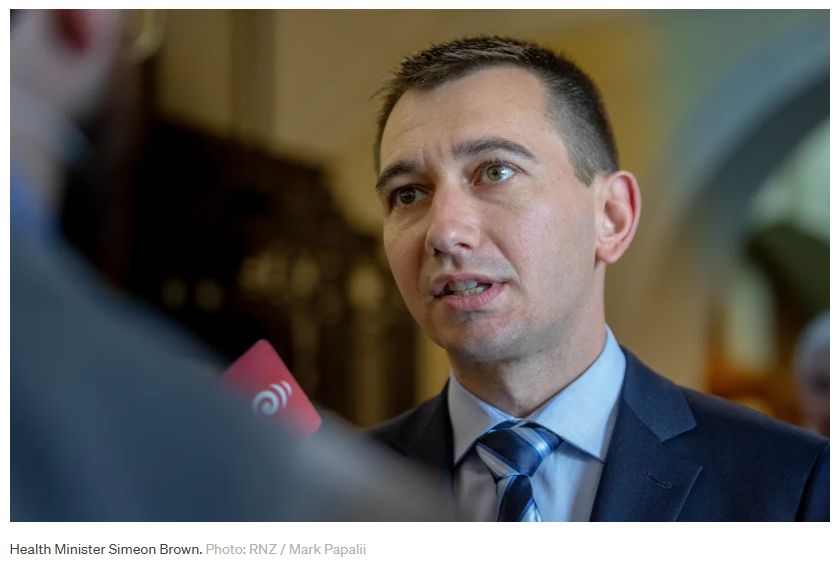
Health Minister Simeon
Brown on Tuesday promised regions and districts would get more
say over budgets and hiring from 1 July so that
decisions on medical care were made closer to the
patient.
Late last year he ordered HNZ to decentralise
rapidly, and this week he said, “This is the most
significant structural change our government is making to
improve how the health system operates.”
But the
latest HNZ internal report on devolution said “people
capability is an extreme risk” in the finance and
operations area, with centralisation diverting
resources.
Advertisement – scroll to continue reading
“Many local teams are under-resourced in
financial management,” said the report done in January for a
new devolution committee.
Brown on Wednesday said
there was a “huge” amount of work underway to build back the
local leadership disempowered by
over-centralisation.
“We are making sure we’ve got the
capability around operations, around finance, human
resources, all of those things are being looked
at.”
The January report by consultants Deloitte laid
that out, he said.
The report has not been publicly
released though RNZ has seen parts of it.
‘Clearly
underpowered’
Former HNZ Te Whatu Ora board chair Rob
Campbell expressed serious misgivings.
“They quickly
need to get some financial resources into those regions and
districts which are clearly underpowered in this respect,”
Campbell said on Wednesday. “That’s the first thing they
have to do.”
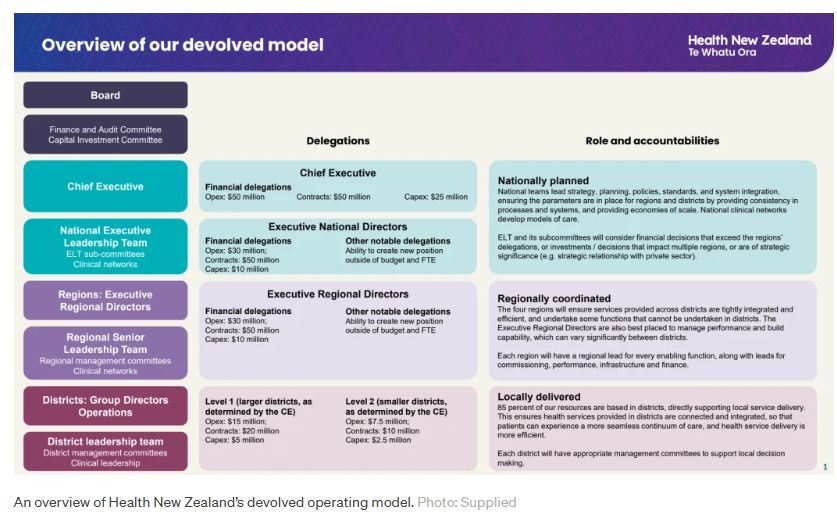
The devolution plan puts executive
regional directors in charge of rebuilding the capability
but at a time when money was exceedingly tight said the
report.
“The financial challenges are going to
increase in 2026/27, meaning there will be even more
pressure on financial controls to reduce the deficit ….
from $200m to breakeven.
“Currently there will be
little to no capacity remaining within the baseline next
year without significant productivity improvements and
prioritisation decisions,” it said.
Campbell said it
was an unenviable task.
“They’re being told they’re
getting more autonomy. The truth is they’re really not, and
they don’t have the money to do that anyway.”
‘Fully
coming into effect’ on 1 July
The devolution report
contains self-assessments by Health NZ’s various business
units showing some progress, and a lot of risks, around
devolving key clinical and service decisions back to the
four health regions and 20 districts.
One section on
“reduced financial visibility” said, “One of the thorniest
aspects of devolution is financial control – ‘who holds the
purse strings’ and how to prevent overspending or
inequities.”
Financial visibility was fragmented
across 20 health boards before 2022’s centralisation, then
smeared after it by “confusion … and weak controls” at
Health NZ Te Whatu Ora. It then began its nosedive towards a
forecast billion-dollar-plus deficit.
The
centralisation also pulled experience and skills into the
centre in Wellington, the report said.
This was
compounded by hundreds of cuts to support jobs since 2024 in
a savings drive.
The January report outlined
“critical” current gaps and “staff churn” in the workforce,
such as in data and digital, analysis and finance, that
supports the frontline doctors and nurses.
Under a
heading ‘Options to accelerate devolution’ it said, “There
is a risk of not understanding cost structures or nuances
between districts, further compounding the risk that pushing
the funding allocation and management of each region and
district to the lower levels quickly may result in loss of
financial visibility across the sector again.”
It said
some fixes might take 18 months to three
years.
However, Brown said
on Tuesday the changes underway would “ensure a
nationally planned, locally and regionally delivered health
system, will come into effect on 1 July”.
Hospitals
would be able to recruit and deploy staff without central
sign-off but with delegated budgets and responsibility to
meet targets in the district or region.
On
Wednesday Brown reiterated the 1 July delivery
date.
The Deloitte report talked about the many
initiatives being done by HNZ “to make sure that districts
and regions are ready for 1 July when the devolved operating
model … is fully coming into effect”, he said.
“Of
course there’s risks in changing an operating model but at
the same time the last government … left local clinicians
not able to make some of the key decisions.”
Globally,
health ran better when a devolved operating model split
decision-making between national, regional and local levels,
Brown said.
New policy on who decides what
The
devolution plan depended on four executive regional
directors at the top being “best placed to manage
performance and build capability, which can vary
significantly between districts”.
Already, a new
policy on who gets to decide on hiring and firing, and on
spending, was being rolled out.
Papers RNZ has seen
showed the policy was approved by the board in
December.
They showed there must be consultation with
the regional or national head of human resources for all
hires, or for creating new positions within budget; and to
create any new positions outside budget needed
“consultation/approval” from either of these heads or from
the executive leadership team.
Campbell said, “You
start off looking like they’ve got a lot of power, and then
when you really read through it, they don’t.
“Even on
items that are within budget and full-time equivalent
allocations, there is a need for … consultation, and in a
hierarchical organisation like this consultation means
getting approval.”
The biggest difference was a bigger
regional element compared to what HNZ was building at the
time he was sacked in 2023 for a political
attack on National’s water infrastructure
policy.
Yet it was “still very tightly controlled” and
regional and district managers were “in a no-win situation”,
Campbell said.
‘Divergent approaches’
In
addition to lack of finance staff, the January report added
“fragmentation” to the hurdles for
devolution.
“Without strong governance structures and
clear national guardrails, regions and districts risk
adopting divergent approaches, weakening system-wide
alignment and equity in service delivery,” it
said.
Those governance structures were still being set
up.
Campbell said good governance meant having a
business model everyone grasped. “People throughout the
organisation still find it very hard to understand what the
responsibility for particular issues is.”
The
report said Health NZ had had to build national financial
guardrails after its lurch towards a big deficit.
“If
HNZ devolves too quickly or carelessly, they risk losing the
opportunity to use its current … structure and scale” to
address system problems, it said.
On the plus side,
devolution could help districts take more responsibility for
day-to-day spending and not expect topdown bailouts, citing
how Australian state hospitals used to have a “rollercoaster
of budget blowouts and rescues”.
Brown’s plan retained
the Wellington-based bureaucracy for strategy, planning,
policies, standards and system integration.
However,
the report said many of the national plans existed in name
but “have not yet been developed or published, and the
decision-making framework to support accountability is still
developing”.
Building districts’ financial capability
an ongoing focus – HNZ
Late on Wednesday Health New
Zealand told RNZ that according to the Deloitte report the
agency’s budgeting, planning, reporting, and performance
management disciplines had been strengthened since a review
of financial management at the end of 2024.
“These
improvements have ‘reduced the risk of a loss of financial
control levers’,” it quoted.
Building financial
capability of districts and regions was an ongoing focus,
said executive national director of strategy performance
improvement, Jess Smaling.
“Regions and districts will
have clear budgets, and delegated authority to make
decisions based on the unique local needs,” she said in a
statement.
“Budgets will be based on expected activity
to meet those local needs, within the resources available to
Health New Zealand.”
A national funding board and
human resources oversight committee had been replaced by
four regional investment committees and “people and culture
committees”, along with a national version of that to
consider human resource policies so there was national
consistency.
A new national investment committee would
make funding decisions above the authority of the four
executive regional directors.
“Hiring decisions will
be made in the regions and districts, within available
budgets,” said Smaling.
Those within existing FTE and
budget would only require the approval of the hiring
manager’s immediate manager.
Decision-makers using
delegated authority had to stay within approved budgets and
limits, and comply with Health NZ policies and legislation,
she
added.
© Scoop Media

New Zealand’s public broadcaster, providing comprehensive NZ news and current affairs, specialist audio features and documentaries.
Radio New Zealand is a Crown entity established under the Radio New Zealand Act 1995. Radio New Zealand News are vital elements in our programming, providing impartial news and information to New Zealanders every day. Radio New Zealand (RNZ) provides listeners with exciting and independent radio programmes in accordance with the Radio New Zealand Charter.

Discussion about this post