
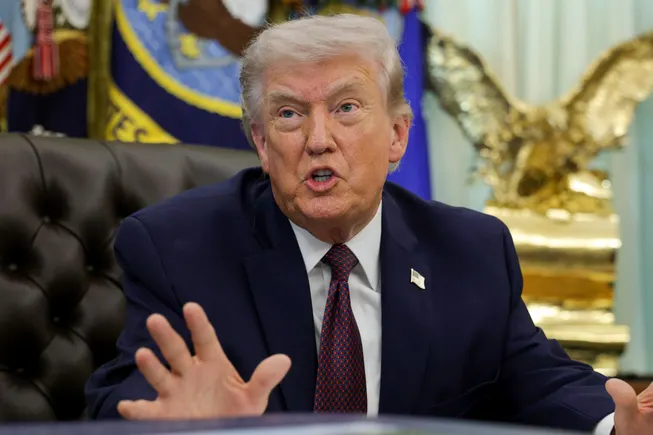
President Donald Trump proposed a fiscal 2027 budget on Friday that calls for eliminating three key educational access programs and $354 million in grants for minority-serving institutions as part of a plan to shrink the U.S. Department of Education’s overall funding.
The plan would lower discretionary funding for the Education Department to $76.5 billion, a 2.9% cut from fiscal 2026. Higher education programs alone would lose $2.7 billion, according to the blueprint.
The moves put the Education Department “on a path to elimination,” according to the budget. Fully eliminating the Education Department would require congressional authorization.
Once again, Trump has proposed eliminating all $1.6 billion in funding for TRIO and Gear Up, according to Education Department documents. The programs help disadvantaged students prepare for and persist in college. The budget proposal would also eliminate all $910 million for the Federal Supplemental Educational Opportunity Grants, which provide aid for the lowest-income students.
The proposal would dramatically reduce Federal Work-Study funding to $123 million — a 90% reduction from fiscal 2025 levels. The program provides part-time jobs to students based on need to help them pay for their education.
Offices within the Education Department would also see big cuts. The Office for Civil Rights, which investigates reports of discrimination and harassment on college campuses, would have its budget trimmed to $91 million, a 35% reduction from fiscal 2025 levels.
Likewise, the Institute of Education Sciences, the department’s research and statistics office that collects data from colleges and K-12 schools, would get about $261 million, a 67.1% reduction from fiscal 2025 levels. Both offices saw heavy staff cuts as part of the Education Department’s massive layoffs last year.
The Education Department isn’t the only agency that would see large-scale reductions. Trump’s proposal would also cut funding for scientific agencies, including the National Institutes of Health and the National Science Foundation.
His budget would reduce funding for NIH research to $41 billion, a cut of $5 billion, and eliminate agency institutes like the National Institute on Minority Health and Health Disparities. Additionally, it would slash the National Science Foundation’s funding by more than half to just $4 billion.
Simultaneously, the proposal would boost military spending 44% to $1.5 trillion.
Budget draws mixed reaction from lawmakers
While Trump’s budget plan outlines his administration’s top priorities, it is up to Congress to develop spending plans and ultimately pass the federal government’s fiscal 2027 budget.
Lawmakers rejected many of Trump’s requests for 2026, including by keeping the Education Department’s funding level, preserving the student access programs the president had sought to eliminate, and opting to only modestly decrease scientific research funding.
Trump’s budget plan would maintain the maximum Pell Grant award at its current level — contrary to last year’s proposal, which would have lowered the top amount. The new proposal would also raise funding for the program to $33 billion, a $10.5 billion increase. That increase is meant to address a major shortfall faced by the program.
Michigan Rep. Tim Walberg, the Republican chair of the House’s education committee, said in a statement Friday that he was eager to work with the administration to carry out its priorities. The education panel is an authorizing committee, which establishes federal programs, though it is ultimately up to appropriations committees to draft legislation to set the federal government’s budget.
“Families across the country are sitting at their kitchen tables making tough decisions about how to stretch every dollar — we owe it to them to do the same in government,” Walberg said. “This budget proposal is a blueprint for cutting wasteful spending, improving government efficiency, and ensuring that every dollar spent delivers real value to taxpayers.”
Meanwhile, Virginia Rep. Bobby Scott, the top-ranking Democrat on the House education committee, slammed the budget proposal for furthering the Trump administration’s goal of dismantling the Education Department.
“This proposal would raise the cost of living, undermine our institutions, and threaten the future of public education,” Scott said Friday. “This budget is more of the same from a President who is prioritizing a war of choice over Americans’ welfare.”
Zeroing out two major higher education grant programs
Trump’s newest budget proposes smaller reductions to the Education Department than he sought for fiscal 2026. Yet the plan would still seek to cut key grant programs that colleges rely on, including funding for MSIs.
Cutting those programs has been a priority for the Trump administration over the past year.
In September, the Education Department canceled $350 million in discretionary grant funding for MSIs, calling the programs discriminatory because they require institutions to enroll certain shares of racial minority students to be eligible for awards. The cancellations did not impact historically Black colleges and universities or tribally controlled colleges, whose designations are not based on student demographics
A few months later, the U.S. Department of Justice issued a legal memo declaring several Education Department grant programs unconstitutional, including those for Hispanic-serving, Native American-serving and predominantly Black institutions.
In Friday’s budget plan, the Trump administration said cutting $354 million from these programs would build on the Education Department’s moves last year to shift this funding to HBCUs and tribally controlled colleges.
The budget proposal also calls for zeroing out the Fund for the Improvement of Postsecondary Education, which provides grants to colleges and other organizations to improve educational opportunities for students. Lawmakers appropriated $136 million for FIPSE for the current fiscal year.
“States and institutions of higher education should be responsible for funding innovations in higher education, not the Federal Government,” Trump’s proposal stated.
EdTrust, an advocacy and research nonprofit, criticized the proposed reductions to the MSI and other grant programs in a Friday statement.
The group called on lawmakers to reject the budget plan and rein in “the lawless dismantling of the Department of Education.”
Addressing the Pell Grant program’s shortfall
Trump’s proposal calls for preserving the maximum discretionary award for the Pell Grant. That would keep the highest award at its current $7,395 while also boosting funding to the program overall by $10.5 billion.
Such an increase could help stave off a major shortfall. According to the latest projections from the Congressional Budget Office, the program is expected to rack up a $5.5 billion budget shortfall by the end of this fiscal year. That amount could grow to $11.5 billion next year without intervention.
The National College Attainment Network praised the budget proposal’s Pell Grant provisions.
“We’re grateful the White House recognized the importance of the Pell Grant by holding the line on funding,” NCAN CEO Kim Cook said in a Friday statement. “Fully funding the Pell Grant program reflects the deep bipartisan support for the program and is an important step towards restoring Pell’s purchasing power for students.”
However, NCAN urged lawmakers to go further and raise the maximum Pell Grant by $200, noting that the top award has stayed level for the past three years, failing to keep pace with inflation.
“Three years of flat appropriations have already cost students hundreds of dollars in purchasing power,” Cook said. “Congress must now go further and restore Pell’s value for the millions of low-income students counting on it.”


Discussion about this post