






New College of Florida Seeks $47.5 Million in Financing
The Board of Trustees at New College of Florida is set to request authorization from the State University System of Florida next week for $47.5 million in new debt financing. This funding is primarily aimed at facilitating the acquisition of the University of South Florida’s Sarasota-Manatee campus.
Legislative Support and Financing Breakdown
Last year, state legislators included this acquisition in a budget bill, with notable backing from Governor Ron DeSantis. The governor has focused on reforming New College into a model of conservative higher education, aimed at expanding its influence.
Approximately $27.6 million of the proposed financing will be allocated to settle existing USF debts linked to a dormitory and student center, which New College will assume as part of this transition. Additionally, $15.6 million will be directed towards refinancing New College’s existing debt obligations.
Loan Structure and Approval Requirements
Of the new financing, $40 million is to be sourced from BankUnited, a regional financial institution, while an additional $7.5 million will come from an undisclosed accredited investor, according to project documents included in the board’s meeting agenda. These loans will be secured through liens on New College’s revenue from the student center and other facilities, reinforced by the institution’s foundation, which has unrestricted assets totaling $3.6 million.
This financing proposal includes several exceptions to the State University System of Florida’s debt policies, necessitating additional approval from its Board of Governors. Following a unanimous resolution by the New College board, formal approval will be sought during a meeting next week.
Alternative Financing Approach
The loans in question are characterized as private agreements rather than the public bond offerings typically mandated by the State University System. The project documentation highlighted the urgency of securing financing swiftly and the current conditions of the bond market, stating, “A private placement of the Debt was not only necessary but is expected to yield the best results in terms of cost and accommodative structure.”
The smaller loan from the unidentified source also entails a subordinate lien on revenue, a provision that is only permissible under specific circumstances. This arrangement is required due to a cap on the larger loan, necessitating the additional financing.
Debt Coverage and Acquisition Timeline
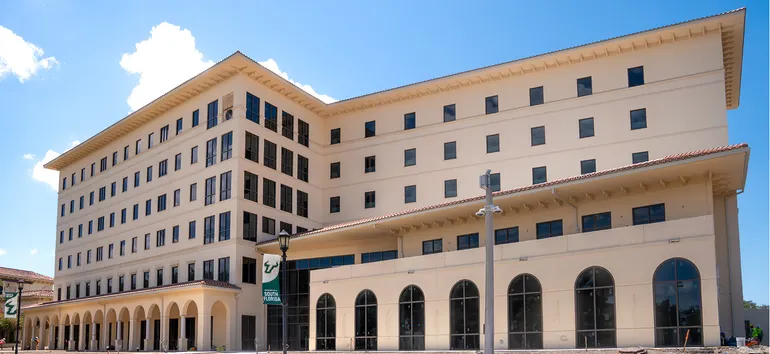
The projected financing is anticipated to fall short of the system’s stipulated debt coverage ratios—indicating an institution’s ability to generate sufficient cash to meet debt obligations—until 2037. The stipulation mandating New College to secure financing for the USF campus transfer by December is closely tied to New College taking on USF Sarasota-Manatee’s debt, chiefly centered on Atala Hall, a newly constructed residence hall and activity center completed in 2023.
Located less than a mile from New College’s existing campus, Atala Hall is a significant asset, comprising a student union on its first two floors and 200 student beds on the upper levels. The acquisition is expected to provide permanent housing solutions, alleviating current reliance on off-campus accommodations.
Institutional Expansion and Future Impact
The project summary points to a 38% increase in enrollment from 2021 to 2025, with current headcount figures reaching 865 students. However, USF Sarasota-Manatee retains priority over campus facilities while accommodating students admitted before July and requires New College to honor existing rental agreements through the next academic year.
Strategic Vision by Governor DeSantis
Governor DeSantis has prioritized the overhaul of New College as part of a broader initiative to reshape higher education within the state. Recently, he has influenced key leadership changes within the institution, including appointing a politically aligned president and dismantling various diversity initiatives and academic programs, aligning the college more closely with conservative educational principles.










Discussion about this post