




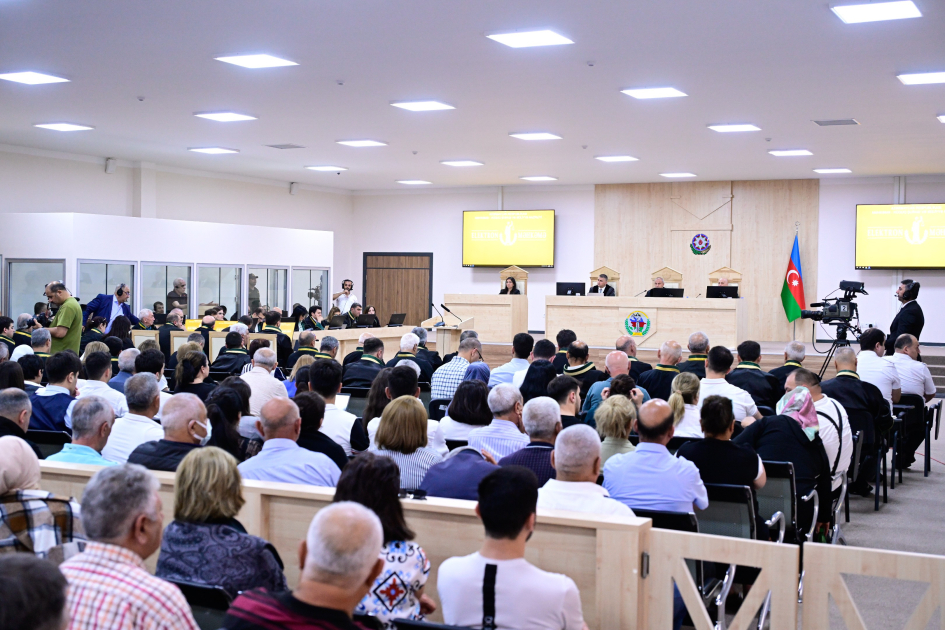
BAKU, Azerbaijan, June 12. The open court
session in the criminal case against Arayik Harutyunyan, Arkadi
Ghukasyan, Bako Sahakyan, Davit Ishkhanyan, David Babayan, Levon
Mnatsakanyan, and others – citizens of the Republic of Armenia –
continued on June 12, Trend reports.
The defendants stand accused of crimes against peace and
humanity, war crimes, including the planning and conduct of
aggressive warfare, genocide, violations of the laws and customs of
war, terrorism, financing of terrorism, forcible seizure and
retention of power, and numerous other offenses stemming from
Armenia’s military aggression against Azerbaijan.
Held at the Baku Military Court under the chairmanship of Judge
Zeynal Aghayev, with Jamal Ramazanov and Anar Rzayev (reserve judge
Gunel Samadova) presiding, the session ensured that each defendant
was provided with a translator in their native language and legal
representation.
The defendants, their lawyers, several victims and their legal
successors, as well as the prosecutors representing the state,
participated in the hearing.
During the session, the accused Levon Mnatsakanyan answered
questions from the state prosecutor regarding the 2016 events known
as the “April battles.” At the time, Mnatsakanyan served as the
“defense minister” of the so-called regime, holding the rank of
lieutenant general. He admitted that 18 combat positions were lost
during the April battles.
In response to questions from Nasir Bayramov, Head of the
Department of Public Prosecution Defense at the Prosecutor
General’s Office, Mnatsakanyan claimed that civilian areas were not
deliberately targeted during the April battles. He said those areas
contained military units, equipment, and personnel, and that any
damage to homes was coincidental. “There was no attack on the
village. We did not open fire on the village,” he said.
The court examined parts of Mnatsakanyan’s interviews with
journalists following the April battles. In one interview, he
stated: “The overall situation is under control. The troops are at
the proper degree of battle preparedness. Our borders are secure
and in reliable hands.” When asked by a journalist whether “the
other side is also being defended,” he answered, “Yes.”
The prosecutor confronted Mnatsakanyan with the contradiction
between his courtroom claim of having made no public statements
during the April battles and the interview footage. When asked who
he referred to as “the other side” and what kind of attack was
being defended against, Mnatsakanyan did not provide a specific
answer.
Another interview featuring Mnatsakanyan was shown, in which he
appeared in the Jidir Duzu plain discussing the battles of February
24–25, 2015, and the April 2016 clashes. He referred to the
Azerbaijani special forces as the “Yashma Brigade,” acknowledging
their participation in the battles. He outlined the regime’s
military developments, stating:
“Improvement means that we must further strengthen the
capabilities we have. We must expand the capabilities of our
firepower and systems. We are carrying out relevant work in this
direction. In particular, we are expanding in the field of
observation devices. Progress has been made in both fire and
destruction systems. We had certain shortcomings in some limited
conditions, but now – whether in the morning or in the afternoon –
we can fire effectively.
Moreover, we have improved our management capabilities. This is
also included in the overall system. We have made progress in both
reconnaissance and firing. In addition, practical measures are
being taken concerning the new technologies and technical means we
have acquired. Work is also underway on the military-industrial
complex.
There are also longer-range anti-tank and other modern means. In
addition, we have acquired new technologies and firepower.
Personnel are also being trained to use these means.”
He explained that the interview was initially intended to be
recorded on a balcony near “Isa Bulaghi,” but due to lighting
issues, it was relocated to the Jidir Duzu plain.
After a break, the court examined another video retrieved from
the internet, showing a dispute between Levon Mnatsakanyan and
former “defense minister” Samvel Babayan. In the footage,
Mnatsakanyan accused Babayan of surrendering 21 kilometers of
territory to Azerbaijan in 1994.
Babayan had previously criticized the Armenian leadership for
strategic failures during the April battles. While not denying
territorial losses, Mnatsakanyan countered by urging Babayan to
recall how land was surrendered in 1994. Babayan referred to the
2016 clashes as a “sabotage,” whereas Mnatsakanyan insisted it was
a full-scale military operation.
Further footage shown in court depicted former Armenian Prime
Minister Karen Karapetyan and the so-called regime’s “prime
minister” Arayik Harutyunyan meeting with servicemen in
Azerbaijan’s then-occupied territories. Mnatsakanyan confirmed that
Armenian officials, including ministers of defense and foreign
affairs, frequently visited the region.
Additional footage showed former Armenian Defense Minister Davit
Tonoyan inspecting the regime’s “military structure,” accompanied
by former Foreign Minister Zohrab Mnatsakanyan and the regime’s
“foreign minister.”
During questioning about landmines in Azerbaijani territories,
Mnatsakanyan said mines had been planted in both the northern and
southern directions. He stated that after placement, documentation
was submitted to higher headquarters: one copy remained with the
military unit, and others were stored in the engineering troops’
office. He emphasized that mine placement forms showed precise
locations, whereas mine maps only indicated general districts.
Mnatsakanyan revealed that the mines were initially produced in
the Soviet Union, later procured from Russia, and then delivered to
the separatist regime via Armenia. More recently, they had also
been manufactured in Armenia. He admitted to planting both
anti-personnel and anti-tank mines in the formerly occupied
areas.
The next court session is scheduled for June 13.
The defendants — Arayik Vladimiri Harutyunyan, Arkadi Arshaviri
Ghukasyan, Bako Sahaki Sahakyan, Davit Rubeni Ishkhanyan, David
Azatini Manukyan, Davit Klimi Babayan, Levon Henrikovich
Mnatsakanyan, Vasili Ivani Beglaryan, Erik Roberti Ghazaryan, Davit
Nelsoni Allahverdiyan, Gurgen Homeri Stepanyan, Levon Romiki
Balayan, Madat Arakelovich Babayan, Garik Grigori Martirosyan, and
Melikset Vladimiri Pashayan — are charged under the following
articles of the Criminal Code of the Republic of Azerbaijan:
Article 100 (planning, preparing, initiating, and waging a war of
aggression); Article 102 (attacking persons or organizations
enjoying international protection); Article 103 (genocide); Article
105 (extermination of the population); Article 106 (enslavement);
Article 107 (deportation or forced displacement of population);
Article 109 (persecution); Article 110 (enforced disappearance of
persons); Article 112 (deprivation of liberty contrary to
international law); Article 113 (torture); Article 114 (mercenary
service); Article 115 (violation of the laws and customs of
warfare); Article 116 (violation of international humanitarian law
during armed conflict); Article 118 (military robbery); Article 120
(intentional murder); Article 192 (illegal entrepreneurship);
Article 214 (terrorism); Article 214-1 (financing terrorism);
Article 218 (creation of a criminal organization); Article 228
(illegal acquisition, transfer, sale, storage, transportation, and
possession of weapons, ammunition, explosives, and devices);
Article 270-1 (acts threatening aviation security); Article 277
(assassination of a state official or public figure); Article 278
(forcible seizure and retention of power, forcible change of the
constitutional structure of the state); Article 279 (creation of
armed groups not provided for by law); and other articles.







Discussion about this post