
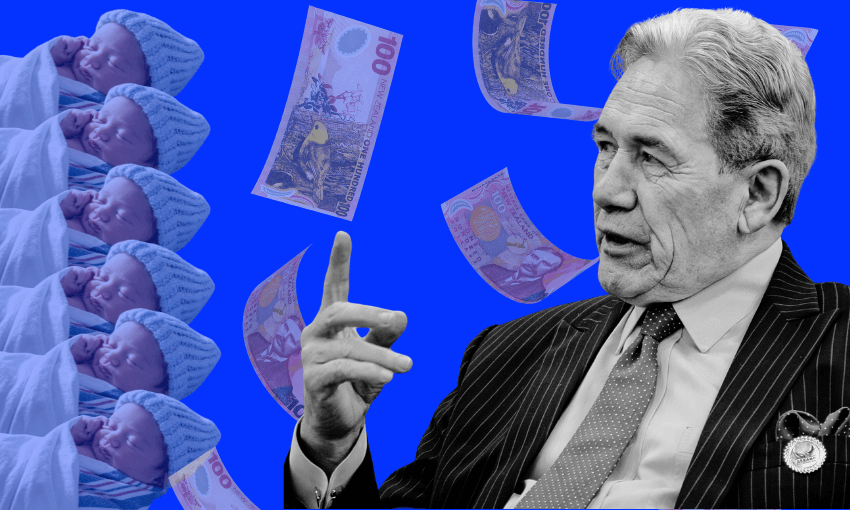
In a bid to halt our falling birth rate, NZ First has announced a policy of cash incentives for having kids. How much would it cost, who would it benefit and has it worked in other countries? Shamubeel Eaqub takes a look at the data.
NZ First is going pro-natal: incentives to have babies. Tax-free $5,000 a year for each of the first three years of a child’s life, for three children, on top of existing support, and no income test. At least one parent must be a citizen.
By my numbers, around 43,000 families a year would be eligible. How many new children? International evidence is sceptical, so between 0 and 2,600 births a year.
That we have a low and falling birth rate is true. It has been below the replacement rate for more than 40 years. So it’s not really “new” and it’s already too late.
I have no problems with wanting to support children and their families. But there are a few issues to address. Here’s some weekend noodling with the data I did to get this announcement straight in my head.
Costing seems too light
Most children have at least one citizen parent (estimate based on some torturing of census data, so grain of salt), and most people have fewer than four children, meaning most children would qualify. I think the policy cost would be roughly $214 million in year one, $428 million in year two, $642 million from year three. This policy would be about 0.4% of our core Crown spend.
This is higher than what NZ First’s release says: “$400 million by the third year once the full cycle is established.” It seems to me they have under-costed the policy, and have only looked at the probability of the mother being a citizen, rather than either parent as per their policy.
There is of course no source of this funding; something else will have to give. No hard choices here – the usual bit of announcement politics with funding and tradeoffs happening later.
Buying a birth
Baby bonuses have been tried internationally: Australia and Hungary spring to mind. The evidence is pretty consistent: these incentives mostly change when people have children, not how many. Demographers term it tempo versus quantum.
In Australia, on the most generous published reading, its baby bonus bought extra births at around A$39,000 to A$43,000 each (Sinclair, Boymal and De Silva). A competing estimate using household panel data puts it at A$126,000 or more per extra birth (Drago and co-authors). Even the friendly number is expensive.
I ran a couple of scenarios for New Zealand. If this grant lifted births by 6% (the generous scenario), that is about 2,600 extra babies a year costing $265,000 each. If the grant only shifts timing as per the conservative scenario, it buys no new births, but helps out upcoming parents.
Hungary spends around 5% of GDP on family policy (loans, debt forgiveness, tax exemptions, housing support). Its fertility rate still fell and is very low at 1.39. If Hungary’s effort couldn’t hold fertility up, this probably won’t.
Children come with financial costs
The main issue for families is they tend to have reduced income, as parents take time off work, move to part time, etc. Illustrative only, based on published evidence (Sin, Dasgupta and Pacheco for New Zealand; Kleven and co-authors internationally): a mother on average earnings for her age who takes a year off and returns full-time forgoes about $52,500 over three years. Take a year off and return three days a week, about $111,300. The grant is $15,000.
Child poverty
Families with children already receive about $4.7 billion a year through Working for Families, paid parental leave, Best Start, FamilyBoost and the rest. This would add 14% on top.
Current instruments are targeted/means tested. NZ First’s Kiwi Kids Grant is not: a family earning $200,000 would get the full $15,000 per child. Universal policies are popular and easy to do, but expensive.
This is while 169,000 or 14.3% of our children are in material hardship. The same $642 million (my estimate of the annual cost of Kiwi Kids Grant by year three) would be ~$3,800 per hardship child per year.
Spending money hoping for more babies despite evidence to the contrary versus spending it on children who are already going without says a lot about our values. So does spending money that has not been funded out of identified spending cuts or tax increases.
What would help
People are having fewer babies than they want because of unaffordable houses, childcare costs, and a job market that is still hostile to time out (which for families is a constant), plus a bunch of other things. Having children is an intensely personal and monumental decision.
International experience suggests some financial support does help to lift fertility at the margin, especially when the policies are sustained and provide stable support for combining work and family. Things like affordable childcare, decent parental leave, flexible work and secure housing. We could spend $642m on other stuff better.
The choice
Fertility is an issue, because we are ageing fast as a society. It’s been too late to lift fertility by near on 40 years. I can see the election allure of a visible monthly payment to 43,000 families – (almost) everyone likes babies.
If we had a spare $642 million a year, and we all professed to like babies so much, if I were asked, I would look after the 169,000 children now living in poverty.
This piece was first published on Shamubeel’s Substack and is republished with permission.

Discussion about this post