








Rocket Lab is an aerospace company specialising in small-satellite launches and spacecraft hardware. Their most recognisable product is the Electron rocket, a partially reusable vehicle designed to deliver satellites of up to 300 kilograms into orbit.
Electron is powered by the Rutherford engine, one of the first 3D-printed, battery-powered engines to fly to space. Since its debut, the rocket has flown more than 60 times, giving Rocket Lab the title of the second most launched US Rocket after SpaceX’s Falcon 9.
The company is also developing a larger vehicle called Neutron, aimed at the medium-lift market. Neutron is designed for full reusability from the start. It features landing legs and a hinged fairing that remains attached, which should enable faster turnaround times between launches. Management has set 2025 as the target date for the rocket’s first flight, although the timeline leaves little room for setbacks.
Rocket Lab’s operations are split into two segments. Launch Services, which cover the actual rockets and Space Systems, include spacecraft platforms, satellite components, and mission software. Together, they allow Rocket Lab to offer an end-to-end service: build the spacecraft, launch it, and manage its mission.
Rocket Lab’s Stock Price
As of early September, the stock is trading at $48.60, very near its 52-week high of $53.44 and up 746.69% from its 52-week low at $5.74. Today, the company’s market capitalisation is about $23.3 billion. Volatility for RocketLab has skyrocketed more than 2 and a half times the market average, as you can see from its 60-month beta. However, RKLB’s weighted alpha, which measures excess return over a pre-established benchmark, is +326.07, meaning the stock is positively outperforming prior expectations.
The surge mimics investor enthusiasm for growth catalysts, such as the Neutron, and winning international deals. Trading at almost 10% away from its 52-week high, does this mean that RKLB is peaking or are they about to shoot for the stars? To answer that, we need to examine the financials.
Financials
The company’s fundamentals do show signs of progress, but profitability could still be a few years away.
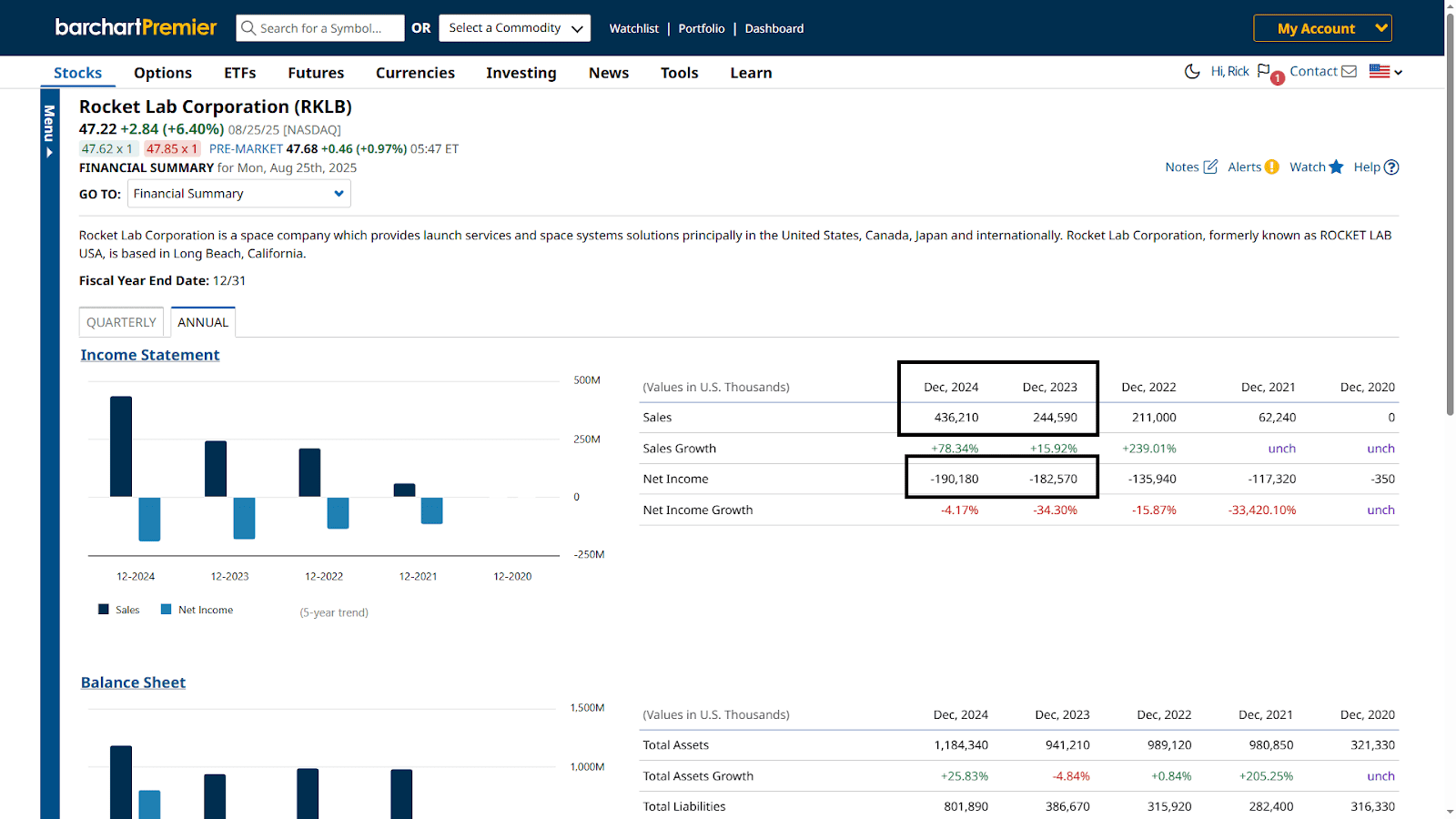
For FY’24, revenue increased 78% year over year to $436 million. Net losses rose slightly, up 4% to $190.2 million.
If we zoom in a little, the Quarterly results show the same trend. In Q2 2025, revenue rose around 36% from the same quarter last year – a sign of progress.

The company closed the quarter out with a net loss of $66 million, or -$0.13 per share.

And because the company is still operating at a loss, its P/E ratio is still zero. Rocket Lab’s debt-to-equity ratio is about 0.61. Debt-to-equity tells you if a company relies on borrowing to survive. When their debt-to-equity ratio is high, approaching a value of 2, it means they borrow a lot, which can be problematic for them to repay investors or generate a profit. If it’s relatively low, say less than one, it could mean “safe,” but it also indicates that the company is not taking advantage of leverage for growth. Rocket Lab’s debt-to-equity ratio suggests it has sufficient liquidity to meet its near-term obligations, putting it in a strong position.
Growth Catalysts
It starts on the ground in Virginia. With Launch Complex 3 now officially open, Rocket Lab has a dedicated home base and ground systems to support its ambitions for larger payloads. LC-3, located at the Mid-Atlantic Regional Spaceport (MARS), enables them to stage higher-value missions, allowing companies to venture further into space with larger cargo. This results in more complex and expensive missions, which in turn generate more profit for Rocket Lab. The new complex was built with a massive steel launch mount, which is the spaceport’s largest orbital capacity.
RocketLab already possesses two satellites that are built and capable of making it to Mars (the planet), and this new rocket is finally big enough and powerful enough to send them there. The opening of LC-3 also signals the operational readiness of Neutron, after heavy speculation on the viability of their original launch date in 2025.
The company has also announced expanded US investments to bolster its national security programs and semiconductor manufacturing. Rocket Lab is scaling production of space-grade solar cells and other high-tech space gear after receiving a grant from the Department of Commerce, which supports U.S. leadership in space-grade semiconductor technology.
This allows manufacturers to equip themselves with easily accessible, domestically made tech that can be integrated into spacecraft built for US national security missions. Now more of each mission will be constructed from in-house components and move through domestic channels, which means fewer delays for prospective clients. This deepens domestic production capacity within RocketLab’s own supply chains, positioning them as the go-to industrial partner for critical space missions in the United States.
Recent investor analysis attributes the stock’s rise to Neutron being a new cash cow and their vertical integration initiatives. Investor sentiment is turning sweet for RKLB as its valuation sits at almost $24 billion, showing that RocketLab’s hard work in developing its new hope is starting to pay off.
Risks & Red Flags
But what are the things that could get in the way of RocketLab finally reaching the point of profit? Let’s look at some of their headwinds.
Even if RocketLab has a favourable valuation and its stock price is trading close to the highest it has experienced over the past year, these expectations are stretched. After a monster run, the stock is priced as if the company has been raking in profits. This sets a high bar for Rocket Lab, so the expectations for them are high. Minor hiccups, such as delays in launches and slow order fulfilment, can deflate the pumping balloon that is capital gains.
Not to mention, profits have yet to be seen. The business is currently spending more than it earns, especially during its vertical integration phase, and margins on the house-made hardware aren’t yet lucrative. That’s okay while they’re hot in the media, but simultaneously scaling factories and rolling out a new rocket program takes some serious cash. If the market gets moody, then raising more money could mean slicing shareholder pizza extra thin.
Still, the opportunities awaiting RocketLab’s horizon are hard to ignore. A new pad in VA, a reusable medium-lift rocket keeping up with competition standards, and a full-service space exploration shop are all things investors can still look forward to. If Neutron lifts off on schedule and space systems start succeeding, then RKLB can be a full-stack compounding stock that long-term investors will love.
Verdict
So, is Rocket Lab a buy or just another space name riding the launch hype?
I think this stock fits investors who want a front-row seat to a company building the full stack of space. Rockets, satellites, software, and services, the whole nine yards. That’s why RocketLab’s story is easy to root for, even if the profits have yet to land. However, unlike mature firms, Rocket Lab is reinvesting its cash in growth rather than paying dividends. This means your upside depends on their execution with Neutron and with their vertical integration.
Recent milestones, such as LC-3 and securing the ability to bid on government contracts, make a compelling case for getting in early. But make no mistake, this ride requires a seatbelt.

Overall, analysts are rating this stock a ‘Moderate Buy’. I’d allocate a small portion of risk capital to this stock so I can still experience some of the boom without worrying about my wallet deploying all of its payload.









Discussion about this post