









Understanding Source Code versus Binary Analysis in Application Security
Application security (AppSec) professionals frequently encounter a challenging scenario as release dates approach. Just two days prior to a major launch, the source code scanner displays green results. However, an unexpected question arises: Is the build intended for submission to the App Store identical to the one that was scanned?
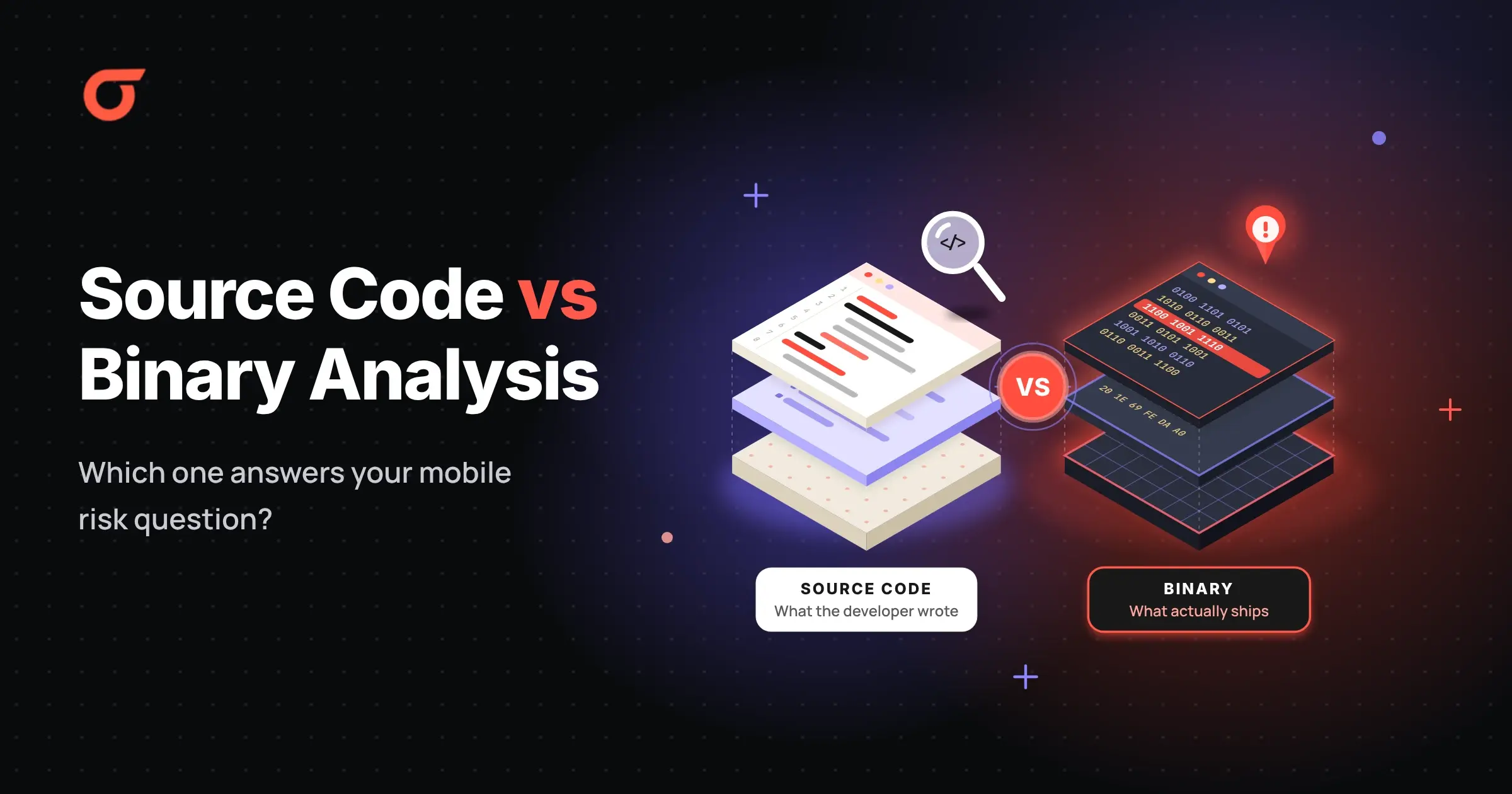
This inquiry highlights the critical distinction between source code analysis and binary code analysis. It is not merely a matter of old tools versus new tools, or developer tools versus security tools. Source code analysis seeks to answer: Did we write this safely? In contrast, binary code analysis aims to clarify: Did we ship safely? Both questions are legitimate, yet they focus on different aspects of the development process.
In mobile development, the divide between these two types of analyses is often wider than teams realize. Once code is compiled and built, it undergoes transformations via SDKs, bundlers, and packaging processes before reaching end-user devices.
Mechanics of Source Code Analysis and Binary Analysis
How Each Process Operates
Source code analysis evaluates the raw code composed by developers in languages such as Kotlin, Java, Swift, Objective-C, Dart, and JavaScript. The analysis tool parses the code, constructs a model of its data flow, and applies rules to identify vulnerabilities—such as user inputs reaching unsafe queries, hard-coded secrets, or weak cryptographic implementations. Results include file references and line numbers, allowing developers to address issues directly within their pull requests.
This method requires access to the repository, a scanner adept in the relevant languages, and typically the build configuration, allowing for early execution—often with every commit. This is its greatest advantage.
Conversely, binary code analysis begins with the compiled artifact, whether it be an APK or AAB for Android, or an IPA for iOS. This tool decompiles or disassembles the package and catalogs the included libraries and SDKs. The findings relate directly to the current build version, not merely a code branch.
To perform binary analysis, only the build file is needed—no repository access or language-specific plugins are required.
Decoding Access to Source Code Within Organizations
Effective source code analysis thrives in environments where a single team oversees the repository, languages, and pipeline. However, in larger companies, dynamics often shift. Security teams face hurdles in accessing source code due to evolving contracts, reorganizations, and reliance on other departments’ cooperation.
Several common scenarios occur:
- Agency Development: A significant portion of mobile applications are developed externally. A 2021 Verimatrix survey revealed that 50% of financial security professionals outsource app development, with 19% acquiring white-label apps. Here, the security team usually evaluates builds without access to source repositories.
- Acquired Applications: Legacy code is often held in the minds of former developers, with institutional knowledge scattered and inaccessible.
- Third-party Code: Applications frequently incorporate compiled SDKs for payments, analytics, and authentication, leaving no source code for scanning—only a complete package.
- Diverse Coding Frameworks: Applications may utilize multiple programming languages, complicating source scanning if no single tool provides comprehensive coverage.
- Rapid Code Generation: With 42% of code in a recent Sonar survey reported as AI-generated, the scanning that occurs often lags behind actual coding velocity.
These limitations highlight that while source analysis can provide insights, it may not fully represent the complexities of the final product. Emerging regulatory standards increasingly require transparency regarding the shipped product itself, emphasizing the need for a complete inventory of software components.
Cross-Platform Applications: The Gaps in Analysis
In practice, discrepancies between implementation and analysis become evident with cross-platform frameworks. For instance, both Flutter and React Native compile source code into machine-readable formats that traditional analyzers may not adequately assess.
- Flutter: Generates native machine code from Dart at build time, producing components that standard analyzing tools may overlook.
- React Native: Utilizes Hermes, which compiles JavaScript to bytecode during release, leaving behind crucial insight for scanning.
Practical Evaluation: When assessing potential vendors, it is vital to validate their capacity to analyze compiled Flutter or React Native builds, ensuring findings extend beyond mere manifests.
Challenges with Binary Analysis
While recognizing the need for binary analysis, it is important to underscore its limitations, including:
- No Direct Line Reference: Binary findings may not link directly to specific lines in the original source code without additional mapping, complicating remediation efforts.
- Obfuscation Issues: While effective in protecting intellectual property, obfuscation complicates the depth of static binary analysis.
- Dependency on Complete Builds: Binary analysis is applicable only post-compilation, limiting immediate developer feedback.
- API Interaction Oversight: Static binaries do not account for server-side interactions, necessitating additional API testing.
- Static Limitations: Patterns identified within binaries require real-time validation against practical exploitation scenarios.
The consensus is clear: binary outcomes should inform release decisions as they directly pertain to the final product, while source scanning is valuable for early-stage detection of issues within owned code.
Making Informed Decisions Based on Context
Determining the appropriate approach hinges on ownership over the code and the demands for compliance. Below are suggested strategies based on common situations:
| Situation | Recommended Lead Approach | Additional Measures |
|---|---|---|
| Single in-house team managing a native application | Implement source scanning at every commit | Adopt binary analysis as a release gate |
| Applications developed by a third party or acquired | Utilize binary analysis for each received build | Ensure future contracts include source access clauses |
| Cross-platform frameworks (Flutter, React Native) | Prioritize binary analysis | Conduct source scans for proprietary code layers |
| Requirement for auditor verification per release | Use binary analysis coupled with a Software Bill of Materials (SBOM) per version | Implement source scanning to aid developer compliance |
| Limited security resources managing numerous applications | Adopt binary analysis for streamlined assessment | Conduct source scans for specific requests |
Critical Vendor Evaluation
When selecting a vendor, consider these essential questions:
- Can the vendor scan APKs, AABs, and IPAs without repository access? What is the average scan duration?
- Can they demonstrate findings from a Flutter and a React Native build?
- How effectively do their findings map back to the original source code?
- What impact does obfuscation have on their findings?
- Do they provide a comprehensive SBOM for each version released?
- How do they differentiate exploitable vulnerabilities from mere patterns?
- Can their scans act as a decisive pass/fail criterion within a CI/CD pipeline?
- Do they include API testing in their offerings, or focus solely on the compiled package?
Conclusion: The Appknox Advantage
Appknox specializes in assessing released builds by evaluating APKs, AABs, or IPAs, employing binary SAST, dynamic testing, and API scrutiny. The platform generates a binary-focused SBOM for each version, prioritizing actionable insights over noise. Notable features include:
- Capability to assess cross-platform builds without reliance on specific frameworks.
- Robust detection mechanisms that remain effective even with significant obfuscation.
- Expedited processing times, with static scans typically completing within an hour.
If you currently employ a source scanner, maintain its use, but consider incorporating binary analysis at the release stage to uncover any discrepancies missed in the source code.
Start your free scan of a release build today, with no repository access required.
Schedule a detailed walkthrough for comprehensive DAST, API testing, and a version-specific SBOM.







Discussion about this post