




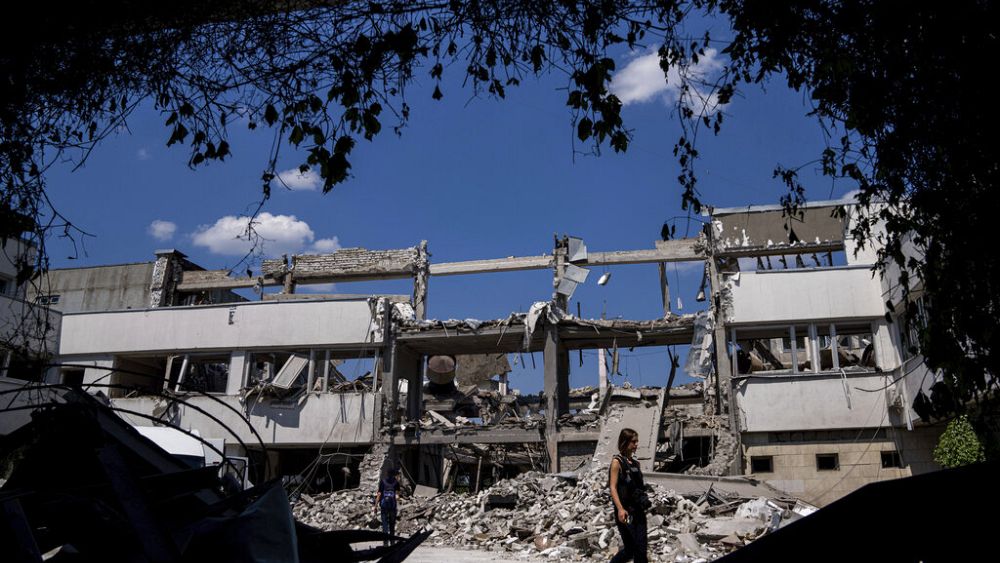
In the early hours of the morning on 24 February, Natalie Vikhrov turned on the TV with bleary eyes to catch the tail end of Putin’s speech.
Minutes later she heard the distant thud of explosions.
“That whole night was a little tense, you could feel something was going to happen,” she said.
Vikhrov is one of hundreds of Ukrainian journalists, braving bombs and bullets to report on the war tearing their country apart.
Writing freelance, she focuses on human rights and marginalised groups, particularly Ukraine’s LGBT community, and has tried to gather stories from people living on the edge of the frontline.
“At times it’s been very emotional,” she said. “You get used to the shelling and what not, but not personal stories”.
“There are some moments that really hit you.”
Vikhrov recalls speaking to one mother whose son had just called her to apologise for anything he had ever done wrong in his life after joining the army, knowing that he might die, or watching families say goodbye at the border, possibly never to see each other again.
“Every time somebody is comfortable enough, and willing, to share their story, it’s a life-shaping, experience.”
“I am always so thankful that that person is willing to trust me.”
‘You see a different side to people’
Spending the first eight years of her life in Kharkiv, Vikhrov was raised in Australia, but decided to return to her native Ukraine when fighting started in 2014.
Since the outbreak of all-out war this year, she has seen a different side of people.
“There’s been a lot of unity. It is touching to see. People have really got together and helped each other out”.
“The war has broken down so many barriers”.
Still, Vikhrov said there were so many issues that were “slipping under the radar” in Ukraine.
“Already before the war, it was difficult for some marginalised voices to be heard. Now they are getting very next to no attention.”
‘War became our reality’
Alya Shandra, editor-in-chief of Euromaidan Press, says she “scarily” grew accustomed to war.
Reporting on the grim aftermath of Russia’s occupation in Bucha and Izium, Shandra said “we got used to expecting mass graves and torture chambers in liberated areas”.
“Now war and loss is all around us,” she said. “It is surprising how easily we have adapted to our new horror”.
“It is troubling that the world is adapting too and seeing the war as something normal.”
“What we report on is generating less and less interest because the war has become something usual, something normal.”
Shandra has been reporting on the bloodshed in her country since 2014, the year Russia invaded and illegally occupied the Crimean peninsula.
Every day she and Euromadian’s team of journalists try to report on the “dysfunction” that Russia causes, though Shandra insisted that “everybody in Ukraine today is part of the war effort.”
“Starting in 2014, we were very much aware of how important it was to be a journalist. We were studying and debunking Russian propaganda, just conveying the truth to the world.
“All Russia does is drench our country and the whole world with a big bunch of lies”.
“Ukrainian journalists dream of living in a peaceful country and would dream of reporting the ups and downs of democracy”.
“We dream of the time that this will come.”
‘Such loss, such suffering’
Yet even doing the basics of her job is a challenge.
Journalists wherever they are need stable internet and access to power to work.
But Shandra said her job was being made especially hard by sporadic outages caused by Russian strikes.
Since the coming of winter in October, Russia has targeted critical infrastructure across Ukraine, knocking out power and water supplies for painstaking stretches of time.
“Despite all of this, we try to keep working as usual,” says Shandra. “Everyone in their own fields keeps working to help our army win.”
Another issue is that journalists are currently banned from visiting the front line.
For Shandra this “information blackout”, though frustrating, was understandable to protect sensitive information, like Ukraine’s military objectives.
Others have criticised Ukraine’s decision to tighten controls over the press.
New draft legislation under discussion could subordinate all media outlets to a single state body that has the power to warn, fine and shut down any media outlet.
Until now, Ukraine has not officially censored reportage, relying largely on self-censorship by journalists.
‘If we burn out, who is left?’
Shandra was torn personally.
Her family was split in two by the war and she does not see her daughter and husband.
Four other female journalists Shandra knows left the country to take their children out of danger.
“I was out of the country for four months at the beginning of the war with the kids,” she said. “But it was very difficult to be away.”
“I wanted to go back”.
Conflict is horrific for all those involved, but as a reporter immersion in the violence and bloodshed is high. Many burn out or are left on edge with nerves fraught.
“We don’t really have a choice of burning out or not burning out,” Shandra told Euronews. “If we burn out and who’s left?
“There are very many choices that people have in their lives, which we do not have right now. The only thing that matters now is winning the war.”
“That eclipses everything,” she added.
Shandra described how her Facebook feed is now one necro-log, littered with the names and faces of people she knew who have been killed in the fighting.
“Everyone in this country is still living on the 24th of February. It has become one giant, enormous date that just stretched out over these eight months.
“It’s when our lives changed for all of us in the country. Just imagine all your life, everything that you were planning for, everything you depended on, was just abandoned.”
Still, Shandra said the war had made her immensely proud of Ukraine and her people.
“I respect my own country a lot more now. We are doing wonders, striking together.
“We are kicking the ass of the so-called second most powerful army in the world”.






Discussion about this post