
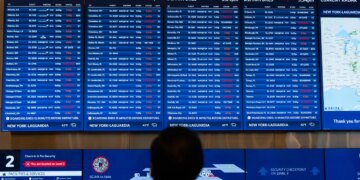







No 10 warns public will face ‘significant disruption’ tomorrow because of mass strikes
Downing Street has warned that the mass strikes tomorrow, with teachers, train drivers, civil servants, university lecturers, bus drivers and security guards all taking action), will be “very difficult” for members of the public. The PM’s spokesperson told journalists:
We know that there will be significant disruption given the scale of the strike action that is taking place tomorrow and that will be very difficult for the public trying to go about their daily lives.
We are upfront that this will disrupt people’s lives and that’s why we think negotiations rather than picket lines are the right approach.
Key events
Filters BETA
Jacob Rees-Mogg, the former business secretary, did a rather better job than Boris Johnson of naming Brexit benefits when he was on Sky News this morning – although, rather bizarrely, he included Britons no longer having to pay for lawnmower insurance as a Brexit bonus.
Asked if he thought Brexit was going well, he replied:
I think Brexit is going well for a whole range of reasons. I can give you one to start with – £192bn that we’ve saved by not being part of the EU’s Covid bailout. That would have been our share of that £2tr scheme.
I’ll give you another one – insurance is cheaper because we’re no longer subject to the Vnuk regulation, which was an extra charge on insurance for lawnmowers, which was quite unnecessary.
Solvency II, potentially £100bn of extra money going into the UK economy, the gene editing bill passing through parliament at the moment to make our agriculture more efficient, a 63% increase in the catch of cod in the last year.
The benefits keep on [coming].
On the subject of Brexit “gloom mongering” (see 3.50pm), Joe Mayes from Bloomberg has more on the Bloomberg Economics analysis saying Brexit is costing the economy £100bn a year in lost output.
The UK economy continues to be blighted by shortages of workers — and Brexit has played no small part. “Scarcity of labor adds to inflationary pressure in the short-term and constrains potential growth further out,” according to @Economics 4/ pic.twitter.com/nerv826G7l
— Joe Mayes (@Joe_Mayes) January 31, 2023
There’s also been a hit to trade, with UK-EU trade now facing the extra burden of customs paperwork and more red tape. But the impact hasn’t been as bad as feared 5/ pic.twitter.com/SugOocnaao
— Joe Mayes (@Joe_Mayes) January 31, 2023
Boris Johnson marks ‘happy Brexit day’ with false claim about vaccine rollout
Boris Johnson has posted a video on Twitter to mark “happy Brexit day”.
If Brexit day does become a regular feature of the British calendar, perhaps, like April Fool’s day, it may end up being being a day most notable for the telling of untruths. Johnson certainly seems to be up for that because, in his video he has rolled out one of the most hoary Brexit myths.
He says:
There was another reason why we were able to do that vaccination rollout so fast, and that was because we took back control of our Medical Health Regulation Agency. We were able to licence that vaccine, to approve it, faster than any other European country. And that gave us a crucial edge.
It was brave of Johnson to mention the MHRA at this point because Dr June Raine, head of the MHRA, is on record as saying that Brexit did not speed up the process. The UK formally left the EU on 31 January 2020 but was bound by EU law for the rest of that year because of the transition process. But EU law allowed the MHRA to authorise a Covid vaccine on public health grounds.
What is true is that EU countries were under political pressure to support the EU’s joint vaccine strategy and that, if the UK government had been led by someone more pro-EU than Johnson in 2020, it might have decided to stick with the collective Brussels effort. But in legal terms Brexit made no difference – and even the most Europhile PM would have been minded to put saving British lives ahead of EU solidarity.
In his video Johnson also urges people to “shrug off all this negativity and gloom mongering that I hear about Brexit”. He doesn’t mention the IMF.
MoJ permanent secretary sidesteps questions from select committee about Raab’s alleged bullying
Peter Walker
The chief civil servant in Dominic Raab’s department has rebuffed an attempt to discover if the justice secretary’s alleged bullying has affected staff, telling MPs she cannot comment while an inquiry into the claims continues.
Rishi Sunak ordered the investigation by Adam Tolley KC after a series of allegations about Raab’s behaviour, which he denies.
Appearing before the justice committee, Antonia Romeo, the permanent secretary in the justice department, declined to engage with questions on the issue by Bob Neill, the Tory MP who chairs it.
“What’s the state of morale in your department at the moment among staff?” Neill began in a slightly loaded opening question, answered by Romeo with a bland answer about staff survey results.
When asked about whether she had needed to support Raab’s private office staff, Romeo said:
I’m sure you’ll understand that while there’s an independent process ongoing, which is KC led, it wouldn’t be appropriate for me to make any comment on that.
Neill had one final try, asking her if the private office had seen a particular turnover of staff. “Well, there’s always a flow,” Romeo answered, again dead-batting the question.
Labour has accused the government of a “lack of respect” to the families of Hillsborough victims because it has yet to publish its full response to the 2017 report into the way they were led down by the investigative process.
As part of its own response, published today, the National Police Chiefs’ Council has issued its own apology on behalf of police officers for failings that contributed to 97 people dying in the 1989 football stadium disaster. My colleague David Conn’s story about the apology is here.
Yvette Cooper, the shadow home secretary, welcomed the move during a Labour debate on crime. But she asked why the government had yet to respond to the 2017 report. She told MPs:
They promised nearly 18 months ago we would have a response by the end of 2021 but the months and the years keep rolling by …
“And I just say to the home secretary that her predecessor but four [Theresa May] did take this seriously, we welcomed that, but it shows a lack of respect to the families who have endured so much and the communities who have supported and fought for them to have no response right now.
In response, Suella Braverman, the home secretary, said the publication of the government’s response had been held up “by the need to avoid the risk of prejudice during any criminal proceedings which related to Hillsborough”.
She also said the government wanted to engage “in a meaningful way with the bereaved families” before publishing an over-arching response “as soon as practicable”.
Labour has urged Rishi Sunak to disown what Jacob Rees-Mogg said about the need not to take a “snowflakey” approach to bullying claims. (See 10.37am.) Florence Eshalomi, a shadow Cabinet Office minister, said:
It speaks volumes that Jacob Rees-Mogg is seeking to belittle the serious claims of bullying and intimidation that have been made against the deputy prime minister.
He should be ashamed of himself. If Rishi Sunak was serious about his zero-tolerance approach, he would distance himself and his party from Jacob Rees-Mogg’s remarks.
Braverman says Tories need to stop small boat crossings to win next election
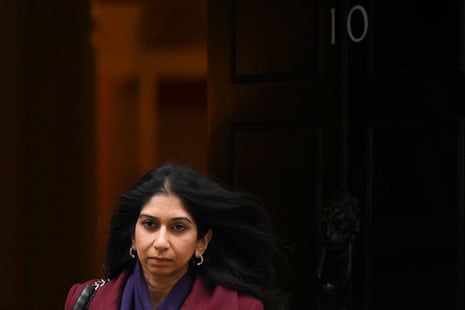
Suella Braverman, the home secretary, has an interview in the Daily Telegraph today where she says her party will not be forgiven if it fails to stop small boat crossings. She tells the paper:
I think we need to stop the boats to win the election. No ifs, no buts. That’s why the prime minister has made migration one of the five priorities.
The main objective is that there is no excuse any more. The government needs to deliver on the promise. The British people are rightly fed up with this problem that has now gone on for years, and I really do think that it’s the last chance for the government to get this right.
It is strong language, which is why the Telegraph has got it on its front page. It is also rather odd, because this is the sort of thing an MP says when they are lobbying a minister to act. But Braverman is the minister in charge in this instance, and so why is she lobbying herself?
The answer probably has something to do with Glen Owen’s story in the Mail on Sunday at the weekend. Rishi Sunak has promised to legislate to stop people arriving in the UK illegally from ever being allowed to claim asylum in the country. According to Owen, Sunak has been told that that, given the UK’s current international legal obligations, this is a non-starter. He reports:
Sources say that attorney general Victoria Prentis has warned No 10 that moves to allow migrants to be detained without having their case heard for three months – when the maximum permitted for terrorism suspects is 28 days – would ‘never get through the courts’.
Separately, Home Office officials are understood to have argued that plans to disapply the right of migrants to claim asylum when they have arrived here illegally would break international laws established with the 1951 Refugee Convention.
This defined ‘refugee’ as someone unable or unwilling to return to their country of nationality ‘owing to a well-founded fear of being persecuted for reasons of race, religion, nationality, membership of a particular social group, or political opinion’.
‘Rishi’s determined to push this through, but with judges and civil servants so opposed it could turn into civil war,’ the Home Office source added.
In the light of this, Braverman’s comments start to look much more like an intervention in an internal, and as yet unresolved, Whitehall battle about whether the government should abandon laws like the European convention on human rights.
Asked about the ECHR by the Telegraph, Braverman said that her views were a matter of record (she thinks the UK should withdraw), but would not comment further.
Rachel Reeves says Tory government has been ‘drag anchor on prosperity’ in UK for 13 years
Tory government has been “a drag anchor on prosperity” for the UK for the past 13 years, Rachel Reeves, the shadow chancellor, told MPs.
In her urgent question on the IMF report, Reeves said:
Britain has huge potential but 13 years of Tory failure has been a drag anchor on prosperity. Today’s IMF assessment holds a mirror up to the wasted opportunities and it is not a pretty sight.
The UK is the only major economy forecast to shrink this year. Weaker growth compared to our competitors for both of the next two years. The world upgraded, Britain downgraded. Growth even worse than sanctions-hit Russia.
Referring to the Jeremy Hunt’s decision not to respond to the UQ in person, she went on:
If the chancellor had ideas, answers or courage, he would be here today. But he is not.
The question people are now asking is this: are me and my family better off after 13 years of Tory government? The answer is no. And as the IMF show today, it doesn’t have to be this way.
In response, James Cartlidge, a junior Treasury minister, said the IMF was endorsing the approach taken by the government. He said:
We agree with the IMF’s focus on the high level of inflation in our country, which is why it’s our top priority.
Inflation is the most insidious tax rise there is and so the best tax cut now is to reduce inflation; it will help families across the country with the cost of living.
As the chancellor has said, short-term challenges, especially ones we’re focused on tackling, should not obscure our long-term forecast. If we stick to our plan to halve inflation, the UK is still predicted to grow faster than Germany and Japan in the coming years.
The National Education Union has told its members they do not need to tell the schools where they work whether or not they will be participating in the strike tomorrow. In an interview with Sky News this morning, Kevin Courtney, the NEU’s joint general secretary, defended this approach, saying that a strike was meant to be disruptive. He explained:
There is disruption every day in our schools because the government isn’t investing in our schools or the people who work in them. The point about tomorrow is that it is a strike. We want our strike to be effective in order to concentrate the government’s mind.
It is not the same as a natural phenomenon like Covid where we would be doing everything we could to make sure schools were running as well as possible.
No 10 warns public will face ‘significant disruption’ tomorrow because of mass strikes
Downing Street has warned that the mass strikes tomorrow, with teachers, train drivers, civil servants, university lecturers, bus drivers and security guards all taking action), will be “very difficult” for members of the public. The PM’s spokesperson told journalists:
We know that there will be significant disruption given the scale of the strike action that is taking place tomorrow and that will be very difficult for the public trying to go about their daily lives.
We are upfront that this will disrupt people’s lives and that’s why we think negotiations rather than picket lines are the right approach.







Discussion about this post