








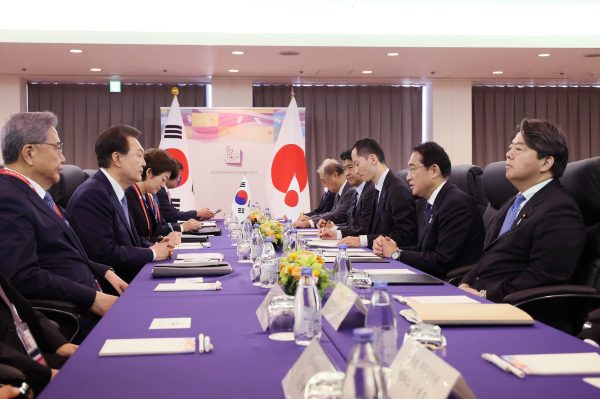
The third meeting in two months between Japan’s Prime Minister Kishida Fumio and South Korea’s President Yoon Suk-yeol, this time on the sidelines of the Hiroshima G-7 summit on May 21, marked a milestone in the relationship between the two Northeast Asian neighbors.
The two nations have long been at loggerheads over Japan’s colonial and wartime legacy. While ongoing hostility toward Tokyo in South Korean society and political opposition may make the two nations’ rapport short-lived, these developments nonetheless mark a turnaround in the bilateral relationship, which had deteriorated over the course of former South Korean President Moon Jae-in’s tenure.
The reason for the improvement in ties has been attributed to a meeting of minds between two conservative leaders on security issues.
Topping the list is the escalating threat posed by North Korea’s increasingly sophisticated nuclear missile arsenal. But clearly the China dimension is critical, given the Chinese government’s increasing authoritarianism at home, and aggression in the maritime domains through which these countries’ key maritime lifelines run. Both leaders have faced growing tensions with Xi Jinping’s China.
The China-South Korea relationship in particular has deteriorated on the back of a complaint lodged by Beijing over Yoon’s views on Taiwan, and a public spat between South Korea’s embassy in Beijing and a Chinese state media tabloid about his friendly overtures toward Washington and Tokyo.
But there is another important factor that warrants consideration in the China-Japan-South Korea triangular dynamic. Both Seoul and Tokyo have seen their trade relationships with China materially transformed, shifting from strong complementarities to increasing competition in key strategic industries.
The growing rapport between Japan and South Korea is happening as long-running trade rivalries between the two democratic nations are being overshadowed by threats posed by China’s economic transformation. This is occurring, moreover, at the very time that the benefits South Korea and Japan have reaped from the China market are declining substantially.
Underlying this transformation is a set of shifts in each nation’s key export industries. Key among these are car exports, including the rapidly growing market of electric vehicles (EVs).
Japan’s Automotive Industry Feels the Pinch
Japan’s automotive industry in particular is feeling the impact of the rise of China as a car-exporting superpower. Based on recent data, China has already taken the mantle of the world’s largest car exporter from Japan, whose exports fell 8 percent in 2022.
Japanese carmakers are also seeing rapidly diminishing returns in the Chinese market. Chinese producers have begun to dominate domestic sales, while the fortunes of Japanese carmakers have fallen dramatically. Nissan’s sales in China fell by 25 percent in the first quarter of 2023; Honda and Toyota both recorded drops of 19 percent.
Led by this fall in demand for cars and auto parts, Japan’s exports to China overall fell 6.2 percent year-on-year in value in December. In January of this year, they plunged to a seven-year monthly low, and continued to fall through to March, which saw a year-on-year decline of 7 percent.
While this already presents troubling milestones for Japan’s champion automotive industry, China’s growth in the EV sector potentially presents bigger challenges.
The EV market is increasingly vital to the sector, with the Boston Consulting Group last year forecasting that EVs will make up one-fifth of global light vehicle sales by 2025, and almost 60 percent by 2035. According to an International Energy Agency report, China last year grabbed a share of roughly 35 percent of the global EV export market, up 10 percentage points in a single year. Japan, which has seen its share drop from around 25 percent to less than 10 percent in four years (2018-2022), is well behind in the race with China to consolidate its market position in the sector that is likely eventually to dominate the automotive industry.
That’s a big problem, given the significance of Japan’s automotive industry to its economy as a whole.
Two of Japan’s three largest companies (Toyota and Honda) are in the automotive sector, with Toyota, Japan’s corporate champion, ranking number 13 in the 2022 Fortune Global 500 list. Vehicles and vehicle parts were Japan’s second top export in 2022, generating $136 billion and representing 18 percent of Japan’s total export value.
The industry directly and indirectly employs about 5.4 million people, or around 8 percent of Japan’s workforce. The government’s Japan External Trade Organization describes the automotive industry as a “key driver of Japan’s manufacturing industry” on account that it has a “significant impact” on “the procurement of materials and parts, which in turn greatly influences the overall Japanese economy.”
In this context, China’s rapidly growing competitiveness and market share in the EV export market in particular potentially pose significant economic dangers for Japan. According to a new Climate Group report, Japan’s sluggishness in the EV market, which Chinese carmakers are looking to dominate, means Japan’s car industry risks losing 1.7 million jobs, and billions in profits. This could, according to the report, prompt a 14 percent drop in the nation’s GDP.
South Korea’s Automotive Industry: A Similar Story
South Korea, whose automotive industry plays a relatively less pivotal but nonetheless important role in shaping that country’s economic fortunes, to a degree shares these anxieties.
The industry in 2020 accounted for roughly 3 percent of the nation’s GDP and over 11 percent of employment in the manufacturing sector. Three automotive/auto parts companies are in the list of the nation’s top 10 firms by market capitalization – Hyundai (4th), Kia (5th), and Hyundai Mobis (6th) – while Samsung, the leading firm, is a supplier of high-tech automotive components.
The industry, along with semiconductors and electronic devices, has also become a key symbol of South Korea’s rise as an advanced manufacturing hub, with two Korean companies in the global top 20 car makers in 2022, and nine Korean companies among the top 100 auto parts makers in 2021. The industry’s strategic significance was reflected by Seoul announcing a $72 billion investment last year, with the aim of capturing 12 percent global market share in the EV market by 2030.
Thus far South Korea’s automotive industry has fared far better than Japan’s in the face of growing Chinese competition. After hitting a new high in 2022 – in which exports exceeded an annual figure of $50 billion for the first time – 2023 has seen continued gains, with February seeing a 34.8 percent year-on-year gain. The sum of automobile and parts exports reached $7.6 billion for that month, making it the number one performing export for the first time in six years, accounting for 15.2 percent of exports by value.
South Korean carmakers also made gains in EV sales, which crossed the previous annual record of $5.42 billion (2022) in only two months in 2023. February’s exports were 83.4 percent higher than those of the same month in the previous year.
But the news has not all been good for South Korean carmakers, particularly regarding opportunities in China and competition from Chinese competitors.
South Korean cars’ share of the Chinese market dropped below 2 percent in 2022, down from nearly 8 percent in 2016. In the first quarter of 2022, Korean carmakers closed some factories in China after a 40 percent decrease in year-on-year sales.
The Korea Automobile Manufacturers Association recently voiced its concerns about the future of South Korea’s industry, saying, “The sharp increase in Chinese automobile exports has a negative impact on the expansion of Korean exports.” It also stated that “Korean companies’ competition with their Chinese counterparts… is expected to intensify as Chinese companies are expanding their exports with governmental support.”
Yet the impact of both declining market share in China, and increasing Chinese competition elsewhere, is not limited to South Korea’s automotive industry.
Total South Korean exports to China have shrunk dramatically in 2023, with most months around 30 percent down from the same month last year. That negative trend brought South Korea’s exports to China below 20 percent of the global total for the first time since 2005, and dragged down South Korea’s overall export volumes, which were down 14 percent year-on-year in April. Aside from lower vehicle sales, the drop was led by a steep decline in China-bound exports of South Korean semiconductors – one of South Korea’s champion industries, and its most lucrative export in recent years – after Korean imports lost ground to local or locally based suppliers.
Moreover, these setbacks could well be a harbinger of greater dangers for South Korea’s high-tech exports more generally.
A 2022 report from the Korea International Trade Association’s Institute for International trade noted that China has already become a market leader in three of five key emerging industries: advanced displays, rechargeable batteries, and newer-generation semiconductors. A survey of 300 South Korean exporting companies by the Korean Chamber of Commerce and Industry reported that nearly 40 percent of industry respondents said that China was less than three years behind south Korea in “technological competitiveness,” a Korean measure of technological superiority, marketability, and feasibility, while almost the same amount felt the two nation’s levels were roughly comparable. More than 40 percent of respondents felt that the speed of China’s technological development will surpass South Korea’s over the next five years.
Competition, Trade, and Geopolitics
The notion that the benefits to South Korea and Japan of trade complementarity with China are declining, while the economic threats of competition are substantially intensifying, offers an alternative explanation for the growing rapport between the two democratic nations.
In view of the recent spate of diplomatic spats between Beijing and both Seoul and Tokyo, it is also worth reflecting on whether this trend is undermining the economic ballast that has hitherto helped stabilize their relations with China. Bilateral ties appear to now be deteriorating against the backdrop of concerns about Beijing’s increasing authoritarianism, assertiveness, and alleged hegemonic ambitions.
This could in turn bring Japan and South Korea closer into the orbit of Washington. The United States is promoting “friend-shoring” and other measures to develop resilient supply chains, which could provide new trade opportunities for its allies, and is seeking to establish a broader front among advanced economies to contain China’s technological development.
It also prompts interrogation on the inflection point where economic competition becomes predominantly political – or when the degradation of key industries threatens to have a profound impact on national strength and international influence.
Relative to the other nations, this is arguably something that has been approached more openly and with some sophistication in Northeast Asia, where Japan, South Korea, and China share roughly similar ideas on the nexus between technological development, national strength, and agency in the international sphere.
This has prompted the development, and ample protection, of highly parallel, and inter-competitive, advanced sector economies. That may be an understated factor underlying frequent tensions in the neighborhood, which have hitherto often been primarily attributed to historical, ethnic, and territorial animosities.
To the extent that this is the case, the impact of these animosities may stretch further. As EV sector competition escalates, EV batteries, and the critical minerals needed to produce them such as lithium, are increasingly being securitized.
Canada ordered three Chinese companies to divest from its lithium mines late last year, while the United States’ Inflation Reduction Act will soon require EV manufacturers to source 40 percent of the critical minerals in their batteries from friendly nations. Australia, which exports the vast majority of the lithium it extracts to China, has been earmarked as a potential beneficiary of the act, and has recently seen growing interest in lithium, hydrogen, and other critical minerals used in EV batteries from both South Korea and Japan.
Having flagged the “need to be… cognizant of the role Australia’s critical minerals will play in the security of our trusted regional friends and allies,” Canberra’s trade conundrums, too, may ultimately depend on its own answers as to how the somber reality of geopolitical considerations, and the principle of unfettered global trade, can renegotiate their coexistence in a post-unilateral global order.








Discussion about this post