









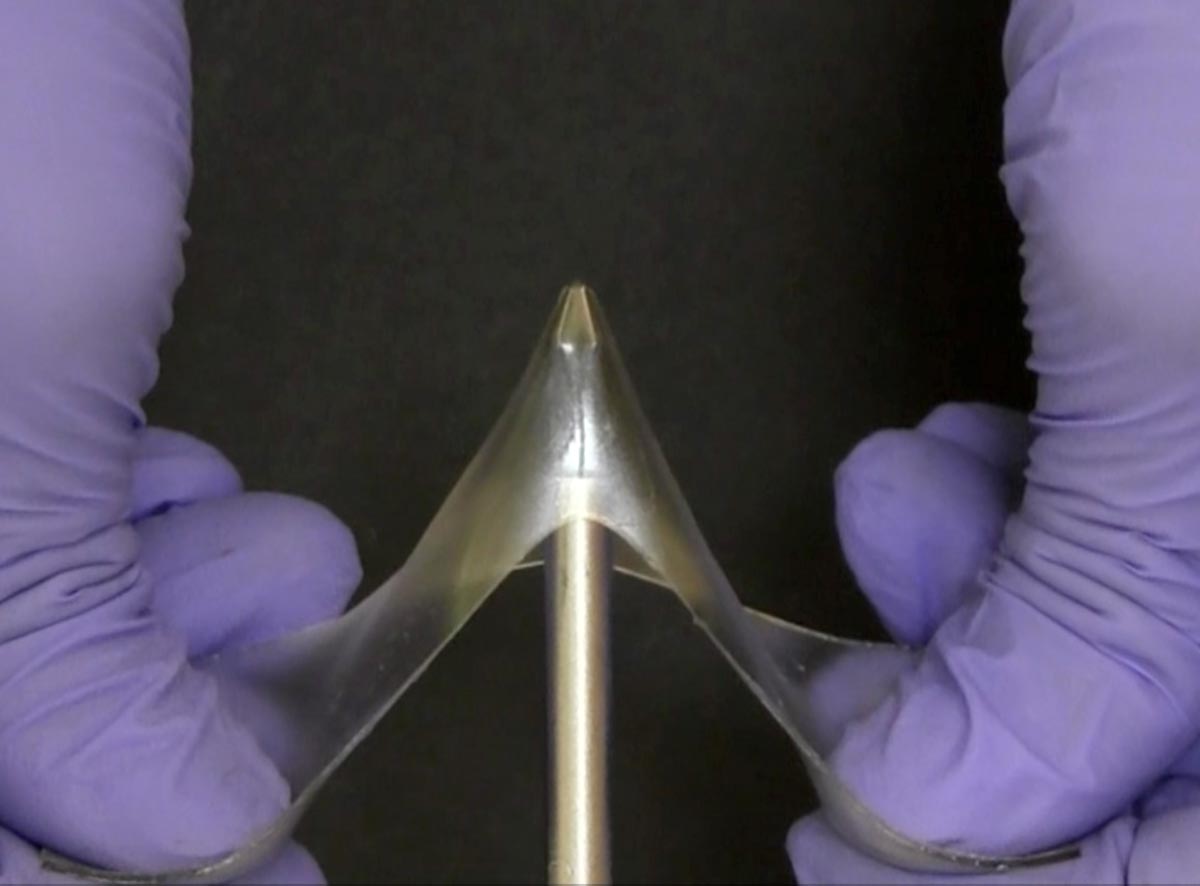
Researchers have created a new class of materials called “glassy gels” that are as hard as glassy polymers, but – if you apply enough force – can stretch up to five times their original length, rather than breaking. A key thing that distinguishes glassy gels is that they are more than 50% liquid, which makes them more efficient conductors of electricity than common plastics that have comparable physical characteristics. Credit: Meixiang Wang, NC State University
Researchers have developed a new class of materials known as glassy gels, which combine the hardness of glassy polymers with the stretchability of gels.
These materials maintain over 50% liquid content, enhancing their elasticity and adhesive properties. The fabrication process involves mixing polymer precursors with an ionic liquid and curing with ultraviolet light, allowing for easy production and potential for widespread application in industries like electronics and medical devices.
Scientists Create New Class of Materials Called “Glassy Gels”
Scientists have invented a novel class of materials called “glassy gels,” which are remarkably hard and difficult to break even though they are composed of more than 50% liquid. Coupled with the fact that glassy gels are simple to produce, the material holds promise for a wide variety of applications.
Gels and glassy polymers are classes of materials that have historically been viewed as distinct from one another. Glassy polymers are hard, stiff, and often brittle. They’re used to make things like water bottles or airplane windows. Gels – such as contact lenses – contain liquid and are soft and stretchy.
Innovative Material Design
“We’ve created a class of materials that we’ve termed glassy gels, which are as hard as glassy polymers, but – if you apply enough force – can stretch up to five times their original length, rather than breaking,” says Michael Dickey, corresponding author of a paper on the work and the Camille and Henry Dreyfus Professor of Chemical and Biomolecular Engineering at DOI: 10.1038/s41586-024-07564-0
Co-lead author of the paper is Xun Xiao of the University of North Carolina at Chapel Hill. The paper was co-authored by Salma Siddika, a Ph.D. student at NC State; Mohammad Shamsi, a former Ph.D. student at NC State; Ethan Frey, a former undergrad at NC state; Brendan O’Connor, a professor of mechanical and aerospace engineering at NC State; Wubin Bai, a professor of applied physical sciences at UNC; and Wen Qian, a research associate professor of mechanical and materials engineering at the University of Nebraska-Lincoln.
The work was partially supported by funding from the Coastal Studies Institute.










Discussion about this post