










Artist’s impression of a microlensing event caused by a black hole observed from Earth toward the Large Magellanic Cloud. The light of a background star located in the LMC is bent by a putative primordial black hole (lens) in the Galactic halo and magnified when observed from the Earth. Microlensing causes very characteristic variation of brightness of the background star, enabling the determination of the lens’s mass and distance. Credit: J. Skowron / OGLE. Background image of the Large Magellanic Cloud: generated with bsrender written by Kevin Loch, using the ESA/Gaia database. Credit: J. Skowron / OGLE. Background image of the Large Magellanic Cloud: generated with bsrender written by Kevin Loch, using the ESA/Gaia database
A population of massive black holes whose origin is one of the biggest mysteries in modern astronomy has been detected by the 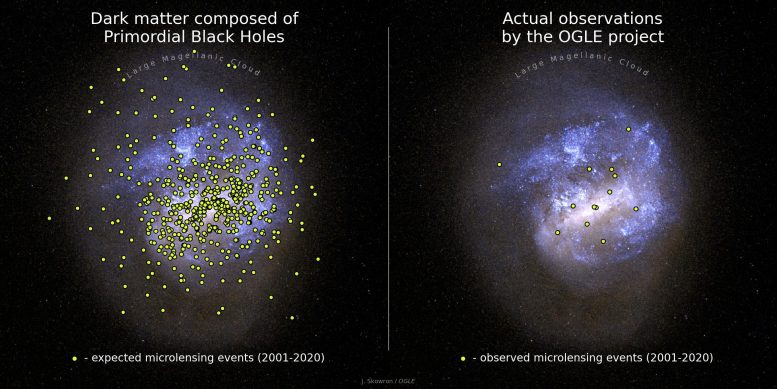
Expected vs. observed microlensing events by massive objects toward the Large Magellanic Cloud as seen through the Milky Way halo. If the dark matter in the Universe consisted of putative primordial black holes, over 500 microlensing events would be detected during the OGLE survey in the years 2001-2020. In reality, the OGLE project registered only 13 detections of microlensing events, most likely caused by regular stars. Credit: J. Skowron / OGLE. Background image of the Large Magellanic Cloud: generated with bsrender written by Kevin Loch, using the ESA/Gaia database. Credit: J. Skowron / OGLE. Background image of the Large Magellanic Cloud: generated with bsrender written by Kevin Loch, using the ESA/Gaia database
The Mystery and Potential of Primordial Black Holes
Since the first detection of 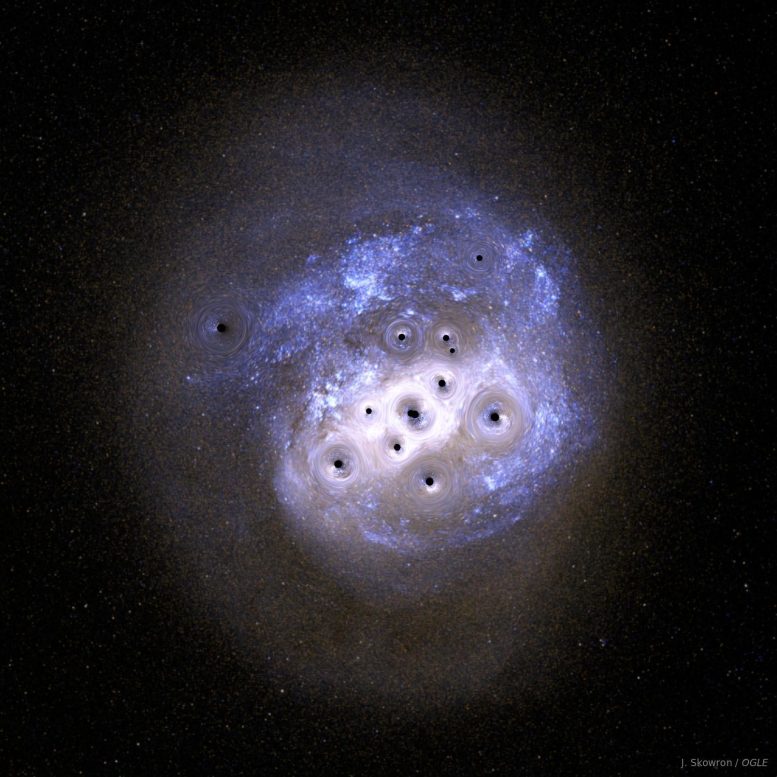
Artist’s impression of the Large Magellanic Cloud being lensed by massive objects in the Milky Way halo. Credit: J. Skowron / OGLE
Exploring Dark Matter With Microlensing Techniques
Fortunately, this hypothesis can be verified with astronomical observations. We observe that copious amounts of dark matter exist in the Milky Way. If it were composed of black holes, we should be able to detect them in our cosmic neighborhood. Is this possible, given that black holes do not emit any detectable light?
According to Einstein’s theory of general relativity, light may be bent and deflected in the gravitational field of massive objects, a phenomenon called gravitational microlensing.
“Microlensing occurs when three objects – an observer on Earth, a source of light, and a lens – virtually ideally align in space,” says Prof. Andrzej Udalski, the principal investigator of the OGLE survey. “During a microlensing event, the source’s light may be deflected and magnified, and we observe a temporary brightening of the source’s light.”
The duration of the brightening depends on the mass of the lensing object: the higher the mass, the longer the event. Microlensing events by solar mass objects typically last several weeks, whereas those by black holes that are 100 more massive than the Sun would last a few years.
The idea of using gravitational microlensing to study dark matter is not new. It was first proposed in the 1980s by the famous Polish astrophysicist Bohdan Paczyński. His idea inspired the start of three major experiments: Polish OGLE, American MACHO, and French EROS. The first results from these experiments demonstrated that black holes less massive than one solar mass may comprise less than 10 percent of dark matter. These observations were not, however, sensitive to extremely long-timescale microlensing events and, therefore, not sensitive to massive black holes, similar to those recently detected with gravitational-wave detectors.
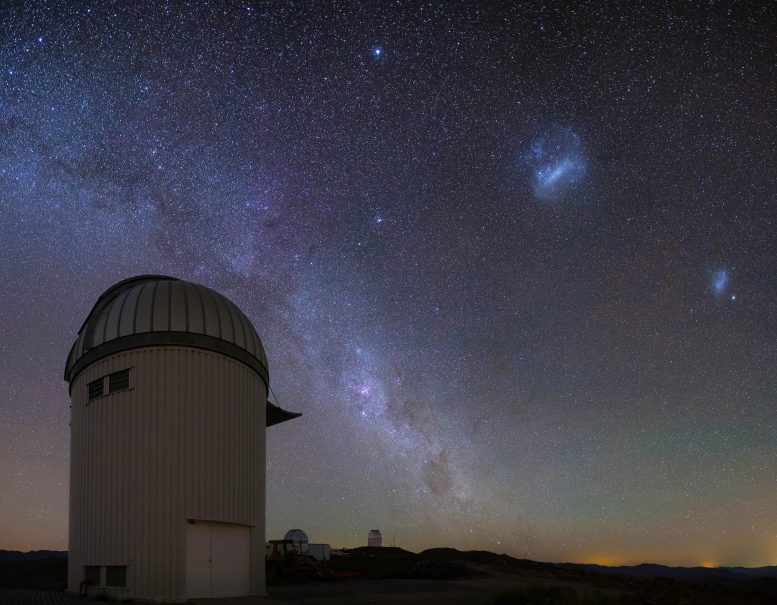
Night over the Las Campanas Observatory in Chile (operated by the Carnegie Institution for Science). The OGLE project observing station and the Large and Small Magellanic Clouds. Credit: Krzysztof Ulaczyk
Long-Term Observational Studies by OGLE
In the new article in the Astrophysical Journal Supplement Series, OGLE astronomers present the results of nearly 20-year-long photometric monitoring of almost 80 million stars located in a nearby galaxy, called the Large Magellanic Cloud, and the searches for gravitational microlensing events. The analyzed data were collected during the third and fourth phases of the OGLE project from 2001 to 2020.
“This data set provides the longest, largest, and most accurate photometric observations of stars in the Large Magellanic Cloud in the history of modern astronomy,” says Prof. Udalski.
Implications of Recent Findings on Dark Matter
The second article, published in Nature, discusses the astrophysical consequences of the findings.
“If the entire dark matter in the Milky Way was composed of black holes of 10 solar masses, we should have detected 258 microlensing events,” says Dr. Mróz. “For 100 solar mass black holes, we expected 99 microlensing events. For 1000 solar mass black holes – 27 microlensing events.”
In contrast, the OGLE astronomers have found only 13 microlensing events. Their detailed analysis demonstrates that all of them can be explained by the known stellar populations in the Milky Way or the Large Magellanic Cloud itself, not by black holes.
“That indicates that massive black holes can compose at most a few percent of dark matter,” says Dr. Mróz.
The detailed calculations demonstrate that black holes of 10 solar masses may comprise at most 1.2% of dark matter, 100 solar mass black holes – 3.0% of dark matter, and 1000 solar mass black holes – 11% of dark matter.
“Our observations indicate that primordial black holes cannot comprise a significant fraction of the dark matter and, simultaneously, explain the observed DOI: 10.1038/s41586-024-07704-6
Reference: “Microlensing Optical Depth and Event Rate toward the Large Magellanic Cloud Based on 20 yr of OGLE Observations” by Przemek Mróz, Andrzej Udalski, Michał K. Szymański, Mateusz Kapusta, Igor Soszyński, Łukasz Wyrzykowski, Paweł Pietrukowicz, Szymon Kozłowski, Radosław Poleski, Jan Skowron, Dorota Skowron, Krzysztof Ulaczyk, Mariusz Gromadzki, Krzysztof Rybicki, Patryk Iwanek, Marcin Wrona and Milena Ratajczak, 24 June 2024, The Astrophysical Journal Supplement Series.
DOI: 10.3847/1538-4365/ad452e









Discussion about this post