
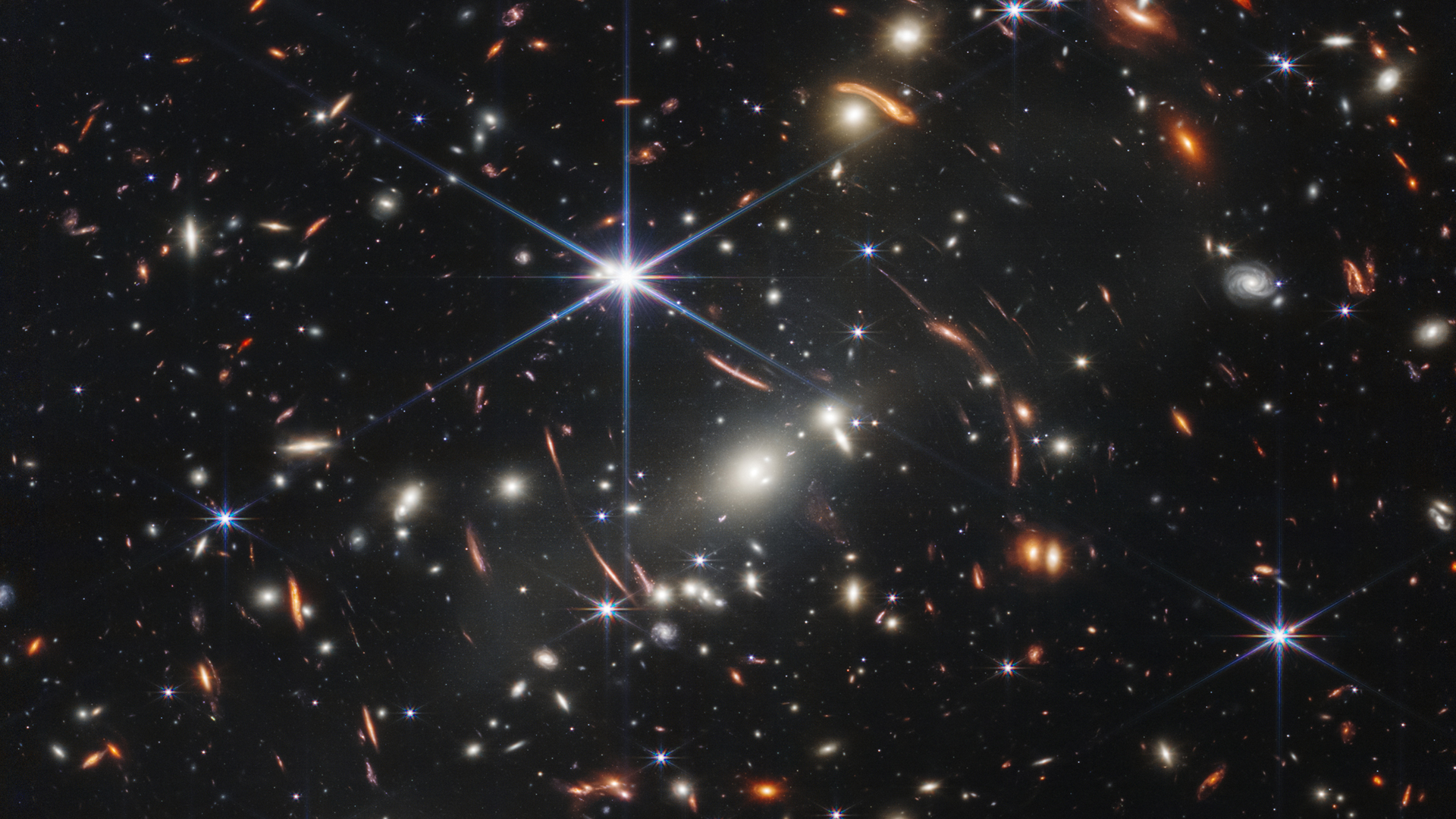
Not long after the James Webb Space Telescope (JWST) began its science operations, astronomers announced that they had discovered galaxies in the early universe that were far too large, bright and full of stars for their age. While headlines around the world claimed that these galaxies were “breaking” our understanding of the Big Bang, the truth is much more nuanced — and much more interesting.
The Big Bang theory is our general picture of the history of the universe, starting in its deep past, when the cosmos was much smaller, hotter and denser than it is today. This model, initially developed in the early 20th century, has survived a battery of observational tests and is extremely good at explaining a variety of cosmological observations, including the redshifting of light from distant galaxies, the appearance of leftover radiation in the form of the cosmic microwave background, the abundances of light elements, and the evolution of galaxies and larger structures.
While the Big Bang theory can’t say for certain which galaxies will appear where, it can talk about probabilities. For example, cosmologists can say roughly how many small galaxies, how many medium galaxies and how many large galaxies should appear in a given volume at a certain age of the universe. But until JWST, we did not have direct observational access to the earliest stages of galactic evolution — something the telescope was explicitly designed to study.
In 2022, astronomers announced that they had found extremely distant galaxies that were surprisingly, weirdly large. They had measured the redshift of the galaxies to be over 16, implying that these galaxies existed just 200 million to 250 million years after the Big Bang. Yet they were gigantic and appeared to be fully formed, with spiral arms and everything.
Related: No, the Big Bang theory is not ‘broken.’ Here’s how we know.
These galaxies seemed far outside the expectations of the Big Bang theory; they were like finding teenagers in a kindergarten classroom. So what was going on?
Bending cosmology
Cue the brazen headlines proclaiming the death of the Big Bang theory. But those stories left out a crucial detail: Astronomers estimated the redshift of those galaxies through a technique known as photometry, which is incredibly uncertain. A full evaluation of the ability of those galaxies to “break” cosmology would have to wait for a more precise measurement of their redshift, and hence their age.
When those more precise measurements finally came a few months later, those galaxies turned from record-shattering to just … normal galaxies. For example, one galaxy’s redshift was revised from over 16 to just 4.9, moving its age from 240 million years after the Big Bang to well over a billion years. That’s more than enough time for the normal Big Bang theory to explain their sizes and shapes.
But along with those less-exciting revisions came some new confirmed redshifts of other galaxies, including JADES-GS-z14-0, the current most distant known galaxy, with a redshift of 14.32. This galaxy was alive and well when the cosmos was just 290 million years old.
Astronomers fully expected galaxies to exist 290 million years after the Big Bang; that’s why they built JWST. And as galaxies go, JADES-GS-z14-0 is certainly a juvenile — it’s only 1,600 light-years across, compared with the Milky Way’s 100,000 light-years. But interestingly, the galaxy is rather bright and full of stars — not enough to outright break cosmology, but enough to open up some questions about the origins and development of the first galaxies to appear in the universe.
Building cosmology
It’s quite possible that the Big Bang theory is wrong; scientists must maintain the mental discipline to admit the possibility. But with such a wealth of evidence behind it, the Big Bang is unlikely to be unseated from a single observation. And it’s worth reiterating that JWST is doing exactly what we designed and built it to do: answer some major lingering questions about how the first stars and galaxies appeared.
It’s entirely possible that cosmologists will be able to explain the appearance of galaxies like JADES-GS-z14-0 within the framework of the Big Bang without having to make any major revisions. For example, large black holes may have appeared before these galaxies did, and their superpowered gravitational attraction may have triggered bright bursts of star formation. Or perhaps supernova feedback and other mechanisms caused the first galaxies to be richer with stars than present-day galaxies, making those early galaxies appear mighty despite their small size.
Or maybe our initial observations are biased toward these small-but-bright outliers and further campaigns will reveal larger populations of more mundane galaxies, thus reducing the tension with galaxy formation models.
And lastly, perhaps we need to add some new ingredient to the universe, like allowing for dark energy to evolve with time, to produce these kinds of galaxies at such early times.
This is exciting enough on its own, without the need to upend the Big Bang as we know it. There are more than enough mysteries and hidden corners within the universe to keep astronomers up at night wondering about the possibilities — and up in the morning to keep working on how to solve them.