









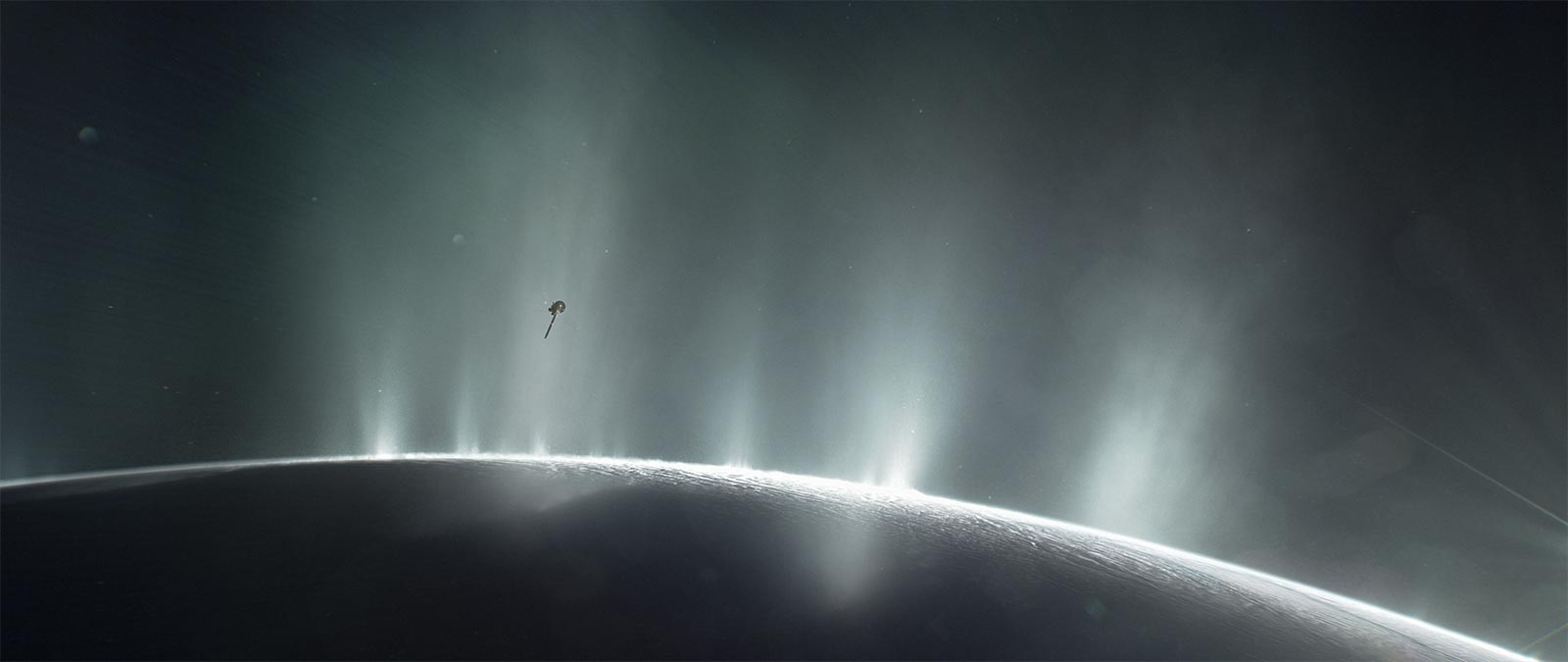
This artist’s impression depicts NASA’s Cassini spacecraft flying through a plume of presumed water erupting from the surface of Saturn’s moon Enceladus. Credit: NASA
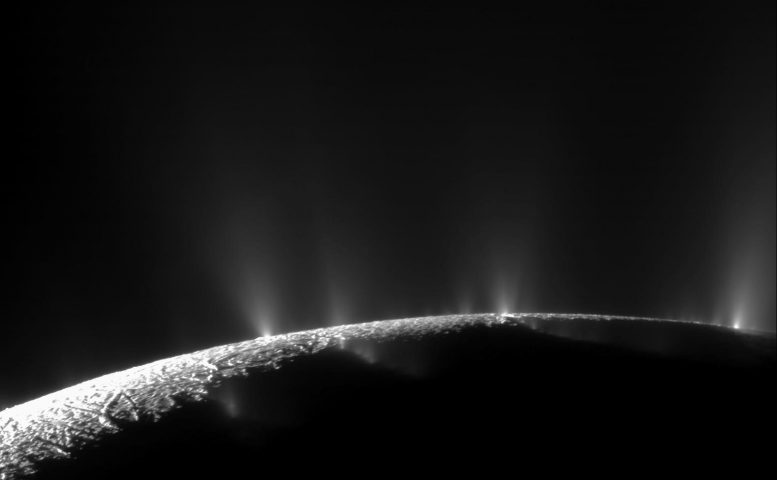
Dramatic plumes, both large and small, spray water ice and vapor from many locations along the famed “tiger stripes” near the south pole of Saturn’s moon Enceladus. Credit: NASA/JPL/Space Science Institute
The frigid surfaces of these nearly airless moons are likely uninhabitable due to radiation from both high-speed particles trapped in their host planet’s magnetic fields and powerful events in deep space, such as exploding stars. However, both have oceans under their icy surfaces that are heated by tides from the gravitational pull of the host planet and neighboring moons. These subsurface oceans could harbor life if they have other necessities, such as an energy supply as well as elements and compounds used in biological molecules.
Experimental Approaches and Findings
The research team used amino acids in radiolysis experiments as possible representatives of biomolecules on icy moons. Amino acids can be created by life or by non-biological chemistry. However, finding certain kinds of amino acids on Europa or Enceladus would be a potential sign of life because they are used by terrestrial life as a component to build proteins. Proteins are essential to life as they are used to make enzymes which speed up or regulate chemical reactions and to make structures. Amino acids and other compounds from subsurface oceans could be brought to the surface by geyser activity or the slow churning motion of the ice crust.
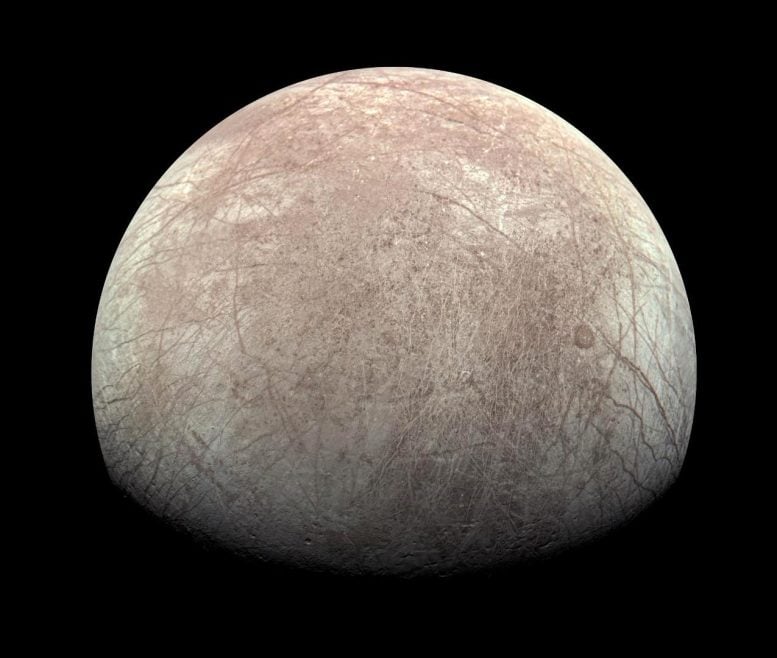
This view of Jupiter’s icy moon Europa was captured by JunoCam, the public engagement camera aboard NASA’s Juno spacecraft, during the mission’s close flyby on September 29, 2022. The picture is a composite of JunoCam’s second, third, and fourth images taken during the flyby, as seen from the perspective of the fourth image. North is to the left. The images have a resolution of just over 0.5 to 2.5 miles per pixel (1 to 4 kilometers per pixel). As with our Moon and Earth, one side of Europa always faces Jupiter, and that is the side of Europa visible here. Europa’s surface is crisscrossed by fractures, ridges, and bands, which have erased terrain older than about 90 million years. Citizen scientist Kevin M. Gill processed the images to enhance the color and contrast. Credit: NASA/JPL-Caltech/SwRI/MSSS, Kevin M. Gill CC BY 3.0
To evaluate the survival of amino acids on these worlds, the team mixed samples of amino acids with ice chilled to about minus 321 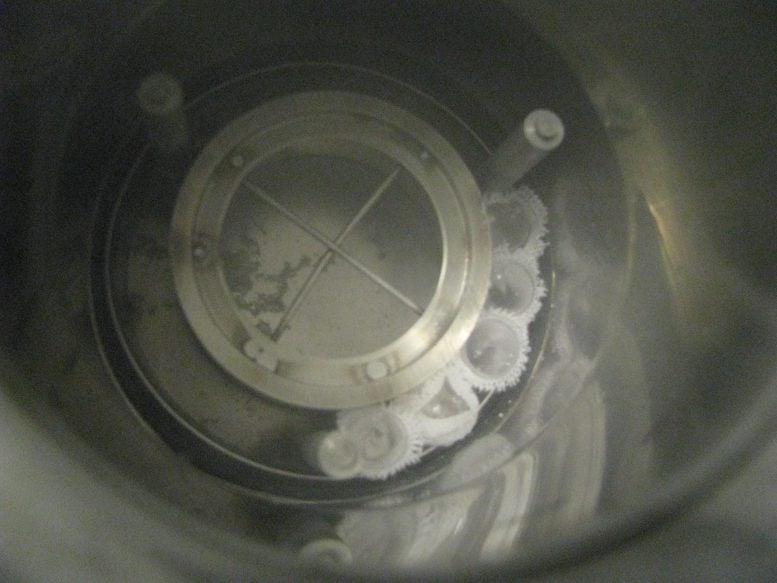
This image shows experiment samples loaded in the specially designed dewar which will be filled with liquid nitrogen shortly after and placed under gamma radiation. Notice that the flame-sealed test tubes are wrapped in cotton fabric to keep them together because test tubes become buoyant in liquid nitrogen and start floating around in the dewar, interfering with the proper radiation exposure. Credit: Candace Davison
“Slow rates of amino ionizing radiation changes molecules — directly by breaking their chemical bonds or indirectly by creating reactive compounds nearby which then alter or break down the molecule of interest. It’s possible that bacterial cellular material protected amino acids from the reactive compounds produced by the radiation.
Reference: “Variable and Large Losses of Diagnostic Biomarkers After Simulated Cosmic Radiation Exposure in Clay- and Carbonate-Rich DOI: 10.1089/ast.2023.0123
The research was supported by NASA under award number 80GSFC21M0002, NASA’s Planetary Science Division Internal Scientist Funding Program through the Fundamental Laboratory Research work package at Goddard, and NASA Astrobiology NfoLD award 80NSSC18K1140.









Discussion about this post