• Home
  • Insight
  • Blog
  • Business
  • Entertainment
  • Health
  • Politics
  • Shop
    • Gift Shop
    • Value Shop
    • Store
    • Bargain Shop
    • Discount
  • Sports
  • Tech
  • Travel
  • USA
  • Video
  • World
    • Asia
    • Africa
    • South America
    • North America
    • Europe
    • Oceania
Thursday, November 19, 2026
No Result
View All Result
Subscribe Now
  • Home
  • Insight
  • Blog
  • Business
  • Entertainment
  • Health
  • Politics
  • Shop
    • Gift Shop
    • Value Shop
    • Store
    • Bargain Shop
    • Discount
  • Sports
  • Tech
  • Travel
  • USA
    FAA Administrator Takes Responsibility as Mullin Faces Tough Questions Over Nationwide Ground Stop

    FAA Administrator Takes Responsibility as Mullin Faces Tough Questions Over Nationwide Ground Stop

    Mary Peltola Emerges Victorious in Alaska Senate Race, Making History for Democrats

    Mary Peltola Emerges Victorious in Alaska Senate Race, Making History for Democrats

    Stranded in Conflict: Palestinians Navigate the Tenuous Balance of War and Peace Amid Ceasefire Efforts

    Stranded in Conflict: Palestinians Navigate the Tenuous Balance of War and Peace Amid Ceasefire Efforts

    Trump Administration Revokes Pay Increase for Head Start Educators

    Trump Administration Revokes Pay Increase for Head Start Educators

    Unexpected Triumph: Gay Candidates Achieve Unforeseen Victories in Challenging Races

    Unexpected Triumph: Gay Candidates Achieve Unforeseen Victories in Challenging Races

    Microsoft Outlook Experiences Prolonged Outage Affecting Users Nationwide

    Microsoft Outlook Experiences Prolonged Outage Affecting Users Nationwide

    Gunfire Erupts in D.C.: Authorities Search for Suspect Amid Rising Concerns Over Public Safety

    Gunfire Erupts in D.C.: Authorities Search for Suspect Amid Rising Concerns Over Public Safety

    LAUSD Takes Strong Action Against Hate Speech Following Racial Slur Incidents

    LAUSD Takes Strong Action Against Hate Speech Following Racial Slur Incidents

    Beloved Former Los Angeles Times Columnist Steve Harvey Passes Away at 80

    Beloved Former Los Angeles Times Columnist Steve Harvey Passes Away at 80

  • Video
  • World
    • Asia
    • Africa
    • South America
    • North America
    • Europe
    • Oceania
The Insight Post
  • Home
  • Insight
  • Blog
  • Business
  • Entertainment
  • Health
  • Politics
  • Shop
    • Gift Shop
    • Value Shop
    • Store
    • Bargain Shop
    • Discount
  • Sports
  • Tech
  • Travel
  • USA
    FAA Administrator Takes Responsibility as Mullin Faces Tough Questions Over Nationwide Ground Stop

    FAA Administrator Takes Responsibility as Mullin Faces Tough Questions Over Nationwide Ground Stop

    Mary Peltola Emerges Victorious in Alaska Senate Race, Making History for Democrats

    Mary Peltola Emerges Victorious in Alaska Senate Race, Making History for Democrats

    Stranded in Conflict: Palestinians Navigate the Tenuous Balance of War and Peace Amid Ceasefire Efforts

    Stranded in Conflict: Palestinians Navigate the Tenuous Balance of War and Peace Amid Ceasefire Efforts

    Trump Administration Revokes Pay Increase for Head Start Educators

    Trump Administration Revokes Pay Increase for Head Start Educators

    Unexpected Triumph: Gay Candidates Achieve Unforeseen Victories in Challenging Races

    Unexpected Triumph: Gay Candidates Achieve Unforeseen Victories in Challenging Races

    Microsoft Outlook Experiences Prolonged Outage Affecting Users Nationwide

    Microsoft Outlook Experiences Prolonged Outage Affecting Users Nationwide

    Gunfire Erupts in D.C.: Authorities Search for Suspect Amid Rising Concerns Over Public Safety

    Gunfire Erupts in D.C.: Authorities Search for Suspect Amid Rising Concerns Over Public Safety

    LAUSD Takes Strong Action Against Hate Speech Following Racial Slur Incidents

    LAUSD Takes Strong Action Against Hate Speech Following Racial Slur Incidents

    Beloved Former Los Angeles Times Columnist Steve Harvey Passes Away at 80

    Beloved Former Los Angeles Times Columnist Steve Harvey Passes Away at 80

  • Video
  • World
    • Asia
    • Africa
    • South America
    • North America
    • Europe
    • Oceania
No Result
View All Result
No Result
View All Result
Home Science

‘We can’t answer these questions’: Neuroscientist Kenneth Kosik on whether lab-grown brains will achieve consciousness

by Theinsightpost
July 19, 2024
in Science
0 0
0
‘We can’t answer these questions’: Neuroscientist Kenneth Kosik on whether lab-grown brains will achieve consciousness

Brain organoids are 3D, lab-grown models designed to mimic the human brain. Scientists normally grow them from stem cells, coaxing them into forming a brain-like structure. In the past decade, they have become increasingly sophisticated and can now replicate multiple types of brain cells, which can communicate with one another.

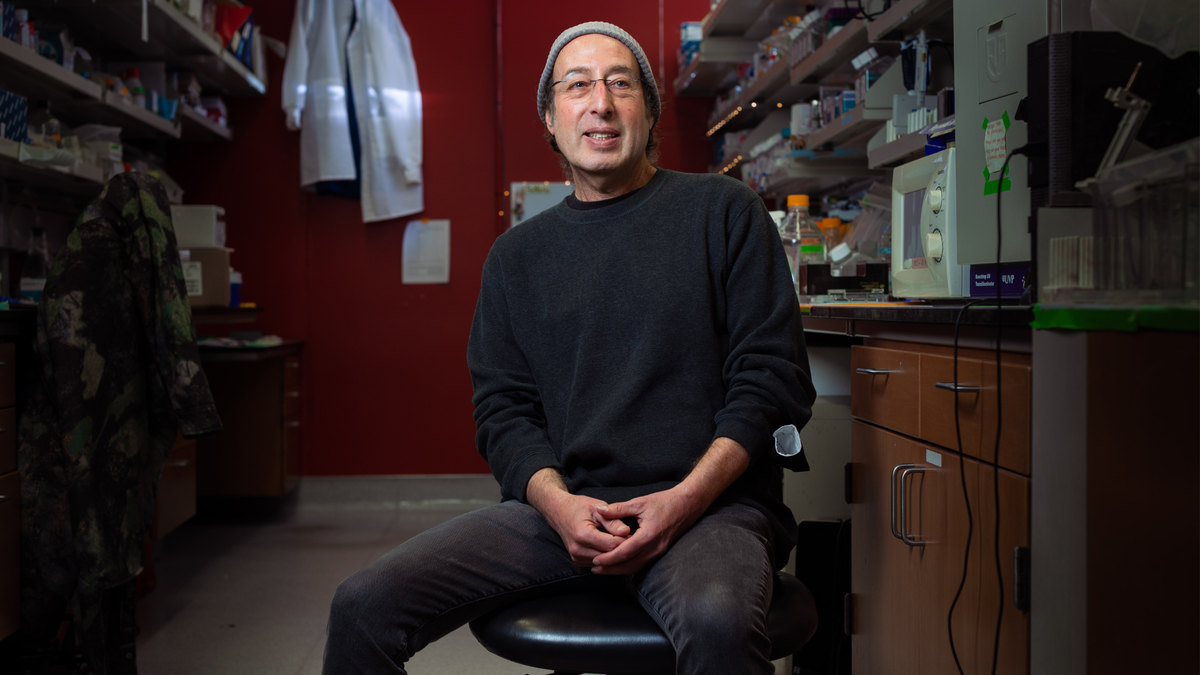
This has led some scientists to question whether brain organoids could ever achieve consciousness. Kenneth Kosik, a neuroscientist at the University of California, Santa Barbara, recently explored that possibility in a perspective article. Live Science spoke with Kosik about how brain organoids are made, how similar they are to human brains and why he believes that brain organoid consciousness is not likely anytime soon.

Related: In a 1st, ‘minibrains’ grown from fetal brain tissue

EC: What are brain organoids, and how do scientists make them?

Kenneth Kosik: A brain organoid is made from stem cells. You can take any person and convert their, say, skin fibroblasts into stem cells, and then differentiate them into neurons. It’s what stem cells are all about — stem cells are called “pluripotent” because they can make any cell in the body.

We spent a fair amount of time before organoid technology came along, taking human-induced pluripotent stem cells and inducing them in a two-dimensional array to look at neuronal differentiation.

So that takes us halfway there. But it only gets us as far as two dimensions. And then the big insight, which came from Yoshiki Sasai in Japan and Madeline Lancaster, was to take these neurons that were beginning to differentiate — cells relatively early in development — and put them in a drop of what’s called Matrigel — a gel that can be either a liquid or a solid depending on the temperature.

Get the world’s most fascinating discoveries delivered straight to your inbox.

So the cells are in this drop, and then the magic happens. Instead of growing in two dimensions, they start to grow in three dimensions. It absolutely fascinates me that when biology begins to explore the third dimension, a very novel biology emerges. Certainly, in two dimensions, these neurons that were growing could achieve a very wide diversity of cell types, but they did not achieve any kind of interesting anatomy.

Once they’re growing in three dimensions, they start to form relationships to each other, kinds of structure and anatomy, that has a very loose resemblance to the brain. And I really emphasize the word “loose,” because there are people that use a misnomer for brain organoids and call them “minibrains.” They’re not brains at all. They are organoids — meaning like the brain.

A question we’re keenly interested in, and many labs are, is that if organoids are like the brain, to what degree do they resemble the brain and to what degree do they differ? And they differ from the brain a lot, so you have to be very careful about interpretations of organoids. Not everybody thinks that organoids are going to be informative for neuroscience because what we find in an organoid may be over-interpretation. But on the other hand, [it] is forming a three-dimensional structure that has some degree of lamination [formation of layers of cells within tissue], it has these rosettes in which, from the center of the rosette, you can progressively see cells becoming more mature as development proceeds, which is very similar to what happens in the brain.

Related: Lab-grown ‘minibrains’ may have just confirmed a leading theory about autism

Brain organoids are becoming more and more sophisticated, but will they ever achieve consciousness? (Image credit: ROGER HARRIS/SCIENCE PHOTO LIBRARY via Getty Images)

EC: Are there any brain organoids that accurately capture the whole brain yet?

KK: There is no organoid that captures the whole brain. There are approaches that attempt to capture more of the brain than, say, just the one part that maybe we and other labs are working on. These are called “assembloids.” [Scientists] take stem cells and differentiate them down a pathway that may make a little more ventral [front part of the] brain, or a little more dorsal [back part of the] brain, and they put them together, they fuse them, so that you get more comprehensive fusion — a wider representation, I should say, of brain anatomy.

There are other ways of making organoids that are a little more indiscriminate. They’re not directing the stem cells towards dorsal and ventral, they are putting them all together. That’s a lot of what we do. Those were the techniques that were originated by Lancaster. And in that case, it’s my opinion that when you do it that way, you get a broader representation of cell types. That’s what you gain, but you sacrifice anatomical accuracy because when you make an assembloid, the anatomy is not great. But when you do it without differentiating toward dorsal and ventral and you put it all together, the anatomy becomes even more problematic.

EC: As you alluded to, these organoids are similar to human brains, but there’s some key physiological differences. Can you explain those?

KK: So, one similarity right away is that you see a lot of spiking going on.

(Editor’s note: Kosik is referring to the fact that, when an organoid is hooked up to electrodes, this triggers electrical spikes, or signals, transmitted between neurons.)

It’s quite remarkable, and underlying this is the notion, which is probably what intrigues me the most, that all of this activity is spontaneous: it just arises based on the assembly of the neurons.

And now we can look at the relationships of those spikes. When you do that, you can ask the question, well, if I see neuron A firing, what’s the likelihood that I’ll see neuron B firing? I’m going to look at the binary relationships among all of them and I’m doing it with the filter that when neuron A fires I’m only going to look at when another neuron fires within 5 milliseconds. Why 5 milliseconds? Because that’s about the time in which it takes for transmission to occur across the synapse. (Editor’s note: A synapse is the gap between two neurons.)

And when we do that, you can see that they form a network. You connect A and B, and then you connect C and D, and then A and C. You can see that the neurons are talking to each other and this arises spontaneously.

That is one example of the way in which an organoid does something that will spontaneously resemble what happens in the brain.

The way I look at an organoid, it is a vehicle that has the capacity to encode experience and information if that experience were available to it — but it’s not. It has no eyes, ears, nose or mouth — nothing’s coming in. But the insight here is that the organoid can set up spontaneous organization of its neurons so that it has the capacity to encode information, when and if it becomes available. That’s just a hypothesis.

Related: Lab-grown ‘minibrains’ help reveal why traumatic brain injury raises dementia risk
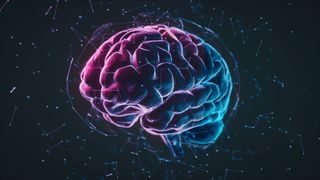
Conceptual illustration of the outside of the brain against a black background. The brain is outlined and shaded in pink and blue. Blue and pink marks are shown dotted around it.

Before determining whether brain organoids will achieve consciousness, scientists still need to define what consciousness actually is, Kosik said. (Image credit: imaginima via Getty Images)

EC: Do you think that brain organoids will ever achieve consciousness?

KK: So that’s where things get a little mysterious. I think that those kinds of questions are predicated on this term that people have a lot of trouble defining: consciousness.

[Based on currently fashionable theories of consciousness] I would say, “No, it doesn’t even come close.”

Related: Mini model of human embryonic brain and spinal cord grown in lab

EC: You spoke about the fact that organoids have shown some capacity to encode information, but they don’t have the experience to do this in the first place. What would happen if, hypothetically, a human brain organoid was transplanted into an animal? Could it then achieve consciousness?

KK: Let’s break that down. Before it is transplanted into an animal, some people would say the animal already has consciousness and some people would say [it does] not. So, right away, we get into this difficulty about where in the animal kingdom does consciousness begin? So, let’s reframe the question. If you then took an animal, which may or may not have some degree of consciousness, and you transplant in a human organoid, would you confer consciousness on that animal or would you enhance consciousness, or would you even get something that resembled human consciousness in the animal? I don’t know the answer to any of those questions.

We can do these hybrids now — so it’s a good question. But the evaluation of consciousness now, because of all the problems as to what consciousness is, is still going to be an open question.

Related: Could mini space-grown organs be our ‘cancer moonshot’?
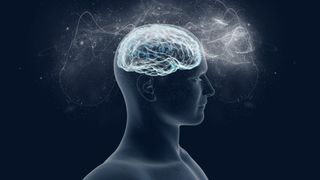
Conceptual illustration showing a side-profile of the white outline of a human head and shoulders. The head is facing the right-hand-side of the image. It is grey in color but the brain is highlighted in a mixture of white and blue lines. What appears to be a

Conscious human brain organoids may have a plethora of applications, from aiding drug discoveries to being able to process huge amounts of information. (Image credit: Shutterstock)

EC: Do we have an idea of rough timescales —, is consciousness something that could happen in the near future, after, say, a certain number of years, or is it still really uncertain at this point?

KK: Technology is moving very fast. One place where we may begin to push the boundary is in the so-called cyborgs, or organoid interfaces. That would be one direction that could be interesting. Maybe a little bit toward consciousness, but even more so toward developing the implementation of human abilities in one of these synthetic systems.

EC: Can you think of any obvious benefits and drawbacks of these organoids being able to achieve consciousness?

KK: We know so little about neuropsychiatric conditions. Neuropsychiatric drugs are developed without understanding any deep physiology. All of that could be done, I think, with organoids. I think as disease models, it could be very, very useful [for them to achieve consciousness].

The dream state that I have is to develop them as computational systems because, right now, to do the kinds of very expensive computations that are required for ChatGPT and many of these large language models, these take hundreds of millions of dollars to develop. They require a server farm of energy to keep them going. We’re really just running out of computer power. Yet, the brain does a lot of this stuff on 20 watts. So, a big interest for me is, “Can organoids, if not solve, contribute to the huge demands that we’re making on the energy system by tapping into the highly efficient way in which the brain, and presumably the organoid, can handle information?”

Editor’s note: This interview has been edited and condensed.
ShareTweetSend
Previous Post

How critical has the past week been for the US election? | TV Shows

Next Post

Biden Administration Faces Rebellion Within its Own Ranks over Gaza War — Global Issues

Related News

Groundbreaking Electric Comb Promises Hair Regrowth in Mice Within Four Weeks, Paving the Way for Future Hair-Loss Solutions
Science

Groundbreaking Electric Comb Promises Hair Regrowth in Mice Within Four Weeks, Paving the Way for Future Hair-Loss Solutions

November 18, 2026
Miniature LSD Doses Administered in Rapid Succession Show Antidepressant Potential in Mice: Exploring the Impact of Timing vs. Tolerance
Science

Miniature LSD Doses Administered in Rapid Succession Show Antidepressant Potential in Mice: Exploring the Impact of Timing vs. Tolerance

November 14, 2026
Investigation Underway: Experts Seek Answers Behind Sudden Brooklyn Building Collapse
Science

Investigation Underway: Experts Seek Answers Behind Sudden Brooklyn Building Collapse

November 12, 2026
Preserve the Unseen: The Essential Role of Parasites in Ecosystems
Science

Preserve the Unseen: The Essential Role of Parasites in Ecosystems

November 11, 2026
Next Post
Biden Administration Faces Rebellion Within its Own Ranks over Gaza War — Global Issues

Biden Administration Faces Rebellion Within its Own Ranks over Gaza War — Global Issues

Discussion about this post

Subscribe To Our Newsletters

    Customer Support


    1251 Wilcrest Drive
    Houston, Texas
    77042 USA
    Call-832.795.1420
    e-mail – news@theinsightpost.com

    Subscribe To Our Newsletters

      Categories

      • Africa
      • Africa-East
      • African Sports
      • American Sports
      • Arts
      • Asia
      • Australia
      • Business
      • Business Asia
      • Business- Africa
      • Canada
      • Defense
      • Education
      • Egypt
      • Energy
      • Entertainment
      • Europe
      • European Soccer
      • Finance
      • Germany
      • Ghana
      • Health
      • Insight
      • International
      • Investing
      • Japan
      • Latest Headlines
      • Life & Living
      • Markets
      • Mobile
      • Movies
      • New Zealand
      • Nigeria
      • Politics
      • Scholarships
      • Science
      • South Africa
      • South America
      • Sports
      • Tech
      • Travel
      • Travel-Africa
      • UK
      • USA
      • Weather
      • World
      No Result
      View All Result

      Recent News

      Six Drainage Enhancement Projects Pending Financial Approval, Says Ahmed Ibrahim

      Six Drainage Enhancement Projects Pending Financial Approval, Says Ahmed Ibrahim

      November 19, 2026
      Jordan Poyer Takes Center Stage: A Look Ahead to November 18, 2026

      Jordan Poyer Takes Center Stage: A Look Ahead to November 18, 2026

      November 19, 2026
      Microsoft’s Satya Nadella Reveals Strategic Rationale Behind Layoff of 60,000 Employees

      Microsoft’s Satya Nadella Reveals Strategic Rationale Behind Layoff of 60,000 Employees

      November 19, 2026
      Super Eagles Rise to 29th in FIFA Rankings, Surpassing Algeria to Claim a Spot in Africa’s Elite Five

      Super Eagles Rise to 29th in FIFA Rankings, Surpassing Algeria to Claim a Spot in Africa’s Elite Five

      November 19, 2026
      • Home
      • Advertise With Us
      • About Us
      • Corporate
      • Consumer Rewards
      • Forum
      • Privacy Policy
      • Social Trends

      Theinsightpost ©2026 | All Rights Reserved. Theinsightpost is an Elnegy LLC company, registered in Texas, USA

      Welcome Back!

      Login to your account below

      Forgotten Password?

      Retrieve your password

      Please enter your username or email address to reset your password.

      Log In

      Add New Playlist

      We are using cookies to give you the best experience on our website.

      You can find out more about which cookies we are using or switch them off in .

      No Result
      View All Result
      • Home
      • Insight
      • Blog
      • Business
      • Entertainment
      • Health
      • Politics
      • Shop
        • Gift Shop
        • Value Shop
        • Store
        • Bargain Shop
        • Discount
      • Sports
      • Tech
      • Travel
      • USA
      • Video
      • World
        • Asia
        • Africa
        • South America
        • North America
        • Europe
        • Oceania

      Theinsightpost ©2026 | All Rights Reserved. Theinsightpost is an Elnegy LLC company, registered in Texas, USA

      The Insight Post
      Powered by  GDPR Cookie Compliance
      Privacy Overview

      This website uses cookies so that we can provide you with the best user experience possible. Cookie information is stored in your browser and performs functions such as recognising you when you return to our website and helping our team to understand which sections of the website you find most interesting and useful.

      Strictly Necessary Cookies

      Strictly Necessary Cookie should be enabled at all times so that we can save your preferences for cookie settings.

      Cookie Policy

      More information about our Cookie Policy