









Observed by NASA’s WISE mission, this image shows the entire sky seen in infrared light. Running through the center of the image and seen predominantly in cyan are the stars of the Milky Way. Green and red represent interstellar dust. Credit: NASA/JPL-Caltech/UCLA
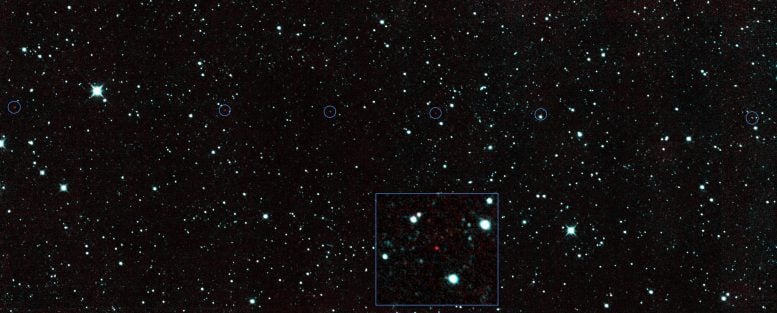
Moving across a background of stars, the six red dots in this composite picture indicate the location of six sequential detections of the first near-Earth object discovered by NEOWISE after the spacecraft came out of hibernation in 2013: the asteroid 2013 YP139. The inset shows a zoomed-in view of one of the detections. Credit: NASA/JPL-Caltech
WISE Beginnings
NEOWISE’s end of mission is tied to the Sun. About every 11 years, our star experiences a cycle of increased activity that peaks during a period called solar maximum. Explosive events, such as solar flares and coronal mass ejections, become more frequent and heat our planet’s atmosphere, causing it to expand. Atmospheric gases, in turn, increase drag on satellites orbiting Earth, slowing them down. With the Sun currently ramping up to predicted maximum levels of activity, and with no propulsion system for NEOWISE to keep itself in orbit, the spacecraft will soon drop too low to be usable.
The infrared telescope is going out of commission having exceeded scientific objectives for not one, but two missions, beginning as WISE (Wide-field Infrared Survey Explorer).
Managed by NASA’s Jet Propulsion Laboratory in Southern California, WISE launched in December 2009 with a six-month mission to scan the entire infrared sky. By July 2010, WISE had achieved this with far greater sensitivity than previous surveys, and NASA extended the mission until 2011.
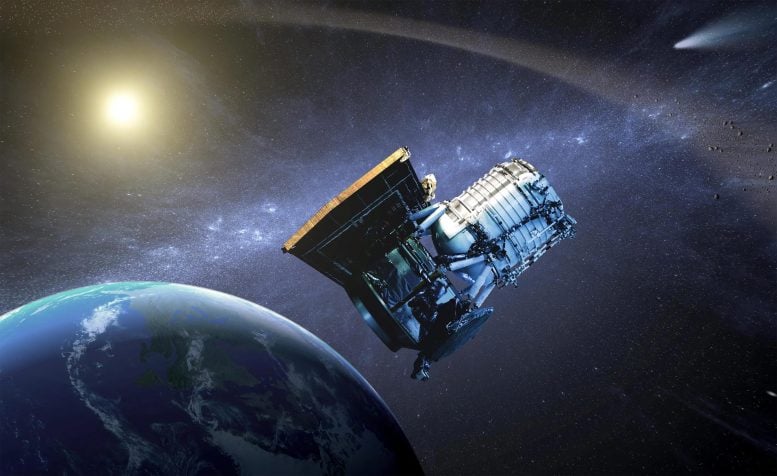
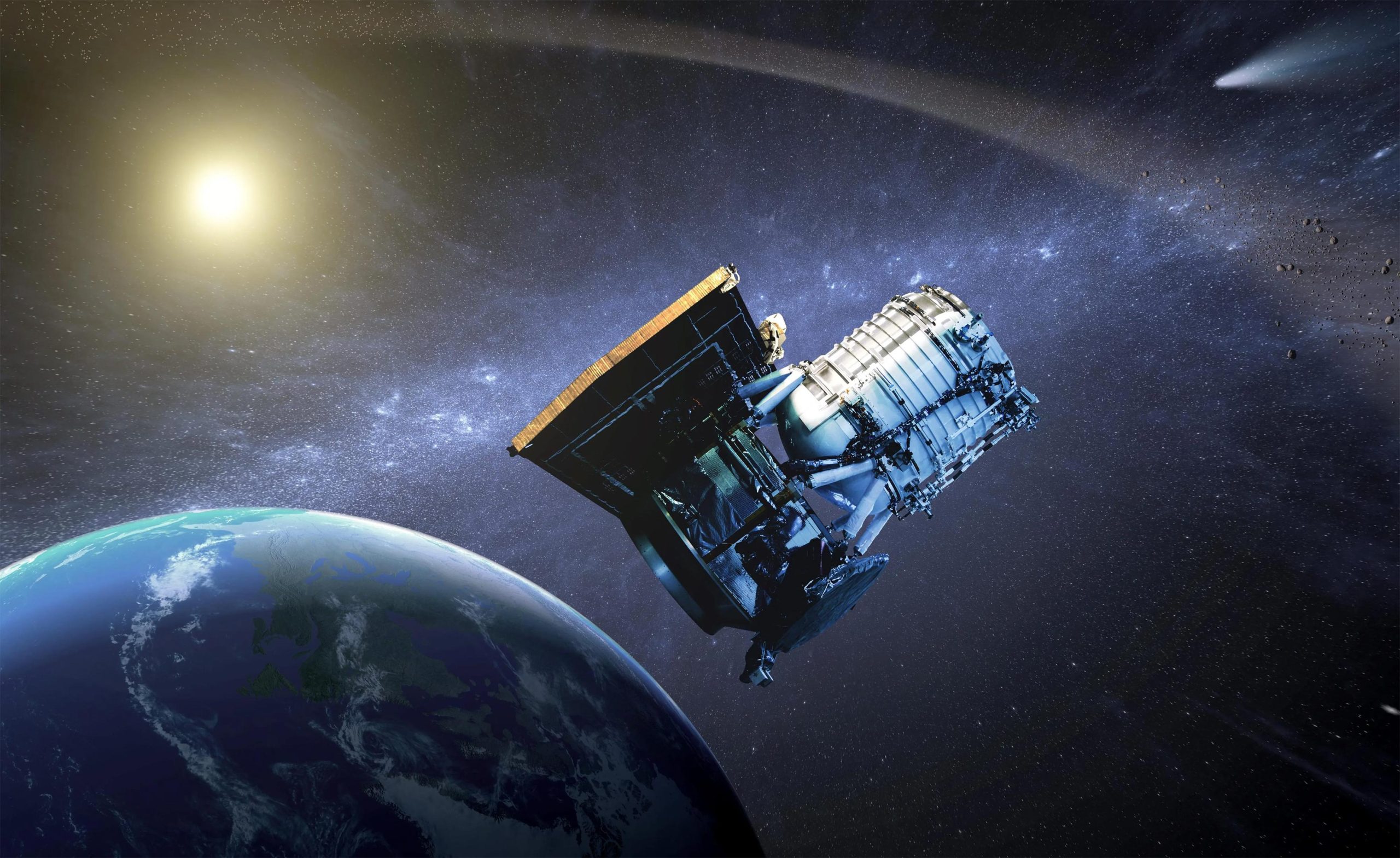
This artist’s concept shows the Wide-field Infrared Survey Explorer, or WISE, spacecraft, in its orbit around Earth. In its NEOWISE mission it finds and characterizes asteroids. Credit: NASA/JPL-Caltech
During this phase, WISE studied distant galaxies, outgassing comets, exploding supermassive black holes. It also generated data on circumstellar disks — clouds of gas, dust, and rubble spinning around stars — that citizen scientists continue to mine through the Disk Detective project.
In addition, it excelled at finding main belt asteroids, as well as near-Earth objects, and discovered the first known Earth Trojan asteroid. What’s more, the mission provided a census of dark, faint near-Earth objects that are difficult for ground-based telescopes to detect, revealing that these objects constitute a sizeable fraction of the near-Earth object population.
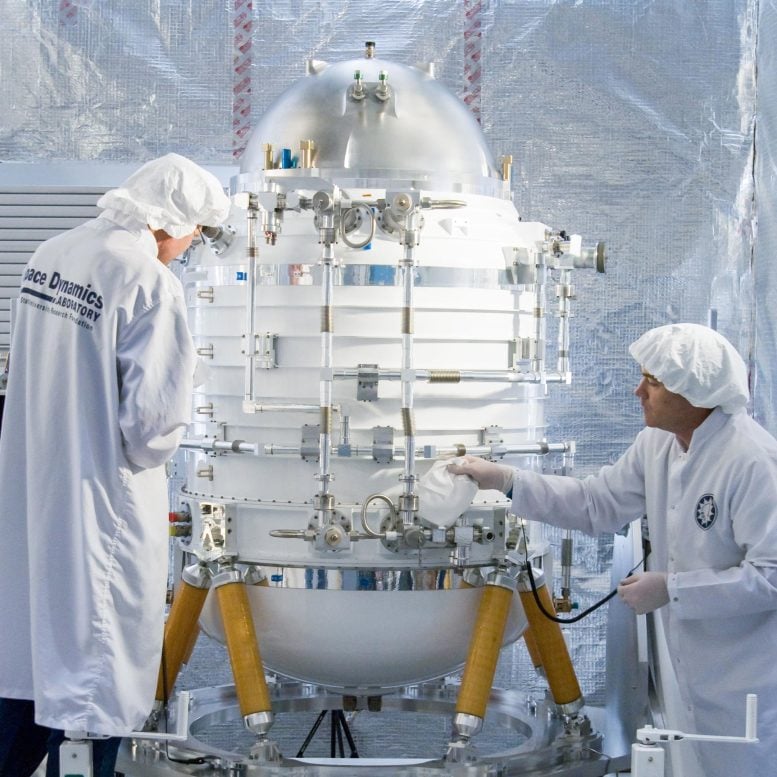
Seen here in a clean room at the Space Dynamics Laboratory in Logan, Utah, the WISE mission’s telescope is worked on by engineers. Avionics hardware and solar panels would later be attached before the spacecraft’s launch on December 14, 2009. Credit: SDL
Infrared Heritage
Invisible to the naked eye, infrared wavelengths are emitted by warm objects. To keep the heat generated by WISE itself from interfering with its infrared observations, the spacecraft relied on cryogenic coolant. By the time the coolant had run out, WISE had mapped the sky twice, and NASA put the spacecraft into hibernation in February 2011.
Soon after, Mainzer and her team proposed a new mission for the spacecraft: to search for, track, and characterize near-Earth objects that generate a strong infrared signal from their heating by the Sun.
“Without coolant, we had to find a way to cool the spacecraft down enough to measure infrared signals from asteroids,” said Joseph Masiero, NEOWISE deputy principal investigator and a scientist at IPAC, a research organization at Caltech in Pasadena, California. “By commanding the telescope to stare into deep space for several months, we determined it would radiate only enough heat to reach lower temperatures that would still allow us to acquire high-quality data.” NASA reactivated the mission in 2013 under the Near-Earth Object Observations Program, a precursor to the agency’s current planetary defense program, with the new name NEOWISE.
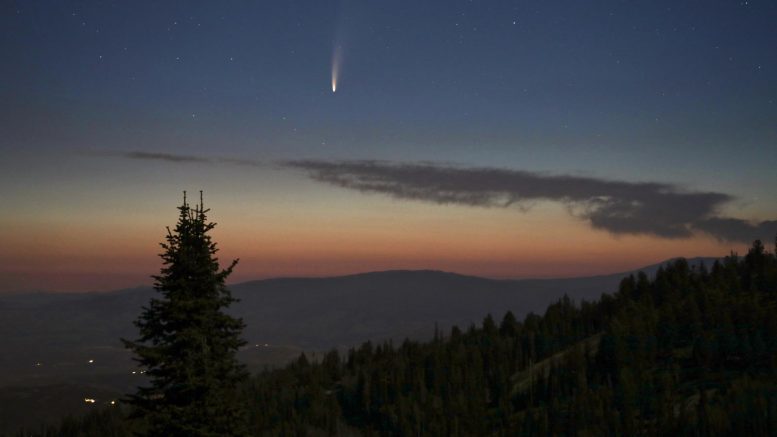
Comet C/2020 F3 (NEOWISE) in the predawn skies on July 9, 2020, over Deer Valley, Utah. Credit: NASA
By repeatedly observing the sky from low Earth orbit, NEOWISE has made 1.45 million infrared measurements of over 44,000 solar system objects to date. That includes more than 3,000 NEOs, 215 of which the space telescope discovered. Twenty-five of those are comets, among them the famed comet NEOWISE that was visible in the night sky in the summer of 2020. (See image above.)
“The spacecraft has surpassed all expectations and provided vast amounts of data that the science community will use for decades to come,” said Joseph Hunt, NEOWISE project manager at









Discussion about this post