










The essence of Olympic competition hasn’t changed over the years. The Games are still about the world’s best athletes gathering to see which of them can truly move faster, higher and stronger. But technology has dramatically changed the way Olympic sports are contested, scored and even watched by the rest of the world. Here’s how technology has transformed events that debuted at the first modern Olympic Games in 1896.
Weapons became electrified
Foil fencers compete against each other in the bronze medal bout during the Tokyo 2020 Olympic Games. Fabrice Coffrini / AFP via Getty Images
Touché! For centuries, while fencing evolved from military training to popular sport, that exclamation acknowledged that a fencer had been touched by their opponent’s weapon, yielding a point.
Such traditions run deep in this ancient endeavor, in which judging hits with the naked eye is difficult. Touches are often hard to see or virtually simultaneous. “We’ve always said the only thing faster in Olympic sports than a fencing blade is a bullet,” says Serge Timacheff, a longtime fencing photographer and head of communications for the International Fencing Federation.
Fortunately fencing has another longstanding tradition—technology. People began experimenting with electric scoring systems back in the 19th century; an intriguing but cumbersome system to electrify weapons debuted in London in 1896.
Modern fencing has three disciplines using three different weapons—foil, épée and saber—and today each of them is electrified. The electric épée debuted at the 1936 Games. Any hit with the tip of this thrusting weapon, from head to toe, counts as a touch, so scoring is relatively simple. The blade’s tip has a plunger. When it touches a fencer with enough force, it depresses, closes an electrical circuit and registers a point that’s immediately conveyed to the scoring system.
“In foil it’s different, because you’re only hitting the torso,” Timacheff explains. So this weapon, electrified for the 1956 Games, required the fencer’s classic white uniforms to also be electrically conductive thanks to a design of mixed fabrics and metals. “When you hit the torso on the electrically conductive vest, it closes a circuit and creates a signal that fires off the scoring machine,” Timacheff says. “If you hit on the arm or leg, it’s detected as [a] non-valid hit.”
Since the 1988 Seoul Games, the saber has been electrified along the weapon’s entire edge. It registers points by striking the opponent’s electrically conductive uniform anywhere above the waist except the hands—including the fencing mask
Wireless technology to track all this swordplay debuted during the Tokyo Games but isn’t currently being used for major international competitions and won’t be seen at the Paris Games.
A second skin streamlined swimmers
Speedo unveiled the Fastskin LZR Racer swimsuit before the 2008 Beijing Olympic Games. The suits were banned in 2010. Torsten Blackwood / AFP via Getty Images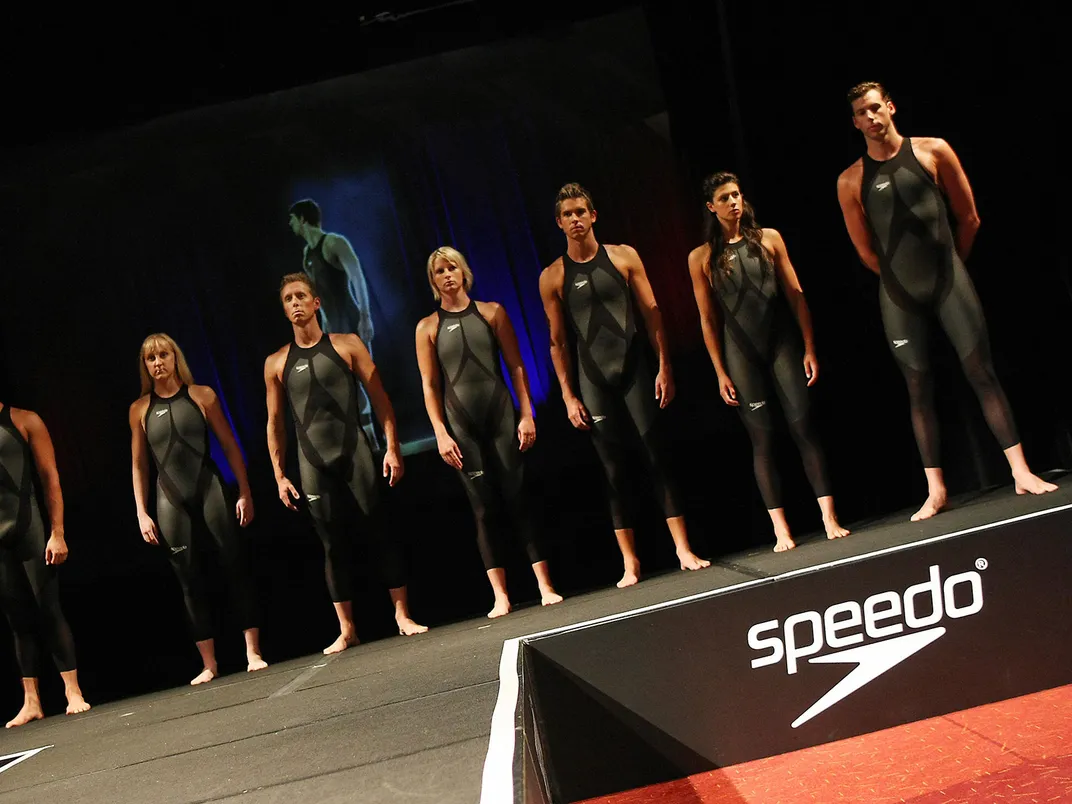
During the 1924 Paris Games, swimmers like Johnny Weissmuller, later of Tarzan fame, raced and won in swimsuits designed with an eye to the modesty of the age; men’s one-piece suits covered their chests, and women’s had a skirted bottom. Early suits were made of wool better suited to a mountain than a pool.
Afterward, however, suits gradually employed lighter, more streamlined materials—and less of them.
In 1927, Australian Alexander MacRae introduced the Racerback suit. It exposed women’s shoulders and back to an extent illegal at some of the era’s public bathing spots, and replaced soggy wool with smooth silk. The next year, MacRae launched the now iconic company Speedo.
Then, in 1932, 16-year-old Clare Dennis broke an Olympic record in the 200-meter breaststroke. Although her Speedo suit conformed to written Olympic standards, she still had to survive a protest that it did not cover enough of her shoulders. By the 1936 Berlin Games, such suits were the norm for women, and men had finally gone topless.
In the early 1970s, the “skinsuit” became state of the art. As the name suggests, this style drastically reduced drag by clinging extremely tightly to the body. First they were made of nearly transparent cotton, and later they were improved with synthetics. They weighed just a few ounces and were so form-fitting many found them immodest. Yet all serious competitors quickly adopted the style. “I don’t feel anything at all,” Olympian Shirley Babashoff told Sports Illustrated in 1974. “It’s just like wearing nothing.” When American Mark Spitz turned in his legendary seven-gold-medal performance, his star-spangled bikini brief suit epitomized “less is more”—it couldn’t have been much smaller.
But the next revolution in competitive swimwear—besides the 1976 Olympic debut of goggles—reversed this trend. At the 2000 Games, Speedo introduced suits that covered swimmers from the ankles to the neck with materials producing less drag in the water than human skin. These Fastskin suits also boasted raised shark-inspired ridges to channel water and boost speed—though lab experiments showed such textures . But other advances did.
Speedo’s LZR Racer suit was a body-clinging combination that compressed a person’s muscles into a sleek, seal-like package. The suit reduced drag dramatically, and its polyurethane boosted buoyancy, a critical aid to speed. In the 2008 Olympics, 23 of the 25 records broken fell to swimmers wearing the suit, and 98 percent of medal winners wore it. In 2010, the governing body of international swimming banned polyurethane and other non-textile suits, and mandated that suits no longer cover a swimmer’s entire body.
After the ban, some feared that the world records set in the fast suits couldn’t be broken. But it wasn’t long before they started falling again to swimmers wearing suits confirming to the new rules.
“So while it was shown scientifically that suits were advantageous to various degrees,” says Bryce Dyer, who studies biomedical engineering and sports technology at England’s Bournemouth University, “there’s an argument to made about how much the psychology of the suits also had an impact on the results.”
Lighter poles vaulted competitors higher
Katerina Stefanidi of Greece competes in the women’s pole vault at the Tokyo 2020 Olympic Games. Today’s poles are much more flexible than those Olympians used decades ago. Cameron Spencer / Getty Images
The pole vault invites technical innovation and creativity because poles can be made of any material. This flexibility has led to a long series of innovations that reshaped the way athletes vault and pushed the sport to new heights.
Early vaulters carried a rigid pole of ash or hickory that was heavy and didn’t bend. Consequently, vaulting looked different. In the years prior to the first Olympics, vaulters were also climbers; after planting, they would jump and climb up the pole as far as possible to clear the bar. The technique was banned just before the Olympics began, and under the limits of a hardwood pole the first gold medalist, William Hoyt, won at a height of around 10 feet and 10 inches.
In the early 1900s, competitors used a bamboo pole that could bend a bit, which changed the game. An athlete sprinting with a pole produces a tremendous amount of energy. After planting the pole, they capture as much of that energy as possible and redirect it to vault themselves over the bar.
But bamboo still didn’t bend that much, and so it only captured so much energy before breaking. Bamboo poles also weighed over 22 pounds, which slowed the approach run. During the 1940s and 1950s, athletes tried steel and aluminum poles, but the material that propelled the sport to new heights was fiberglass.
Fiberglass, and the later development of strong carbon fiber poles that can weigh less than five pounds, enabled athletes to run faster and produce more energy for the vault. And as skilled athletes and coaches went to work refining techniques, and inventing new ones, they took full advantage of the poles’ new capabilities to capture horizontal energy and direct it vertically—all the way to today’s Olympic heights of over 19.5 feet.
Super shoes helped athletes run faster
The Nike Zoom Vaporfly Elite Flyprint Patrik Lundin / Getty Images for Nike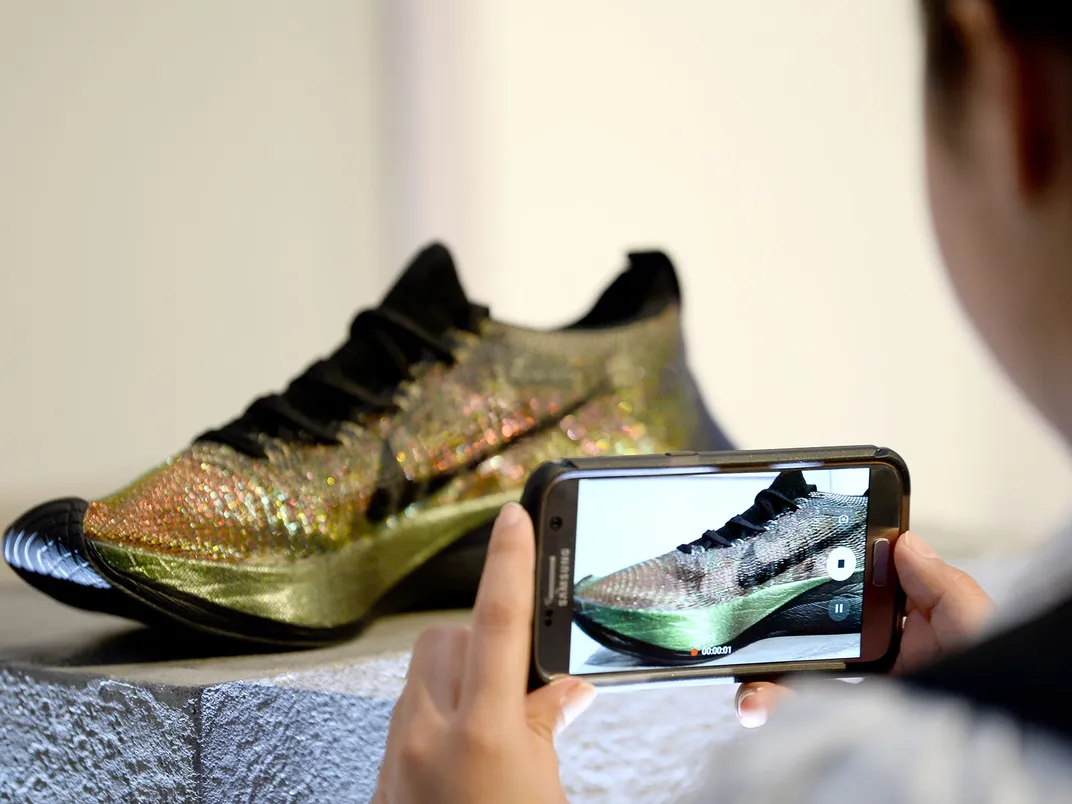
For much of modern Olympic history, footwear remained basically the same. Marathoners or distance runners plodded along on rubber soles, with leather or canvas uppers. Speedsters blazed along on leather shoes with metal spikes; Harold Abrahams, in the race later immortalized in Chariots of Fire, won the 1924 100 meters on a pair of J.W. Foster’s “running pumps,” lightweight leather track shoes with metal spikes at the front of the shoe—state of the art in the era. (Foster’s grandsons would launch the Reebok company.)
During the 1970s, running shoe soles changed for good with the introduction of air-infused foam, which made shoes springier and lighter. In 2017, distance running entered a new era when Nike introduced the Vaporfly. Layers of lightweight foam that absorbed energy from impact and returned it back to the runner were paired with a stiffening carbon-fiber plate that gave structure to all that bounce and focused it on making runners faster.
Studies of the Vaporfly revealed that runners, particularly distance runners, could boost their running economy by 4 percent using the shoes’ revolutionary design. Some runners shaved key seconds or, in the case of marathoners, two to four minutes off their times. Benefits vary among individual runners and styles. But as the shoes spread, World Athletics, the governing body of international running, found that runners wearing these super shoes with a carbon fiber plate have broken all outdoor track world records in distances from 5,000 meters up to the marathon since 2016.
These successes drove super-shoe technology into the mainstream, spawned advanced versions like Nike’s Alphafly and eventually spurred World Athletics to take action. In 2020, the organization banned super shoes that had more than one carbon-fiber plate or midsoles deemed too thick. But that hasn’t slowed the development of faster footwear.
Today shoemakers have adapted to the new rules with legal designs based on the same principles. And most major shoemakers produce their own versions of a super shoe, or a super spikes for those on the track. “There’s an argument that [many different super-shoe companies] should make a more level playing field,” says Bournemouth University’s Dyer. “But honestly it just means there’s an arms race and the shoes could have a greater influence on results.”
New timing methods provided more accurate results
Usain Bolt of Jamaica poses next to a clock after winning the men’s 200-meter final at the Beijing 2008 Olympic Games. Mark Dadswell / Getty Images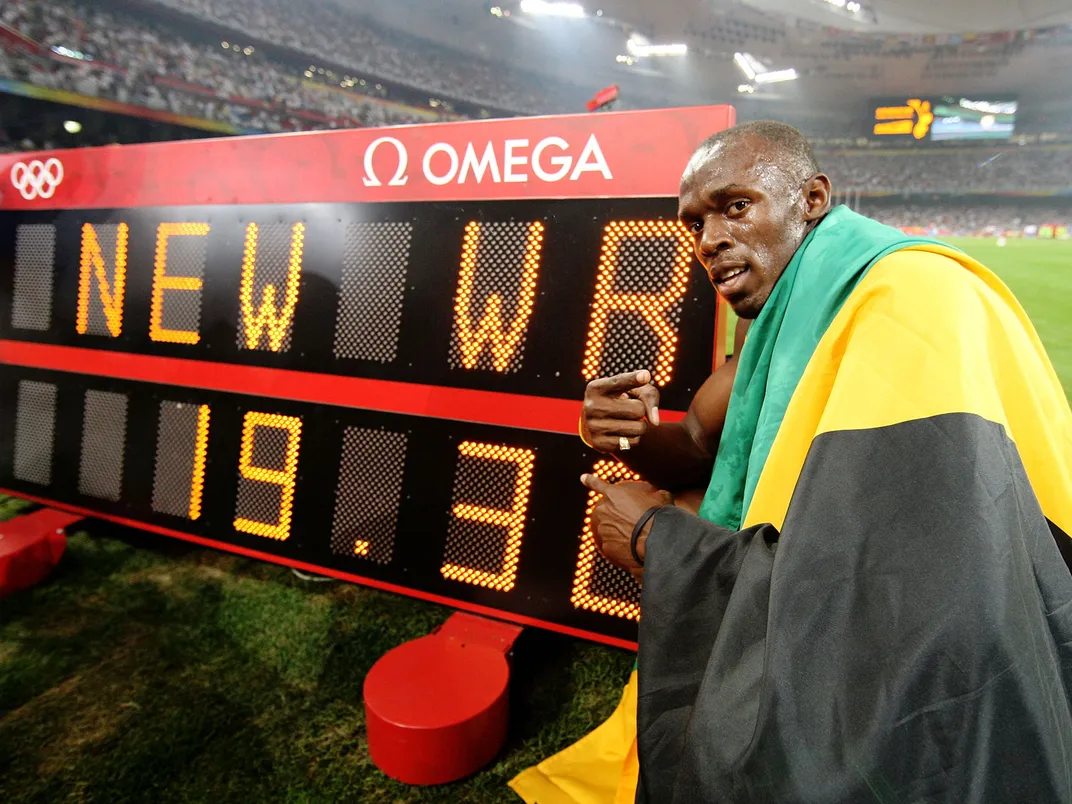
Modern Olympic timekeeping began with a bang. Races started with a pistol shot, and judges started a hand timer to be stopped when the winner crossed the line. During the 1896 marathon, this meant judges raced ahead of the runners by bike, carrying the running watch, to stop it at the finish. In the early Games, times weren’t recorded for silver medalists—the watches stopped with the winner.
At the 1932 Los Angeles Games, a single Omega watchmaker traveled from Switzerland with a suitcase of 30 stopwatches, each equipped with a split-second hand that could be stopped independently to measure split times while the race timing continued—producing accurate times for all competitors. Today Omega employs more than 500 people for the event—and almost as many tons of tech equipment.
The 1932 Games included the first photo finish. The 100-meter sprint saw Eddie Tolan edge fellow American Ralph Metcalfe for the gold. Both were timed, with stopwatches, at 10.38 seconds, but a series of split-second images showed Tolan crossed the line first.
During the 1948 Olympics, held both that summer and winter, finish-line tapes and hand timing were replaced by a photoelectric beam. The “Magic Eye” stopped the timing system when broken by athletes.
At the 1968 Games, swimmers found a swimming touchpad at the end of each lane, stopping the clock with a fingertip and eliminating stopwatch errors.
Starting blocks became smarter beginning with the 1984 Los Angeles Olympics. They used pressure sensor systems to detect false starts if a runner pushed off sooner than a tenth of a second after the signal.
Today we take precise timing for granted and enjoy watching runners, swimmers, cyclists and others clocked in real time during events, with sensors revealing split times, real-time speed or distance off a world record pace. Results are instantaneous, eliciting the thrill of victory or the agony of defeat before the athletes have even slowed down.










Discussion about this post